
Caregiver decision guide
How to Support a Grieving Parent After Losing a Spouse
A stage-aware guide for adult children supporting a widowed parent through the first 18 months after spousal loss — balancing practical tasks, emotional presence, and the caregiver's own grief.
In the first days after a parent loses a spouse, helping them cope is not an abstract emotional project. It is Tuesday morning: the pill organizer is still on the counter, condolence flowers are browning in vases, the refrigerator is full of food nobody has appetite for, and a sibling is texting, “What do you need me to do?”
You are trying to support your surviving parent while you are also grieving the person who died. That double role is easy for families to miss because the practical work looks so urgent. Someone has to answer calls, find passwords, sort envelopes, check insurance notices, manage funeral leftovers, and notice whether Mom or Dad has taken blood pressure medication. The child who does those things may look capable from the outside. Capability is not the same as being untouched.
There is good reason to show up early, but not because you can rescue your parent from grief. A systematic review of older adults’ adjustment after spousal bereavement summarizes CLOC study findings showing that positive support from adult children in the first 6 months after spousal death predicted fewer depressive symptoms in widowed seniors at 18 months. The underlying Ha 2010 analysis included 148 participants, and the broader CLOC data came from a Detroit-area cohort collected between 1987 and 1993, so it should be read as strong but contextual evidence rather than a timeless formula for every family [1].
That finding gives early support real weight. It should not become a guilt weapon. Depression after bereavement is not a report card on an adult child’s devotion. Your job is to create enough stability, observation, and connection that your parent is less alone and less exposed to avoidable harm while grief does what grief does.
If you are brand-new to caregiving, it may help to keep a broader crisis map nearby. Our first 90 days of caring for an aging parent guide can sit beside this bereavement plan, and our stage-based guide for new caregivers can help you sort what is urgent from what can wait.

The First Weeks: Keep the Floor Under Them
The first weeks are less about finding the right words and more about reducing the number of ways the day can fall apart. Practical senior-care guides commonly point to immediate needs such as meals, medication routines, sleep, transportation, paperwork, and avoiding rushed financial decisions after the funeral [2][3]. Those are not small things. They are the floor.
Start with the body. Has your parent eaten something with protein today? Are they drinking water? Are prescription medications being taken at the right time, or did the routine die with the spouse who used to remind them? Is anyone staying overnight for the first few nights if the house feels unsafe or disorienting? You do not need to turn the home into a clinic. You do need to know whether grief has interrupted basic care.
Food support works best when it is specific. Instead of asking, “Do you want dinner?” put soup in single-serving containers, label leftovers, remove spoiled food, and make sure there are easy breakfast options. The casseroles may be generous and still useless if your parent cannot face opening the refrigerator.
Then look at the paper. In the first week or two, create one place for death certificates, funeral home papers, insurance letters, bank notices, Social Security or pension correspondence, bills, passwords if they are available, and a running list of calls made. Do not try to settle every financial question while everyone is stunned. The useful move is to prevent missed deadlines and slow down irreversible decisions.
- Pay or schedule essential household bills so utilities, insurance, rent, mortgage, and phone service are not interrupted.
- Confirm medication refills and upcoming medical appointments, especially if the deceased spouse handled the calendar.
- Ask the funeral home how many death certificates are realistically needed before ordering extras.
- Set aside unfamiliar financial offers, annuity changes, home-sale pressure, or requests from relatives until a calmer review is possible.
- Keep a call log with dates, names, phone numbers, and next steps so no single child has to hold the whole situation in memory.
Government payments deserve special care because families often do not know what must be stopped, returned, or reported after a death. If you are handling that part now, use our guide to stopping government payments when a senior dies before assuming every deposit belongs to the surviving spouse.
Being present in this stage may mean sitting in the same room while your parent says almost nothing. It may mean taking out the trash, walking the dog, driving to the cemetery, or answering the same question twice. Do not force a deep conversation because you are afraid silence means failure. Early presence is often logistical, physical, and quiet.
| Stage | What usually needs attention | What to avoid |
|---|---|---|
| First weeks | Meals, medication, sleep, funeral aftermath, urgent bills, government payments, safe companionship | Major financial decisions made under shock |
| Months 1–6 | Support gap, grief fog, isolation, finances, living situation, health appointments, grief support | Assuming your parent is “fine” because visitors have stopped asking |
| Months 6–18 | Depression warning signs, professional support, anniversaries, caregiver burnout, delayed grief | Becoming the parent’s entire emotional and practical system |
Months 1–6: The House Gets Quiet After Everyone Leaves
The first month can be strangely busy. There are services, visitors, forms, flowers, thank-you notes, and phone calls. Then the public part fades. This is often when the adult child’s work becomes less visible and more important: checking in when nobody else is calling, noticing mail piling up, hearing the strain in a parent’s voice, and deciding whether to drive over or let the evening pass.
The same systematic review that reported the first-6-month support finding also summarizes research on geographic proximity. In one Ha and Carr 2005 analysis with 223 participants, adult children living within one hour’s drive was associated with lower depressive symptoms and reduced anxiety in the surviving parent, while over-dependence on children was a sign that adjustment may be harder [1]. That is a useful tension. Being nearby can help. Becoming the only person your parent relies on can quietly shrink both lives.
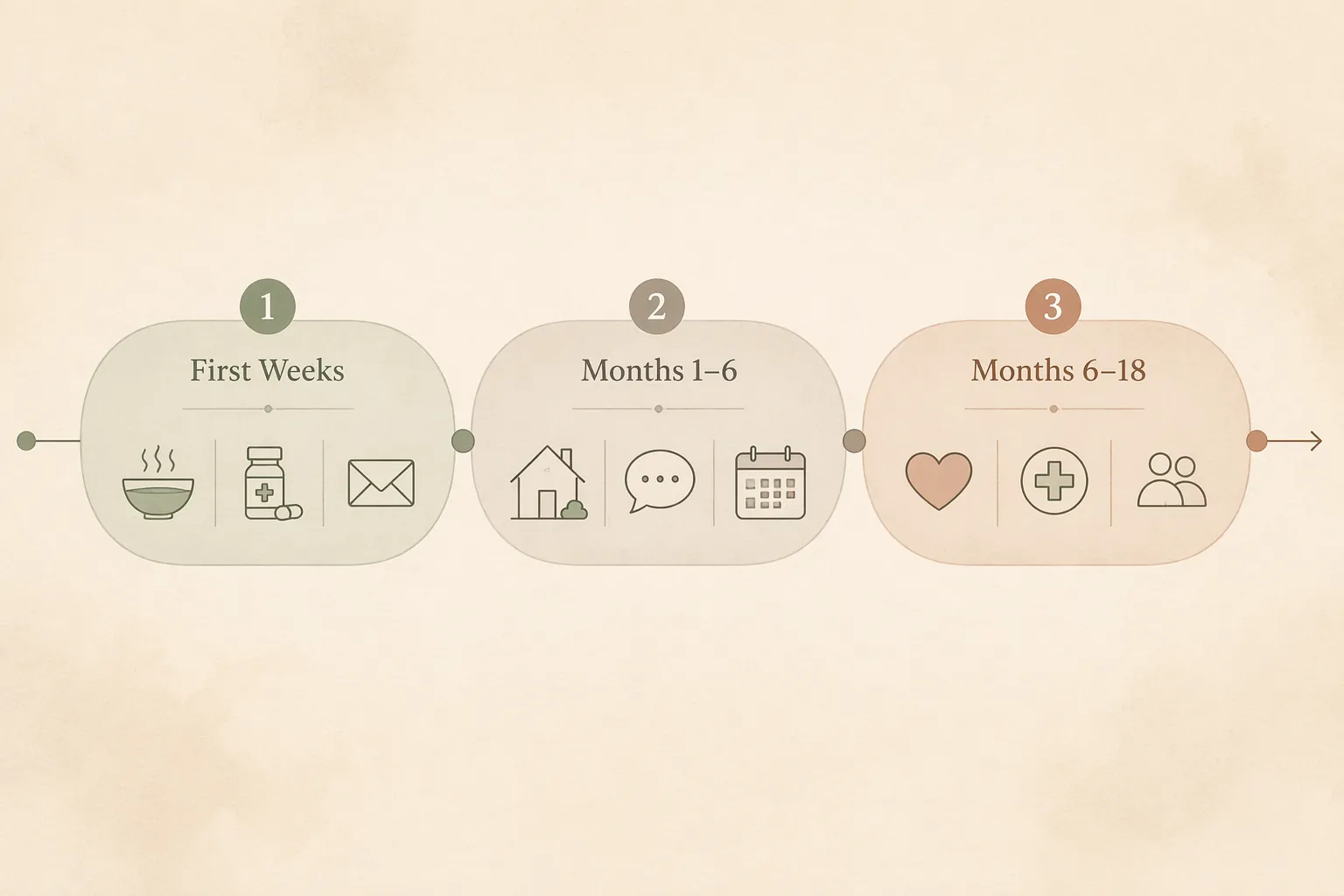
This stage needs rhythm more than heroics. A rhythm might be a Sunday meal, a midweek medication check, one sibling handling bills, another making medical calls, and a neighbor invited to walk with your parent twice a week. If you live far away, rhythm may look like scheduled video calls, grocery delivery, a shared document for tasks, and one local person who can physically check the home when something sounds wrong.
Watch grief fog without rushing to a dementia label
A grieving parent may repeat questions, misplace bills, lose track of appointments, forget why they entered a room, or struggle to follow a conversation. A Place for Mom, citing psychological guidance, notes that grief in older adults can include short-term memory loss, concentration difficulty, and disorganization, and that these symptoms may resolve within weeks to months rather than indicating dementia by themselves [2].
That distinction matters because families can overcorrect in both directions. One family may dismiss every change as “just grief” and miss a medical problem. Another may see three missed bills and decide the parent can no longer live independently. Neither reaction is fair without observation and professional input.
- Track patterns instead of arguing over single incidents: missed medications, unpaid bills, spoiled food, unsafe driving, falls, wandering, or confusion about familiar places.
- Ask whether sleep, dehydration, medication changes, infection, or poor nutrition could be worsening confusion.
- Bring specific observations to the primary care physician rather than presenting a conclusion such as “Mom has dementia.”
- Use temporary supports first when appropriate: bill reminders, pill packs, appointment calendars, transportation help, and regular check-ins.
The key word is evaluation. Adult children can observe, document, and raise concerns. They should not diagnose grief, depression, dementia, or capacity at the kitchen table.
Talk about money before a crisis makes the decisions
By the second or third month, the financial picture often starts to change shape. Income may be different. Bills may have been paid by the spouse who died. A parent may not know where account statements are, or may know but feel too overwhelmed to open them. This is not the moment for a child to take over by default. It is the moment to slow the room down.
Ask permission to sit together for one bounded task: “Can we spend 30 minutes sorting the mail into bills, benefits, taxes, and things to ask a professional?” That is different from arriving with a folder and announcing a new system. If there are questions about retirement income, survivor benefits, housing costs, or whether the current home remains affordable, our guide to helping aging parents with retirement planning in 2026 can help you organize the conversation without turning grief into a spreadsheet.
Some choices can wait. Selling the house, moving in with a child, giving away possessions, changing investment strategies, or adding family members to accounts can carry long consequences. There are exceptions when safety or affordability demands action, but shock is a poor advisor. When possible, separate urgent administration from life-changing decisions.
Invite support without making it sound like exile
Professional help is not a punishment for grieving too long, and it is not an easy topic just because it is sensible. A surviving parent may hear “counselor” as “you are not handling this,” or may hear “senior living” as “we want you out of the way.” The conversation needs more respect than a brochure left on the counter.
Lead with what you have noticed, not what you have decided. “I’ve noticed evenings are the hardest and you’ve stopped going to church on Sundays. Would you be open to talking with someone who works with grief?” lands differently than “You need therapy.” If the harder conversation is about safety at home, transportation, finances, or whether living alone still works, use our guide to having hard conversations with aging parents as a way to prepare before emotions are already high.
AARP notes that caregivers can look for grief support groups and also points to Medicare coverage options for grief counseling [5]. Those resources do not replace a physician, counselor, or emergency support when needed, but they make the next step less vague. “Let’s find one group or ask your doctor for a referral” is more useful than “You should get help.”
Months 6–18: Keep Watching Without Freezing Their Life in Place
By 6 months, some parents are functioning better than they expected. Some are functioning worse than they let anyone see. Many are doing both: paying bills on time and crying every night, attending a grandchild’s birthday and coming home to a house that feels unbearably empty.
Grief does not become suspicious because it is still present at 6 months, 12 months, or the first anniversary. What deserves attention is a pattern that looks like deepening impairment or danger: not eating, not bathing, not taking medications, heavy alcohol use, persistent inability to manage basic tasks, giving away money impulsively, talking about wanting to die, or withdrawing from every source of contact. Practical guidance for seniors coping with spousal loss commonly separates ongoing grief from signs that may warrant professional support or medical evaluation [3][4].
If your parent talks about suicide, wanting to die, or not being able to stay safe, treat it as urgent. In the U.S., call or text the 988 Suicide & Crisis Lifeline, contact a local emergency number, or go to the nearest emergency department. Do not leave a parent alone while you are trying to decide whether the words were “serious enough.”
For non-crisis concerns, start with the primary care physician. Bring concrete observations: appetite changes, sleep changes, medication misses, falls, confusion, weight change, missed appointments, or statements your parent has repeated. A grief counselor, therapist, clergy member trained in bereavement support, or support group may also be appropriate depending on your parent’s preferences and symptoms.
Let routines return, but do not make independence a performance
Some adult children push too hard for independence because they are afraid of being swallowed by need. Others do everything because watching a parent struggle feels cruel. Both reactions make sense. Neither works well for 18 months.
A better question is: which tasks preserve dignity, and which tasks create unnecessary risk? Your parent may be able to choose meals but need grocery delivery. They may manage daily medications if the pharmacy uses blister packs. They may be safe at home with transportation help but unsafe driving at night. They may not need you to visit every day, but they may need predictable contact so the silence does not become total.
The line will move. A good support plan changes with evidence instead of family guilt.
Your Own Grief May Arrive Late
Adult children often spend the early months in management mode. A Place for Mom notes that children coordinating funerals, finances, and care may not feel the full emotional impact until months or years later [2]. That observation is easy to recognize if you have been the one making the calls. You may cry at the service and then feel almost numb while you cancel accounts. You may handle every detail competently and then fall apart in a grocery aisle because you saw your father’s coffee or your mother’s handwriting.
Delayed grief is not proof that you loved less. It may be the cost of having to function before you had time to feel. Build your support plan with that delay in mind.
- Give siblings and relatives named assignments: Tuesday call, insurance paperwork, grocery order, medical appointment, house maintenance, or monthly bill review.
- Stop using “Let me know how I can help” as the family system; it puts the planning burden back on the person already carrying it.
- Schedule your own medical care, sleep, meals, and grief support as part of the caregiving plan, not as rewards after everything else is done.
- Use respite before resentment becomes the only signal you need a break.
Respite does not have to mean leaving your parent somewhere they do not want to be. It can mean an afternoon companion, a neighbor visit, a paid aide for errands, a church volunteer, or a structured program. If your parent needs supervision and social contact while you work or rest, adult day care for caregiver respite may be worth exploring before exhaustion forces a rushed decision.
What Support Looks Like by 18 Months
By 18 months, the goal is not that your parent has “moved on.” It is that the household is not being held together by shock, that medical and financial basics are visible, that grief has somewhere to go besides the empty rooms, and that you are not the only person standing between your parent and isolation.
Structured early support matters. The evidence from the older Detroit cohort does not tell every modern family exactly what to do, but it does point toward something many adult children already know in their bones: the first 6 months are a vulnerable window, and steady, positive support can affect how a widowed parent is doing much later [1].
The boundary is just as important as the support. You are not trying to become your parent’s whole world. You are trying to help build enough practical stability, emotional presence, professional backup, and shared responsibility that both of you can survive this first long stretch with less isolation and more help than you had on that first Tuesday morning.
References
- Psychological Adjustment to Spousal Bereavement in Older Adults: A Systematic Review, PMC/NIH
- 5 Ways to Help a Grieving Parent Who Lost a Spouse, A Place for Mom
- A Guide to Help a Grieving Parent After Losing a Spouse, Fairmont Senior Living
- Helping Seniors Cope with the Loss of a Spouse, Comfort Keepers
- How Caregivers Can Find Grief Support Groups, AARP
Questions to bring to a clinician or OT
This is not medical, legal, or a family's final decision — only a framework. Bring these questions to a clinician, occupational therapist, or your local Area Agency on Aging.
Find Local HelpRelated reading
Noticed something outdated or inaccurate on this page? Flag a correction. We review every report against CDC, NIA, and AARP HomeFit guidance before updating a page.