
Caregiver decision guide
How to Find Caregiver Self-Care Workshops and Events
Find caregiver self-care workshops and events worth your time: start with national evidence-based programs, move to free local aging-network offerings, then use a cost-and-format screening checklist.
Caregiver self-care workshops and events are findable, but the useful search does not start with a random event calendar. Start with recognizable national program names, then ask your local aging network who is hosting them near you or online, then fill gaps with national nonprofit calendars. Before you register, verify cost, dates, host, format, audience fit, and whether the class is live, recorded, online, or in person.
- Search first by program name: Powerful Tools for Caregivers, Savvy Caregiver, and Family Caregiver Alliance classes.
- Use the local aging network next: Eldercare Locator, your Area Agency on Aging, and programs funded through the National Family Caregiver Support Program.
- Add national nonprofit calendars only after that: Caregiver Action Network, AARP, and VA Caregiver Support if you care for a veteran.
- Screen the event before you give up a lunch break, evening, or Saturday: cost, schedule, caregiver type, topic, accessibility, and follow-up.
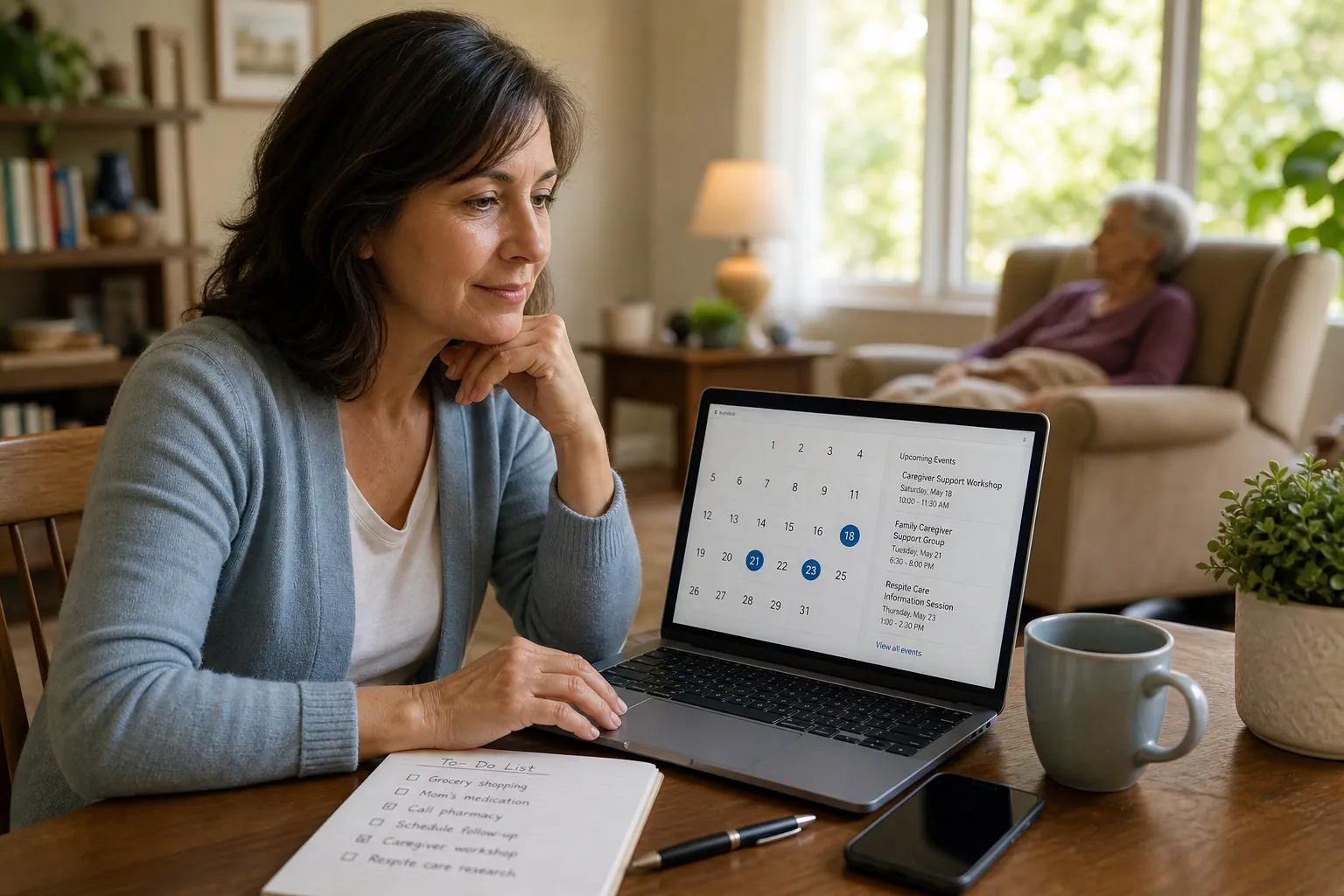
That extra verification step matters because “free caregiver workshop” is not a stable category. The same kind of class may be free through a county office, low-cost through a nonprofit, or fee-based through a licensed community host. None of that means the paid option is bad. It only means the host’s page, not the program name alone, tells you what it will actually cost.
The time is worth protecting. In the 2025 Caregiving in the US report, based on a sample of 6,858 caregivers, 64% reported high emotional stress and nearly 1 in 5 rated their own health as fair or poor.[1] Those numbers are not a reason to panic-register for the first webinar you see. They are a reason to treat finding support as part of the caregiving job, the same way you would treat medication refills, home-safety checks, or transportation.
Start with names you can actually search
Searching “caregiver self-care workshops and events near me” can bring up beautiful pages that are expired, out of state, or not really meant for family caregivers. Searching by a known program name narrows the field. It also gives you better questions to ask when you call a local agency: “Do you offer Powerful Tools for Caregivers?” is easier to answer than “Do you have anything for caregivers?”
| Program or source | Best fit | Typical shape to look for | Cost caution |
|---|---|---|---|
| Powerful Tools for Caregivers | Family caregivers who want structured support for self-care, stress, communication, and use of community resources | Six-week group class, in person or remote, co-led by two trained lay leaders; available in English, Spanish, and Korean | Often free through community hosts, but some licensed hosts charge fees; ask the host directly |
| Savvy Caregiver | People caring for someone living with dementia | A dementia-caregiver training of roughly 12 hours | Often offered free through aging agencies, but local availability varies |
| Family Caregiver Alliance classes | Caregivers who want practical care skills and self-care education | Free classes and workshops, including Caregiver College and a 2-hour self-care workshop | Check the current event page; FCA retreats have been on hiatus since COVID |
Powerful Tools for Caregivers: useful, structured, and not always free
Powerful Tools for Caregivers is the first name I would search because it is specific enough to separate real classes from generic advice pages. The National Council on Aging lists it as an evidence-based six-week group class, offered in person or remotely, with two trained lay leaders. NCOA says the program improves self-care behaviors, emotion management, self-efficacy, and use of community resources.[2]
This is also the program that shows why cost-checking cannot be skipped. NCOA notes that Powerful Tools for Caregivers is widely offered and often free through community hosts such as Area Agencies on Aging and Family Caregiver Alliance settings, but some licensed hosts charge substantial fees; one example in the source material is about $550 through a licensed extension host.[2] When you find a listing, do not assume the price from another host applies.
A quick registration email can save a wasted week:
- “Is this the six-week Powerful Tools for Caregivers class?”
- “Is there a fee, materials charge, deposit, or suggested donation?”
- “Is it online, in person, or hybrid?”
- “Do I need to attend all sessions?”
- “Is this class for dementia caregivers, general family caregivers, spouses, adult children, or anyone?”
Savvy Caregiver: look here when dementia is part of the picture
If your parent has Alzheimer’s disease or another dementia, search Savvy Caregiver by name. It is a recognized evidence-based dementia-caregiver training with a defined shape of roughly 12 hours, rather than a one-off lecture with a broad title.[3] That matters when your week is already full; a dementia-focused class should help with the caregiving situation you are actually managing, not offer general encouragement and send you home.
Availability is local. Some aging agencies offer Savvy Caregiver free, but you still need to check the host, dates, and format. If a listing says “Savvy” but does not clearly say whether it is the caregiver training, contact the organizer before registering.
Family Caregiver Alliance: free classes, with one retreat caution
Family Caregiver Alliance is worth checking because it names real offerings instead of only publishing self-care advice. FCA describes Caregiver College as a free day-long or four-week class covering practical care tasks such as transfers, bathing, hygiene, feeding, behavioral issues, and caregiver self-care. FCA also offers “Taking Care of SoMEone Else,” a free two-hour workshop on stress sources, negative self-talk, asking for help, and what can and cannot be changed.[4]
One caution: FCA’s one- and two-day retreats should not be treated as a current reliable option when you are making plans, because FCA says those retreats have been on hiatus since COVID.[4] Use the active classes and workshops page instead of building your search around a retreat that may not be available.
Then use the local aging network, not just Google
The best free or low-cost caregiver self-care workshops are often hosted by local aging offices, county partners, universities, hospital community programs, or nonprofits that do not always rank well in search results. This is where the aging network helps. Start with Eldercare Locator at 1-800-677-1116, or use it to find the Area Agency on Aging serving your parent’s ZIP code. Then ask that agency about caregiver education, respite-linked support, and free or low-cost classes funded through the National Family Caregiver Support Program.[5]
Call based on your parent’s location, not necessarily your own. If your mother lives in Ohio and you live in Illinois, her Area Agency on Aging is usually the better first call for in-person support, local respite programs, and county-based caregiver education. If you need online options because you are long-distance, say that early.
A practical call script:
- “I’m caring for my parent and I’m looking for caregiver education or self-care workshops. Do you offer Powerful Tools for Caregivers, Savvy Caregiver, or similar classes?”
- “Are any classes free through the Area Agency on Aging, county aging services, or the National Family Caregiver Support Program?”
- “Do you have online options, evening sessions, or recordings for working caregivers?”
- “Is respite available during the class, or can you refer me to respite resources?”
- “Are there classes for dementia caregivers, adult children, spouses, Spanish-speaking caregivers, or veteran caregivers?”
- “If your agency is not hosting anything this month, who is?”
That last question is not politeness; it is the workaround. Local caregiver education is often distributed across partner organizations. The AAA may not have a class on its own calendar, but it may know that the library, a dementia coalition, a hospital system, or a neighboring county is hosting one.
If you are newly in the role and still figuring out which office does what, keep a short contact list as you call. The same list will help with other practical work, from respite questions to home-safety referrals. For a broader orientation, see this guide to getting started as a family caregiver for an aging parent.
What to do when the local calendar is thin
If the AAA has nothing soon, ask for the next cycle instead of ending the call. Six-week and 12-hour programs are often offered in rounds. A class that is not available this month may open next month, and getting on the interest list is better than rediscovering the same page after registration closes.
Also ask whether the agency sends caregiver newsletters. A plain email newsletter from a county office may be more useful than a polished national calendar because it catches the small local events: a Saturday stress-management session, a dementia-skills class at a senior center, or a virtual session hosted by a neighboring agency.
Use national nonprofit calendars to fill gaps
National nonprofit calendars are useful, especially for online events, but I would not make them the first stop if you are hoping for local free support. Use them after you have checked the program names and the aging network.
- Caregiver Action Network lists free caregiver webinars, a bi-weekly Facebook Live conversation called “Real Talk,” and on-demand series.[6]
- AARP lists recurring free virtual caregiving events, which can be useful when you need something online and do not need a local class tied to your county.[7]
- VA Caregiver Support offers self-care materials for caregivers of veterans, including free workbooks, a 30-day daily-attention diary, and a self-enrichment journal.[8]
The tradeoff is that a national webinar may not connect you to respite, transportation help, benefits counseling, or local dementia services. That does not make it useless. It just means it fills a different job: education, encouragement, or a short reset when you cannot add a multiweek class.
If you are looking less for an event and more for something you can do in ten minutes between tasks, pair the workshop search with short self-care ideas for family caregivers. If you are trying to decide whether what you feel is ordinary strain or something closer to burnout, this burnout recognition guide may help you sort the signs.
Screen the workshop before you commit
A caregiver workshop is not medical advice, and it should not replace care guidance from your parent’s clinicians, social worker, therapist, or emergency services. Its job is narrower: help you build skills, reduce isolation, understand options, and keep functioning well enough to do the next necessary thing.
Before you register, check the parts that decide whether you will actually attend:
- Cost: Is it free, donation-based, low-cost, or fee-based? Are materials included?
- Dates: Is the page current? Are all sessions listed? Has registration already closed?
- Host: Is it run by an Area Agency on Aging, nonprofit, hospital, university extension, public agency, private company, or licensed program host?
- Format: Is it a one-time webinar, six-week class, 12-hour training, day-long event, support group, or on-demand recording?
- Location: Is it online, in person, or hybrid? If in person, is parking realistic and is the room accessible?
- Language: Is the class offered in the language you need, or are interpretation or captions available?
- Caregiver type: Is it for dementia caregivers, veteran caregivers, cancer caregivers, adult children, spouses, general family caregivers, or professionals?
- Topic fit: Does it cover what is wearing you down now: stress, communication, bathing and transfers, dementia behaviors, asking for help, legal planning, or navigating services?
- Recording options: If you miss the live event because of work or caregiving, can you watch later?
- After the event: Will you receive handouts, local referrals, a contact person, a certificate, or information about the next class?
The best choice may be a free county class, a national webinar, or a paid program that fits your schedule and your parent’s condition. What matters is that you are no longer scrolling random listings and hoping. You have a route: program name first, local aging network second, national calendars third, and a cost-and-format check before you give the workshop space on your calendar.
References
- Caregiving in the US Report 2025, Caregiving in the US, 2025.
- Evidence-Based Program: Powerful Tools for Caregivers, National Council on Aging.
- Savvy Caregiver, Savvy Caregiver.
- FCA Classes, Workshops, and Retreats, Family Caregiver Alliance.
- National Family Caregiver Support Program, Administration for Community Living.
- CAN Caregiver Events, Caregiver Action Network.
- AARP Family Caregiver Events, AARP.
- VA Caregiver Support Self-Care, VA Caregiver Support.
Questions to bring to a clinician or OT
This is not medical, legal, or a family's final decision — only a framework. Bring these questions to a clinician, occupational therapist, or your local Area Agency on Aging.
Find Local HelpRelated reading
Noticed something outdated or inaccurate on this page? Flag a correction. We review every report against CDC, NIA, and AARP HomeFit guidance before updating a page.