
Caregiver decision guide
Is Chair Yoga Safe for Seniors with Mobility Issues?
This guide helps caregivers determine whether chair yoga or adapted yoga is a safe, beneficial option for their aging parent with limited mobility — covering medical clearance, class selection, and what progress looks like.
Chair yoga can be a safe, useful starting point for yoga for seniors with mobility issues, especially when the alternative is doing nothing because walking outside, standing exercise classes, or gym equipment feel too risky. But the safe version is not simply any class labeled "gentle." Safety depends on the parent's medical history, current balance and transfer ability, medications, pain pattern, and the instructor's ability to adapt the class in real time.
The best evidence supports a careful yes, not a blanket yes. A Harvard-led review of 33 randomized controlled trials involving 2,384 adults over 65 found that yoga improved walking speed and leg strength, two measures closely tied to frailty risk and everyday independence.[1] That matters because families do not usually need an aging parent to become flexible. They need the parent to rise from a chair more confidently, walk a little more steadily, tolerate movement with less pain, and feel less afraid of the next transfer.
What the Evidence Actually Supports
For a parent with limited mobility, the reassuring research is not about difficult poses. It is about adapted formats. In one chair-yoga pilot, older adults averaging 88 years old, all using assistive devices at baseline, completed the sessions with no adverse events reported during class and had a significant reduction in fear of falling.[2] That is a small study, so it should not be inflated into proof that chair yoga prevents falls. Still, for the oldest-old and fall-risk group, "no adverse events during sessions" is exactly the kind of safety signal caregivers should care about.
The broader National Center for Complementary and Integrative Health evidence summary also points to yoga benefits for balance, mobility, and mental health in older adults, while noting chair yoga as one of the safer adaptations.[3] That distinction matters. The evidence is not saying that every yoga studio class is appropriate for a parent who uses a walker. It is saying that adapted yoga can be matched to older bodies and mobility limits in ways that may improve function.
Arthritis evidence is especially relevant because pain and stiffness are often what keep a parent from moving in the first place. Johns Hopkins Arthritis Center reports that an 8-week modified Integral Yoga program, held twice weekly, improved walking speed, physical function, positive affect, and perceived stress among arthritis patients, with most benefits still present 9 months later.[4] In older adults with lower-extremity osteoarthritis, an 8-week chair yoga program reduced pain, pain interference, and fatigue and improved gait speed, with benefits sustained at 3-month follow-up.[5] A 12-week chair yoga study in older women with knee osteoarthritis in Taiwan also found improved functional fitness.[6]
Those are practical outcomes. Less pain interference means a parent may be more willing to walk to the dining room, attend a senior-center activity, or practice a physical therapist's home exercises. Better gait speed is not a vanity metric. It is one of the small measurements that can reveal whether an older adult is moving through daily life with more reserve.
Start With the Doctor, Not the Class Calendar
If your parent has mobility issues, the first decision is not which pose video looks approachable. It is whether there are medical reasons to modify, delay, or avoid certain movements. A primary care clinician, physical therapist, rheumatologist, orthopedist, cardiologist, ophthalmologist, or surgeon may each hold one piece of the safety picture.
Bring a specific plan to the appointment: "My parent wants to try a chair-based yoga class for seniors. It may include seated breathing, gentle range-of-motion work, optional standing balance near a chair, and slow transitions. Are there movements or positions they should avoid?" That question is much more useful than asking whether yoga is "okay."
| Safety issue to ask about | Why it changes the yoga decision |
|---|---|
| Severe osteoporosis or a history of vertebral fracture | Forward folds, twisting, and loaded spinal flexion may need strict modification or avoidance. |
| Recent joint replacement | The surgeon should clear participation, especially before standing poses, deep hip positions, or movements that could violate precautions. |
| Uncontrolled blood pressure | Breath-holding, rapid position changes, heat, or strain may be unsafe until blood pressure is better managed. |
| History of retinal detachment or serious eye concerns | Inversions, head-down positions, or pressure-increasing movements may be inappropriate without ophthalmology guidance. |
| Dizziness, fainting, vertigo, or balance concerns | Even a chair class can involve transfers and head movement; these symptoms need a fall-risk plan. |
| Medications that affect alertness, blood pressure, or balance | Sedatives, some blood pressure medicines, and other drugs may raise fall risk during transitions. |
Medication review is not a side errand here. If your parent gets lightheaded when standing, seems sleepy at certain times of day, or recently changed prescriptions, build that into the decision. A class scheduled at the wrong time, after a dose that lowers blood pressure or causes drowsiness, can turn a good activity into a preventable fall risk. If this is already a concern, use a structured medication review for fall prevention before the first session.
The same applies after a recent fall. Chair yoga may eventually support confidence and mobility, but a fall should trigger a broader review first: injuries, vision, footwear, blood pressure changes, medications, home hazards, and whether physical therapy is needed. If the fall is recent, start with a senior health care after a fall plan before treating yoga as the recovery plan.
Choose the Format Before You Choose the Instructor
Chair yoga usually means poses are done seated, or with a chair used for support during optional standing work. Adapted yoga is broader: it may include props, wall support, slower pacing, smaller ranges of motion, and individualized modifications. Iyengar, Integral, and Viniyoga formats can be appropriate when taught by someone experienced with older adults and health limitations. The name of the style is less important than what actually happens in the room.
For most seniors with mobility limitations, the safest starting point is a truly chair-based class, ideally designed for older adults rather than a general "gentle yoga" class that happens to allow chairs. A parent who uses a cane, walker, rollator, or wheelchair needs a class that expects assistive devices, not one that treats them as disruptions.
- Reasonable starting formats: chair yoga, senior chair yoga, therapeutic yoga, adapted yoga, gentle Iyengar with props, modified Integral Yoga, or physical-therapy-affiliated movement classes.
- Formats to avoid for this audience: Bikram or other high-heat yoga, Ashtanga, Power Yoga, fast vinyasa classes, strength-intensive classes, or any class that assumes floor transfers are easy.
- Classes that need extra scrutiny: "beginner yoga," "gentle flow," and "senior yoga" when the description does not say whether chairs, props, balance support, or medical modifications are built in.
Only 6.7 percent of U.S. adults 65 and older practiced yoga in 2017, up from 1.3 percent in 2002, so many older adults entering these classes are beginners, not people returning to a familiar lifelong practice.[3] That makes the first format important. A discouraging or unsafe first class can close the door on movement altogether.
The Instructor Questions That Matter
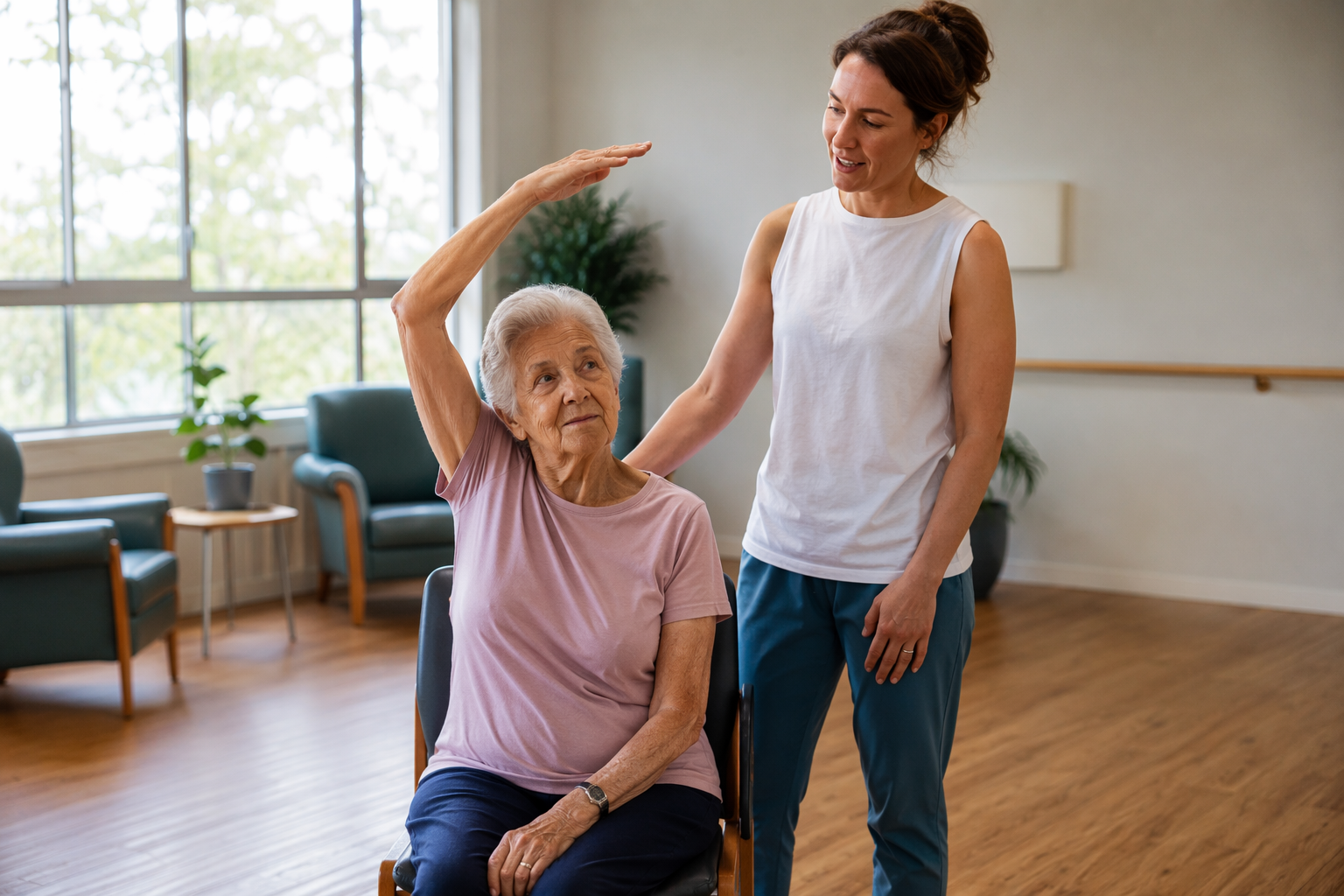
A good instructor will not be offended by careful questions. For an older adult with mobility issues, instructor fit is part of the safety equipment. The chair, the pacing, the spacing between participants, and the way the instructor responds to pain or fear all matter.
- Is the class fully chair-based, or are standing poses expected?
- Are standing poses optional without embarrassment or pressure?
- What training do you have in chair yoga, senior yoga, therapeutic yoga, arthritis modification, fall risk, or working with assistive devices?
- How do you handle walkers, rollators, canes, and participants who need extra time to transfer?
- Do you ask participants about joint replacements, osteoporosis, dizziness, blood pressure concerns, eye restrictions, or recent falls before class?
- How do you modify for knee pain, hip precautions, hand arthritis, shoulder limitations, or fear of falling?
- What happens if someone feels dizzy, short of breath, painful, or anxious during class?
Listen for specifics. "Everyone works at their own pace" is pleasant, but it is not enough. A stronger answer sounds more like: "Standing work is optional. We keep walkers close. I avoid deep forward folds for osteoporosis unless cleared. I offer seated versions for balance poses. I ask people not to push through joint pain. If someone is dizzy, they stay seated and we stop."
Also ask about the room. A safe chair-yoga class should use sturdy, non-rolling chairs; leave enough space for walkers; avoid clutter; allow water breaks; and give participants time to change positions. If the class is in a senior center, ask whether staff know how to respond if someone becomes lightheaded or falls. If it is online, the caregiver may need to be present for the first session, especially if the parent has trouble transferring or following instructions.
What Progress Should Look Like
Early progress in yoga for seniors with mobility issues should look ordinary. That is a good thing. The parent gets up from the chair with less hesitation. They report less stiffness the next morning. They are willing to walk a short hallway they had been avoiding. They finish a class without feeling wiped out. They seem less frightened by movement.
Do not measure success by whether your parent can reach farther than last week or perform a recognizable pose. The better measures are function, comfort, and confidence:
- Transfers: rising from a chair, sitting down with control, turning safely, and using the walker or cane without rushing.
- Walking confidence: moving a little more steadily, walking slightly longer distances, or feeling less afraid of short household trips.
- Pain interference: less avoidance of daily activities because of knee, hip, back, hand, or foot pain.
- Fatigue tolerance: finishing class without a prolonged crash later in the day.
- Mood and participation: being more willing to attend, socialize, or keep moving between appointments.
This is where yoga overlaps with fall prevention, but it should not be oversold. Exercise and balance work are part of a stronger four-pillar fall-prevention approach, but falls are also affected by medications, vision, footwear, home setup, blood pressure, cognition, and health changes. Chair yoga can support the movement side of the plan. It should not be asked to carry the whole plan by itself.
When to Pause or Stop
Some discomfort from moving stiff joints is possible, especially for a parent with arthritis. Sharp pain, chest pain, unusual shortness of breath, faintness, new neurological symptoms, sudden vision changes, or pain that lingers or worsens after class should stop the experiment until a clinician weighs in. Dizziness deserves special attention because it may come from blood pressure changes, inner-ear issues, dehydration, medication effects, or other causes. If standing causes lightheadedness, address orthostatic hypotension and fall prevention before adding standing yoga work.
Osteoporosis is another place to be careful rather than casual. Severe bone loss or a vertebral fracture history can change which spinal movements are safe. A class that includes repeated forward rounding, twisting, or deep stretching may need modification. If bone health is already on your worry list, treat it as a medical clearance issue, not a vague "take it easy" issue; this broader bone health guide for caregivers can help frame the conversation.
After joint replacement, do not rely on generic yoga advice. The available yoga research is helpful for arthritis and mobility, but joint-replacement-specific modification guidance is thinner. The surgeon or physical therapist should say when yoga is allowed, which movements are restricted, and whether standing balance work is appropriate.
How Yoga Compares With Other Senior Activities
Yoga does not need to be framed as better than every other activity. Some older adults thrive with walking groups, water exercise, tai chi, strength classes, dance, pickleball, or supervised physical therapy. A parent with better mobility and a taste for social competition might eventually enjoy something like pickleball for seniors. A more adventurous parent might be curious about unconventional strength activities. The question is not which activity sounds most inspiring. It is which one your parent can start safely and repeat.
For a parent with limited mobility, chair yoga often has a lower entry barrier because it can reduce floor transfers, limit standing time, and allow rest without leaving the class. That makes it useful when the immediate goals are mobility, confidence, pain management, and preserving independence rather than athletic improvement.
A Practical Go-or-Pause Framework
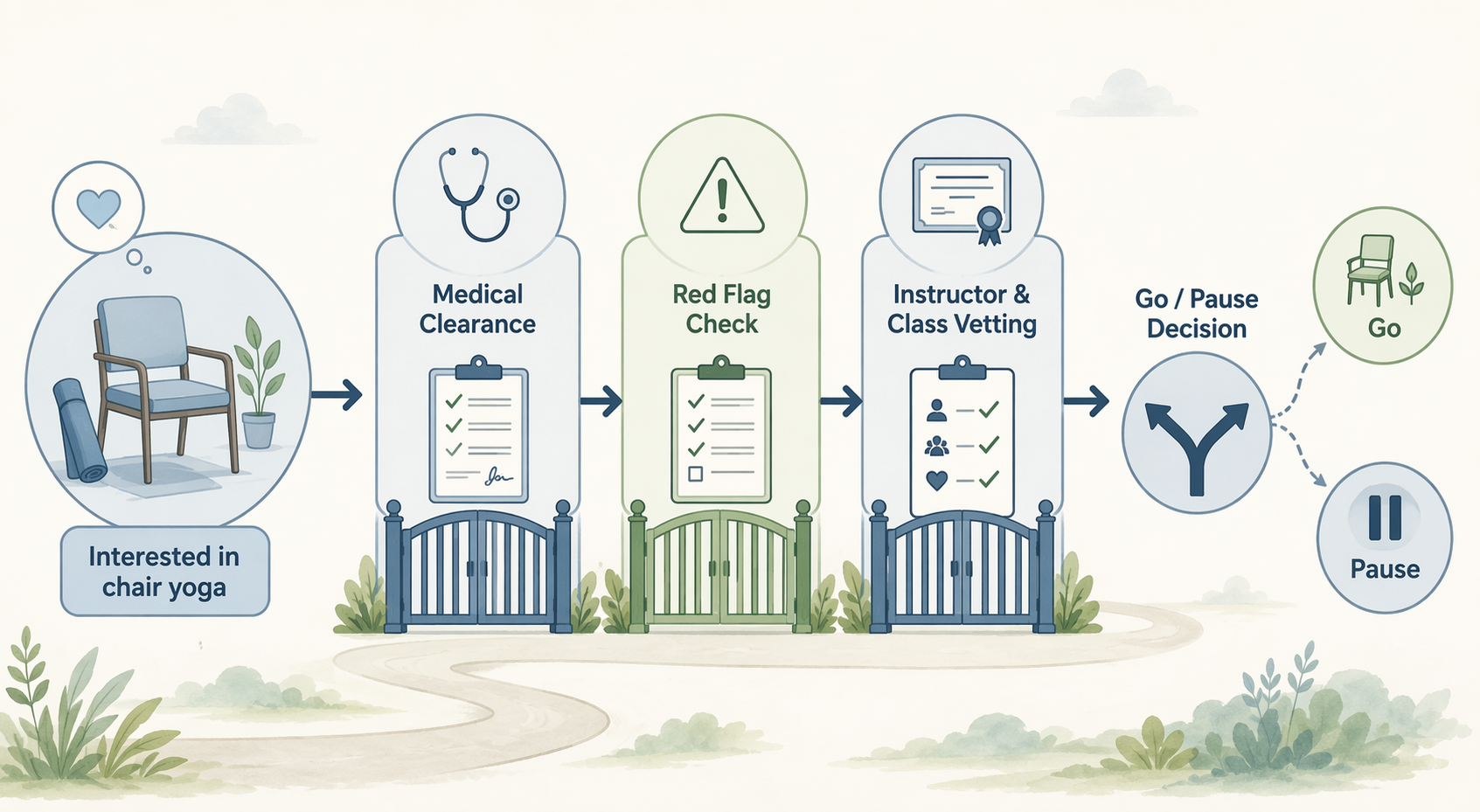
A reasonable yes requires several smaller yeses. The doctor or relevant clinician clears participation or gives clear restrictions. Red flags such as severe osteoporosis, recent joint replacement, uncontrolled blood pressure, retinal concerns, dizziness, balance instability, and medication-related fall risk have been addressed. The class is genuinely adapted, not merely gentle in name. The instructor can explain modifications for assistive devices, arthritis, knee pain, hip precautions, fear of falling, and optional standing work. Your parent is willing, not pushed.
If those conditions are met, chair yoga is a reasonable evidence-backed option to try. If one is missing, the next step is not to argue harder for yoga. It is to pause, ask the clinician or physical therapist a more specific question, and find a safer starting point for mobility and independence.
References
- Strong evidence that yoga protects against frailty in older adults, Harvard Gazette, March 2023.
- Safety and feasibility of modified chair-yoga on functional outcome among elderly at risk for falls, PMC, 2012.
- Yoga for Health: What the Science Says, NCCIH / NIH.
- Yoga for Arthritis: Benefits of Yoga for the Arthritis Patient, Johns Hopkins Arthritis Center.
- Chair Yoga for Osteoarthritis: A Randomized Controlled Trial, PMC, 2017.
- Effects of Chair Yoga Therapy on Functional Fitness and Daily Life Activities among Older Female Adults with Knee Osteoarthritis in Taiwan: A Quasi-Experimental Study, Healthcare, 2023.
Questions to bring to a clinician or OT
This is not medical, legal, or a family's final decision — only a framework. Bring these questions to a clinician, occupational therapist, or your local Area Agency on Aging.
Find Local HelpRelated reading
Noticed something outdated or inaccurate on this page? Flag a correction. We review every report against CDC, NIA, and AARP HomeFit guidance before updating a page.