
Caregiver decision guide
How to Choose the Best Stroke Care for Older Adults
Not all stroke centers are equal. This guide gives you a clear two-step framework for choosing the right hospital and rehabilitation facility for your older parent — matching stroke severity to the correct certification level and functional potential to the right therapy intensity.
At the bedside, "best stroke care" is not a comforting phrase. It is a routing decision. About half of strokes occur in people over 75, and roughly 30% occur after 85, so the person making that decision is often an adult child who suddenly has to translate hospital language into something the family can act on [1]. Stroke is also the fourth leading cause of death in the U.S., with nearly 800,000 strokes each year, and about 1 in 4 survivors will have another stroke within five years [2].

The cleanest way to sort the choices is to separate the hospital decision from the rehabilitation decision.
| Decision | What to match |
|---|---|
| Acute hospital | Match the stroke severity to the center's actual capability, especially if large-vessel occlusion or endovascular treatment may be involved. |
| Post-acute rehab | Match the parent's endurance, medical complexity, and support at home to the right therapy intensity and supervision. |
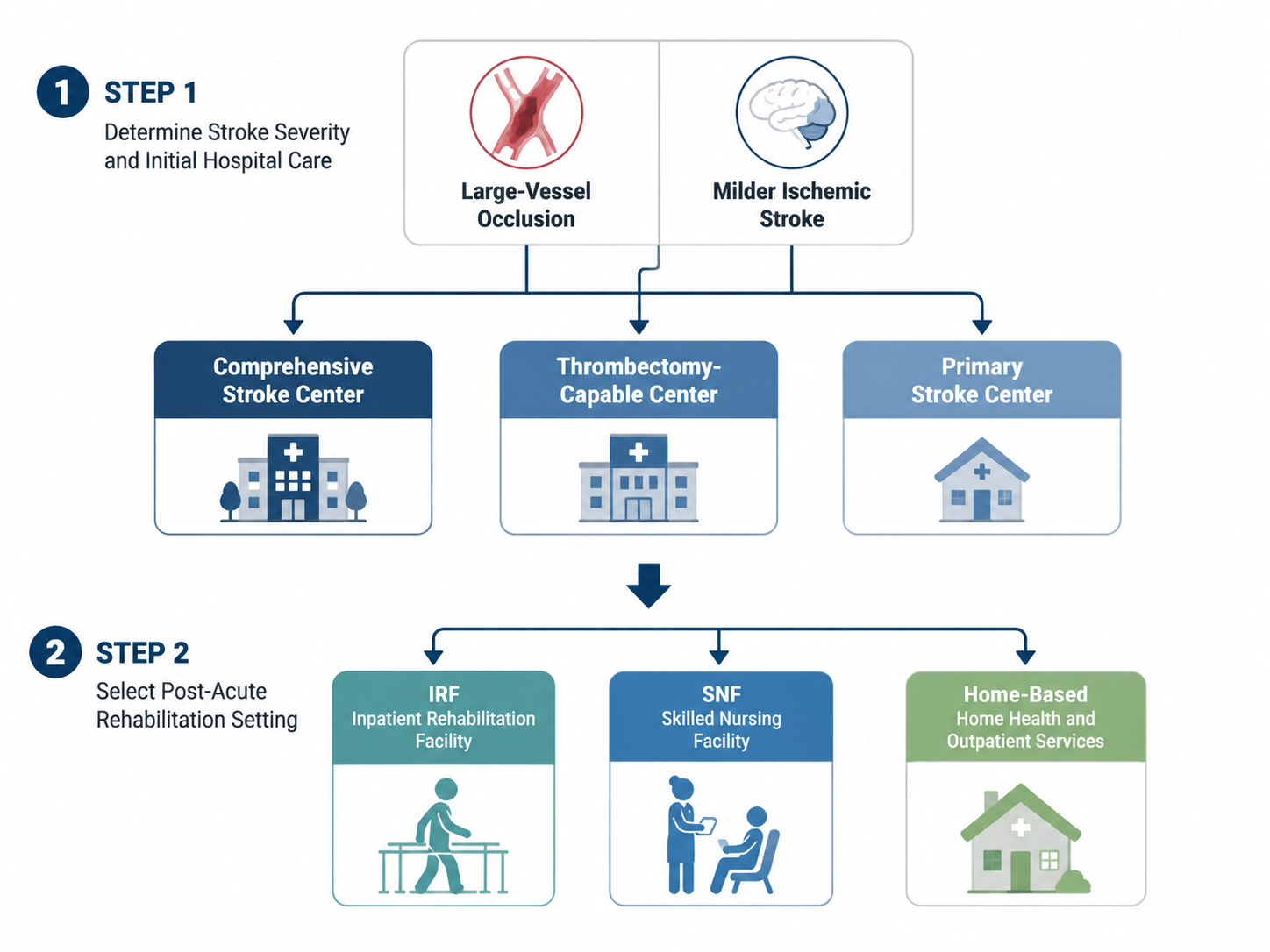
The Hospital Match
The first decision is not which hospital has the nicest unit or the best online score. It is whether the hospital can treat the kind of stroke your parent may have. For selected patients with salvageable tissue, endovascular therapy can still be on the table up to 24 hours after last known well, and the 2026 AHA/ASA guideline treats onset-to-treatment time as one of the strongest modifiable predictors of outcome [3].
| Stroke center level | What it should be able to do | Why it matters |
|---|---|---|
| Comprehensive Stroke Center | 24/7 neuroendovascular capability for thrombectomy and the broadest stroke coverage, including at least 50 thrombectomies a year [5] | This is the right destination when a large-vessel occlusion or other complex stroke may need advanced intervention. |
| Thrombectomy-Capable Center | Can perform endovascular treatment, though not always with the same breadth as a comprehensive center [5] | A good fit when EVT may be needed and the patient does not need the highest-complexity stroke hub. |
| Primary Stroke Center | Can stabilize the patient and transfer quickly if advanced intervention is needed [5] | A useful stop when the real strength is rapid triage, imaging, and transfer rather than keeping the patient in place. |
That label only matters if it matches the problem in front of you. A stroke center certification is not one uniform promise, so ask who certified the hospital and what that certification actually covers. If the team says "good with stroke patients," follow with the practical question: can this place do what my parent needs now, or is it the right place only long enough to stabilize and transfer? A dedicated stroke unit also matters; stroke unit care reduces death and dependency regardless of age [3].
The Rehab Match
Discharge pressure can make the second decision feel calmer than it is. The family is tired, the acute crisis is easing, and every option starts to sound like a version of "some rehab is better than none." But the first rehab placement is not paperwork. About 70% of functional recovery happens in the first 3 months, so early access to the right intensity matters [1]. And for adults 70 and older, improvement may continue to 6 months before decline can appear between 6 and 30 months, which is a reason to plan carefully, not a reason to assume recovery is already over [4].
| Rehab setting | Intensity and supervision | When it usually fits |
|---|---|---|
| IRF | At least 3 hours of therapy a day, at least 5 days a week, under physician supervision [1]. | Best when the patient can tolerate intensive therapy and still benefit from coordinated medical rehab. |
| SNF | Less intensive, with a stronger nursing focus than an IRF. | Better when endurance, medical complexity, or safety makes IRF unrealistic right now. |
| Home-based rehab | Therapy delivered at home with the home environment and caregiver support in view. | Appropriate when the patient can work safely at home and the family can support that plan. |
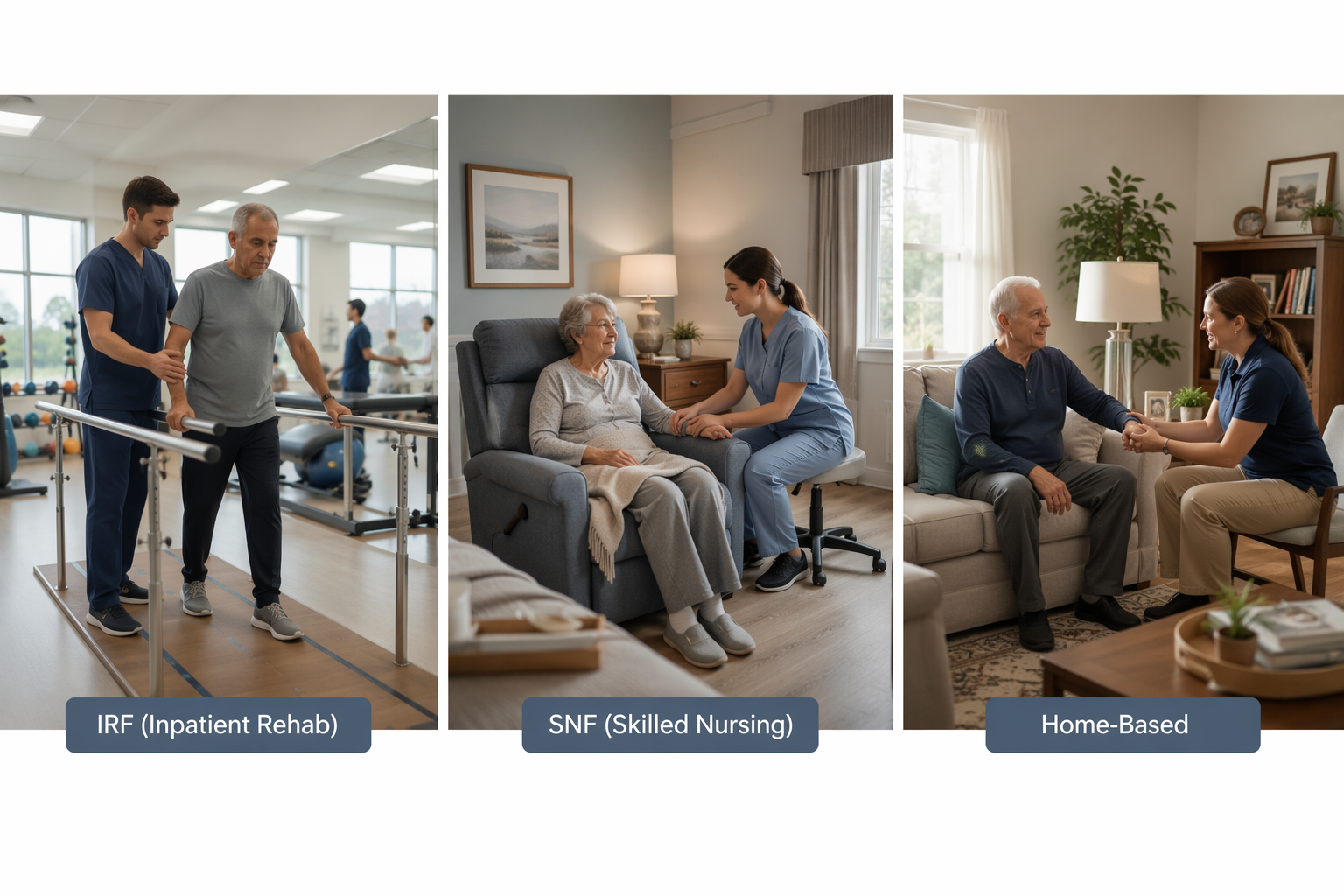
IRF is not "better" because it sounds more impressive. It is better when the patient can actually use that intensity. SNF-level rehab is not a downgrade by default; it is the safer match when the parent needs more nursing support, less therapy at once, or a slower pace. Home-based rehab is not a consolation prize either if the house, caregiver support, and safety setup make it workable. The point is fit, not prestige.
Questions That Change the Conversation
- What stroke type are we treating right now, and has large-vessel occlusion been ruled in or out?
- If EVT is still possible, does this hospital do it here, or should we transfer now?
- Which organization certified this stroke center, and what capability does that certification actually cover?
- Can my parent realistically do 3 hours a day of therapy, 5 days a week, under physician supervision?
- If not, what makes SNF or home-based rehab the safer fit today?
- What is the plan for the first 3 months, when most recovery tends to happen?
Families do not need to diagnose the stroke subtype or prescribe the rehab level themselves. They do need to ask sharper questions, verify the capability behind the label, and keep the next decision tied to the parent's actual stroke severity, medical complexity, and functional potential.
References
- Elderly Stroke Rehabilitation: Overcoming the Complications and Its Associated Challenges — PMC, 2018
- Stroke Treatment — CDC, 2024
- 2026 AHA/ASA Acute Ischemic Stroke Guideline — AHA Journals, 2026
- Effects of Age on Long-Term Functional Recovery — PMC, 2020
- Stroke Center Designation Levels — GetAheadOfStroke.org
Questions to bring to a clinician or OT
This is not medical, legal, or a family's final decision — only a framework. Bring these questions to a clinician, occupational therapist, or your local Area Agency on Aging.
Find Local HelpRelated reading
Noticed something outdated or inaccurate on this page? Flag a correction. We review every report against CDC, NIA, and AARP HomeFit guidance before updating a page.