
Caregiver decision guide
How to Choose a Southwest Seat for an Elderly Parent
Southwest's move to assigned seating means the 'best seat' for an older parent is now a needs-to-seat match you can lock in when you book. This guide shows how to map your parent's mobility, continence, and comfort needs to the right seat type and exact row — and when preboarding or wheelchair assistance should back it up.
Since January 27, 2026, choosing the best seat for an elderly parent on Southwest is no longer a boarding-position strategy. Southwest now uses assigned seating: Basic fare passengers receive an auto-assigned seat at check-in, while other fare types allow seat selection earlier, including at booking depending on the fare.[1][2] That changes the caregiver’s job in a useful way. You are not trying to “get lucky” in the boarding line. You are matching the seat to the limitation that will matter most at 30,000 feet.
Start with the real constraint: bathroom urgency, stiff knees or hips, circulation, balance, motion sensitivity, a wheelchair transfer, or early confusion in a crowded cabin. Those are different problems. “Aisle near the front” is a good baseline — AARP gives caregivers similar broad advice when traveling with an older loved one — but it is not specific enough for Southwest’s 2026 seat map.[3]
First decide what the seat must solve
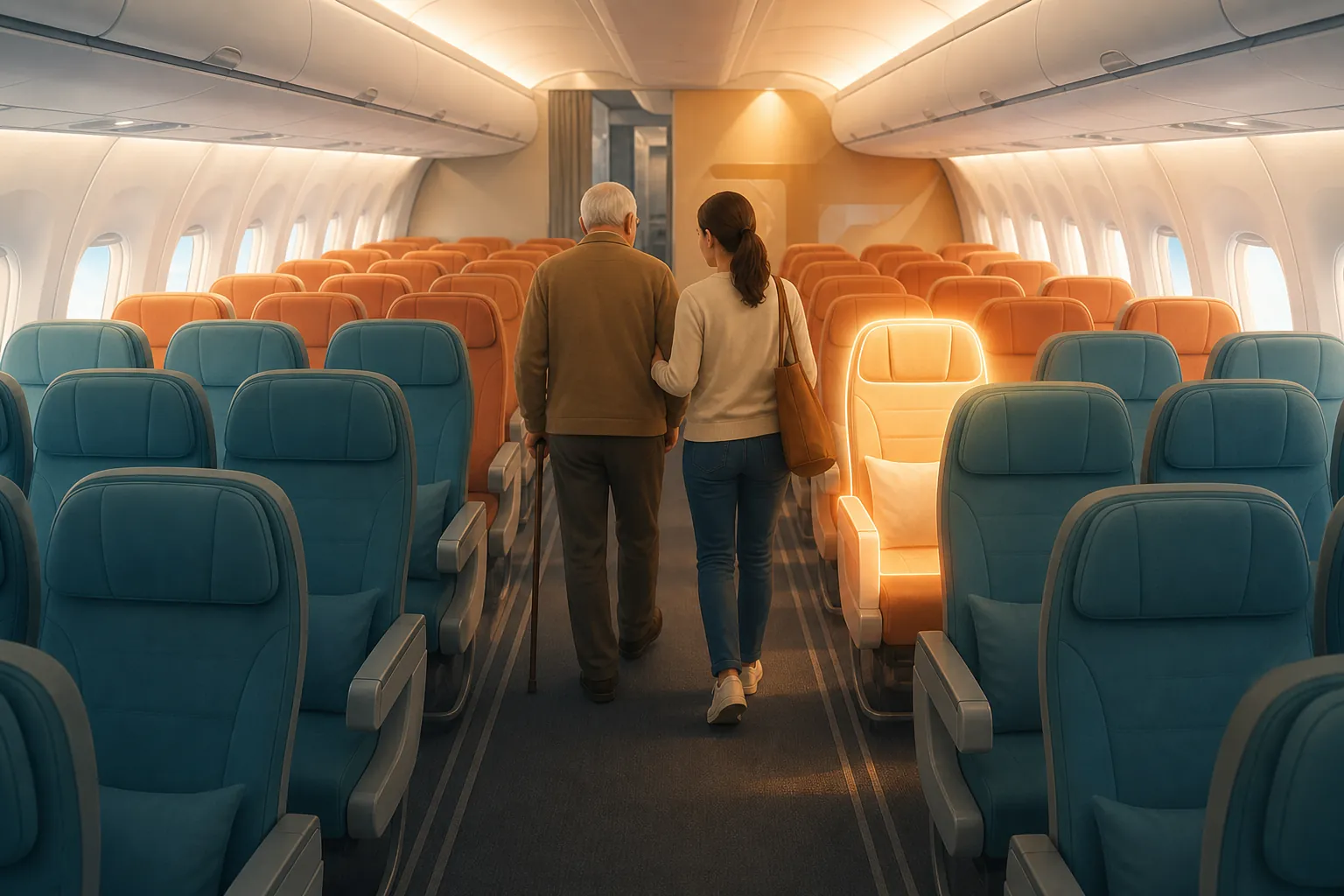
The best Southwest seat for an older parent is usually the one that reduces the most predictable failure point. If your mother cannot rise easily from a low seat, extra legroom may help more than proximity to the lavatory. If your father needs the bathroom urgently, a rear aisle seat near the lavatory may be more dignified than a front window seat with slightly more space. If your parent uses preboarding because of a disability, an exit-row seat is off the table.
| Parent’s main need | Seat choice to start with | Rows or zones to consider | Watch-outs and backup support |
|---|---|---|---|
| Stiff knees, hip pain, or difficulty standing up | Extra Legroom aisle, if affordable and selectable | Front-cabin Extra Legroom before considering exit rows | Do not assume an exit row is allowed or safe. If the parent preboards, they cannot sit in an exit row.[4] |
| Needs the bathroom quickly or often | Aisle seat near a lavatory | Forward aisle if walking distance matters most; rear aisle if bathroom access matters more than being near the front | Rear-lavatory rows can have traffic, noise, and no-recline tradeoffs. Avoid making a parent shuffle from a window seat past strangers during urgency. |
| Balance problems or fall risk in the aisle | Aisle seat close to the boarding door, usually Preferred or front Extra Legroom | Front cabin when the seat can be selected in advance | Pair the seat with wheelchair assistance or preboarding if the parent qualifies; the seat alone does not make the airport walk safe. |
| Wheelchair transfer or very slow boarding | Aisle seat with preboarding support; ask about a movable aisle armrest when relevant | Front cabin can reduce transfer distance, but row 1 is not automatically best | Bulkhead row 1 has no underseat storage, so medical items and small bags must go overhead during taxi, takeoff, and landing.[4] |
| Circulation concerns or needs to stretch legs | Extra Legroom aisle, preferably not a row with awkward restrictions | Front-cabin Extra Legroom first; exit-row legroom only if the parent meets exit-row requirements and does not preboard | Extra pitch helps space, but it does not replace movement advice from a clinician. |
| Motion sensitivity or early confusion | Aisle seat where the caregiver can sit beside them; avoid unnecessary cabin traffic | Front or mid-cabin Preferred/Standard depending on budget and seat availability | Being close to a lavatory may add noise and movement. Seat certainty and an adjoining caregiver seat may matter more than a famous “best row.” |
What Southwest’s 2026 seat types mean for an older parent
Southwest’s assigned-seating system groups seats into three practical buckets: Extra Legroom, Preferred, and Standard. Extra Legroom seats are in the front cabin and exit rows and are described by Southwest as offering up to five additional inches of pitch; Preferred seats have standard legroom in the front cabin; Standard seats are farther back in the cabin.[1] The “up to” matters because aircraft layouts and third-party pitch figures vary, so caregivers should treat exact inch claims cautiously and check the seat map for the actual aircraft before travel.

For a parent with painful knees, weak hips, or difficulty rising from a seated position, Extra Legroom is often the first seat type to check. The extra space can make it easier to place feet, shift weight, and stand without bumping the seat ahead. But the exit-row portion of Extra Legroom is not a caregiver shortcut. Exit rows come with safety responsibilities, and Southwest says customers who preboard may not sit in an exit seat.[4]
Preferred seats are less glamorous but often more useful than people expect. They are standard-legroom seats toward the front of the cabin, which can reduce the boarding and deplaning walk without putting your parent into row 1 storage limits or an exit-row eligibility problem.[1] If the main concern is confusion, fatigue, or a long aisle walk, a Preferred aisle seat may be the cleanest choice.
Standard seats are not automatically wrong. They sit farther back, which may be less convenient for boarding and deplaning, but they can be reasonable when the parent is stable on their feet, cost matters, or the key need is sitting next to the caregiver rather than buying more pitch. The mistake is letting Basic auto-assignment decide this for a parent who truly needs a particular aisle, zone, or companion arrangement.
Exact Southwest rows that deserve a second look
Some Southwest rows get attention because they offer unusual legroom. On the Boeing 737-800 and 737 MAX 8, 16A and 16F are commonly identified as especially roomy because there is no seat directly in front of them; on the Boeing 737-700, 15A is the comparable standout.[5][6][7] These can be excellent for a traveler who wants space and can safely meet the rules attached to the row.
They are not universal “elderly parent” seats. If your parent needs preboarding, do not plan on an exit row. If they cannot understand or perform exit-row duties, do not plan on an exit row. If they need you immediately beside them for cueing, medication reminders, or anxiety, a single prized window seat with unusual legroom may be less useful than two ordinary seats together.
Row 1 also needs care. It can reduce walking distance and may feel appealing for a parent who tires quickly, but bulkhead seats do not have underseat storage.[4] That means the purse with hearing aids, medication, glasses, snacks, or a change of briefs cannot sit at their feet for takeoff and landing. For some families that is fine. For others it creates the exact scramble the seat was supposed to prevent.
Rows to treat cautiously
- No-recline rows: third-party seat guides identify 737-700 rows 14, 15, and 27, and 737-800/MAX 8 rows 13, 14, 15, and 30 as no-recline rows.[5][8] That may matter for a parent with back pain or stiffness.
- Windowless seats: 10A, 11A, and 11F are commonly flagged as windowless on Southwest layouts.[5][8] This is not a medical issue, but it can matter for orientation, anxiety, or nausea.
- Rear-lavatory rows: rows 29–30 can reduce the bathroom walk, but they may also bring standing passengers, odors, noise, and recline limitations depending on aircraft.[5][8]
- Exit rows: useful for space only when the parent is eligible, willing, and able to perform exit-row functions, and not using preboarding.
How to actually secure the seat
If the seat matters, do not book as though every fare gives the same control. Under Southwest’s assigned-seating model, Basic fares receive auto-assigned seats at check-in. Choice, Choice Preferred, and Choice Extra are the fares that move you toward seat selection rather than waiting for assignment, with higher fare types offering more seat-selection access.[1][2]
For a parent who can sit almost anywhere as long as you are on the same plane, Basic may be a budget decision. For a parent who needs an aisle, must be near you, should avoid long walking distance, or cannot tolerate a surprise middle seat, auto-assignment is a poor place to save money. The cost of the wrong seat is paid in pain, embarrassment, delays, and extra work for the gate and cabin crew.
Southwest also describes a 48-hour window before departure when customers may be able to buy an upgrade to Extra Legroom if seats are available.[1] That is a fallback, not a care plan. Availability can be gone by then, and the parent who needs the space most is often the parent least able to absorb a last-minute seating compromise.
Some travelers may have A-List or credit-card-related access windows, and those can affect when a seat becomes selectable.[2] Use them if they apply. Just do not let loyalty-program mechanics distract from the central booking question: can you choose the parent’s needed seat before the trip becomes fragile?
One small correction is worth making before anyone spends time hunting for a senior trick: Southwest does not offer senior fares, so age alone does not create a seat-selection benefit.[9] Plan through fare choice, paid or included seat selection, and disability accommodations when they apply.
When the seat needs airport support around it
A good seat does not solve the curb, the jet bridge, the transfer, or the walk to baggage claim. If your parent needs help because of a disability, Southwest’s preboarding and wheelchair-assistance pages should be checked directly before travel, because airline support pages can change and some older summaries still use legacy open-seating language. For rights language, the safer backstop is the Department of Transportation and the Air Carrier Access Act rules.
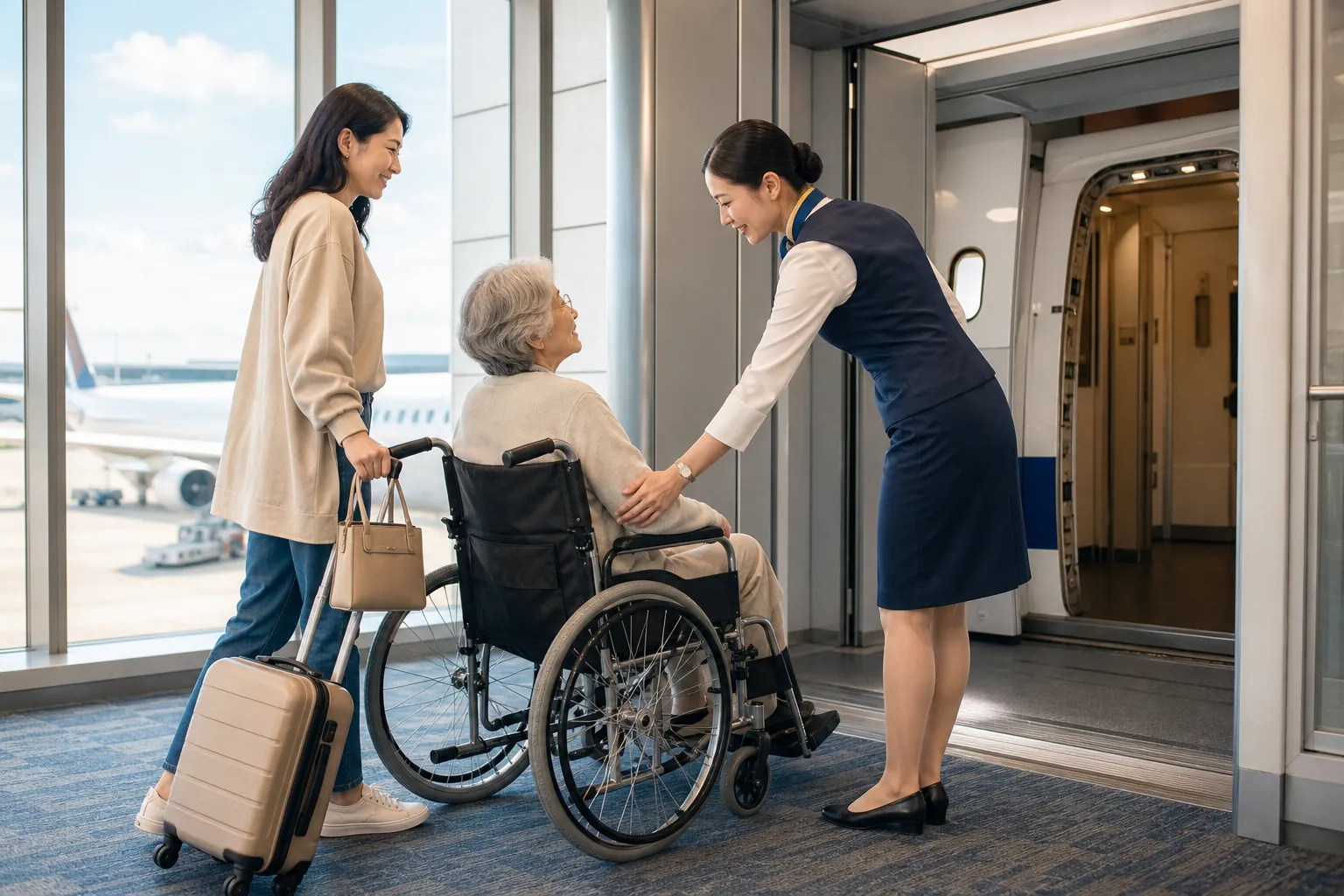
Under federal disability rules, airlines must provide certain seating accommodations when requirements are met, including a movable-aisle-armrest seat for a passenger who uses an aisle chair to board and cannot transfer over a fixed aisle armrest, a greater-legroom or bulkhead seat for a passenger with a fused or immobilized leg, a bulkhead seat for a passenger traveling with a service animal when needed, and an adjoining seat for a required attendant.[10] The DOT’s seating-accommodation guide lists Southwest’s method for seating accommodations as preboarding.[11]
Wheelchair assistance is also not a favor slipped in if someone looks old enough. DOT materials describe wheelchair and guided assistance as free assistance from curb to gate and gate to curb, with limits on how long a passenger may be left unattended in a wheelchair.[12] If your parent cannot safely manage the airport distance, request the help instead of hoping the nearest employee will improvise during boarding.
For many families, the right combination is simple: select the seat you can control, then request the support the parent qualifies for. That keeps the seat choice from becoming a private problem handed to a gate agent after the map has filled.
One-screen seat-picking checklist
- Name the limiting need first: bathroom urgency, painful joints, circulation, balance, wheelchair transfer, motion sensitivity, or confusion.
- Choose the seat type that fits that need: Extra Legroom for space, Preferred for front-cabin standard legroom, or Standard when the parent can tolerate the farther-back location and you can still secure the aisle or companion seats they need.
- Favor an aisle when standing, toileting, or caregiver access matters.
- Do not choose an exit row for a parent who preboards or cannot perform exit-row duties.
- Think twice before row 1 if the parent needs medication, hearing aids, glasses, or personal items within reach during takeoff and landing.
- Check no-recline, windowless, and rear-lavatory tradeoffs before accepting a row that looks good on distance alone.
- Book a fare that lets you secure the needed seat instead of relying on Basic auto-assignment if the seat is important.
- Request preboarding, wheelchair assistance, movable-armrest seating, or attendant seating when the parent qualifies.
- Recheck the aircraft type and seat map before travel, especially if Southwest changes equipment.
References
- Assigned Seating, Southwest Airlines, https://www.southwest.com/customer-enhancements/assigned-seating/
- How to Get the Best Seat on Southwest, NerdWallet, https://www.nerdwallet.com/travel/learn/how-to-get-the-best-seat-on-southwest
- How to Travel With Older Parents as a Caregiver, AARP, https://www.aarp.org/caregiving/home-care/traveling-with-your-loved-one/
- Preboarding, Southwest Airlines, https://support.southwest.com/helpcenter/s/article/preboarding
- Best Seats on Southwest Airlines, Upgraded Points, https://upgradedpoints.com/travel/airlines/best-seats-on-southwest-airlines/
- Southwest Airlines Boeing 737-800, SeatMaps, https://seatmaps.com/airlines/wn-southwest-airlines/boeing-737-800/
- Southwest Airlines Boeing 737-700, SeatMaps, https://seatmaps.com/airlines/wn-southwest-airlines/boeing-737-700/
- Southwest Assigned Seating Seat Selection Guide 2026, SeatCompare.ai, https://seatcompare.ai/insights/southwest-assigned-seating-seat-selection-guide-2026
- Senior Fares, Southwest Airlines, https://support.southwest.com/helpcenter/s/article/senior-fares
- 14 CFR § 382.81 - For which passengers must carriers make seating accommodations?, Electronic Code of Federal Regulations, https://www.ecfr.gov/current/title-14/chapter-II/subchapter-D/part-382/subpart-F/section-382.81
- Seating Accommodation Methods, U.S. Department of Transportation, https://www.transportation.gov/resources/individuals/aviation-consumer-protection/seating-accommodation-guide/methods
- Wheelchair and Guided Assistance, U.S. Department of Transportation, https://www.transportation.gov/individuals/aviation-consumer-protection/wheelchair-and-guided-assistance
Questions to bring to a clinician or OT
This is not medical, legal, or a family's final decision — only a framework. Bring these questions to a clinician, occupational therapist, or your local Area Agency on Aging.
Find Local HelpRelated reading
Noticed something outdated or inaccurate on this page? Flag a correction. We review every report against CDC, NIA, and AARP HomeFit guidance before updating a page.