
Caregiver decision guide
How to Monitor Health Changes in Elderly Parents
Gradual health changes in an aging parent are easy to miss, but catching them doesn't require daily charting or monitoring cameras. A simple weekly observation log — with a monthly pattern review and a dated doctor handoff — gives a clinician specifics they can actually act on.
When you are trying to figure out how to monitor health changes in elderly parents, the hardest part is usually not caring enough. It is knowing what to write down. “Mom seems weaker lately” may be true, but it gives a doctor very little to work with. “Since July 10, she has held the wall on the basement stairs three times and skipped dinner twice because she was too tired to cook” is different.
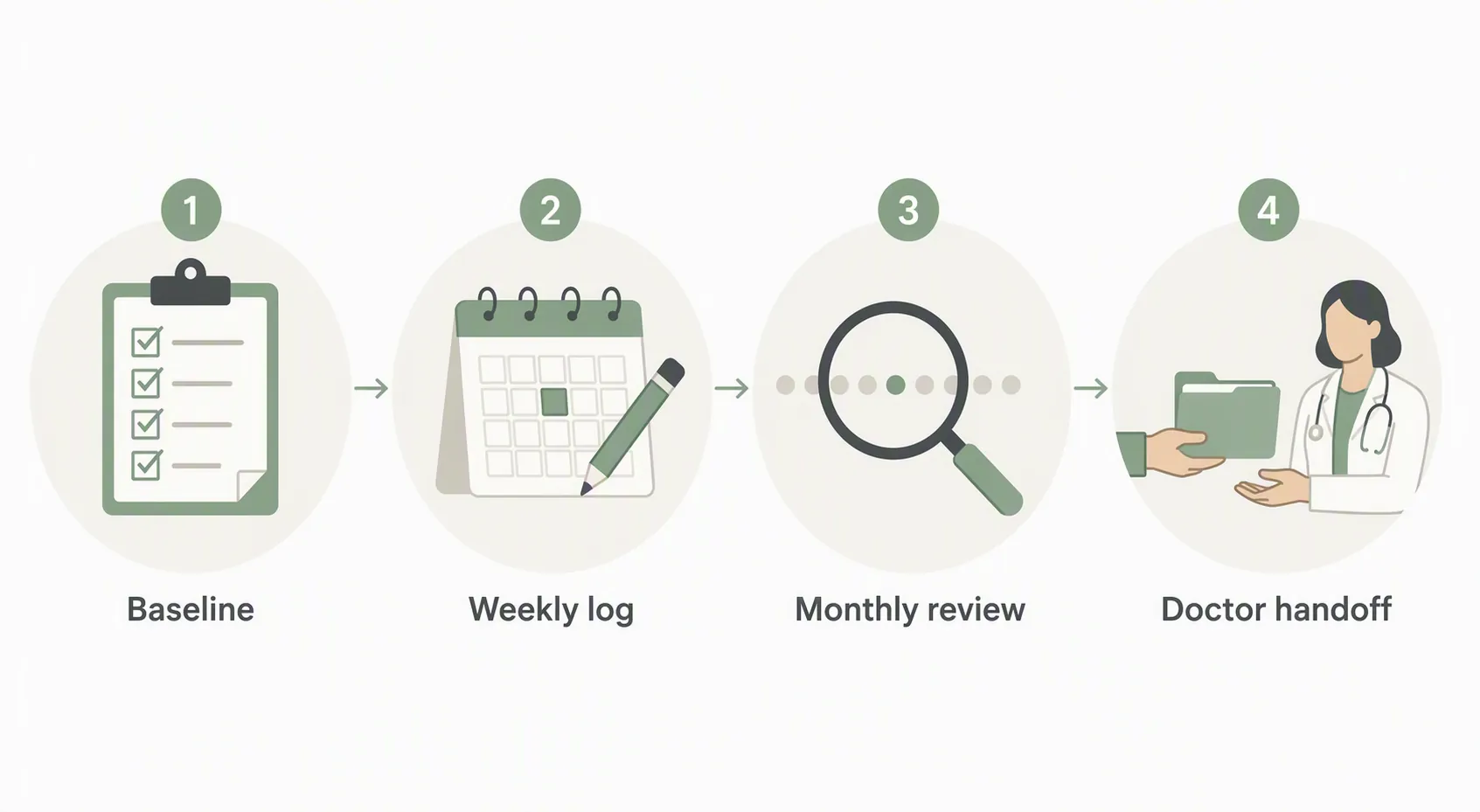
For gradual changes, you do not need a daily spreadsheet, a camera system, or a medical chart at home. Start with one shared, dated log. Make one brief entry each week. Add extra notes after falls, near-falls, medication changes, ER visits, hospital stays, or any event that could change how your parent functions. Once or twice a month, look back for patterns. Before a doctor visit, turn those patterns into a short written handoff.
There is one important boundary: sudden change is not a “watch it for a month” problem. Rapid confusion, new disorientation, or a sharp change in attention over hours or days can fit the pattern of delirium, which Mayo Clinic distinguishes from slower cognitive decline and describes as often developing quickly over hours or a few days.[1] If that is what you are seeing, seek urgent clinical guidance rather than waiting for your next log review.
Start with today’s baseline, not last year’s memory
A useful log begins with a plain question: what can your parent do today? Not what they used to do. Not what everyone hopes they can keep doing. Today.
Use everyday function as the starting point. Clinicians often separate basic activities of daily living, or ADLs, from instrumental activities of daily living, or IADLs. Cleveland Clinic lists ADLs as bathing, dressing, transferring, toileting, continence, and feeding; IADLs include more complex tasks such as managing money, taking medications, preparing meals, and transportation.[2]
You do not have to score your parent or turn this into an exam. Write a dated baseline in ordinary language. The baseline is just the reference point you will compare later observations against.
| Baseline area | What to write down |
|---|---|
| Bathing and dressing | Can they bathe safely? Choose clean clothes? Fasten buttons, zippers, shoes, or compression socks? |
| Transferring and walking | Can they get out of bed, rise from a chair, use stairs, and move through the home without help? |
| Toileting and continence | Any new accidents, trouble reaching the bathroom, or need for reminders? |
| Eating and meals | Can they feed themselves, prepare simple meals, and keep enough food in the home? |
| Medications | Can they fill, open, and take medications correctly, especially after a prescription change? |
| Money, transportation, and appointments | Can they pay bills, arrange rides, drive safely if they still drive, and keep appointments? |
A baseline entry might be only half a page. For example: “Aug. 5: Dad showers independently using grab bar; dresses without help except compression socks; drives only local daytime routes; uses pill organizer filled by daughter on Sundays; cooks breakfast and lunch, usually microwaves dinner; no falls reported; uses cane outside.”
That is enough. Later, if he stops showering unless reminded, leaves pills in the organizer, or starts avoiding the porch steps, you have something real to compare against.
Keep one weekly log that the family can actually maintain
A monitoring system fails when it asks too much of the person who is already tired. The workable rhythm is one dated entry per week, with two to five bullets, plus extra entries when something notable happens. That weekly-plus-event rhythm is the approach used in simple caregiver observation log guidance, which also emphasizes that daily charting is not required for gradual change tracking.[3]

Use whatever format your family will keep using: a paper notebook on the kitchen counter, a shared note on the phone, a printed sheet in a binder, or a shared document for siblings. If you already use a caregiver binder, the log can sit beside medication lists, appointment notes, and daily-care sheets. A printable system like Get Your Free Printable Caregiver Checklist Binder can help keep those papers together so the doctor visit is not built from memory the night before.
Each weekly entry should answer three questions:
- What changed from the baseline?
- When did it happen, or how often did it happen?
- Did it affect function, safety, eating, medication use, mood, sleep, or appointments?
Good entries are short and dated. They do not need diagnosis language. In fact, they are usually better without it.
| Vague note | More useful note |
|---|---|
| Seems weaker. | Aug. 12: Needed both hands to push up from kitchen chair twice; said legs felt tired after walking to mailbox. |
| Eating poorly. | Aug. 14 and 16: Skipped dinner; fridge still had untouched prepared meals from Tuesday. |
| Memory getting bad. | Aug. 18: Took morning pills again at noon until son noticed pillbox was empty for two days. |
| Not safe alone. | Aug. 20: Left stove burner on after heating soup; no fire, but pan was still on burner when neighbor arrived. |
If several people help, ask everyone to use the same log and avoid arguing inside it. One person can write, “Found unopened mail stacked on table; electric bill due tomorrow.” Another can add, “Dad says he plans to pay it Friday.” The doctor does not need a family verdict in the log. The doctor needs dated observations.
What to track without bloating the log
The log should cover more than one symptom, because older adults often lose function through a mix of small changes. UnitedHealthcare describes the age-friendly “4 Ms” as What Matters, Mobility, Memory, and Medications.[4] That is a useful lens when you are deciding what deserves a note. It keeps the family from staring only at memory, or only at pain, while missing the medication change or the stairs.
For weekly use, these categories are enough:
- Energy and stamina: tiring sooner, needing more naps, abandoning usual errands, or taking longer to recover after activity.
- Mobility and balance: slower walking, furniture-walking, trouble rising from chairs, avoiding stairs, new cane or walker use, falls, and near-falls.
- Pain: new pain, worsening pain, pain that changes walking or sleep, or pain that makes bathing, dressing, cooking, or errands harder.
- Appetite, weight, and sleep: skipped meals, spoiled food, loose clothing, nighttime wandering, sleeping much more, or sleeping much less.
- Mood or behavior: withdrawal, irritability, anxiety, loss of interest, suspiciousness, or behavior that is new for your parent.
- Memory and thinking: missed bills, repeated medication mistakes, getting lost, confusion with appliances, repeated calls about the same issue, or trouble following familiar routines.
- Safety incidents: stove left on, doors left unlocked, unsafe driving moments, wandering, scams, missed emergency pendant use, or unsafe tool use.
- Medical changes: new prescriptions, dose changes, ER visits, hospital stays, infections, new diagnoses, therapy starts or stops, and discharge instructions.
Those categories are a menu, not eight boxes to fill every week. If nothing happened with appetite, do not write about appetite. If the only notable item was a near-fall on the porch, write that.
Why “small” changes still belong in the log
It is tempting to ignore brief changes once your parent seems better. That can be a mistake. AAFP’s review on functional decline in older adults notes that most disability episodes in older adults are brief, lasting one to two months, yet they increase the risk of recurrent or progressive decline.[5] A short period of needing help with bathing, meals, or stairs may still be worth bringing to a clinician’s attention if it repeats or connects with other changes.
The same review gives another reason not to track only one problem. As the number of impairments rises from one to four, the share of older adults reporting functional dependence rises from 7% to 14% to 28% to 60%.[5] That does not mean every tired week predicts a major decline. It means the combination matters. Mild pain, missed meals, slower walking, and a new medication problem together deserve more attention than any one of them might get alone.
Falls and near-falls get their own note
Log every fall, even if your parent says they are fine. Log near-falls too: grabbing the counter, catching themselves on the wall, stumbling on the same step, or needing someone’s arm when they usually walk alone. The CDC reports that more than 1 in 4 people aged 65 and older falls each year, and fewer than half tell their doctor.[6]
A fall note should include the date, place, activity, injury if any, whether there was dizziness or loss of consciousness if known, what footwear or assistive device was used, and what happened afterward. For prevention planning, connect those notes with a broader Fall Prevention review rather than waiting for a serious injury.
Memory and safety notes should be concrete
For memory and thinking, avoid labels unless a clinician has already given them. Write what happened. “Asked the same question six times in one afternoon” is useful. “Acting senile” is not. “Put the TV remote in the freezer” may be odd but isolated. “Three appliance mistakes in two weeks” is a pattern.
Safety lapses are especially important because they show how thinking changes affect real life. If you are seeing stove mistakes, missed medications, financial confusion, unsafe driving, or wandering, it may help to read more about how safety lapses can be early signs of cognitive decline and keep the log focused on specific incidents a clinician can evaluate.
Add event-triggered entries when something disrupts the usual pattern
The weekly entry is for gradual change. Event-triggered entries are for moments that can reset the baseline or explain a new decline. Do not wait until Sunday if something important happens on Tuesday.
- A fall or near-fall
- A medication start, stop, or dose change
- An ER visit, urgent care visit, hospital admission, or discharge
- A new infection, dehydration concern, or sudden appetite drop
- A new home-care service, therapy visit, or equipment change
- A major life disruption, such as a spouse’s illness, a move, or the loss of a usual helper
After a hospital stay or a major neurologic event, the log should pay close attention to function, falls, discharge instructions, medication changes, and what help is actually needed at home. If stroke recovery is part of the picture, a Fall-First Stroke Recovery Checklist for Elderly Parents can help you think through that post-event window without relying on memory alone.
An event entry can be short: “Aug. 22: Started new blood pressure medication. By Aug. 24, reported dizziness when standing from recliner; held wall walking to bathroom. Called clinic nurse line Aug. 25.” That is the kind of sequence a clinician can use.
Review the log once or twice a month for patterns
The review is where the log earns its keep. Do not reread it looking for proof that everything is fine or proof that everything is terrible. Read it looking for repeated changes, clusters, and losses of function.
A monthly review can take 15 minutes if the entries are short. Circle or copy anything that repeats.
| Pattern to look for | Example from the log | Why it matters |
|---|---|---|
| More frequent help with ADLs | Needed reminders to bathe for three weeks; daughter helped with socks twice. | Shows a change in basic self-care compared with the baseline. |
| Shrinking activity range | Stopped walking to mailbox; canceled church twice because of fatigue. | May show stamina, pain, mood, mobility, or transportation changes. |
| Repeated near-falls | Held wall on stairs three times; stumbled at curb once. | Suggests a fall-risk conversation should not wait for an injury. |
| Medication errors after a change | Missed evening dose twice after new prescription was added. | May point to complexity, side effects, vision, memory, or packaging problems. |
| Safety incidents with memory concerns | Left burner on once; misplaced bills twice; repeated same appointment question. | Shows thinking changes affecting daily safety and independence. |
| Care needs increasing | Family now covering groceries, pill setup, laundry, and transportation every week. | Shows the support plan may no longer match the parent’s actual function. |
This review should lead to one of three ordinary actions: keep watching because the issue was isolated and resolved; call the clinic because a pattern is emerging; or ask for a visit because function or safety has changed. If the pattern shows worsening safety, repeated night needs, frequent falls, or a level of hands-on help the family cannot reliably provide, that is the time to look at a bigger care plan. A guide such as Is 24-Hour Home Care Right for Your Parent? can help with that escalation conversation after you have several days or weeks of concrete observations.
Turn the pattern into a doctor handoff
A doctor visit is not the place to unload three months of family worry in one long story. Bring the pattern. Harvard Health recommends sending a brief written list of concerns ahead of the appointment, bringing all medications, and deciding in advance who will talk during the visit.[7]

The handoff should fit on one page. If you cannot fit it on one page, you are probably giving the doctor raw material instead of the pattern.
| Doctor handoff section | What to include |
|---|---|
| Main concern | One sentence: “Since mid-July, balance and medication management have both worsened.” |
| Baseline | A short reminder of what your parent could do before the change. |
| Dated examples | Three to five bullets with dates, frequency, and consequences. |
| Medical changes | New medications, dose changes, ER visits, hospitalizations, infections, or therapy changes. |
| Questions | What you need from the clinician: evaluation, medication review, therapy referral, fall-risk review, cognitive assessment, home-safety guidance, or follow-up plan. |
A useful handoff might read:
- Main concern: Since July 10, Mom has had more balance problems and two medication mix-ups.
- Baseline: In June she walked independently inside, used a cane outside, showered without help, and took medications from a weekly pill organizer.
- Dated examples: July 12 held wall on stairs; July 21 caught herself on kitchen counter; Aug. 2 skipped evening pills; Aug. 8 took morning pills twice; Aug. 11 canceled grocery trip because she felt too tired.
- Medical changes: New blood pressure medication started July 1.
- Questions: Could medication side effects, blood pressure changes, pain, or balance problems be contributing? Should we request a fall-risk review or therapy referral?
Bring the medication bottles or a complete medication list, including over-the-counter drugs and supplements. If your parent wants to speak for themselves, respect that and decide beforehand how you will add observations without taking over. A simple agreement helps: your parent starts, you add the dated examples, and the clinician asks follow-up questions.
Where devices fit, and where they do not
Monitoring devices can be useful supports for some families. A fall-detection pendant, medication dispenser, motion sensor, or shared calendar may provide reassurance or fill gaps when no one lives nearby. The problem comes when the device collects signals but no one turns them into a clear story: what changed, when it started, how often it happened, and how it affected function or safety.
If you use technology, let it feed the same log. “Pendant alert at 2:10 a.m.; Dad found seated beside bed, no injury, said he slipped reaching for walker” is useful. “Motion looked different this week” is less useful unless someone can connect it to sleep, bathroom trips, falls, pain, confusion, or another real-life change.
A simple monitoring routine
This is the whole system:
- Write today’s baseline for ADLs and IADLs.
- Make one dated weekly entry with two to five bullets.
- Add event-triggered entries after falls, near-falls, medication changes, ER visits, hospital stays, or other disruptions.
- Review once or twice a month for repeated changes, clusters, and loss of function.
- Before a clinician visit, turn the pattern into a one-page handoff with dated examples and specific questions.
This log is not medical advice, not a diagnosis, and not a promise that every decline can be prevented. It is a way to stop arriving at appointments with only a feeling. A clinician can do much more with dated notes about skipped meals, near-falls, medication errors, new pain, or lost stamina than with a worried sentence that your parent “seems off.”
References
- Delirium - Symptoms and causes, Mayo Clinic.
- Activities of Daily Living (ADLs and IADLs), Cleveland Clinic.
- Track health changes in an aging parent – simple log, Sagebeam.
- Signs aging parents may need help, UnitedHealthcare.
- Functional Decline in Older Adults, AAFP, 2013.
- Facts About Falls, CDC.
- Taking an aging parent to the doctor? 10 helpful tips, Harvard Health, 2022.
Questions to bring to a clinician or OT
This is not medical, legal, or a family's final decision — only a framework. Bring these questions to a clinician, occupational therapist, or your local Area Agency on Aging.
Find Local HelpRelated reading
Noticed something outdated or inaccurate on this page? Flag a correction. We review every report against CDC, NIA, and AARP HomeFit guidance before updating a page.