
Caregiver decision guide
Is Coffee Safe for Your Aging Parent's Heart? AHA Guidelines
This guide translates American Heart Association guidelines and recent large-cohort research into clear, actionable advice for family caregivers wondering whether coffee is safe for an elderly parent with heart conditions. It explains the benefits, the critical exceptions, and how to make informed daily decisions.
If your parent has a heart condition and still reaches for the same morning mug, the usual answer is not an automatic ban. For most older adults, moderate coffee intake — roughly 2 to 4 cups a day, or about 200 to 300 mg of caffeine — is generally compatible with heart health and, in several large studies, is associated with lower cardiovascular and all-cause mortality. The American Heart Association’s public guidance says up to 400 mg of caffeine a day is generally safe for healthy adults, and that 3 to 5 cups of plain coffee can fit within a heart-healthy eating pattern.[1]
That is the reassurance. Here is the part that belongs on the kitchen counter: do not make the decision by counting mugs alone. Check whether your parent’s blood pressure is severely uncontrolled, whether the coffee is filtered or unfiltered, and whether caffeine seems to worsen their blood pressure, palpitations, sleep, anxiety, tremor, or medication timing. A “cup” in research may not match the oversized mug in the cabinet, and caffeine can vary widely by bean, brew strength, serving size, and coffee shop preparation.
The Household Rule Starts With Blood Pressure
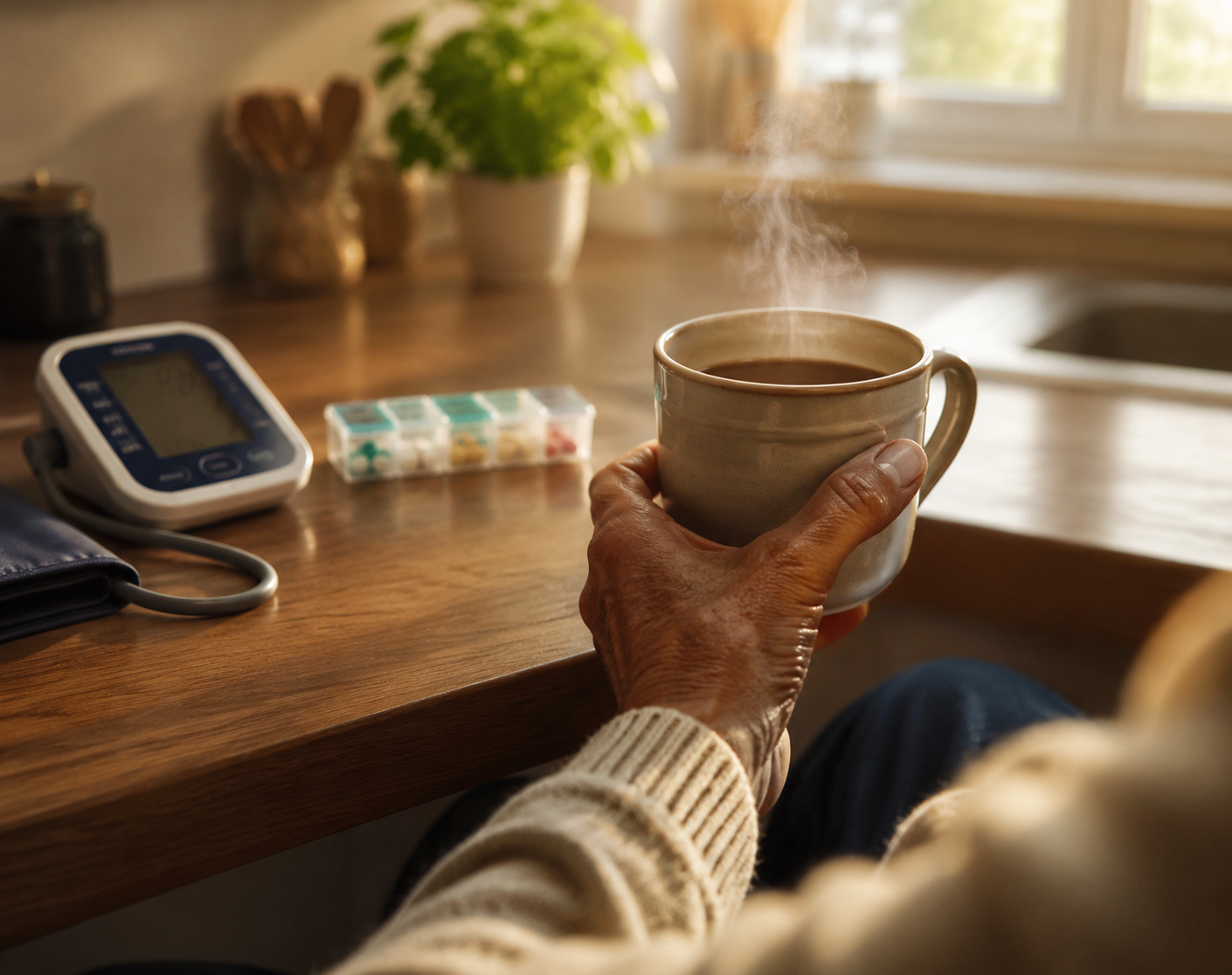
For an older adult with hypertension, the best question is not “Is coffee heart-healthy?” It is “What are the actual home blood pressure readings, and are they controlled enough that the usual coffee evidence applies?” That difference matters because a parent whose readings are commonly near 130s or 140s over 70s or 80s is not in the same situation as a parent who keeps showing numbers around 160/100 mm Hg.
The most directly useful study for families caring for older adults with hypertension used NHANES data in adults age 65 and older. In that group, 200 to 300 mg of caffeine a day was associated with a 30% lower risk of all-cause mortality and a 45% lower risk of cardiovascular mortality compared with less than 10 mg a day.[2] This does not prove that coffee caused the lower risk, and it does not mean every hypertensive older adult should start drinking coffee. It does mean families should stop assuming that a stable coffee habit is automatically dangerous just because a parent has high blood pressure.
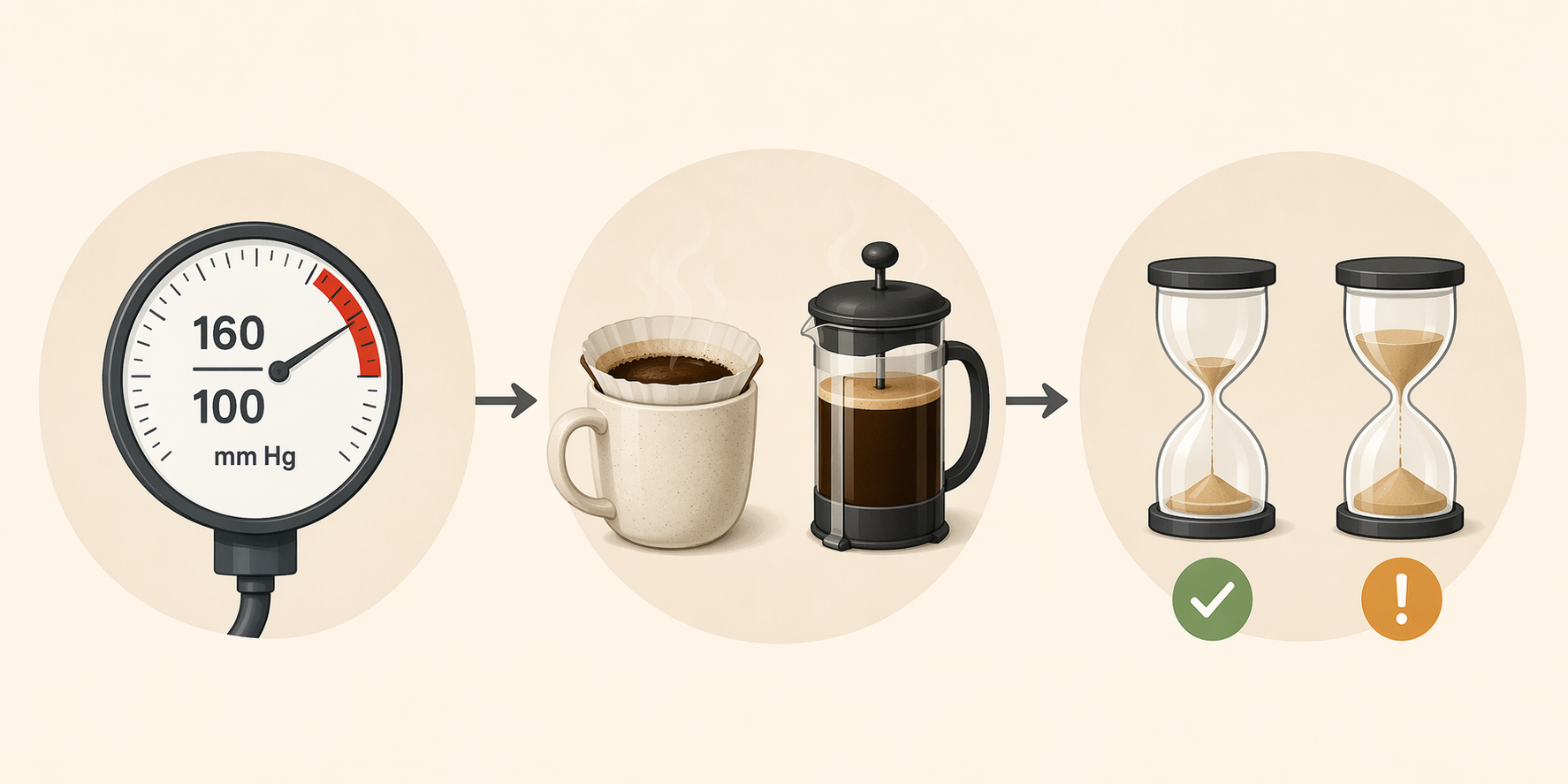
There is also a hard exception. In an AHA-reported study of more than 18,600 adults, people with severe hypertension — defined as blood pressure at or above 160/100 mm Hg — who drank 2 or more cups of coffee daily had double the risk of cardiovascular disease death. One cup a day did not show increased risk at any blood pressure level in that finding.[3]
| What you see at home | What to do with the coffee routine |
|---|---|
| Blood pressure is not severely uncontrolled, coffee intake is moderate, and symptoms are stable | A ban is usually not necessary; keep intake consistent and monitor the parent’s real response |
| Readings are around or above 160/100 mm Hg | Pause the 2-or-more-cups routine and ask the clinician before continuing unchanged |
| Blood pressure jumps noticeably after coffee | Measure, write it down, and discuss dose, timing, and medication interactions with the care team |
| The parent drinks very large mugs, strong coffee, or coffee shop drinks | Estimate caffeine in milligrams rather than assuming each mug equals one research cup |
The uncomfortable part is that families often remember the comforting half of the evidence and miss the exception. A parent with a long coffee habit and a blood pressure log full of severe readings is not the same as a parent whose hypertension is treated and stable. If the cuff is giving numbers near 160/100, the coffee question belongs in the same conversation as medication adherence, missed doses, pain, decongestants, salt intake, sleep, and whether the blood pressure plan needs to be changed.
AFib Does Not Automatically Mean No Coffee
Atrial fibrillation changes the coffee conversation, but not in the way many families expect. The 2023 ACC/AHA/ACCP/HRS guideline for AFib states that abstaining from caffeine to prevent heart rhythm disturbances is of no proven benefit.[4] That guideline language matters more than the reflex to clear the kitchen of coffee after an AFib diagnosis.
This does not mean caffeine is invisible to the heart. Some people feel more palpitations after coffee. Some sleep worse, and poor sleep can make rhythm problems harder to live with. Some are taking medications where timing, hydration, appetite, or side effects need attention. But for an older adult with AFib who has always tolerated a modest morning cup, the evidence does not support a blanket household rule that coffee must disappear.
Newer AFib research adds support, with caution. In the DECAF trial, 200 adults with AFib, with an average age of 69, who drank coffee daily had 39% lower AFib recurrence.[5] That result is interesting, but it should not be stretched into advice for a non-coffee-drinker to start coffee as treatment. The study concerned people who already habitually drank about a cup a day, and it does not replace individualized cardiology advice.
Another AHA-reported study, Swiss-AF, followed more than 2,400 people with AFib with an average age of 73. Drinking 5 or more cups a day was associated with cognitive test results corresponding to 6.7 years younger cognitive age and more than 20% lower inflammatory markers.[6] That is relevant to families watching both heart rhythm and memory, but it is still observational and was not conducted in a U.S. population. It cannot tell a caregiver that more coffee is automatically better for their own parent.
Filtered Coffee Is the Safer Default
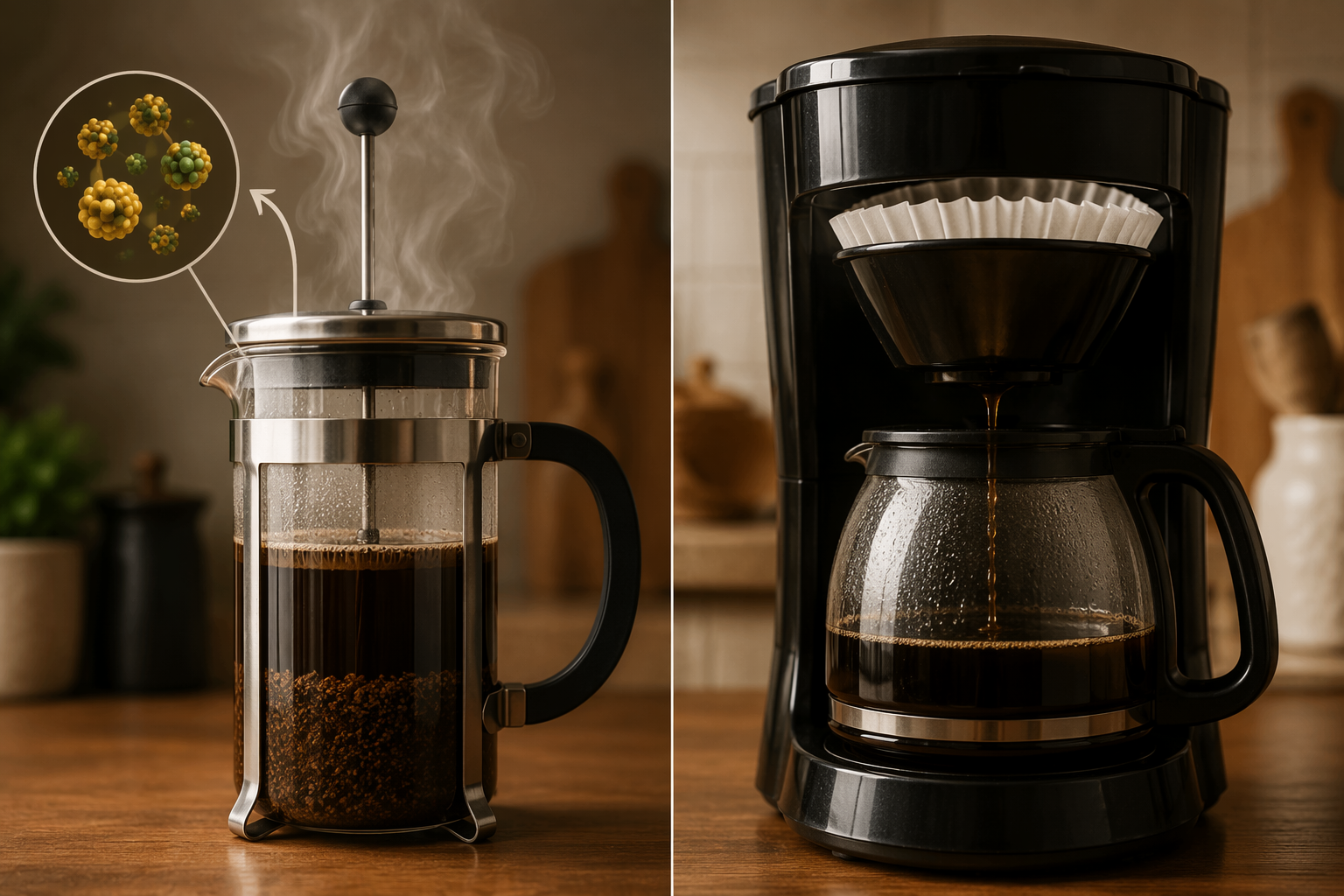
Once blood pressure and rhythm symptoms are considered, brewing method is the next practical check. French press, boiled coffee, Scandinavian-style coffee, and Turkish coffee are unfiltered methods. They leave more cafestol and kahweol in the drink, compounds that can raise LDL cholesterol. Paper-filtered drip coffee traps much of those diterpenes before the coffee reaches the cup.
For a parent with high cholesterol, coronary artery disease, prior heart attack, stroke risk, or several cardiovascular risk factors, this is one of the easiest changes to make without taking away the ritual. Keep the morning coffee, but switch the preparation to a paper-filtered method. That preserves the routine while removing a known cholesterol concern.
The Same Mug Can Affect Two Parents Differently
Caffeine metabolism is another reason not to turn study averages into rigid household law. The CYP1A2 enzyme helps determine how quickly a person clears caffeine, and about 59% of the population are slow metabolizers. In slower metabolizers, caffeine may affect blood pressure differently and may linger longer into the day.
Most families do not need genetic testing to make a sensible coffee decision. They need a short observation period. If the parent’s blood pressure is acceptable before coffee and rises sharply afterward, or if coffee reliably brings palpitations, shakiness, anxiety, reflux, or poor sleep, that parent is giving useful information. If nothing changes except that the parent enjoys breakfast more, that is useful information too.
Use milligrams when possible. A small home-brewed cup may fit comfortably within the moderate range; a large, strong coffee shop drink may carry far more caffeine than the family imagines. Decaf is also not always caffeine-free, but it can be a reasonable step-down option when a parent wants the taste and routine without the full stimulant load.
What About Heart Failure and Coronary Disease?
The broader heart-health literature is generally reassuring about habitual coffee drinking, especially when coffee is plain rather than loaded with sugar and cream. In an analysis using Framingham data, drinking at least 1 cup a day was associated with 43% lower coronary heart disease-related deaths in older adults.[7] Again, that is association rather than proof that coffee caused the benefit.
For a parent with heart failure, the practical question is usually less about coffee as an isolated food and more about the whole morning pattern: fluid limits if prescribed, diuretic timing, appetite, weight changes, sleep, blood pressure, and symptoms such as shortness of breath or swelling. A moderate, filtered coffee habit may be acceptable for many people, but heart failure plans can be very individualized. If the care team has given fluid or rhythm-specific instructions, those instructions outrank a general coffee article.
A Caregiver’s Morning Check
A useful rule should fit on the same page as the medication list. Before changing a parent’s long-standing coffee routine, check the few items that actually change the risk calculation.
- Blood pressure: If readings are around or above 160/100 mm Hg, do not treat 2 or more cups a day as routine until the clinician weighs in.
- Amount: Translate the usual mug into estimated caffeine, aiming roughly for the moderate range rather than relying on cup count.
- Brewing method: Prefer paper-filtered coffee when cholesterol or cardiovascular risk is a concern.
- Symptoms: Watch for palpitations, unusual heart racing, tremor, anxiety, reflux, dizziness, or sleep disruption after coffee.
- Medication fit: Ask about coffee timing if the parent takes heart rhythm drugs, blood pressure medicines, diuretics, thyroid medication, stimulants, or medications with strict absorption instructions.
A simple home trial can be more useful than family arguing. For several mornings, measure blood pressure before coffee and again after the usual cup, using the same cuff, posture, and timing as consistently as possible. Write down the amount, brew method, symptoms, sleep quality, and any missed medications. Bring that log to the clinician instead of bringing a vague report that coffee “seems fine” or “must be bad.”
Green tea is worth one small note because it reminds us not to blame or praise caffeine alone. In the severe hypertension research, green tea did not show the same increased cardiovascular death risk seen with 2 or more cups of coffee in people at or above 160/100 mm Hg.[3] That may mean coffee’s effects involve more than caffeine, including other compounds in the drink. It does not mean green tea is automatically the right substitute for every parent, especially if caffeine sensitivity, sleep, reflux, or medication timing is part of the problem.
When to Ask Before the Routine Continues
Some coffee decisions should not be settled at the breakfast table. Ask the clinician before continuing the same routine if your parent has repeated readings around or above 160/100 mm Hg, new or worsening palpitations, fainting, chest pain, unexplained shortness of breath, severe insomnia, a recent hospitalization for heart failure or rhythm problems, or a clear blood pressure surge after caffeine.
Also ask if the parent recently started, stopped, or changed heart medications. Families sometimes blame coffee for symptoms that began with a medication change, or they miss that caffeine, dehydration, poor food intake, and diuretics are all landing in the same morning window.
If blood pressure is not severely uncontrolled, the coffee is filtered, intake stays moderate, and the parent tolerates caffeine without worsening symptoms, coffee usually does not need to be banned. If the numbers are near 160/100, the mug is very large, the coffee is unfiltered, or the parent’s body clearly reacts badly, the safer answer is not a family-wide decree. It is a measured pause, a written log, and individualized medical guidance before the routine continues unchanged.
References
- Caffeine and Heart Disease, American Heart Association.
- Association of caffeine intake and mortality in elderly patients with hypertension: a cohort study, Frontiers in Nutrition, 2022.
- Drinking 2 or more cups of coffee daily may double risk of heart death in people with severe hypertension, American Heart Association Newsroom, December 2022.
- 2023 ACC/AHA/ACCP/HRS Guideline for the Diagnosis and Management of Atrial Fibrillation, Circulation, 2023.
- Cup of coffee a day may not be harmful for some adults with AFib, American Heart Association Newsroom.
- Drinking coffee may help prevent mental decline in people with atrial fibrillation, American Heart Association Newsroom, December 2024.
- Association Between Coffee Intake and Incident Heart Failure Risk: A Machine Learning Analysis of the FHS, the ARIC Study, and the CHS, Circulation: Heart Failure, 2021.
Questions to bring to a clinician or OT
This is not medical, legal, or a family's final decision — only a framework. Bring these questions to a clinician, occupational therapist, or your local Area Agency on Aging.
Find Local HelpRelated reading
Noticed something outdated or inaccurate on this page? Flag a correction. We review every report against CDC, NIA, and AARP HomeFit guidance before updating a page.