
Caregiver decision guide
Protect Your Aging Parent from Cruise Ship Norovirus
Norovirus outbreaks on cruise ships are a real concern for older adults, but with the right preparation, hand hygiene, and response plan, caregivers can significantly lower the risk. This guide covers pre-cruise medical steps, smart food choices, early symptom recognition, and what to do if your parent gets sick at sea.
The uneasy moment usually comes before the suitcase is closed: the cruise is paid for, the medications are counted out, your parent is looking forward to dinner by the water, and then another headline says norovirus is spreading on cruise ships. That does not make you irresponsible for going. It does mean the safety plan for an older adult has to be more specific than “wash your hands and be careful.”
Cruise ship norovirus outbreaks are real. CDC Vessel Sanitation Program data recorded 23 gastrointestinal illness outbreaks on cruise ships in its jurisdiction in 2025, the highest annual count in more than a decade, and multiple additional outbreaks had already been posted for 2026 by June.[1] The same CDC program notes that norovirus is the most common cause of acute gastroenteritis on cruise ships, though its public outbreak pages cover only ships in VSP jurisdiction, not every ship sailing anywhere in the world.[1]

For seniors, the part that deserves the most attention is not the stomach bug as an abstract threat. It is what vomiting and diarrhea can do to an older body over a short window of time. Dr. Samuel Mathis of the University of Texas Medical Branch told AARP that dehydration is the biggest norovirus risk for older adults, more than the virus itself.[2] That single point changes the packing list, the pre-cruise phone calls, and the threshold for asking the ship’s medical team for help.
Calibrate the Risk Without Waving It Away
Norovirus spreads easily because a very small amount of virus can make someone sick, and cruise conditions give it what it likes: shared dining, shared surfaces, close quarters, and people moving through the same elevators, railings, restrooms, and buffet areas. A ship also concentrates the consequence. If your parent gets sick at home, you can call their doctor, use their usual pharmacy, and decide whether urgent care is needed. At sea, you are working through the ship’s medical center, the itinerary, and whatever health history you remembered to bring.
The cruise industry often points to a lower individual risk. CLIA has cited odds of roughly 1 in 5,500 passengers developing laboratory-confirmed norovirus during a ship outbreak.[3] That figure is useful for fear calibration, but it should not be stretched into “there is nothing to worry about.” It is industry-sourced, it refers to lab-confirmed norovirus during outbreaks, and it does not capture every upset stomach that is never tested or reported.
The better conclusion is narrower and more useful: most cruise passengers will not get norovirus, but an older adult who does get it can run into trouble faster if fluid loss is not recognized and managed early.
Before You Board, Make the Medical Plan Boringly Specific
The safest norovirus plan starts before the cruise because the hardest decisions are not made well at 2 a.m. in a small cabin bathroom. For an older adult, the pre-cruise question is not only “How do we avoid getting sick?” It is also “If vomiting or diarrhea starts, what would make dehydration dangerous for this particular person?”
Call your parent’s clinician before departure, especially if your parent takes a diuretic, an ACE inhibitor, or medicines for diabetes, chronic kidney disease, congestive heart failure, or blood pressure. The call does not need to be dramatic. Ask what symptoms should trigger medical attention, whether any medication instructions change during significant vomiting or diarrhea, and whether oral rehydration solution is appropriate for your parent. Do not create your own “sick day” medication rules unless the clinician gives them.
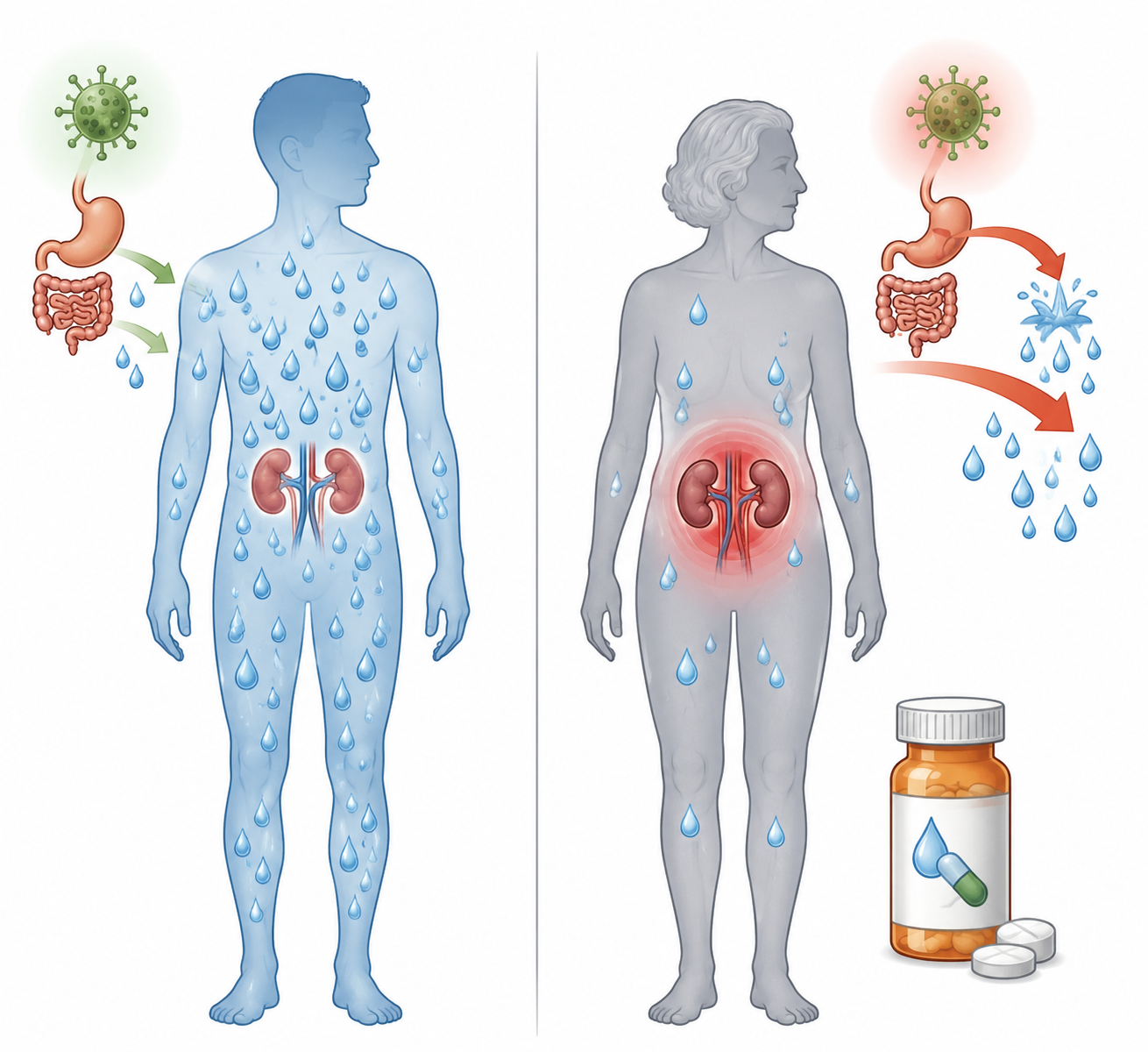
This is where many generic cruise tips fail older adults. “Drink more fluids” sounds simple until your parent has heart failure and has been told not to overdo fluids, or has kidney disease, or takes a water pill, or uses insulin and cannot keep food down. The point of the clinician call is to replace guesswork with a short written plan.
- Write the ship medical center threshold in plain language: repeated vomiting, frequent diarrhea, dizziness, confusion, fainting, inability to keep fluids down, reduced urination, blood in stool, fever, or worsening weakness.
- Bring a current medication list with doses, not just pill bottles or a phone photo.
- Pack oral rehydration solution packets if the clinician agrees they are appropriate.
- Ask whether any medical conditions make dehydration, electrolyte imbalance, or blood sugar swings more dangerous.
- Decide in advance who will call the ship medical center if your parent wants to “wait and see.”
That last item matters. Many older adults underreport symptoms because they do not want to spoil the trip, miss an excursion, or be confined to the cabin. Respecting their autonomy does not mean pretending the risk is the same for everyone. It means agreeing ahead of time which symptoms are private inconveniences and which ones are medical information the ship needs.
Choose the Cruise With Recovery in Mind, Not Just the Brochure
If the trip is not yet booked, ship and itinerary choices can make caregiving easier. CDC analysis of 252 ships from 2006 through 2019 found higher acute gastroenteritis rates on larger ships and on voyages longer than seven days.[4] That does not mean every large ship or longer sailing is unsafe. It does mean a caregiver planning for an older adult may reasonably prefer a shorter itinerary, a cabin location that is easy to reach, and a ship where medical services and dining logistics are clear before boarding.
| Planning choice | Why it matters for an older adult |
|---|---|
| Shorter itinerary when possible | Less time in a closed travel environment if gastrointestinal illness begins circulating |
| Cabin near elevator but not in the loudest traffic area | Easier bathroom access and medical-center trips if weakness or dizziness develops |
| Travel insurance with medical and evacuation details reviewed | Fewer decisions made under pressure if symptoms become severe |
| Accessible dining alternatives | Less dependence on crowded buffet timing |
Real outbreaks are not just theoretical. CruiseMapper’s 2025 illness log includes named ships and case counts, including a Coral Princess outbreak affecting more than 80 passengers.[5] A single entry does not tell you what will happen on your sailing, but it is enough to justify doing the dull preparation before anyone is tired, nauseated, or embarrassed.
Hand Sanitizer Is Not the Main Defense
This is the habit to get right: hand sanitizer does not reliably kill norovirus. It may be useful for some germs when soap and water are not available, but it should not be the family’s main norovirus strategy. For norovirus, the practical defense is scrubbing with soap and water, especially before eating and after using the restroom.
On a cruise, that means building handwashing into movement, not treating it as a moral reminder. Wash before entering the dining room. Wash after touching buffet utensils. Wash after the casino, theater, elevator buttons, railings, and public restrooms. Wash again before handling pills, dentures, glucose supplies, eye drops, or snacks in the cabin.
If your parent has arthritis, balance problems, low vision, or mild cognitive changes, hand hygiene may need logistics, not lectures. Choose the restroom with the easier sink. Carry a small towel or tissues if air dryers are hard to use. Stand with them in line for the sink before meals rather than asking afterward whether they washed well. The goal is not to police them; it is to make the safest action the easiest action.
Buffets Need a Little Strategy
Food choices cannot eliminate norovirus risk, because norovirus can spread from surfaces and person to person as well as through contaminated food. Still, dining habits matter because buffet service creates many shared touchpoints.
- Prefer staffed service lines when available, especially during busy meal periods.
- Avoid reaching into shared bread, garnish, or snack areas with bare hands.
- Use a fresh plate for every trip through the buffet.
- Skip food that looks handled, picked over, or poorly protected.
- Wash hands after using shared serving utensils and before eating.
For a parent with diabetes, limited appetite, swallowing issues, or dietary restrictions, do not let norovirus worry turn meals into a battle. The safer approach is predictable food, cleaner handling, and enough fluid intake for that person’s medical situation. A hungry, tired older adult who skips meals all day and then eats quickly in a crowd is not being protected.
Watch for the First Signs, Then Act Earlier Than You Would at Home
Norovirus often starts abruptly. Vomiting, watery diarrhea, stomach cramps, and nausea can move a person from “fine at breakfast” to weak by evening. In a younger, healthy adult, the plan may be fluids and rest unless severe symptoms appear. With an older parent, the safer threshold is lower because dehydration can arrive before the family has fully accepted that this is more than a bad meal.
Use your written plan instead of negotiating from scratch. If your parent has repeated vomiting or diarrhea, cannot keep fluids down, becomes dizzy, seems confused, urinates much less than usual, develops blood in stool, or looks suddenly frail, call the ship medical center. If they have kidney disease, heart failure, diabetes, or take medications that affect fluids, blood pressure, or blood sugar, do not wait until everyone is frightened.
The ship also needs illness reporting for outbreak control. A parent may hear “report it” as “I will be punished by missing the cruise.” A caregiver can reframe it more honestly: reporting symptoms is how the medical team helps with dehydration risk and how the crew knows whether extra sanitation and isolation steps are needed.
If Symptoms Start in the Cabin
- Stop group activities and keep your parent in the cabin while you assess symptoms.
- Call the ship medical center if symptoms meet the plan you wrote before travel.
- Offer small, frequent sips of the clinician-approved fluid rather than large amounts at once.
- Track vomiting, diarrhea, fluid intake, urination, dizziness, confusion, and blood sugar if relevant.
- Do not give anti-diarrheal or anti-nausea medication unless a clinician or ship medical staff says it is appropriate for your parent.
- Use gloves or careful barriers if cleaning, wash hands thoroughly afterward, and keep contaminated laundry or towels separate until crew instructions are clear.
This is the unglamorous part of cruise caregiving: counting bathroom trips, coaxing sips, changing towels, and deciding whether “a little weak” is becoming “medically concerning.” It is also where preparation protects the trip. The earlier the medical team knows, the more room there is to manage fluid loss before it becomes an emergency.
Cabin Cleaning Is Not the Same as Normal Tidying
If vomiting or diarrhea happens in the cabin, do not treat it like ordinary mess. Norovirus can spread easily from contaminated surfaces, and casual wiping may move contamination around. Notify the ship staff and follow their cleaning instructions. They should have protocols and disinfectants suited to gastrointestinal illness; your travel-size scented wipes are not a norovirus control plan.
For the caregiver, the priority is to reduce contact while still helping. Keep the sick person’s towels, clothing, and bedding separate. Wash your own hands with soap and water after every cleanup, after touching laundry, and before touching your face, food, medications, phone, or cabin surfaces. If you become sick too, report your own symptoms rather than trying to power through the itinerary.
A Short Caveat About Outbreak Lists and Accountability
Public outbreak lists are useful, but they are not a complete map of every gastrointestinal illness at sea. CDC’s Vessel Sanitation Program covers ships in its jurisdiction, including international voyages with U.S. port stops, so ships sailing entirely outside that system are not represented in the same way.[1] Food Poison Journal, a publication connected to a law firm that represents foodborne illness plaintiffs, also reported that April 2025 HHS staffing cuts affected the Vessel Sanitation Program before some positions were partially restored, leaving uncertainty about the impact on inspection and outbreak work.[6]
That context should make families attentive, not helpless. It is also worth knowing that maritime law can shorten the window for certain cruise-related claims; Food Poison Journal notes a one-year window under 46 U.S.C. § 30508.[6] Most families reading this are not planning litigation. They are trying to keep a parent safe. Still, if a serious illness occurs, save medical records, communications, receipts, and photos instead of assuming everything can be reconstructed later.
The Plan That Lets the Trip Stay a Trip
A good norovirus plan for a senior does not need to dominate the vacation. It should fit on one page: medical conditions, medications, clinician guidance, hydration approach, symptoms that trigger a call, and the ship medical center contact process. Keep it with the medication list, not buried in email.
Then let your parent enjoy the cruise. Sit on the deck. Go to dinner. Take the photo. The reason to plan for norovirus is not because every sailing is a disaster waiting to happen. It is because vague worry does not help when an older adult starts losing fluid quickly, and a written plan does.
References
- Outbreaks on Cruise Ships in VSP's Jurisdiction, CDC Vessel Sanitation Program, https://www.cdc.gov/vessel-sanitation/cruise-ship-outbreaks/index.html
- Norovirus Is Rising on Cruise Ships: How to Stay Safe, AARP, https://www.aarp.org/health/conditions-treatments/norovirus-cruise-ships/
- Cruise Industry Norovirus Risk Statistic, CLIA, https://cruising.org/
- Vessel Sanitation Program Frequently Asked Questions, CDC Vessel Sanitation Program, https://www.cdc.gov/vessel-sanitation/faq/index.html
- Cruise Ship Norovirus Outbreaks, CruiseMapper, https://www.cruisemapper.com/wiki/760-cruise-ship-norovirus-outbreaks
- Cruise Ships in 2026: What the CDC's Outbreak List Does — and Doesn't — Tell You, Food Poison Journal, https://www.foodpoisonjournal.com/
Questions to bring to a clinician or OT
This is not medical, legal, or a family's final decision — only a framework. Bring these questions to a clinician, occupational therapist, or your local Area Agency on Aging.
Find Local HelpRelated reading
Noticed something outdated or inaccurate on this page? Flag a correction. We review every report against CDC, NIA, and AARP HomeFit guidance before updating a page.