
Caregiver decision guide
How Much Coffee Is Safe for Seniors With Heart Conditions?
A single daily coffee limit doesn't fit all seniors. Learn how many cups are safe based on your parent's specific heart condition — from hypertension to atrial fibrillation — and why moderate intake may actually protect their heart.
If your parent has a heart condition, the safest coffee limit is not a single number. It depends first on blood pressure control, then on rhythm symptoms, medications, and the kind of coffee sitting in the mug. The general adult caffeine ceiling often quoted in health articles is up to 400 mg per day, but that is too broad to settle the kitchen-table question for an older adult with cardiovascular disease.[1]
A practical starting point is this: for many seniors with controlled hypertension and no concerning rhythm symptoms, 1 to 3 cups of coffee a day can be a reasonable range to discuss with the clinician. For someone whose blood pressure is severely elevated, especially around 160/100 mm Hg or higher, the upper limit should drop sharply; 1 cup is the safer working limit until the treating clinician says otherwise.
| Parent's heart situation | Practical coffee limit to discuss | Why this limit changes |
|---|---|---|
| Well-controlled hypertension, no troublesome palpitations | Often 1-3 cups daily | Senior-specific data found lower cardiovascular mortality around 200-300 mg caffeine per day in elderly hypertensive adults. |
| Severe hypertension, about 160/100 mm Hg or higher | Use 1 cup as the safer upper limit | A Japanese cohort found 2 or more cups daily was linked with doubled cardiovascular death risk in this group. |
| Atrial fibrillation, frequent palpitations, or recent rhythm concern | Individualize with the cardiology team | Coffee studies do not replace symptom tracking, rhythm history, or medication review. |
| High LDL cholesterol or strong cholesterol concern | Prefer paper-filtered coffee | Unfiltered preparations contain far more diterpenes, compounds that can raise cholesterol. |
Blood Pressure Control Is the First Divider
The most useful evidence for an older parent with hypertension comes from a NHANES 2003-2018 analysis of 6,076 elderly hypertensive patients. In that group, caffeine intake of 200-300 mg per day was associated with a 45% lower risk of cardiovascular mortality compared with minimal intake.[2] That amount roughly matches the familiar middle ground of coffee drinking rather than the extremes: not zero coffee, and not a pot that lasts until lunch.
This finding does not mean every hypertensive senior should add coffee. It means that among older adults already living with hypertension, moderate intake was not the danger signal many families fear. For a parent whose blood pressure log is generally controlled, whose clinician has not warned against caffeine, and who drinks coffee as part of a stable routine, 1 to 3 cups is a defensible discussion range rather than something to automatically take away.
The catch is that blood pressure category matters. A study reported by the American Heart Association followed 18,600 Japanese adults and found that among people with severe hypertension, defined as systolic blood pressure of 160 mm Hg or higher or diastolic blood pressure of 100 mm Hg or higher, drinking 2 or more cups of coffee per day was associated with twice the risk of cardiovascular disease death. One cup per day was not associated with elevated risk in that severe-hypertension group.[3]
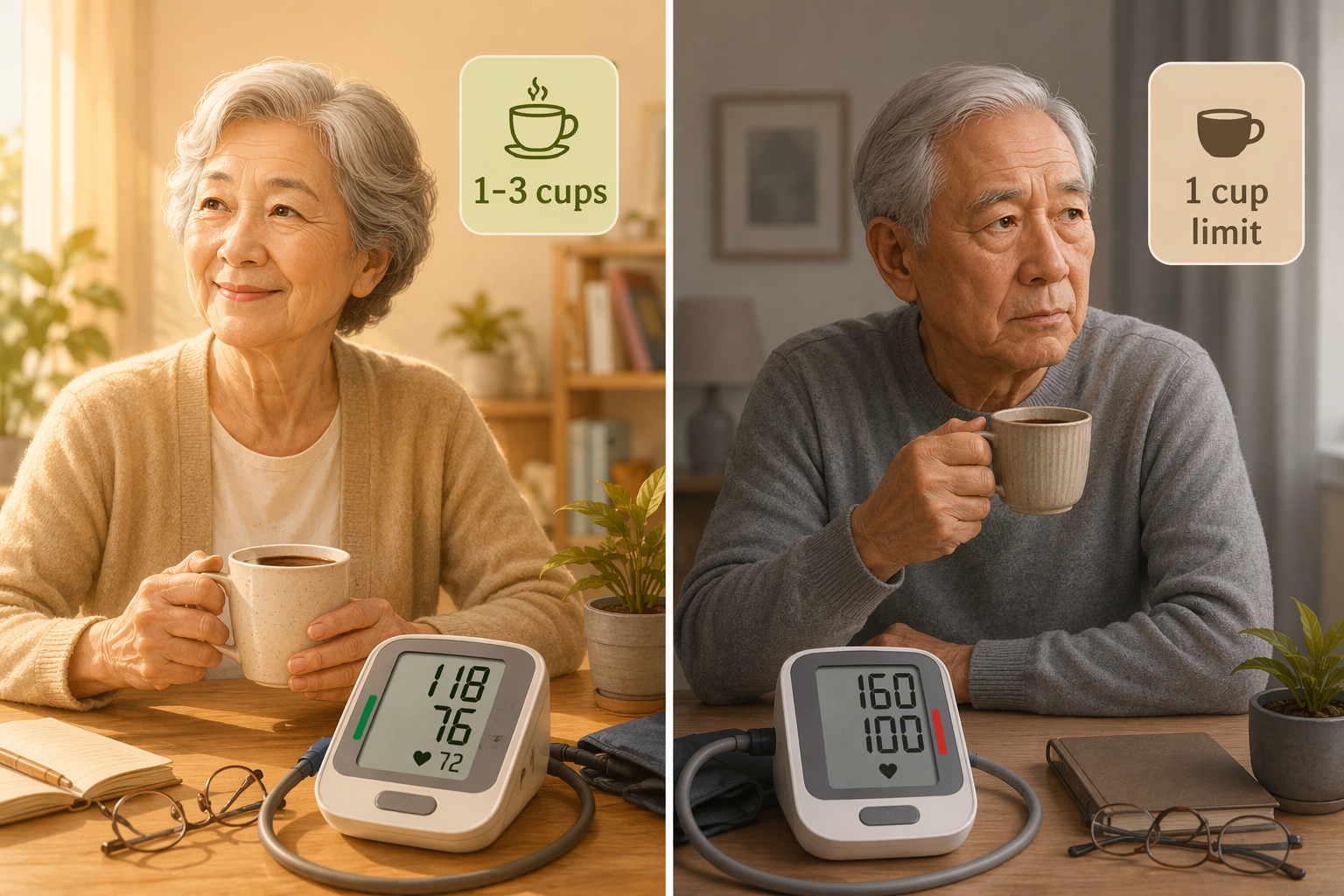
That is the point that changes tomorrow morning. Two cups can sit inside a reasonable range for one older adult and outside the safer range for another. If your parent's recent readings are near 160/100 or above, this is not the moment to average together all the reassuring coffee headlines. Bring the log, the mug size, and the usual number of refills to the clinician; until then, treat 1 cup of caffeinated coffee as the cautious ceiling.
The severe-hypertension evidence also has limits. The cohort was Japanese, enrollment occurred in 1988-1990, coffee intake was self-reported, and preparation habits may not match those of a U.S. senior today.[3] Those caveats do not erase the warning. They keep it in the right place: not as proof that coffee is dangerous for every older adult, but as a strong reason not to apply a casual 2-cup rule to someone with very high blood pressure.
Why Moderate Coffee Often Looks Better Than No Coffee
Several large studies have found a J-shaped pattern: the lowest cardiovascular risk tends to appear at moderate coffee intake, while higher intake does not keep adding benefit and may become a problem for some groups. In older adults from the Framingham Heart Study, coffee consumption was associated with a 43% reduction in coronary heart disease-related deaths.[4] That is supportive evidence, not a universal prescription, because one elderly cohort cannot answer every question about every heart condition.
The NHANES hypertensive-patient data are more useful for this decision because the population is closer to the person many caregivers are asking about: older adults with high blood pressure. Still, the study shows association, not a guarantee that coffee caused the lower mortality. Coffee intake was part of a larger pattern of health, medication use, diet, and daily behavior that observational research cannot fully separate.[2]
So the working interpretation should stay modest. Moderate coffee can remain on the table for many seniors with controlled blood pressure. It should not be turned into a heart treatment, and it should not be protected from review when the blood pressure numbers, symptoms, or medications change.
When Rhythm Symptoms Make the Mug Count Less Simple
Blood pressure is not the only heart issue that matters. If your parent has atrial fibrillation, frequent palpitations, unexplained lightheadedness, recent medication changes, or a recent cardiology warning to limit caffeine, the safe limit cannot be borrowed from hypertension studies. A cup count that looks reasonable on paper can still be wrong for a person who feels their heart race after breakfast.
This is where the caregiver's notes become more useful than a generic rule. Track the time coffee is consumed, approximate amount, blood pressure readings if the clinician requested them, and symptoms such as racing heartbeat, skipped beats, dizziness, chest discomfort, or unusual shortness of breath. The point is not to turn the kitchen into a clinic. It is to make the next appointment concrete enough that the clinician can answer a real question instead of a vague one.
- Ask whether the parent's specific diagnosis requires a caffeine limit, not just a coffee limit.
- Bring the usual mug size, number of refills, and timing of coffee.
- Mention decaf, espresso drinks, tea, soda, and energy drinks separately.
- Report symptoms that occur within a few hours of caffeine.
Coffee Is Not the Same as Caffeine
One common mistake is to treat coffee research as permission for any caffeinated product. Coffee contains caffeine, but its cardiovascular profile also includes other compounds, including polyphenols and chlorogenic acid, that may contribute to observed benefits.[5][6] That is why a coffee-cup limit should not be converted casually into energy drinks, caffeine pills, or large sweetened beverages.
Decaf deserves a more respectful place in this conversation than it usually gets. If caffeine pushes a parent's blood pressure up, worsens tremor, interferes with sleep, or seems to trigger palpitations, decaf may preserve the morning ritual while reducing the stimulant load. It is not pointless just because it is not fully caffeinated; some of coffee's non-caffeine compounds remain relevant.
The FDA-style 400 mg caffeine number can still be useful as a ceiling for healthy adults, but it is not the number to lead with when a parent has severe hypertension, arrhythmia symptoms, or complicated medication management.[1] For those situations, the better question is not, "How much caffeine is generally allowed?" It is, "What amount fits this person's diagnosis and current control?"
The Brewing Method Matters Most for Cholesterol
For seniors with coronary artery disease risk, high LDL cholesterol, or a clinician already watching cholesterol closely, paper-filtered coffee is the safer default. The reason is not caffeine. It is diterpenes, coffee compounds that are much higher in boiled or unfiltered coffee than in paper-filtered coffee. One review reported about 7.2 mg of diterpenes per cup in boiled coffee compared with about 0.02 mg per cup in paper-filtered coffee.[5]
That does not require a complicated brewing lesson. If your parent uses a drip machine with a paper filter, that already points in the safer direction for cholesterol. If they drink French press, boiled coffee, or other unfiltered styles every day, it is worth asking whether a filtered version would keep the ritual while removing one avoidable cholesterol concern.
A Caregiver-Ready Rule for Tomorrow Morning
Start with the blood pressure log, not the coffee headline. If your parent's hypertension is controlled and there are no rhythm symptoms or clinician warnings, 1 to 3 cups of coffee a day is a reasonable range to bring to the care team, with the strongest senior-specific signal around 200-300 mg caffeine per day.[2] If readings are around 160/100 mm Hg or higher, use 1 cup of caffeinated coffee as the safer upper limit and ask directly whether even that should be reduced.[3]
If palpitations, atrial fibrillation concerns, poor sleep, medication changes, or blood pressure spikes enter the picture, stop treating the cup count as settled. Consider decaf, switch to paper-filtered coffee when cholesterol is a concern, and write down what your parent actually drinks before the next appointment. The goal is not to take away a familiar morning pleasure by default. It is to keep the pleasure inside a limit that matches the heart condition your parent actually has.
References
- Caffeine: How much is too much? Mayo Clinic.
- Association of caffeine intake and all-cause and cause-specific mortality in elderly patients with hypertension. Frontiers in Nutrition. 2022.
- Drinking 2 or more cups of coffee daily may double risk of heart death in people with severe hypertension. American Heart Association. 2022.
- Does coffee help or harm your heart? Harvard Health Publishing.
- Coffee and its effects on the cardiovascular system. Ochsner Journal.
- Coffee, caffeine and heart disease. Victor Chang Cardiac Research Institute.
Questions to bring to a clinician or OT
This is not medical, legal, or a family's final decision — only a framework. Bring these questions to a clinician, occupational therapist, or your local Area Agency on Aging.
Find Local HelpRelated reading
Noticed something outdated or inaccurate on this page? Flag a correction. We review every report against CDC, NIA, and AARP HomeFit guidance before updating a page.