
Caregiver decision guide
When Coffee Helps Seniors' Hearts — and When It Doesn't
Learn how moderate morning coffee consumption may lower heart disease risk in seniors, and when medication interactions or blood pressure status require caution — a practical framework for family caregivers.
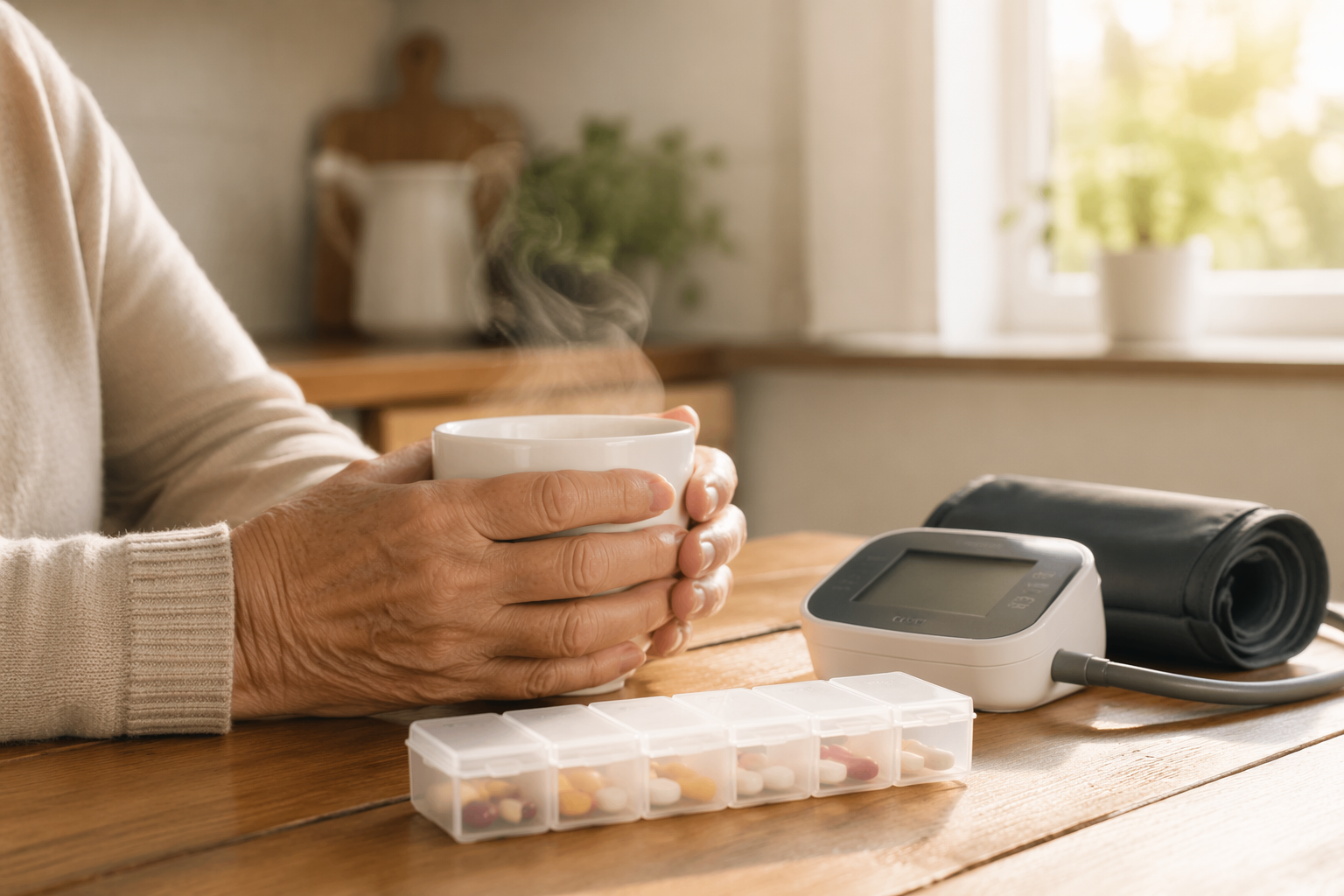
The coffee question rarely shows up as an abstract heart-health debate at home. It shows up at 7 a.m., next to a pill organizer, a blood pressure cuff, and a parent who has had the same mug for years. For many seniors, coffee intake and heart disease prevention can fit together well. The safer answer, though, is not simply “coffee is good” or “coffee is bad.” It is more like this: moderate coffee, mostly in the morning, preferably filtered, and matched to the person’s blood pressure and medication schedule.
That may sound fussy until the morning routine is the thing you are trying to protect. A recent study of 40,725 U.S. adults found that people who drank coffee in the morning had 31% lower cardiovascular disease mortality and 16% lower all-cause mortality compared with non-drinkers, while people who drank coffee throughout the day did not show a significant mortality benefit.[1] The study was observational and the timing finding still needs confirmation, but it gives caregivers something unusually practical: if coffee stays, keeping it earlier in the day may matter.
The amount matters too. In a study of 6,076 older adults with hypertension from NHANES 2003–2018, caffeine intake of 200–300 mg per day, roughly the amount in about 2–3 cups of coffee, was associated with 45% lower cardiovascular mortality and 30% lower all-cause mortality compared with less than 10 mg per day.[2] The useful part is the condition attached to that result: the benefit was significant in older hypertensive adults whose blood pressure was well controlled, not in those whose blood pressure was poorly controlled.[2]
The Practical Middle Ground: Morning, Moderate, Monitored
For a senior who enjoys coffee and is not having symptoms from it, the best-supported everyday pattern is fairly plain: about 2–3 cups, earlier in the day, with blood pressure under reasonable control. This is not a prescription for coffee as medicine. The evidence linking coffee with lower cardiovascular mortality is observational, so it cannot prove that coffee itself prevents heart disease. But the pattern is consistent enough that automatically taking coffee away from an older adult who enjoys it can be just as thoughtless as ignoring obvious warning signs.
A broad review of coffee and cardiovascular health describes a J-shaped pattern in which moderate intake is generally associated with lower cardiovascular risk than either no intake or high intake, and it notes meta-analytic findings in which about 2.5 cups per day was linked with the lowest cardiovascular mortality risk.[3] That does not mean every senior should aim for 2.5 cups. It means that, when a family is deciding whether the daily mug is helping or hurting, moderate intake has better support than all-day sipping or very high caffeine use.
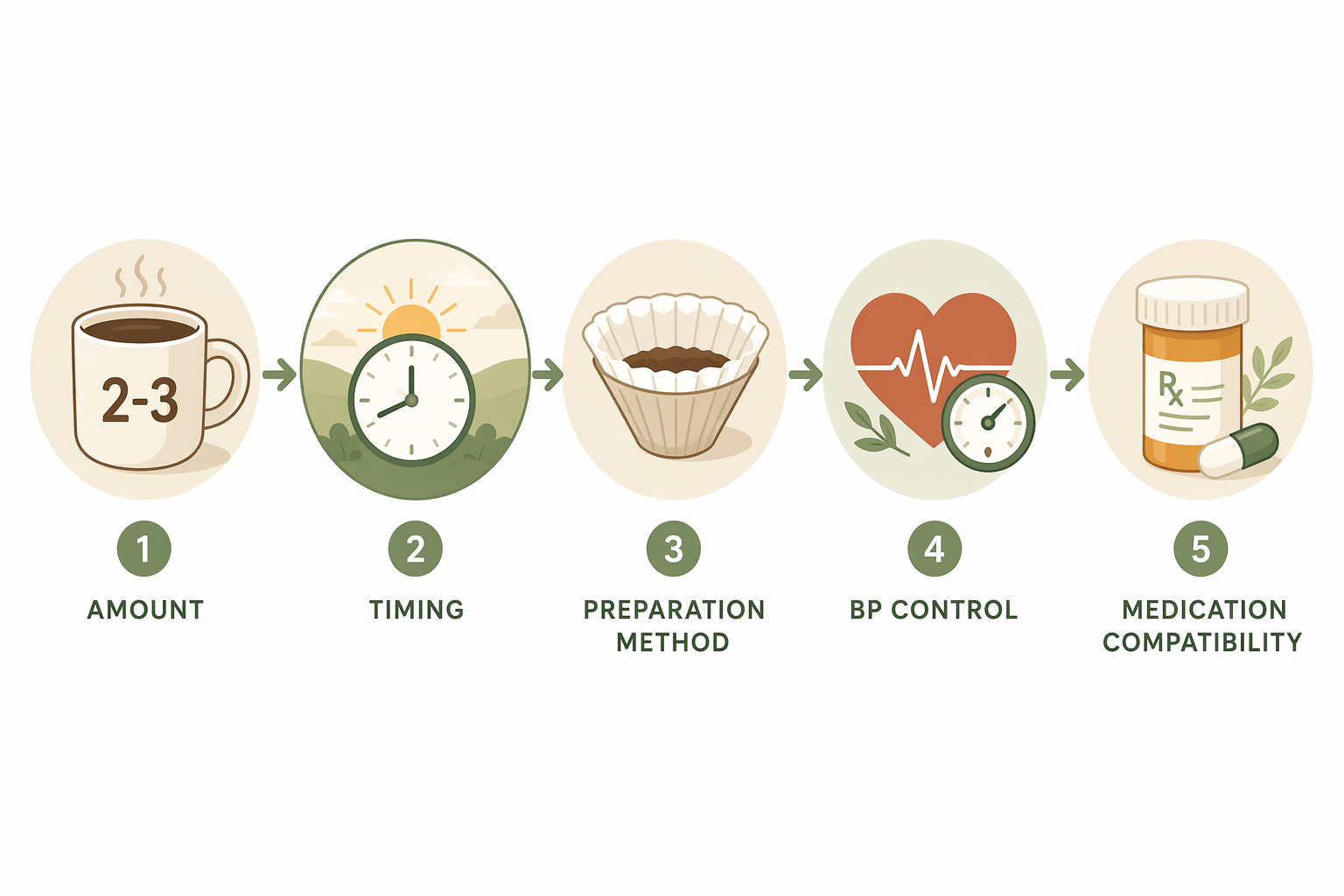
| Caregiver Check | What To Look For | Why It Matters |
|---|---|---|
| Amount | Usually about 2–3 cups daily, or roughly 200–300 mg caffeine | This is the range linked with lower mortality in older hypertensive adults with controlled blood pressure |
| Timing | Mostly morning, not spread across the whole day | Morning coffee drinkers showed lower cardiovascular and all-cause mortality in the timing study |
| Preparation | Filtered coffee when cholesterol is a concern | Paper filters remove much more of the coffee compounds that can raise cholesterol |
| Blood pressure | Home readings are stable and the clinician considers BP controlled | The hypertensive-senior benefit was seen in well-controlled BP, not poorly controlled BP |
| Medication schedule | Coffee is separated from medicines that interact with it | Some interactions are large enough to change treatment effectiveness |
Why Morning Coffee Looks Different From All-Day Coffee
Morning coffee is easier to fit around sleep, blood pressure tracking, and medication timing. All-day coffee is harder to judge because it can become background caffeine: a cup with breakfast, a refill midmorning, iced coffee in the afternoon, then maybe tea or cola without anyone counting it. For an older adult, that matters because caffeine clearance slows with age; seniors over 65 take about 33% longer to clear caffeine than younger adults.[4]
Slower clearance does not make coffee unsafe by itself. It does mean an afternoon cup can still be doing its work at bedtime. Poor sleep can make the next morning harder, and a rough morning often leads to extra caffeine, missed exercise, late medications, or another skipped blood pressure check. Those are not dramatic heart events, but they are exactly how a household routine starts working against itself.
The American Heart Association notes that moderate coffee intake appears safe for most people, while individual tolerance varies.[5] That last phrase is not a throwaway. In a senior who gets palpitations, tremor, anxiety, reflux, insomnia, or a noticeable blood pressure rise after coffee, the population average is less important than the reaction sitting at the kitchen table.
Filtered Coffee Is the Cleaner Choice for Cholesterol-Conscious Seniors
Preparation method deserves a place in the decision, especially for seniors managing cholesterol. The issue is not whether the coffee is dark roast, single-origin, or fashionable. It is whether the brew leaves in more cafestol and kahweol, coffee compounds known as diterpenes that can raise cholesterol.
Filtered coffee keeps most of those compounds out of the cup. One cardiovascular review reports about 0.02 mg of cholesterol-raising diterpenes per cup in filtered coffee compared with about 7.2 mg in boiled or unfiltered coffee.[3] For a senior whose clinician is already watching LDL cholesterol, that is a meaningful difference and an easy adjustment: use a paper filter more often, and treat French press, boiled coffee, or other unfiltered styles as something to discuss if cholesterol is difficult to control.
This is also where decaf can be useful. Decaf is not automatically “heart healthy,” and it can still interact with routines because it is still coffee. But for someone who loves the taste and ritual while becoming jittery or sleepless from caffeine, switching part of the day’s intake to decaf may preserve the habit without pushing total caffeine higher.
Blood Pressure Control Changes the Answer
The Chen study is useful because it does not treat all older adults with hypertension as one group. Moderate caffeine intake was associated with lower cardiovascular and all-cause mortality among elderly hypertensive patients overall, but the cardiovascular mortality benefit was significant only when blood pressure was well controlled.[2] That is the kind of distinction families can actually use.
If home readings are usually in the range the clinician wants, coffee does not need to become the first suspect every time the word “heart” comes up. If readings are bouncing, frequently high, or measured only when someone feels unwell, then it is harder to assume the coffee habit is harmless. The point is not to panic over one cup. It is to stop treating coffee as separate from the blood pressure pattern.
High total caffeine is the clearer concern. An American College of Cardiology press release in August 2024 warned that chronic caffeine intake above 400 mg per day may increase heart rate and blood pressure over time.[6] For a senior, that number can arrive quietly: large mugs, strong coffee, energy drinks, caffeinated tea, cola, chocolate, and some over-the-counter products can all add to the total.
- If blood pressure is controlled and coffee is moderate, the evidence supports keeping the habit under observation rather than stopping it by default.
- If blood pressure is poorly controlled, rising, or not being checked consistently, coffee should be part of the medication and lifestyle conversation.
- If coffee causes palpitations, shakiness, chest discomfort, dizziness, or sleep disruption, the person’s reaction outweighs general population findings.
- If total caffeine may be above 400 mg per day, count every source before deciding the morning cup is the problem.
Medication Timing Is Where a Good Habit Can Go Wrong
The biggest morning trap is not the coffee itself. It is coffee taken too close to certain medications. Levothyroxine is the one that deserves special attention because the interaction is large and easy to miss. Coffee can reduce levothyroxine absorption by up to 55% when the medication is taken with coffee or too close to it.[4]
That can turn a normal routine into a confusing lab result. A parent may be taking the thyroid pill every morning exactly as told, yet washing it down with coffee five minutes later. From the caregiver’s side, it looks like adherence. From the body’s side, the dose may not be getting absorbed as expected. If thyroid levels are unstable, fatigue is worsening, or the prescriber keeps adjusting the dose, the coffee timing belongs on the list of things to review.
The fix should come from the prescribing clinician or pharmacist, because medication instructions vary. Many levothyroxine routines involve taking the medication with water and waiting before coffee or breakfast. The practical caregiver move is to bring the actual schedule, not just the medication list: “7:00 thyroid pill, 7:05 coffee, 7:30 breakfast” is more useful than “takes levothyroxine daily.”
Other drug categories also deserve a check, though the issues are not all the same. Coffee and caffeine may complicate routines for people taking anticoagulants, beta-blockers, or certain antidepressants.[4] That does not mean everyone on these medications must stop drinking coffee. It means the pharmacist should know the usual amount and timing, especially if there are new symptoms, new prescriptions, dose changes, or unexplained blood pressure or heart-rate changes.
A Morning Routine That Respects Both Pleasure and Safety
A workable routine does not need to make coffee feel like a medical procedure. It does need to stop pretending that timing is irrelevant. For many families, the safest adjustment is not taking coffee away; it is moving one piece of the morning so the medication can do its job and the coffee can stay.
- Write down the real coffee pattern for three typical days: cup size, refill habits, caffeinated tea, soda, energy drinks, and afternoon coffee.
- Place that pattern beside the medication schedule, especially thyroid medication, heart medicines, blood pressure medicines, anticoagulants, and antidepressants.
- Check whether the usual coffee is filtered or unfiltered, particularly if cholesterol is being treated or monitored.
- Compare coffee days with home blood pressure readings, sleep quality, palpitations, dizziness, and shakiness.
- Bring the schedule to a clinician or pharmacist before making major changes if medications or blood pressure control are uncertain.
The three-day log is not meant to police an older adult. It is meant to replace vague arguments with a shared picture. “You drink too much coffee” often leads nowhere. “Your second mug is at 3 p.m., and you were awake until midnight twice this week” is a different conversation. So is “Your thyroid pill and coffee are five minutes apart; let’s ask whether that timing is a problem.”
When Coffee Is Reasonable to Keep
Coffee is easier to defend when the pattern is moderate and boring. About 2–3 cups in the morning, filtered, no energy drinks layered on top, no late-day caffeine, no palpitations or insomnia, and blood pressure that the clinician considers controlled: that is the scenario where the evidence is most reassuring. In that setting, coffee may be part of a heart-healthy routine, not an exception that has to be confessed.
It still does not replace the basics that actually carry heart care: prescribed medications, blood pressure control, cholesterol management, movement as tolerated, diabetes care when relevant, sleep, and follow-up appointments. Coffee can sit inside that routine. It should not be asked to carry it.
When to Pause and Ask the Clinician or Pharmacist
Some situations call for a pause before reassuring everyone that coffee is fine. The pause does not have to mean stopping forever. It means the coffee habit has enough moving parts that a clinician or pharmacist should help sort the risk.
- The senior takes levothyroxine, especially if coffee follows the pill closely or thyroid lab results have been unstable.
- Blood pressure is poorly controlled, newly rising, or not being measured often enough to know.
- Total caffeine may exceed 400 mg per day, including coffee, tea, soda, energy drinks, and supplements.
- Coffee is associated with palpitations, chest discomfort, tremor, anxiety, dizziness, reflux, or sleep disruption.
- The person takes anticoagulants, beta-blockers, certain antidepressants, or has had recent medication changes.
- Cholesterol is difficult to control and the usual coffee is French press, boiled, or otherwise unfiltered.
The best question is not “Can Dad have coffee?” It is more specific: “He drinks two filtered cups before 10 a.m., takes levothyroxine at 7 a.m., uses a beta-blocker, and his home blood pressure is usually in the range you gave us. Should we change the timing or amount?” That is the kind of question that lets a professional give an answer tied to the person rather than to coffee in general.
The Caregiver’s Bottom Line
Coffee intake and heart disease prevention in seniors is a conditional yes, not a blanket rule. The strongest everyday pattern is moderate morning coffee, preferably filtered, in someone whose blood pressure is controlled and whose medication schedule leaves room for coffee without interfering with treatment. The red flags are just as practical: thyroid medication taken too close to coffee, uncontrolled blood pressure, high total caffeine, unfiltered coffee in someone struggling with cholesterol, and symptoms that show the body is not tolerating the habit well.
If the cup is part of a stable, safe routine, it may be worth preserving. If the routine is working against the medicine or the blood pressure plan, the answer is not guilt. It is timing, dose, preparation, and a pharmacist or clinician who knows the whole morning.
References
- Coffee drinking timing and mortality in US adults — European Heart Journal, 2025.
- Association of caffeine intake with all-cause and cardiovascular mortality in elderly patients with hypertension — Frontiers in Nutrition, 2022.
- Impact of Coffee Consumption on Cardiovascular Health — PMC review.
- The Pros and Cons of Seniors Drinking Coffee – Moderation is Key — Visiting Angels.
- Caffeine and Heart Disease — American Heart Association.
- New Study Finds Chronic High Caffeine Consumption May Heighten Risk for Cardiovascular Disease — American College of Cardiology, August 2024.
Questions to bring to a clinician or OT
This is not medical, legal, or a family's final decision — only a framework. Bring these questions to a clinician, occupational therapist, or your local Area Agency on Aging.
Find Local HelpRelated reading
Noticed something outdated or inaccurate on this page? Flag a correction. We review every report against CDC, NIA, and AARP HomeFit guidance before updating a page.