
Caregiver decision guide
What to Do When a Flood Watch Is Issued for Tahoe Seniors
A flood watch in Lake Tahoe signals a critical window for unhurried preparation. This guide walks seniors and their caregivers through the specific steps to take within the first 24 hours — from managing medications and mobility to securing evacuation routes — tailored to Tahoe's unique rain-on-snow flood risks.
When a flood watch appears on a Tahoe phone, the first job is not to decide whether the forecast will be “right.” A flood watch means conditions are favorable for flooding; the National Weather Service frames it as “Be Prepared.” A flood warning is different: flooding is imminent or already happening, and the instruction changes to “Take Action.” [1]
That distinction matters for older adults because the watch is the usable time. It is when there is still daylight to check icy steps, still enough calm to find the medication list, still time to call the neighbor with the key, and still room on the road before everyone else decides to move. By the time a watch becomes a warning, a senior who needs a walker, oxygen supplies, hearing aids, prescription refills, or help getting into a vehicle may already be behind.
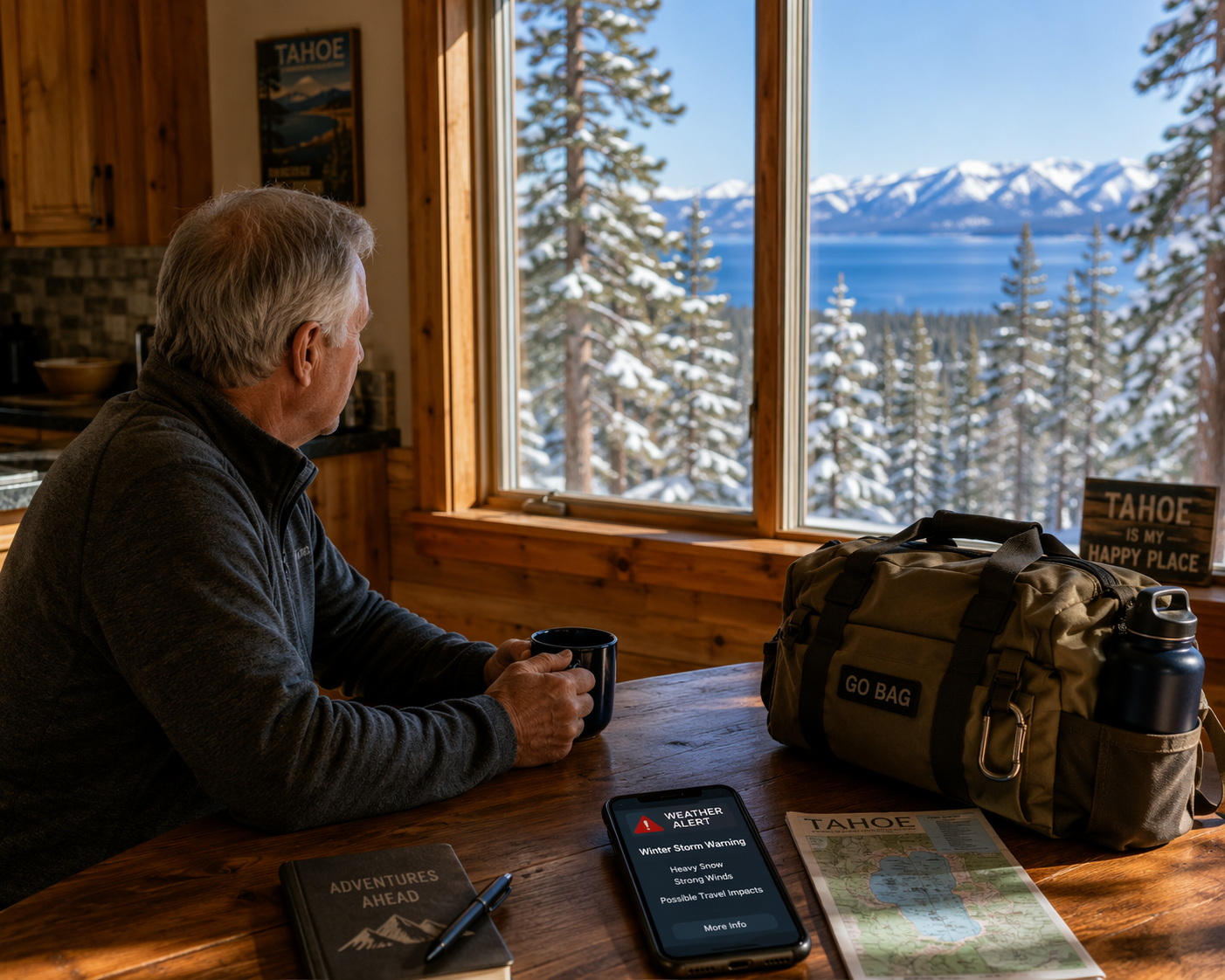
First, translate the alert into a household decision
A flood watch does not mean an older adult must immediately evacuate. It does mean the household should stop treating the day as ordinary. For a senior living alone, a caregiver should make contact early, not at bedtime. For a long-distance adult child, this is the point to move from “keep me posted” to specific questions: Are your medications together? Is your walker by the door or already in the car? Can you get down the steps safely if they freeze? Who nearby has a key?
Ready.gov’s older-adult preparedness guidance emphasizes planning around transportation, medical needs, support networks, and supplies rather than assuming a person can respond like a younger, fully mobile adult. [2] In Tahoe, that difference is not theoretical. Snowbanks, sloped driveways, wet steps, power outages, and two-lane evacuation routes can turn a simple “leave if needed” plan into a series of delays.
| Alert stage | Plain meaning | Senior-caregiver posture |
|---|---|---|
| Flood watch | Flooding is possible; conditions are favorable. | Prepare now while movement, phone calls, packing, and decisions are still easier. |
| Flood warning | Flooding is imminent or occurring. | Shift to action: leave early if evacuation is needed, avoid floodwater, and stop gathering nonessential items. |
Why Tahoe seniors should use the watch window seriously
Tahoe flooding is not only a creek-over-its-banks problem. The dangerous setup is often warm rain falling on snowpack. Atmospheric rivers can carry large amounts of moisture; NOAA describes a single atmospheric river as transporting water vapor comparable to 7 to 15 Mississippi Rivers. [3] Around Tahoe, that moisture can fall as rain on deep snow, accelerating meltwater and runoff into creeks, low-lying streets, and drainage systems.

Keep Tahoe Blue describes atmospheric rivers as a major driver of Tahoe flood risk, especially when warm storms interact with snowpack. [4] The regional memory is not vague: during the 1997 New Year’s flood, warm rain and melting snow contributed to flooding over approximately 64,000 acres across three days. [5] That does not mean every watch becomes 1997. It means rain-on-snow is a known local mechanism, and seniors need lead time before the road, driveway, or threshold becomes the problem.
The longer-term risk picture also points in the same direction. The ARkStorm@SierraFront 2.0 project from the Desert Research Institute found that a warming climate is expected to push snow-to-rain lines higher, increasing the frequency of rain-on-snow flooding. [6] For a caregiver, the useful takeaway is modest but important: do not wait for certainty. A watch is enough reason to prepare.
There is also a local aging reality. In South Lake Tahoe, 18% of the population is over age 64, according to Data USA’s 2024 profile. [7] That figure does not automatically describe every unincorporated neighborhood around the basin, but it is enough to show that flood planning here is not just a tourist-traffic or property issue. First Street Foundation’s climate-adjusted model identifies 346 South Lake Tahoe properties at flood risk over the next 30 years; that is not the same as a FEMA flood-map designation, but it adds context for why household-level preparation should not be postponed until water is visible. [8]
Hours 0–6: do the senior-specific work first
The first six hours after a flood watch are where caregivers can prevent the most confusion later. Start with the things that take longer for an older adult than for everyone else: moving safely, gathering medications, contacting helpers, and making sure alerts will actually reach the right person.
Check whether leaving is physically possible today
Before packing another flashlight, confirm the path from the senior’s chair or bedroom to the vehicle. Can they get down the steps if the surface is wet or icy? Is the ramp clear? Is the driveway passable for the car that would actually take them out? If a walker, cane, wheelchair, portable oxygen, or transfer board is needed, put it where it will go with the person, not where it usually lives.
This is also the time to name the driver. A plan that says “my daughter will come” is not complete if the daughter is over the pass, at work, or unreachable. If the first-choice driver cannot arrive within a reasonable window, call the second person now. A neighbor who can help someone into a vehicle may be more useful in the first hour than a family member who is three hours away.
Put medications where they can leave with the person
The Red Cross recommends that older adults include a 30-day supply of medications and medical supplies in emergency planning when possible. [9] During a Tahoe flood watch, do not leave that as a theory in a binder. Count what is actually in the pill organizer and bottles. Check insulin, inhalers, blood-pressure medication, anticoagulants, pain medication, test strips, batteries for medical devices, and any supplies that would be hard to replace if roads are closed or the pharmacy loses power.
If the senior uses mail-order prescriptions, call the pharmacy early if a refill is already close. If controlled medications or insurance rules make a full 30-day backup difficult, write down exactly what is short and put that note with the go-bag. The goal is not to create a perfect medical cache in one afternoon. The goal is to avoid discovering during a warning that the most important bottle has three pills left.
Find the go-bag, then make it senior-specific
A generic go-bag usually has water, food, a flashlight, and phone chargers. For an older adult, the items that preserve function are just as important: backup glasses, hearing aid batteries, dentures and supplies, incontinence products, mobility-device parts, a sweater that can be layered, a paper medication list, and emergency contacts printed large enough to read without a phone.
California Department of Aging disaster preparedness materials emphasize that older adults should prepare for medical, mobility, communication, and support needs before an emergency. [10] That is a useful test for the bag: if the senior could not hear instructions, read a text message, walk unaided, or explain medications clearly, what item or document would fill the gap?
Call the support network before the phone lines are busy
One caregiver should not carry the whole watch alone. Make a short call list: the senior, the nearest neighbor, the person with a key, the likely driver, and one out-of-area family contact who can relay updates. If the senior receives services through El Dorado County Senior Services or another local program, confirm who is open, who is reachable after hours, and what transportation options are realistic if conditions worsen.
The call does not need drama. It needs assignments. “If this becomes a warning, can you help Mom get to the car?” is better than “Keep an eye on things.” “Do you still have the side-door key?” is better than assuming the key is where it was last winter.
Turn on local alerts, not just national weather apps
A national app may show the watch, but local alerts are what help a caregiver understand road closures, evacuation notices, shelter information, and county instructions. El Dorado County emergency-alert resources include Smart911, Nixle alerts by texting a ZIP code to 888777, and NOAA Weather Radio on 162.550 MHz for the South Lake Tahoe area. [11]
For an older adult who does not reliably check texts, set up alerts on the caregiver’s phone too. If the senior has a NOAA Weather Radio, confirm it has power and the volume is loud enough. If the senior uses a landline, decide who will call them if a phone alert comes only to mobile devices.
Hours 6–24: reduce damage, but do not bury the evacuation plan
After the senior’s mobility, medications, contacts, and alerts are handled, the next layer is household preparation. This part matters, but it should not consume the whole day if leaving may become necessary. A caregiver can replace a rug. They cannot replace the hour lost searching for hearing aid batteries after a warning is issued.
- Move important items off basement, garage, and ground-floor surfaces if the home has had seepage, drainage, or past low-lying water problems.
- Put irreplaceable documents, insurance papers, medical information, and identification in a waterproof binder or sealed plastic container that can leave with the senior.
- Fuel the vehicle before conditions worsen, and park it facing out if that can be done safely.
- Confirm two routes out, recognizing that Tahoe-area roads may be limited, two-lane, weather-affected, or slowed by visitor traffic.
- Charge phones, hearing aids, backup batteries, medical-device batteries, and portable power banks.
- If sandbags are locally available and the home is in a known problem spot, place them before heavy rain or runoff makes the work unsafe.
For South Lake Tahoe residents, the city has identified sandbags at Fire Station 3, 2101 Lake Tahoe Boulevard, in local storm-preparation information. [12] That detail may not apply to every unincorporated address around the basin, so caregivers outside city limits should check their county, fire district, or local emergency-management channel rather than assuming the same pickup point serves them.
Route planning deserves more than a glance at a map. A senior may be able to tolerate a 20-minute drive but not a long gridlocked crawl without a restroom, oxygen backup, food, or pain medication. If evacuation seems plausible, put those needs in the vehicle early. Also decide where the senior is going: a relative’s home, a hotel outside the immediate hazard area, or an official shelter if one is announced. “We’ll figure it out in the car” is too much uncertainty for someone with medical needs.
If the watch becomes a warning, stop preparing and start acting
A flood warning is not the moment to begin the medication search, argue about whether the parent is “really at risk,” or move heavy belongings in the garage. The decision standard changes. If local officials advise evacuation, or if the caregiver already knows the senior cannot safely wait through worsening access, leave early.
Early does not mean panicked. It means leaving while the senior can still move deliberately, while the driver can still see the road, and before a two-lane route fills with everyone who waited for the same final confirmation. Bring the go-bag, medications, mobility aids, phone chargers, backup glasses, hearing aid batteries, waterproof document binder, and any medical equipment that must stay with the person.
Keep a File of Life or similar medical-information sheet on the refrigerator or another obvious location for responders, and put a copy in the travel folder if the senior leaves. The paper should include diagnoses, medications, allergies, emergency contacts, physician names, pharmacy information, mobility limitations, communication needs, and whether the person uses devices such as oxygen, CPAP, hearing aids, or a pacemaker.
Do not walk or drive through floodwater. The Red Cross warns that 6 inches of fast-moving water can knock over an adult, and 12 inches can carry away many vehicles. [9] That warning is especially important for older adults, who may have less balance, slower reaction time, or less ability to recover after a fall. California Department of Aging disaster materials also stress evacuation readiness and avoiding unsafe conditions during disasters. [10]
A simple caregiver sequence for the first day
| Time after flood watch | Caregiver action | Why it matters for an older adult |
|---|---|---|
| 0–1 hour | Call the senior, confirm they understand it is a watch, and check whether they are alone. | Confusion at the alert stage wastes the calmest part of the day. |
| 0–2 hours | Check mobility path: steps, ramp, driveway, walker, cane, wheelchair, oxygen, and vehicle access. | Evacuation is only real if the person can physically reach the vehicle. |
| 0–3 hours | Gather medications, medical supplies, glasses, hearing aid batteries, and the printed medication list. | Pharmacies, roads, and power may not be reliable later. |
| 0–4 hours | Notify the neighbor with a key, the likely driver, and one out-of-area family contact. | A support network needs assignments before conditions deteriorate. |
| 0–6 hours | Sign up for or confirm Smart911, Nixle, and NOAA Weather Radio alerts. | Local instructions may arrive faster through local systems than through family rumor or social media. |
| 6–24 hours | Fuel the vehicle, elevate vulnerable belongings, prepare documents, consider sandbags where appropriate, and confirm two routes. | Property protection should happen after the senior’s exit plan is workable. |
| If warning is issued | Leave early if evacuation is advised or access is becoming unsafe. | The warning phase is for action, not supply gathering. |
No single checklist can cover every Tahoe address. South Lake Tahoe city resources, El Dorado County alerts, Placer County procedures, private roads, mobile-home parks, apartment buildings, and rural driveways all differ. The common rule is the timing: once a watch is issued, use the calm window to prepare the person, not just the property. Once it becomes a warning, shift to early evacuation and safety.
References
- Flood Watch vs. Flood Warning — National Weather Service.
- Older Adults — Ready.gov.
- Atmospheric Rivers — NOAA.
- Atmospheric Rivers and Climate Change — Keep Tahoe Blue.
- Remembering the flood of 1997 — Tahoe Daily Tribune.
- ARkStorm@SierraFront 2.0 — Desert Research Institute.
- South Lake Tahoe, CA — Data USA, 2024.
- South Lake Tahoe, California Flood Risk — First Street Foundation.
- Emergency Preparedness for Older Adults — American Red Cross.
- Disaster Preparedness Tip Sheets for Seniors — California Department of Aging.
- El Dorado County Emergency Alerts and Resources — California Local.
- Storm Preparedness and Sandbag Information — City of South Lake Tahoe.
Questions to bring to a clinician or OT
This is not medical, legal, or a family's final decision — only a framework. Bring these questions to a clinician, occupational therapist, or your local Area Agency on Aging.
Find Local HelpRelated reading
Noticed something outdated or inaccurate on this page? Flag a correction. We review every report against CDC, NIA, and AARP HomeFit guidance before updating a page.