
Caregiver decision guide
Safety Tips for Seniors During the Cyclospora Food Recall
This step-by-step guide helps caregivers protect older adults during the 2026 cyclospora outbreak, from checking recalled foods to recognizing senior-specific dehydration symptoms and knowing when to seek emergency care.
Last reviewed: July 21, 2026. This outbreak is active, and recall details may change quickly. Check the CDC and FDA updates before making food decisions for an older adult’s household.
The 2026 cyclospora outbreak is already large enough that caregivers should treat it as a kitchen task, not just a news item. As of the CDC’s July 14 Health Alert Network update, there were 1,645 confirmed domestic cyclosporiasis cases since May 1, with more than 5,100 additional illnesses under investigation; the confirmed count was seven times the 249 cases reported at the same point in 2025. The CDC linked the outbreak investigation to shredded iceberg lettuce from Taylor Farms de Mexico served at Taco Bell locations in Michigan, Ohio, West Virginia, Kentucky, and Indiana.[1] AARP, citing CDC data, reported that 141 of the 1,645 confirmed cases, or 9%, had required hospitalization as of July 14.[2]
That is enough information to act before the final outbreak map is neat. For a healthy younger adult, a few days of diarrhea may be managed at home while watching symptoms. For an older parent, diarrhea can start a chain reaction: less drinking, low urine output, dizziness, a fall on the way to the bathroom, or a medication problem that no one connects back to the salad eaten days earlier.
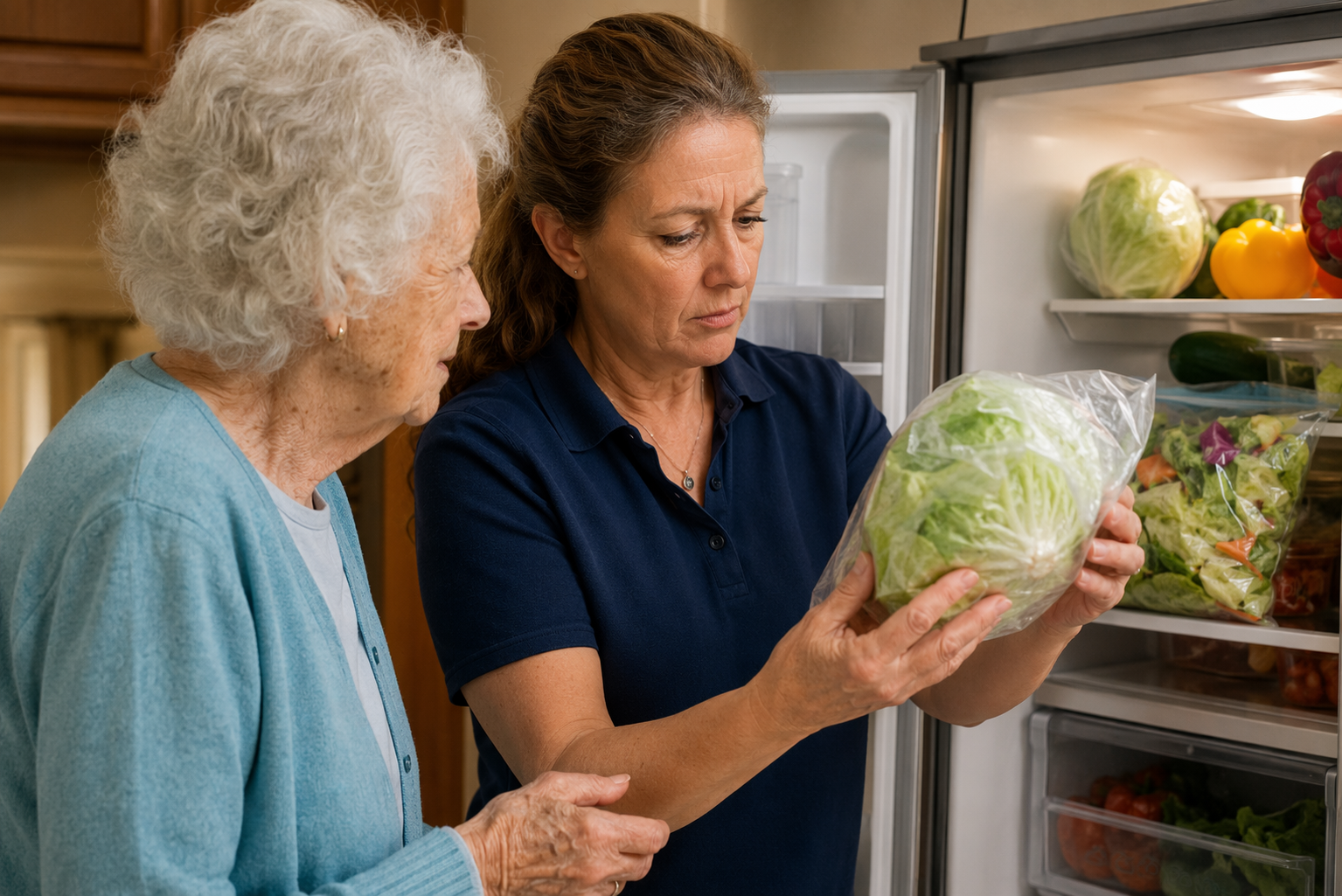
Start With the Refrigerator, Not the Sink
The first pass should be practical and slightly ruthless. Open the refrigerator, freezer, and pantry. Look for iceberg lettuce, shredded lettuce, salad kits, deli salads, prepared sandwiches, wraps, tacos, takeout containers, and anything repackaged so the original label is gone. If the older adult lives alone, also check the crisper drawer where half-used bags tend to sit after the front label has been torn away.
| What you find | What to do now |
|---|---|
| Recalled product or product that matches an official FDA recall listing | Do not serve it. Throw it away in a closed bag so it cannot be eaten later. |
| Shredded iceberg lettuce from an unknown source | Treat it as suspect and discard it, especially in a senior’s household. |
| Takeout or restaurant leftovers containing shredded lettuce from the affected states | Discard them if the source cannot be confirmed. |
| Loose greens or salad kits with labels still attached | Check the FDA recall page and the store’s recall notice before serving. |
| Cooked vegetables, canned vegetables, frozen vegetables that will be cooked | Keep them available as safer substitutes while the recall picture develops. |
The FDA said Taylor Farms de Mexico voluntarily removed all iceberg lettuce sourced from central Mexico from the U.S. market on July 17, 2026.[3] Consumer Reports later reported that the recall had expanded to Walmart and food distributors in 27 states, but the official CDC and FDA pages should remain the place caregivers verify the current recall list because the public picture was still moving as of this review date.[4]
If state-level numbers appear higher than CDC’s confirmed national count, do not let that distract from the home decision. State tallies may include probable and confirmed cases, while the CDC count cited here is lab-confirmed. For the caregiver standing in front of the refrigerator, that distinction matters less than whether a food can be clearly cleared.
Why “Just Wash It” Is the Wrong Instruction Here
With many produce scares, people reach for the same routine: rinse it longer, use a salad spinner, wipe the counter, move on. Cyclospora is where that habit can give caregivers a false sense of control.
Consumer Reports cited a 2021 study in which rinsing raspberries under cold tap water for one minute removed only 11% to 69% of Cyclospora cayetanensis, and the result was less effective than removal seen for bacteria or viruses.[4] That study tested raspberries and blueberries, not shredded iceberg lettuce, so it should not be stretched into a precise prediction for leafy greens. The useful lesson is narrower and still important: rinsing may reduce some contamination, but it is not a dependable rescue step for food that may be involved in this outbreak.
Routine produce sanitizing is not a dependable fallback either. The FDA states that Cyclospora is resistant to routine chemical disinfection and sanitization, including standard chlorine-based sanitizers, and that these methods are unlikely to kill it.[3] In a senior’s kitchen, that means the decision is not “wash or sanitize?” It is “discard, verify, or cook.”
- Do not try to save recalled lettuce by rinsing, soaking, adding vinegar, or using a produce wash.
- Do not move suspect greens into another container without labeling them; that only separates the food from the information needed to judge it.
- Do wash hands, refrigerator drawers, cutting boards, knives, and counters after discarding suspect food, because kitchen cleanup still matters even when it cannot make the recalled food safe.
- Do choose cooked vegetables when the older adult is at higher risk or when the source of raw greens cannot be verified.
The reliable kill step is heat. CDC prevention guidance says cooking food to 158°F, or 70°C, kills Cyclospora.[5] That does not mean every vegetable in the house is dangerous. It means that, during an active and evolving recall, cooked vegetables are the safer default for an older adult when the raw produce source is uncertain.
What to Serve While the Recall Picture Is Still Moving
The goal is not to frighten an older adult away from fruits and vegetables. It is to remove the foods most tangled in the current recall and replace them with options that do not require guesswork at every meal.
- Serve cooked vegetables, including frozen vegetables heated according to package directions, canned vegetables that are heated, soups, stews, and cooked side dishes.
- Pause salad bars, unlabeled deli salads, premade sandwiches with lettuce, and takeout items where shredded lettuce may be added automatically.
- If the parent lives in Michigan, Ohio, West Virginia, Kentucky, or Indiana, be especially cautious with lettuce and salad greens while official updates continue.
- For an immunocompromised older adult, or someone who is frail, dehydrated easily, or already recovering from illness, consider cooked vegetables only until the household can verify safer raw options.
Consumer Reports advised people in the five affected states to avoid lettuce and salad greens until more is known, and said older adults and immunocompromised people should consider eating only cooked vegetables during the outbreak.[4] That is a cautious standard, but it fits the reality of caregiving: the cost of skipping raw greens for a while is low compared with the cost of a preventable dehydration episode.
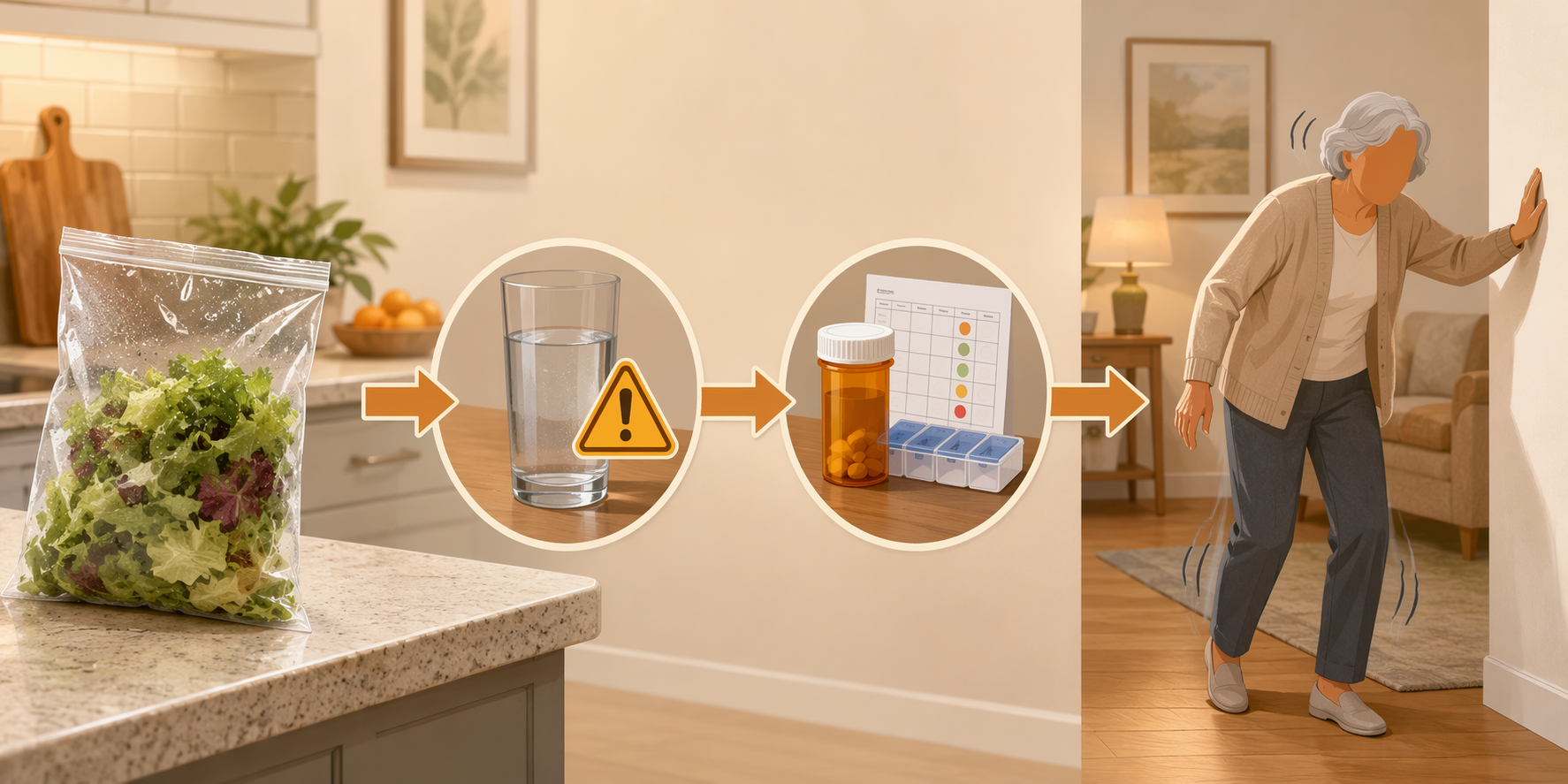
Why Diarrhea Is Harder on Older Adults
The parasite is only part of the risk. The bigger caregiving problem is what repeated diarrhea does to a body that has less reserve.
AARP quoted Dr. Luis Marcos of Stony Brook Medicine explaining that older adults may have a blunted thirst sensation, more underlying conditions such as kidney disease, heart failure, and diabetes, and medication regimens that affect fluid balance, including diuretics and ACE inhibitors.[2] Those factors do not prove that every older adult with cyclosporiasis will become severely ill. They do explain why a caregiver should not wait for dramatic symptoms before checking fluids, urine output, dizziness, and medication risks.
Blunted thirst is especially treacherous. An older parent may say they are “not thirsty” while they are drinking far less than usual. A person on a diuretic may be losing fluid faster. Someone with kidney disease or heart failure may not be able to simply drink large volumes without medical guidance. A person rushing to the bathroom six or more times a day may also become unsteady, especially at night.
This is also where fall prevention becomes part of food safety. Diarrhea creates urgency, urgency creates fast standing and poor lighting, and dehydration adds dizziness. If the parent already has balance problems, use the same kind of home scan you would use during any high-risk period: clear the path to the bathroom, turn on night lights, keep a phone within reach, and make sure slippers or shoes have traction. The site’s guide to how to protect seniors from falls during heavy rain warnings uses a similar urgent-home-scan mindset; the trigger is different, but the fall mechanics are familiar.
Watch Symptoms Like a Caregiver, Not Like a Healthy Adult Waiting It Out
Cyclosporiasis can cause diarrhea that lingers, and delayed diagnosis is a real problem because the right test may not be included automatically. Stanford and Johns Hopkins experts have both noted that standard ova-and-parasite stool testing may miss Cyclospora unless testing specifically looks for it.[6][7]
For a caregiver, the symptom log does not need to be fancy. It needs to capture the facts a clinician will ask for, especially if the older adult minimizes symptoms or forgets how often they have gone to the bathroom.
| Track this | Why it matters |
|---|---|
| Number of diarrhea episodes in 24 hours | A high count helps determine when to call the doctor. |
| Whether diarrhea is improving, unchanged, or worsening | Duration without improvement changes the urgency. |
| Fluid intake | Older adults may not feel thirsty even when losing fluid. |
| Urination frequency and urine color | Little or no urination is a dehydration red flag. |
| Dizziness, confusion, weakness, or rapid heartbeat | These can signal that the illness is affecting more than the gut. |
| Foods eaten in the days before symptoms | This helps the clinician connect symptoms to a possible outbreak exposure. |
| Current medications | Treatment and dehydration can both interact with existing prescriptions. |
AARP cited Cleveland Clinic physician Dr. Cory Fisher advising people to call a doctor if diarrhea exceeds six to eight episodes per day or lasts more than two to three days without improvement.[2] For older adults, do not use that threshold as permission to ignore earlier warning signs. Confusion, dizziness, little or no urination, and rapid heartbeat deserve faster medical contact because they suggest dehydration or systemic stress, not just an inconvenient stomach bug.[2]
When to Call, What to Ask For, and When It Is an Emergency
Call the older adult’s doctor or an urgent care clinic if diarrhea is frequent, persistent, or tied to a likely exposure. When you call, be direct: mention the 2026 cyclospora outbreak, any recalled or suspect lettuce exposure, the number of diarrhea episodes, hydration concerns, and the full medication list. If testing is ordered, ask whether the stool test specifically checks for Cyclospora rather than assuming a standard test will catch it.[6][7]
- Call the doctor if diarrhea reaches more than six to eight episodes in a day.
- Call the doctor if diarrhea lasts more than two to three days without improvement.
- Call sooner if the person has kidney disease, heart failure, diabetes, frailty, dementia, or trouble keeping fluids down.
- Ask specifically about Cyclospora testing if symptoms persist after possible exposure.
Seek urgent or emergency help if the older adult is confused, fainting, too dizzy to stand safely, has little or no urination, has a rapid heartbeat, cannot keep fluids down, or appears suddenly much weaker than usual. Those signs are not just “diarrhea symptoms.” They are signs that the body may be losing the ability to compensate.
Do a Medication Review Before Treatment Starts
The preferred treatment for cyclosporiasis is often TMP-SMX, but that does not make it a casual prescription in a household with a long medication list. AARP warns that TMP-SMX can significantly interact with warfarin, sulfonylureas, methotrexate, and drugs that affect potassium levels.[2] That list overlaps with medications many older adults take for common chronic conditions.
Before the appointment or call, gather the actual bottles, not just a memory-based list. Include prescriptions, over-the-counter medicines, vitamins, supplements, and “as needed” pills. If the parent uses a pill organizer, check it against the bottles. If another family member manages refills, loop them in before treatment is chosen.
- Tell the clinician if the older adult takes warfarin or another blood thinner.
- Flag diabetes medications, especially sulfonylureas.
- Mention methotrexate, potassium supplements, ACE inhibitors, diuretics, and other medicines affecting fluid balance or potassium.
- Ask whether hydration advice should be modified because of kidney disease, heart failure, or other fluid-sensitive conditions.
- Ask what changes should trigger a same-day callback after treatment begins.
This is not a reason to avoid treatment. It is a reason to make sure the prescriber sees the whole medication picture before choosing a dose, monitoring plan, or alternative.
If You Manage Care From a Distance
Long-distance caregiving makes recalls harder because the person who gets the alert is often not the person opening the refrigerator. The safest approach is to turn the recall into a short assignment for someone local: a neighbor, sibling, home aide, building staff member, or grocery delivery helper.
- Ask them to photograph the refrigerator shelves, crisper drawer, and any salad packaging.
- Have them discard recalled or unlabeled shredded lettuce while on the phone with you.
- Replace raw salad meals with cooked vegetables, soup, or another easy meal the older adult will actually eat.
- Set a twice-daily check-in for diarrhea count, fluids, urination, dizziness, and confusion if there has been possible exposure.
- Keep the medication list ready in case a clinician orders testing or treatment.
If the parent has dementia or tends to eat discarded food from the trash, do not leave the bag in the kitchen bin. Remove it from the home or place it somewhere inaccessible until trash pickup. A recall plan only works if the food cannot find its way back into a sandwich.
The Practical Bottom Line for Seniors
For older adults, the danger in this cyclospora outbreak is not only the parasite. It is the cascade that can follow a few days of diarrhea: dehydration that is not felt as thirst, dizziness that becomes a fall, kidney or heart conditions that complicate fluid replacement, and drug interactions that appear only after treatment begins.
The safest response is immediate kitchen triage, no attempt to wash recalled lettuce into safety, cooked vegetables when raw greens cannot be verified, close tracking of diarrhea and hydration, a medication review before treatment, and prompt medical contact when symptoms cross the line. Because the outbreak and recall scope are still changing, check the CDC and FDA pages again before serving questionable produce or assuming yesterday’s recall list is complete.
References
- Health Alert Network (HAN) - 00531: Outbreak of Cyclosporiasis Associated with Lettuce, CDC, July 14, 2026, link
- Cyclospora Outbreak: What Older Adults Should Know, AARP, link
- Investigation of 5-State Outbreak of Cyclospora Illnesses: Iceberg Lettuce (July 2026), FDA, July 2026, link
- You Shouldn’t Avoid Fruits and Vegetables Due to Cyclospora, Consumer Reports, link
- Preventing Cyclosporiasis, CDC, link
- Cyclosporiasis diarrheal outbreak: what experts say, Stanford Medicine, July 2026, link
- Cyclosporiasis Outbreak, Johns Hopkins Medicine, link
Questions to bring to a clinician or OT
This is not medical, legal, or a family's final decision — only a framework. Bring these questions to a clinician, occupational therapist, or your local Area Agency on Aging.
Find Local HelpRelated reading
Noticed something outdated or inaccurate on this page? Flag a correction. We review every report against CDC, NIA, and AARP HomeFit guidance before updating a page.