
Caregiver decision guide
Recognizing cyclospora symptoms in elderly loved ones
Learn the key symptoms of cyclospora in older adults, how to tell it apart from a routine stomach bug, and when to request the right lab test for diagnosis.
Last reviewed: July 18, 2026. The 2026 outbreak numbers mentioned here are changing as public health agencies update their reports.

The first question is usually not “Is this cyclospora?” It is more ordinary and more urgent: an older parent has watery diarrhea, seems wiped out, maybe looked better yesterday, and now the bathroom trips have started again. At that point, the useful distinction is not the restaurant name in the news. It is the pattern.
Cyclospora food poisoning symptoms in elderly adults can look like a stomach bug at first, but the timing is different. Norovirus and many routine viral stomach bugs tend to hit fast and clear within about 1 to 3 days. Cyclospora usually appears later after exposure, causes watery diarrhea that can last from several days to more than a month if untreated, and may seem to improve before coming back again.[1][2]
| What you are seeing | More typical of a short stomach bug | More concerning for cyclospora |
|---|---|---|
| Timing after a possible exposure | Often fast | Often days later; average about a week, with a possible range from 2 days to more than 2 weeks |
| Diarrhea pattern | Improves steadily over a few days | Watery diarrhea continues for days to weeks |
| Course | One short illness | Symptoms may ease, then return |
| Energy level | Tired during the illness, then gradually better | Fatigue may persist even after diarrhea improves |
The symptom pattern that deserves a second call
Watery diarrhea is the symptom caregivers usually notice first. With cyclospora, the problem is not just that it happens. It is that it does not behave like a brief household virus. The CDC describes the diarrhea as lasting from a few days to a month or longer without treatment.[1] For an older adult, that length of time matters because every extra day raises practical concerns: fluid intake, weakness, appetite, medication routines, and whether the person is safe getting to the bathroom.
The next clue is the stop-start course. AARP, quoting Cleveland Clinic family physician Dr. Cory Fisher, describes a waxing-and-waning pattern in which symptoms seem to resolve and then return, a feature that can separate cyclospora from many other foodborne illnesses.[2] This is the part that tricks families. A parent eats a little more on Tuesday, sounds stronger on Wednesday, and everyone relaxes. Then Thursday looks like the beginning again.
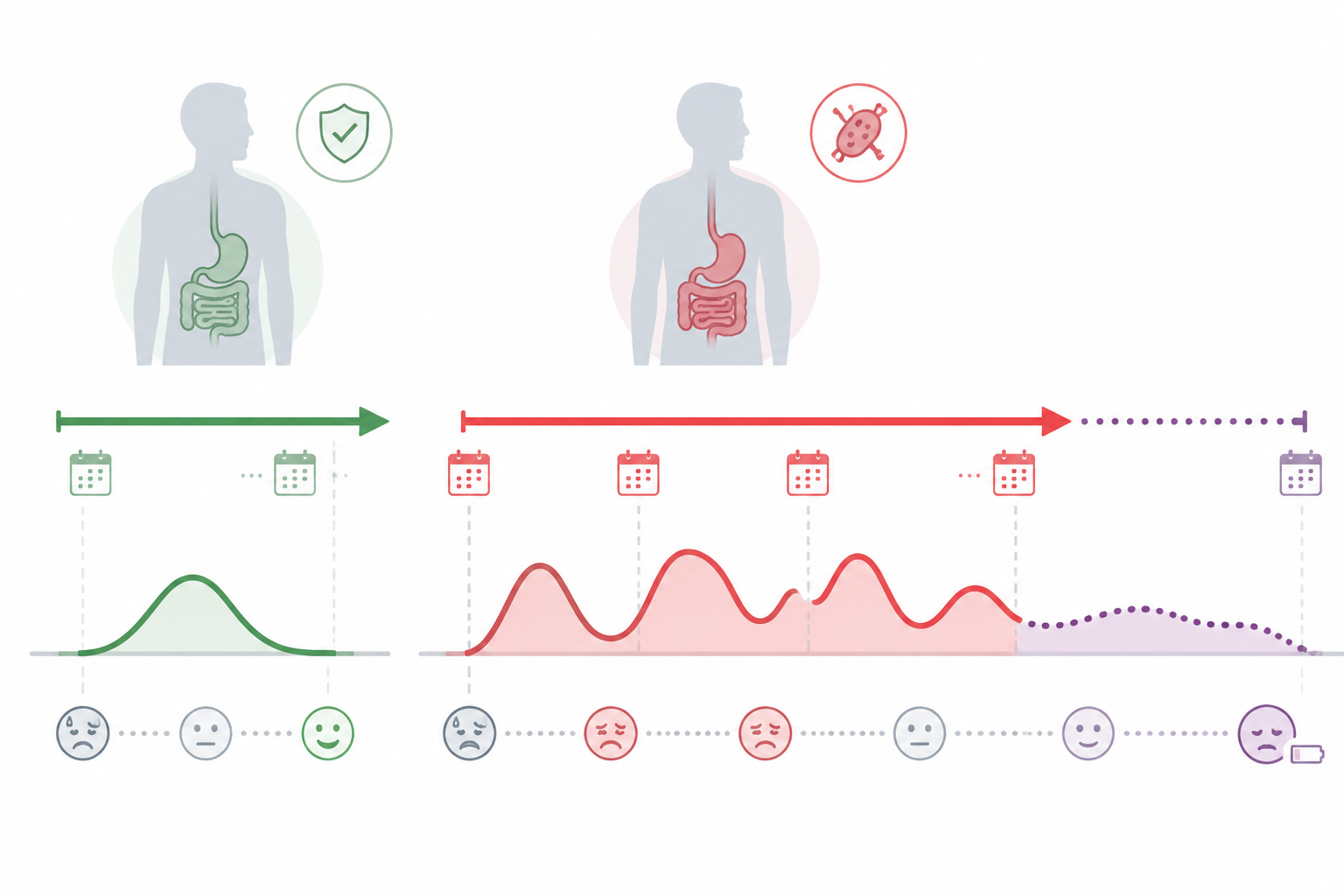
Fatigue is not a side note. Stanford Medicine infectious disease specialist Dr. Niaz Banaei has noted that fatigue can continue for weeks after the gastrointestinal symptoms resolve.[3] That is important because many caregivers stop tracking once the diarrhea slows down. If an older adult is still unusually wiped out, sleeping more, eating less, or struggling with normal activity after the bathroom symptoms improve, that belongs in the message to the clinic.
Weight loss pushes the situation into a more serious category. Stanford Medicine notes that weight loss can reach up to 10% of body weight in severe cases.[3] A caregiver does not need to calculate anything perfectly at home to know when the belt is suddenly looser, meals are being skipped, or the scale is dropping. Those observations are worth reporting plainly.
Symptoms to write down before calling
- The first day watery diarrhea started, even if symptoms later improved.
- How many times a day diarrhea is happening, especially if it is frequent enough to disrupt sleep, meals, or medication timing.
- Any pattern of “better, then worse again,” with dates if possible.
- Appetite changes, fluid intake, dizziness, dry mouth, confusion, or unusual weakness.
- Weight change, looser clothing, or a noticeable drop in strength.
- Fatigue that continues after diarrhea slows or stops.
AARP also quotes infectious disease specialist Dr. Luis Marcos describing 6 to 8 episodes of diarrhea a day as a threshold that should prompt medical evaluation, particularly when symptoms are not improving.[2] That is clinician guidance, not a rule that says fewer episodes are automatically safe. In an elderly parent, the overall picture matters: duration, hydration, weakness, and whether the course is getting better or circling back.
Why yesterday’s meal may not explain today’s illness
It is natural to ask what the person ate yesterday. With cyclospora, that question can be too narrow. The CDC describes the incubation period as about 1 week on average, with illness developing anywhere from 2 days to 2 weeks or more after exposure.[4] Cleveland Clinic gives the same general range, noting that symptoms can begin days to more than 2 weeks after ingesting the parasite.[5]
That long window makes individual detective work unreliable. A caregiver may remember one takeout meal, one salad, or one family gathering, but the relevant exposure could have been much earlier. Public health investigators can connect cases through broader patterns; a family at home usually cannot. What the family can do is describe the symptom timeline accurately.
The 2026 outbreak is one reason cyclospora is on more caregivers’ radar this summer. Johns Hopkins Medicine reported more than 1,645 CDC-confirmed cases as of mid-July 2026 in an outbreak linked to Taco Bell, with case numbers still evolving.[6] CIDRAP also reported that U.S. cyclospora cases were mounting while tracking lagged.[7] Those reports are a reason to stay alert in Q3 2026, not a reason to assume every older adult with diarrhea has cyclospora. No deaths have been reported in the 2026 outbreak across any age group as of the materials available for this review.[6][7]
Why older adults get less room for “wait and see”
Adults 65 and older are not automatically fragile, and prolonged diarrhea should not be brushed off as normal aging. The CDC lists adults 65 and older among people at increased risk for severe foodborne illness.[8] FoodSafety.gov notes that nearly half of adults 65 and older with a lab-confirmed bacterial foodborne illness are hospitalized.[9] That statistic is about bacterial foodborne illness, not cyclospora specifically, but it explains why clinicians and caregivers take dehydration and decline seriously in this age group.
The practical warning signs are the ones a caregiver can observe: fewer fluids going in, more time in bed, dizziness when standing, confusion, dry mouth, a sharp drop in appetite, or diarrhea that keeps returning. If an older parent has heart disease, kidney disease, diabetes, takes diuretics, or already has limited reserve, the threshold for calling should be lower. The point is not to diagnose cyclospora at the kitchen table. The point is to make sure the pattern is not minimized as “just a bug” when it has stopped acting like one.
The test has to be specific
This is where many families lose time. The CDC’s clinical overview says diagnosis requires identifying Cyclospora in stool, but routine ova and parasite testing may not include Cyclospora unless specifically requested; the CDC also notes that Cyclospora is not routinely detected by many gastrointestinal molecular panels.[10] In plain language: a “stool test” can come back negative and still not have looked for the right thing.
That does not mean a caregiver should demand one diagnosis or decide treatment. It means the call to the clinic needs enough detail for the clinician to choose the right evaluation. The most useful message includes duration, recurrence, hydration concerns, fatigue, and the specific testing question.
A caregiver script for the clinic
You can say:
“My parent is 65 or older and has had watery diarrhea since [date]. It seemed to improve on [date] but returned on [date]. They are also unusually fatigued and [not eating well / losing weight / drinking less / feeling weak]. With the current cyclospora outbreak, should they be evaluated for cyclosporiasis? If stool testing is ordered, can you confirm whether it includes a stool oocyst and parasite exam with modified acid-fast stain for Cyclospora, or another test that specifically detects Cyclospora?”
If the first answer is “we already ordered a stool culture,” it is reasonable to ask one more clarifying question: “Does that culture or panel detect Cyclospora, or would a separate Cyclospora-specific test be needed?” That is advocacy, not self-diagnosis. It gives the clinician the facts that are easiest to miss when everyone is tired and the illness has already dragged on too long.
Seek urgent medical advice rather than waiting for an office callback if an older adult has signs of dehydration, confusion, fainting, severe weakness, blood in stool, severe abdominal pain, or cannot keep fluids down. Those signs are not specific to cyclospora; they are reasons an elderly person with diarrhea needs prompt medical attention.
References
- Symptoms of Cyclosporiasis, Centers for Disease Control and Prevention.
- Cyclospora Outbreak: What Older Adults Need to Know, AARP.
- Cyclosporiasis diarrheal outbreak: What experts say, Stanford Medicine, July 2026.
- About Cyclosporiasis, Centers for Disease Control and Prevention.
- Cyclosporiasis, Cleveland Clinic.
- Cyclosporiasis Outbreak, Johns Hopkins Medicine.
- US Cyclospora cases mount as CDC lags in tracking, CIDRAP.
- People at Increased Risk for Foodborne Illness, Centers for Disease Control and Prevention.
- Older Adults, FoodSafety.gov.
- Clinical Overview of Cyclosporiasis, Centers for Disease Control and Prevention.
Questions to bring to a clinician or OT
This is not medical, legal, or a family's final decision — only a framework. Bring these questions to a clinician, occupational therapist, or your local Area Agency on Aging.
Find Local HelpRelated reading
Noticed something outdated or inaccurate on this page? Flag a correction. We review every report against CDC, NIA, and AARP HomeFit guidance before updating a page.