
Caregiver decision guide
Elderly Veterans Benefits Bill Debate Explained for Caregivers
Learn what the Take Care of America's Veterans Act debate means for elderly veterans and their family caregivers, including which benefits are at risk, what stays stable, and how proposed changes to disability ratings affect current recipients.
The veterans benefits bill debate for elderly veterans became urgent on July 16, 2026, when the Take Care of America’s Veterans Act was pulled from the House floor after a 210–211 procedural defeat, just before a scheduled vote. Speaker Mike Johnson indicated the bill might not return for weeks, possibly not until September. For families watching from home, the immediate question is much simpler than the floor fight: will an elderly veteran’s current VA disability check, caregiver stipend, or survivor benefit disappear because of this bill? The answer, for current sleep apnea and tinnitus compensation, is no under the TCAVA proposal as described in available reporting: existing recipients would not lose those current benefits because of this bill.[1]
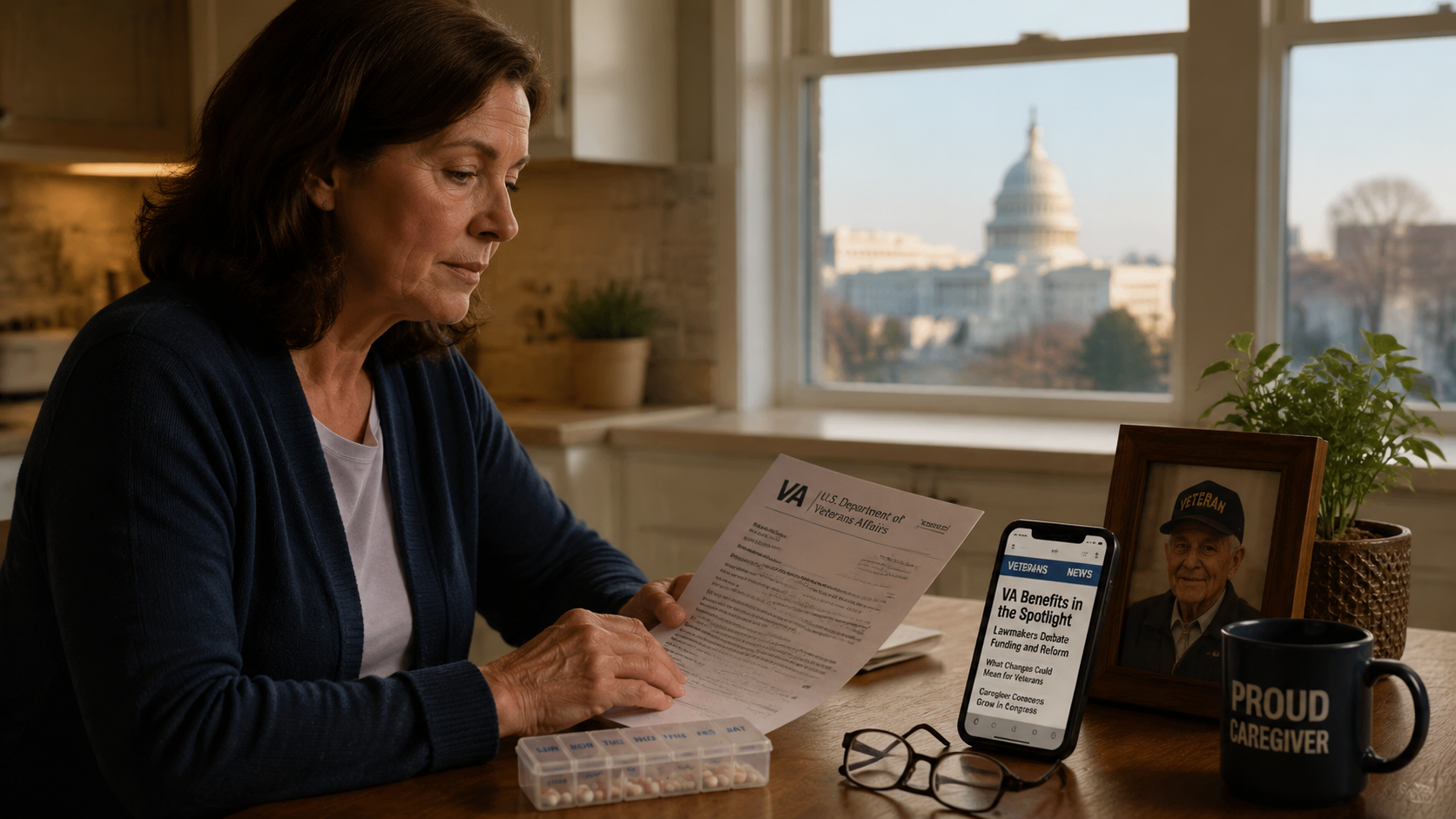
That does not make the debate meaningless. It means the scary version of the story needs to be separated from the real one. The bill’s controversy is not that it would reach into a current elderly veteran’s bank account next month and take away an already awarded sleep apnea or tinnitus payment. The controversy is that supporters want to use projected savings from future VA rating changes to pay for a large package of other veterans programs.
What changes for your family today
If your parent, spouse, or other family member is already receiving VA disability compensation for sleep apnea or tinnitus, the July 2026 House dispute over TCAVA does not by itself reduce that existing award. The proposed rating changes at the center of the bill are described as prospective, meaning they would apply to new claims or future re-evaluations rather than automatically cutting current awards.[2]
The same basic clarification applies to VA caregiver programs that already exist. Program of Comprehensive Assistance for Family Caregivers stipends and Program of General Caregiver Support Services support are not immediately disrupted by the TCAVA floor fight. NCOA describes PCAFC stipends as ranging from $1,896 to $3,791 per month depending on level, and VA extended PCAFC eligibility for legacy participants and applicants in November 2025.[3]
| Benefit or program | What the July 2026 TCAVA debate means right now |
|---|---|
| Current sleep apnea disability compensation | Not cut for existing recipients under the TCAVA proposal described in reporting |
| Current tinnitus disability compensation | Not cut for existing recipients under the TCAVA proposal described in reporting |
| PCAFC caregiver stipends | Not immediately changed by the House floor dispute |
| PGCSS caregiver services | Not immediately changed by the House floor dispute |
| Future sleep apnea or tinnitus claims | Could be affected if VA rating changes move forward |
| Future re-evaluations | Potential effect depends on final legislative and regulatory language |
The table matters because caregivers often have to act before Congress finishes arguing. If you are managing rent, medication copays, respite care, or paid help at home, the difference between “current benefit” and “future claim” is not legal hair-splitting. It is the difference between reviewing your household budget today and keeping an eye on a policy fight that could shape what happens later.
Why people are still worried
The center of the dispute is a projected $57 billion in savings over 10 years from changing how VA rates sleep apnea and tinnitus for disability compensation. Supporters argue those changes were already expected through VA regulation and that Congress should use the savings to fund more than 60 veterans bills. Opponents describe the same mechanism as a major benefits cut, with DAV and AFGE citing up to 1.5 million veterans who could be affected by sleep apnea and tinnitus rating changes.[2][4]
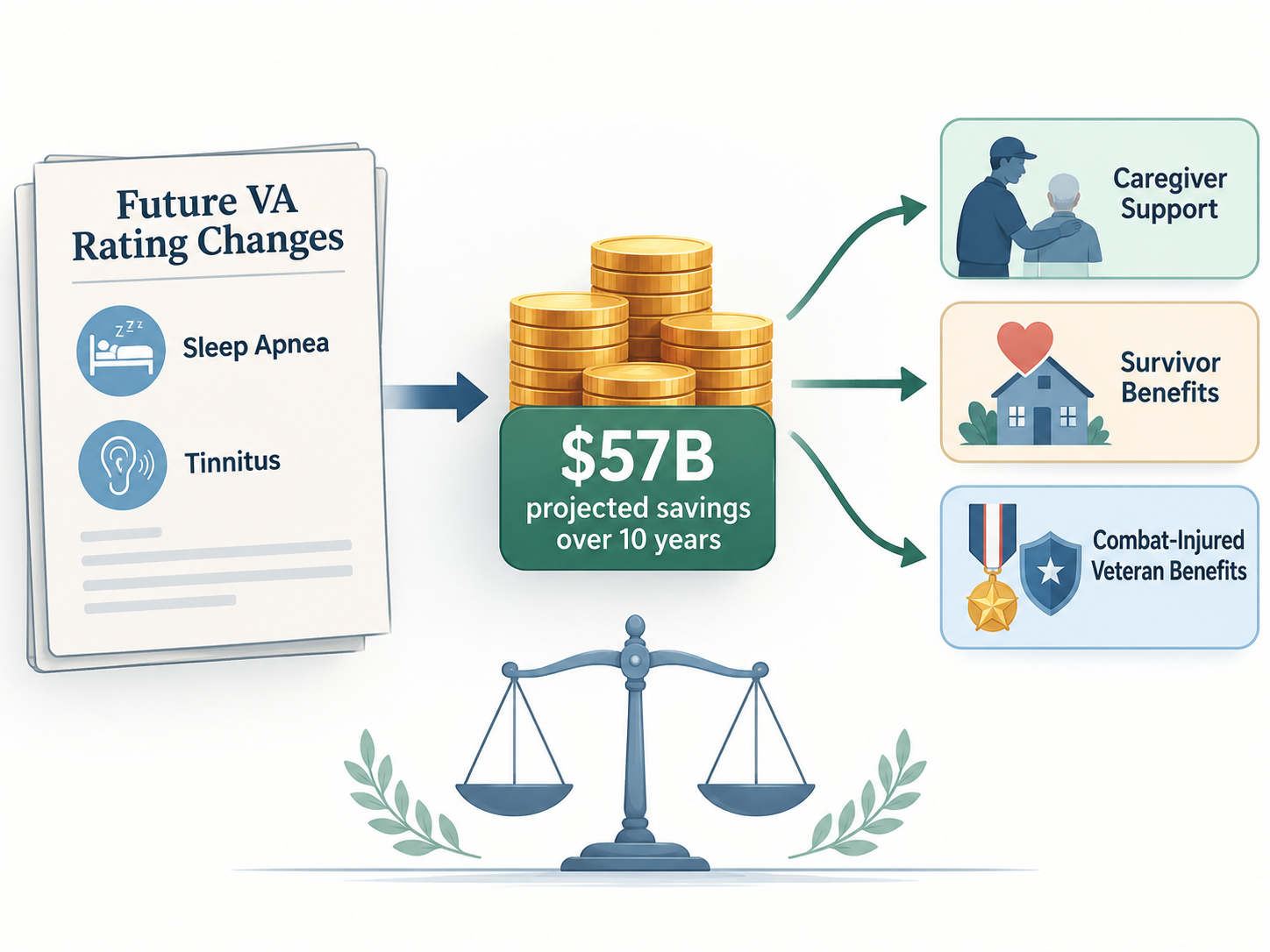
That 1.5 million figure should be handled carefully. It is part of the opposition case against the rating changes, not proof that 1.5 million current elderly recipients would immediately lose existing checks. The actual impact would depend on final language, whether the rating changes apply only to new claims, how future re-evaluations are handled, and whether VA moves separately through regulation.
There is also a trust problem. VA reportedly told Congress in January 2026 that it expected to finalize sleep apnea and tinnitus rating changes by the end of fiscal year 2026. By July 2026, VA said no changes were “planned or imminent.”[2] For a caregiver who has learned to save every VA letter and screenshot every portal message, that shift is not reassuring enough to ignore. It is a reason to watch the funding mechanism closely, even while rejecting the idea that current checks are being cut by TCAVA today.
Current recipients and future claimants are not in the same position
For an elderly veteran already rated for sleep apnea or tinnitus, the first question is whether the proposed bill reaches backward. Available reporting says it does not. That is the fact that should come before any argument about party strategy or vote-counting: a veteran currently receiving compensation for those conditions would not lose that existing compensation under the TCAVA proposal.[1][2]
Future claimants are in a different position. If VA rating criteria change, a veteran who files a new sleep apnea or tinnitus claim later could receive a different rating than someone who filed under the current rules. A veteran who is re-evaluated later could also face different treatment depending on exactly how the final rule and any legislative protections are written. That is where the uncertainty sits.
This distinction is especially important for elderly households because disability compensation is often already built into the monthly plan. Families may use it to cover property taxes, supplemental insurance, transportation to appointments, in-home help, or the gap between what Medicare covers and what a frail veteran actually needs. A prospective change can still be a serious policy fight without being an immediate cut to an existing award.
What caregiver provisions are tied up in the package
The difficult part of TCAVA is that the disputed funding mechanism is attached to provisions many families would actually welcome. One of the most caregiver-relevant pieces is the Veteran Caregiver 3R Act, which addresses a quiet financial problem: VA caregiver stipends are not treated as earned income. That means the caregiving labor may help keep a veteran at home, but it does not build retirement credits, Social Security work history, or unemployment eligibility in the same way a paycheck does.[5]
For a spouse in her late 60s or an adult daughter who cut back work hours to manage bathing, medication, meals, falls, and appointments, that classification matters long after the most intense caregiving years end. The 3R Act would provide reemployment assistance, access to education and training, and retirement planning support for caregivers. MOAA has also noted that the 3R Act exists as standalone legislation, H.R. 2148, and still needs House Ways and Means Committee clearance, so its future is not entirely limited to the fate of TCAVA.[5]
The need behind that bill is not small. Military and veteran caregivers provide an estimated $119 billion in annual unpaid care, with 14.3 million people providing care to service members and veterans, according to Elizabeth Dole Foundation and RAND data cited by caregiver policy groups.[3][5]
- Reemployment support matters when a caregiver has been out of the workforce or working less because the veteran could not be left alone.
- Education and training access matters when caregiving has interrupted a career path, especially for adult children in midlife.
- Retirement planning support matters because a stipend can help with today’s bills without building the same long-term protections as earned wages.
This is why the debate is so frustrating for families. The same package that raises fears about future rating changes also contains measures aimed at the financial damage caregivers absorb while keeping veterans safe at home.
Other pieces that matter to elderly veterans and survivors
The Major Richard Star Act is one of the largest practical provisions in the package. It would allow about 54,000 combat-injured medically retired veterans to receive both military retirement pay and VA disability compensation, often called concurrent receipt.[2][5] For an older veteran living on a fixed income, the issue is straightforward: the bill would stop forcing some combat-injured retirees to offset one earned benefit against another.
The Love Lives On Act would remove the penalty that ends Dependency and Indemnity Compensation and Survivor Benefit Plan payments when a surviving spouse remarries before age 55.[5] That provision is not abstract for older surviving spouses or widowed partners deciding whether remarriage could cost them income or health security.
TCAVA also includes a DIC increase of 3% above cost-of-living adjustments spread across three years, along with protections for surviving spouses who rely on TRICARE continuation.[5] These are not the provisions driving the loudest headlines, but they are the kinds of changes that can decide whether a widow can keep a doctor, afford a prescription, or remain in the same home.
Veterans groups are split for real reasons
The disagreement is not simply one party supporting veterans and the other opposing them. Reporting before the pulled vote described a real split among veterans service organizations. Supporters included 22 organizations such as The American Legion, MOAA, the Elizabeth Dole Foundation, and TAPS. Opponents included groups such as VFW, DAV, IAVA, and AFGE.[6]
Supporters see a chance to move a large package of long-stalled veterans bills, including caregiver, survivor, and medically retired veteran provisions. Opponents object to financing those bills with projected savings from disability rating changes and warn that it sets a dangerous precedent. House Veterans’ Affairs Committee Democrats called the approach “the largest veterans benefits cut in a generation,” while supporters argue the rating changes are future-facing and would not strip current awards.[2][7]
Both concerns can be real at the same time. A current elderly veteran may not be losing an existing tinnitus or sleep apnea award under TCAVA, and it can still be fair to ask whether future disability savings should be used as the pay-for for other veterans programs.
What caregivers should watch next
The bill’s timeline is uncertain. After the July 16 procedural defeat, the House did not pass TCAVA, and Speaker Johnson indicated it likely would not return immediately.[1] Caregivers do not need to follow every floor maneuver, but three practical questions are worth tracking.
- Does the $57 billion funding mechanism stay in the bill, get rewritten, or get removed?
- Does VA move separately through regulation on sleep apnea and tinnitus ratings, regardless of what happens to TCAVA?
- Do caregiver-support provisions, especially the Veteran Caregiver 3R Act, advance inside TCAVA or as standalone legislation?
- Does final language clearly protect current recipients and define how any future re-evaluations would be treated?
For now, an elderly veteran already receiving sleep apnea or tinnitus compensation should not assume TCAVA is cutting that existing benefit. A caregiver receiving PCAFC support should not assume the July 2026 floor fight has stopped that stipend. The real watch point is what Congress and VA do next with future rating rules and whether the caregiver, survivor, and medically retired veteran provisions survive the fight over how to pay for them.
References
- Disputed veterans benefits bill gets pulled before House vote, Military Times, July 16, 2026.
- 60 Veterans Bills, 1 Big Misunderstanding, Military.com, July 2026.
- What Support Is Available For Caregivers of Veterans?, NCOA.
- Opposition statement citing 1.5 million veterans affected, DAV, July 2026.
- MOAA Takes Pragmatic Approach to Supporting Landmark Veterans Bill, MOAA, 2026.
- How veterans groups came to clash over a sweeping VA benefits bill, Military Times, July 10, 2026.
- Press release on TCAVA and veterans benefits cuts, House Veterans’ Affairs Committee Democrats.
Questions to bring to a clinician or OT
This is not medical, legal, or a family's final decision — only a framework. Bring these questions to a clinician, occupational therapist, or your local Area Agency on Aging.
Find Local HelpRelated reading
Noticed something outdated or inaccurate on this page? Flag a correction. We review every report against CDC, NIA, and AARP HomeFit guidance before updating a page.