
Caregiver decision guide
Protect Your Elderly Parent from Cyclosporiasis in the Kitchen
Standard produce washing doesn't reliably eliminate Cyclospora. Learn a stepped kitchen framework that prioritizes cooking to 158°F, choosing smooth-skinned alternatives, and discarding outer layers to protect your elderly loved one.
At 5:30 p.m., cyclosporiasis prevention for elderly parents is not an abstract food-safety topic. It is a cutting-board decision: whether to use the cilantro, whether the bagged shredded lettuce is worth opening, whether raspberries can be washed well enough, and whether a parent who already struggles to stay hydrated can afford several days of diarrhea.
The hard part is that the usual kitchen advice has a limit. The CDC says washing fresh produce can reduce Cyclospora contamination, but it does not reliably eliminate the parasite; the same CDC guidance names foods previously linked to outbreaks, including cilantro, basil, raspberries, snow peas, bagged salad mixes, shredded lettuce, green onions, and leafy greens.[1] The FDA also notes that Cyclospora resists standard chemical sanitizers used in produce handling, which is one reason “washed” and “safe for an elderly household” should not be treated as the same thing.[2]
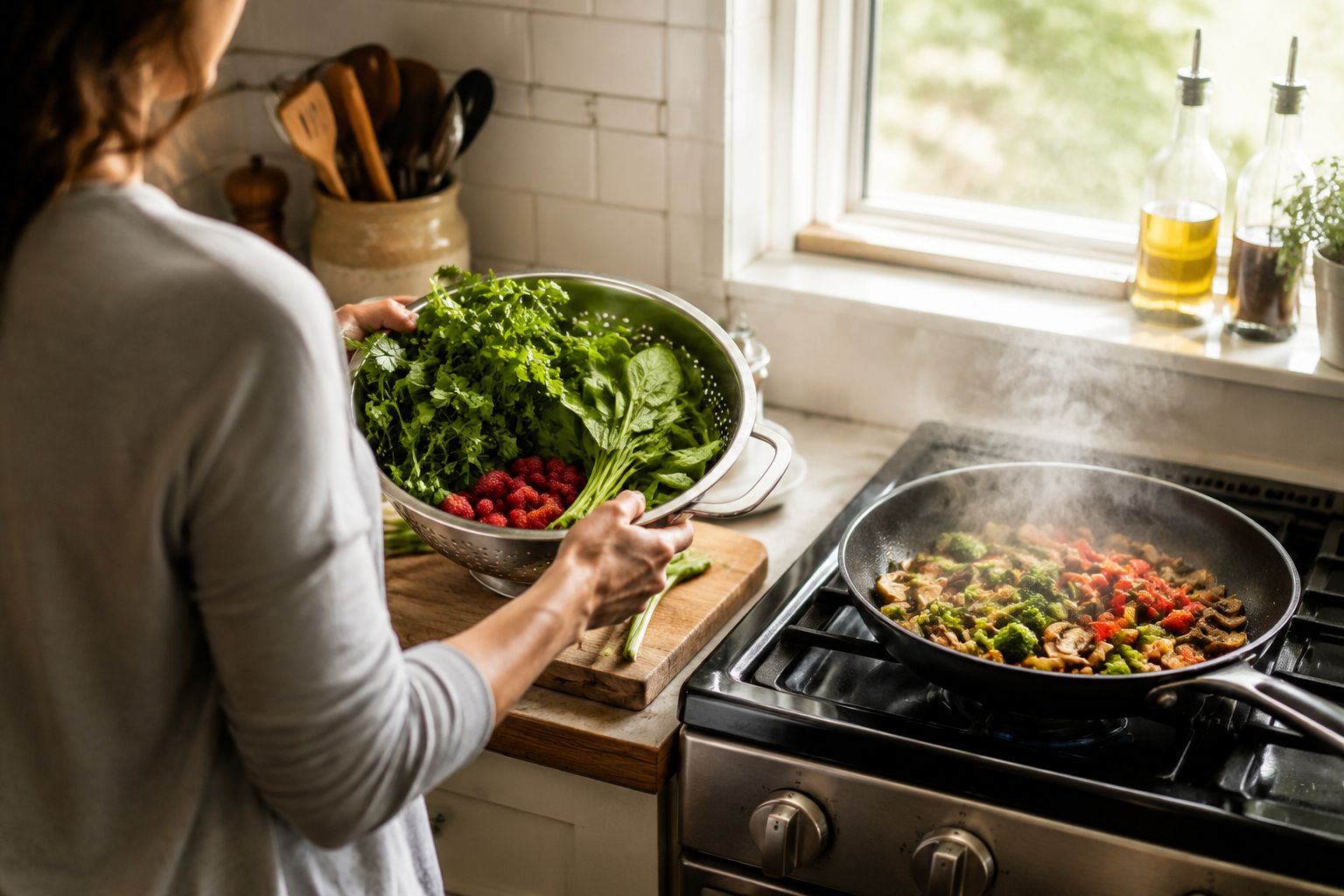
That does not mean every raw vegetable is equally dangerous, or that a caregiver has to empty the refrigerator in a panic. It means the household needs a different order of operations. For an older adult, especially one who is frail, chronically ill, or quick to dehydrate, prevention should start with the choices that work even when rinsing does not.
Start With The Kill Step, Not The Rinse
The clearest kitchen rule is also the least glamorous: cook produce when the risk is high. CDC guidance says cooking food to 158°F kills Cyclospora.[1] KDHE’s 2026 multi-state outbreak guidance goes further for vulnerable households, stating that cooking fresh produce before eating is the safest option and calling this the preferred prevention method for elderly people.[3]
That gives caregivers permission to stop pretending that a longer rinse can do the same job as heat. If a parent is 82, has kidney disease, takes multiple medications, or has already had trouble recovering from stomach illness, the more defensible dinner is often the cooked one: sautéed greens instead of a raw salad, herbs stirred into soup or sauce instead of scattered fresh on top, cooked snow peas instead of a raw crunch on the plate.
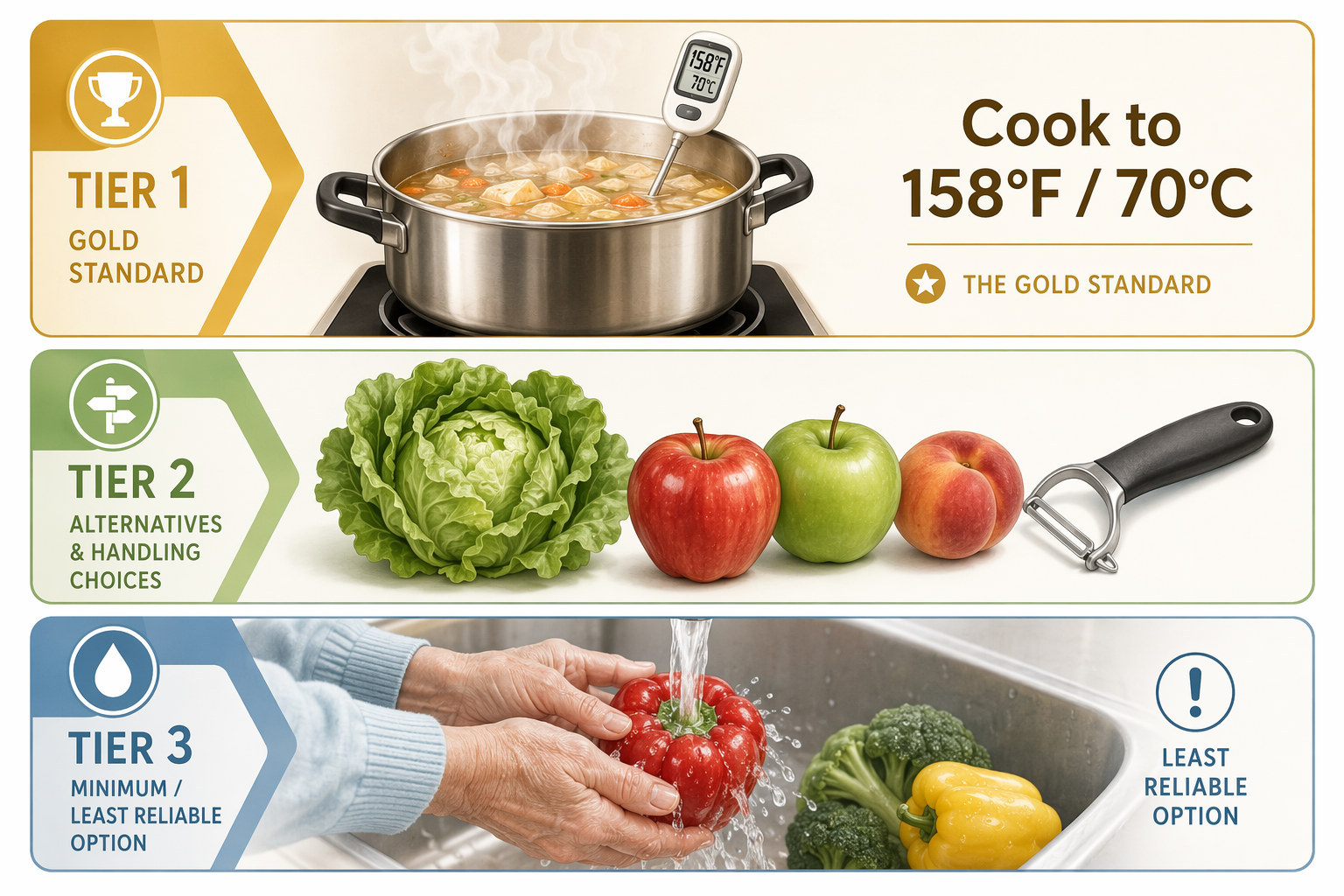
| Tier | Kitchen decision | Use it when |
|---|---|---|
| 1 | Cook produce to 158°F | Your parent is medically vulnerable, the produce is textured, or outbreak risk is active |
| 2 | Choose lower-risk handling patterns | You can switch to whole, peelable, scrub-friendly, or less processed produce |
| 3 | Wash and scrub thoroughly | Raw produce cannot be avoided, and you understand this reduces risk but does not reliably eliminate Cyclospora |
This stepped framework is a practical synthesis of public-health guidance, not a single agency’s named system. Its purpose is to make the caregiver’s choice visible. First ask whether the produce can be cooked. If not, ask whether a different produce choice would be easier to clean, peel, or prepare safely. Only after that should washing be treated as the remaining option.
How To Shop When “Fresh” Is Not Automatically Better
The grocery-store adjustment is simple in principle and annoying in practice: stop shopping as if raw freshness is always the goal. During an active outbreak, especially for an elderly household, the safer cart may look more boring.
- Choose produce that can be cooked without ruining the meal: spinach for soup, zucchini for sautéing, green beans for steaming, cabbage for braising.
- Prefer smooth-skinned or peelable options when raw produce is hard to avoid: apples that can be scrubbed and peeled, cucumbers that can be peeled, oranges or bananas with inedible peels.
- Be more cautious with textured foods that are hard to clean thoroughly, including fresh herbs, berries, leafy greens, and shredded produce.
- Skip bagged shredded lettuce or salad mixes during the outbreak if your parent is high-risk; processing creates more cut surfaces and gives the caregiver less control.
- Buy smaller amounts so the household is not pressured to “use up” questionable produce later in the week.
Michigan health officials specifically recommend buying whole heads of lettuce instead of pre-cut bags, discarding outer layers of leafy greens, and scrubbing firm produce with a clean brush under running water.[6] Those are not equal substitutes for cooking, but they are useful when the meal cannot be moved fully into Tier 1.
A caregiver does not need to ban every salad forever. The better question is whether this particular salad asks too much of rinsing. A whole head of lettuce with outer leaves discarded gives you more control than a bag of shredded lettuce. A cooked herb sauce gives you more control than raw cilantro folded in at the end. A peeled orange gives you more control than raspberries with tiny surfaces that cannot be scrubbed.
Use The Framework At The Counter
Once groceries are home, the caregiver’s job is to remove guesswork. A refrigerator full of raw herbs, lettuce, berries, and green onions creates a series of small negotiations. A planned workflow turns those negotiations into defaults.
Tier 1: Cook What Can Be Cooked
Move vulnerable meals toward heat. Add herbs while soup is simmering instead of using them raw as a garnish. Wilt greens into eggs, beans, pasta, or rice. Steam snow peas. Cook green onions into a sauce, stir-fry, or broth. If the produce reaches 158°F, you are using the prevention step that public-health guidance identifies as reliable against Cyclospora.[1]
A food thermometer is not just for meat in this context. If the meal depends on produce that has been associated with outbreaks or is difficult to clean, temperature gives the caregiver something concrete to verify. The point is not to turn dinner into a lab process; it is to avoid relying on visual cleanliness when the organism may not be removed by ordinary washing.
Tier 2: Change The Produce Before You Change The Parent’s Whole Diet
If your parent wants something fresh, look first for a version that gives you more control. A peeled fruit may satisfy the same craving better than a bowl of berries. A cooked vegetable side may replace a salad without making the meal feel punitive. A whole head of lettuce, handled at home with outer leaves discarded, is easier to reason through than a bag of mixed greens whose handling history is mostly invisible.
This is where the caregiver has to be willing to disappoint someone gently. The parent who has eaten the same lunch salad for years may not be persuaded by a discussion of sanitizers or parasites. A practical script can be short: “For now, I’m switching us to cooked vegetables and peelable fruit until the outbreak guidance changes.” That keeps the rule attached to the kitchen workflow, not to a permanent loss of independence.
Tier 3: Wash Carefully, But Do Not Upgrade Washing Into A Guarantee
When raw produce remains on the menu, washing is still worth doing. Rinse under running water. Scrub firm produce with a clean brush. Remove and discard outer leaves from leafy greens. Keep washed produce away from raw meat, poultry, seafood, and dirty surfaces. Then keep the conclusion honest: washing may reduce contamination, but CDC guidance says it does not reliably eliminate Cyclospora.[1]
That distinction matters because caregivers can otherwise end up doing more labor without gaining the level of protection they think they are gaining. Triple washing a delicate herb does not make it the same risk decision as cooking it into a hot dish. Rinsing raspberries does not turn them into a scrubbed, peeled fruit. A “pre-washed” bag does not erase the problem that the product is still raw and difficult for the home cook to control.
Why The Threshold Is Stricter For An Older Parent
Public guidance does not show a Cyclospora-specific infection rate for older adults. The concern is not that every older adult is proven to catch cyclosporiasis more often. The concern is what happens when an older adult gets a diarrheal illness and cannot recover quickly.
AARP’s coverage of the 2026 outbreak, citing infectious-disease physician Dr. Luis Marcos, describes the risk in older adults as a dehydration cascade: diarrhea can lead to dehydration, which can contribute to weakness, falls, kidney strain, and worsening chronic conditions.[4] That is the kitchen consequence. The same raw salad that would be a miserable inconvenience for a younger adult can become the start of a week in which an older parent is lightheaded, misses medications, stops eating, or needs urgent care.
The outbreak numbers explain why public-health agencies are paying attention, but they should not become the center of the family’s dinner plan. As of CDC’s July 14, 2026 Health Alert Network notice, there were 1,645 confirmed cases, more than 5,100 additional cases under investigation, reports from 34 states, and a 9% hospitalization rate among confirmed cases with available information.[5] Those numbers are still evolving. For the caregiver, they are enough context to justify stricter produce rules without needing to track every new map update before cooking dinner.
A One-Week Produce Reset For An Elderly Household
A reset works better than a vague promise to be careful. For one week, move the household into a stricter pattern and see what meals still feel normal.
- Pull high-friction raw produce to the front of the refrigerator: herbs, berries, bagged salad mixes, shredded lettuce, green onions, leafy greens, and snow peas.
- Decide item by item: cook it, replace it, or discard it. Do not leave “maybe” produce waiting for a tired evening.
- Plan two or three cooked vegetable defaults, such as soup with greens, steamed vegetables, or sautéed zucchini and onions.
- Replace raw garnishes with cooked-in flavor: herbs simmered into sauce, scallions cooked in broth, greens wilted into eggs or beans.
- Keep peelable or scrub-friendly fruit available so the parent still has an easy fresh option.
- Write the temporary rule where other helpers can see it: “During the outbreak, cook produce when possible; avoid bagged shredded lettuce and hard-to-clean raw herbs for Dad.”
The written rule matters if siblings, aides, neighbors, or grandchildren bring food. A caregiver can control the Tuesday grocery list and still lose the thread when someone arrives with a prepared salad. The goal is not to police kindness; it is to make the household standard easy to follow.
If Symptoms Start, Ask About Cyclospora Specifically
Prevention is the main job, but caregivers should know what changes the next call. Cyclosporiasis commonly involves watery diarrhea, and older adults can deteriorate from fluid loss before the family realizes how much has changed. If diarrhea persists, if the parent is weak or dizzy, if urination drops, or if chronic conditions worsen, call a clinician promptly rather than trying to manage it only with bland food and fluids.
CDC’s July 2026 HAN notice warns that routine ova and parasite stool testing may miss Cyclospora unless testing is specifically requested.[5] That is an important caregiver detail: when speaking with the clinic, mention possible Cyclospora exposure from raw produce and ask whether specific testing is needed.
Treatment decisions belong with the clinician, especially for older adults taking multiple medications. AARP notes that the commonly used treatment TMP-SMX can interact with medications such as warfarin, sulfonylureas, methotrexate, and potassium-sparing diuretics.[4] That is not a reason to delay care; it is a reason to have the medication list ready when you call.
If you already use a caregiver binder, add a temporary symptom page for stool changes, fluid intake, urination, dizziness, fever, and calls to the clinic. A simple printable such as the site’s free caregiver checklist can be adapted for this purpose.
The Kitchen Rule Until The Outbreak Passes
For elderly households during this outbreak, the practical rule is not “wash harder.” It is “change the produce workflow.” Cook what can be cooked to 158°F. When cooking does not fit the meal, choose produce that can be peeled, scrubbed, or handled as a whole item, and discard outer leaves where appropriate. Treat washing as the minimum fallback, not as a guarantee.
Last reviewed: July 18, 2026. Outbreak counts and source investigations may change as public-health agencies update their guidance.
References
- Preventing Cyclosporiasis, CDC, https://www.cdc.gov/cyclosporiasis/prevention/index.html
- Cyclospora, FDA, https://www.fda.gov/food/foodborne-pathogens/cyclospora
- 2026 Multi-State Outbreak guidance, KDHE, https://www.coronavirus.kdheks.gov/m/newsflash/Home/Detail/2044
- What Older Adults Should Know, AARP, https://www.aarp.org/health/conditions-treatments/cyclospora-outbreak-older-adults/
- HAN-00531, CDC Health Alert Network, July 14, 2026, https://www.cdc.gov/han/php/notices/han00531.html
- MDHHS makes recommendations on preventing foodborne illness amid growing cyclosporiasis outbreak, MDHHS, July 4, 2026, https://www.michigan.gov/mdhhs/inside-mdhhs/newsroom/2026/07/04/mdhhs-makes-recommendations-on-preventing-foodborne-illness-amid-growing-cyclosporiasis-outbreak
Questions to bring to a clinician or OT
This is not medical, legal, or a family's final decision — only a framework. Bring these questions to a clinician, occupational therapist, or your local Area Agency on Aging.
Find Local HelpRelated reading
Noticed something outdated or inaccurate on this page? Flag a correction. We review every report against CDC, NIA, and AARP HomeFit guidance before updating a page.