
Caregiver decision guide
What to Do During an Emergency Landing With an Elderly Parent
If your elderly parent has a medical emergency mid-flight, the response follows a predictable sequence. This guide walks you through each step—from crew assessment to diversion decisions—so you can stay calm, collect key information, and advocate effectively.
The first useful move is usually the plainest one: press the call button and tell the flight attendant what changed. “My mother was answering me five minutes ago, and now she is hard to wake.” “My father stood up, got dizzy, and almost fainted.” “She is vomiting and seems confused.” On an airplane, those observations matter more than a guessed diagnosis.
A medical event in the air can feel like the whole cabin has become unpredictable, but the response does not start from zero. In-flight medical emergencies are uncommon, with one CDC Yellow Book estimate at about 1 in 604 flights; another estimate cited there is about 1 in 212 flights. Only about 10% of in-flight medical emergencies lead to diversion, and death is reported in about 0.3% of cases.[1] Those numbers do not make the moment less serious. They do make it less mysterious.
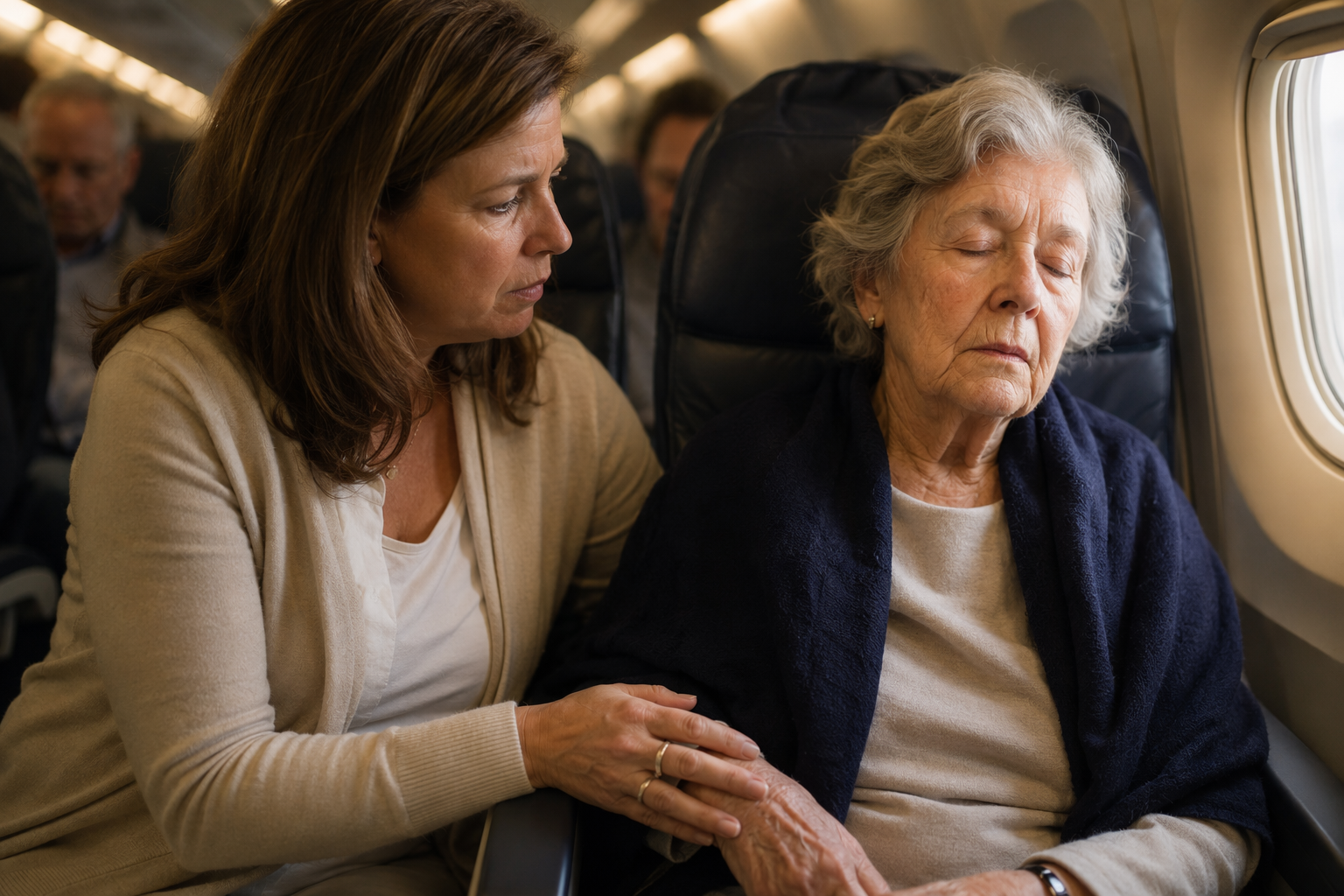
If an elderly passenger’s emergency leads to an unscheduled landing, the caregiver’s job is not to run the medical response. It is to notice, speak clearly, find information, and stay close enough to answer questions without blocking the crew. The sequence usually moves from cabin assessment, to medical consultation, to the captain’s diversion decision, to landing and EMS handoff.
Start With What Changed
Older adults can have symptoms that are easy to understate in a crowded cabin. A parent may say they are “just tired,” may be embarrassed by vomiting, or may become quiet when they are actually more confused than usual. Tell the crew what is new compared with your parent’s baseline.
- Say when the change started: “About ten minutes after meal service,” or “right after standing up.”
- Describe baseline: “She has mild memory loss but usually knows my name and where we are.”
- Name visible symptoms: fainting, dizziness, chest pain, trouble speaking, weakness on one side, vomiting, shortness of breath, new confusion, severe anxiety, or pain.
- Mention known conditions and medications: diabetes, heart disease, stroke history, dementia, blood thinners, insulin, oxygen use, seizure history, allergies.
- Hand over the medication list if you have it, even if you cannot explain every drug.
This is not overreacting. In MedAire’s 2024 in-flight medical call data, neurological events, including fainting, dizziness, and altered mental status, accounted for 37% of calls, while gastrointestinal issues accounted for 23%.[2] Those are exactly the kinds of symptoms a family member may recognize before anyone else does.
What the Crew Does First
Once you alert the crew, flight attendants begin a trained response. They may ask the passenger’s age, symptoms, medical history, medications, allergies, and whether the person has taken anything recently. They may check breathing, level of alertness, pulse, and whether the person can answer simple questions. They may move nearby passengers, bring oxygen, retrieve the onboard medical kit, or ask whether there is a medical professional onboard.
The familiar cabin announcement for a doctor or nurse is only one part of the system. U.S. commercial aircraft carry emergency medical kits, automated external defibrillators, and first aid kits, and airlines commonly use ground-based medical consultation services to guide care from the ground.[1] MedAire describes this as a link between the cabin crew, any onboard medical volunteer, pilots, and emergency physicians on the ground who advise in real time.[2]
If a volunteer clinician comes forward, let them work. Then make yourself useful in a narrower way. Pull out the medication list. Unlock your parent’s phone if it contains health information. Find hearing aids, glasses, dentures, inhalers, glucose tablets, nitroglycerin, or a CPAP battery if relevant. If your parent has a medical ID bracelet or emergency card, show it.
The Information That Helps Fastest
| What the crew or clinician may ask | What you can say or provide |
|---|---|
| What happened? | Describe the first change you noticed, not a diagnosis. |
| When did it start? | Give the closest time or flight moment you can remember. |
| Is this normal for them? | Explain baseline memory, speech, walking, breathing, and alertness. |
| What conditions do they have? | Name major diagnoses, recent hospitalizations, surgeries, or falls. |
| What medications do they take? | Provide the list, pill bottles, pharmacy app, or photo of labels. |
| Any allergies? | State drug, food, or latex allergies and what reaction occurs. |
| Who should be contacted? | Give the name and phone number of a spouse, sibling, doctor, or facility. |
If you do not know an answer, say so. Guessing that a parent “probably took everything” or “probably has no allergies” can create more confusion than a clear “I’m not sure; I’m checking the medication list now.”
How the Diversion Decision Is Made
A diversion is not decided by the loudest person in the cabin, the volunteer doctor alone, or the family alone. Medical input matters, but the captain has final authority. The decision has to weigh the passenger’s condition against fuel, weather, terrain, airport options, runway and medical access, air traffic, and the safety of everyone onboard.[1]
The CDC Yellow Book identifies cardiac arrest, cardiac symptoms, obstetric emergencies, and possible stroke as common reasons for diversion.[1] For an elderly parent, that means the crew may take symptoms such as chest pain, fainting with poor recovery, one-sided weakness, trouble speaking, or new severe confusion especially seriously. Still, the presence of frightening symptoms does not automatically mean the aircraft can or will land immediately.
This is a hard waiting period for families because there may be visible urgency but little visible explanation. The pilots may be speaking with dispatch and medical consultants. The cabin crew may be relaying vital signs and symptom changes. The volunteer clinician, if present, may be following guidance from ground physicians. You may not hear every exchange, and that silence can feel like inaction when it is actually coordination.
- Stay reachable: remain where the crew can find you unless asked to move.
- Watch for changes: more confusion, worsening pain, repeated vomiting, breathing changes, weakness, or loss of consciousness.
- Keep belongings contained: medications, ID, phone, glasses, hearing aids, and documents should not disappear into an overhead bin.
- Do not crowd the aisle: if responders need space, step back but stay available for questions.
- Ask one practical question at a time: “Do you need her medication list?” is more useful than “What is happening?” repeated every minute.
If the Plane Does Divert
If the captain decides to divert, the announcement may be brief. You may hear that the aircraft is landing for a medical situation, or you may be told privately if the situation involves your parent. Descent and landing are not instantaneous. First-person diversion accounts commonly describe roughly 25 to 30 minutes to descend and land, followed by one to two hours on the ground for medical handoff, paperwork, refueling, crew decisions, rebooking, or onward arrangements, though actual timing varies by aircraft location, airport, and airline operations.[3][4]
During descent, keep your parent’s essentials with you if the crew says it is safe: ID, insurance card, medication list, medications, phone, charger, glasses, hearing aids, mobility aids if accessible, and any advance directive or emergency contact card. If a bag must stay stowed, remember exactly where it is. If your parent uses a cane, walker, wheelchair, or portable oxygen concentrator, tell the crew before landing so the need is not discovered at the aircraft door.
When the aircraft lands, EMS may board the plane, meet the aircraft at the gate, or receive the passenger after deplaning. Passengers may be asked to remain seated while responders reach the patient. This can be uncomfortable if your parent is conscious and frightened, but it helps keep the path clear.
What to Tell EMS
The EMS handoff is where your earlier observations become especially valuable. Cabin crew and any medical volunteer may give their own report. You can add the family context that strangers cannot know.
- “This is new for him” or “this is close to her usual baseline” if cognition is involved.
- The last time your parent seemed normal.
- Recent falls, infections, medication changes, missed doses, dehydration, alcohol use, or long travel days.
- Any blood thinners, insulin, seizure medications, heart medications, oxygen use, or implanted devices.
- Preferred hospital system, primary doctor, emergency contact, and whether another family member has medical power of attorney.
If your parent is transported, ask where they are being taken before the ambulance leaves. Say the hospital name back to confirm it. If airport staff or airline staff are present, ask who can help you with the next step: getting off the aircraft, retrieving bags, or locating a rebooking desk.
Costs, Liability, and Airline Obligations
Passengers are not billed for onboard medical supplies or care used during the flight, and the Aviation Medical Assistance Act of 1998 provides liability protection for volunteer medical professionals who assist in good faith, with exceptions for gross negligence or willful misconduct.[1][3] That does not mean every cost after landing is covered. Ambulance care, emergency department treatment, missed connections, hotel nights, and replacement flights move into health insurance, airline policy, credit card benefits, or travel insurance territory.
For the travel side, avoid assuming one universal rule. The U.S. Department of Transportation says passengers may be entitled to a refund if an airline cancels or significantly changes a flight and the passenger does not accept the alternative offered; specific handling after a diversion can still depend on the airline’s contract of carriage, the reason for the disruption, and whether the traveler continues the trip.[5] A medical diversion is not the same as a controllable mechanical delay.
If you bought travel insurance, contact the insurer as soon as practical, but do not let that call interrupt medical handoff. Ask what documentation they require for trip interruption, medical care, baggage delay, or a new itinerary. If the policy involves pre-existing condition language, medical evacuation, or companion coverage, read the exact terms rather than relying on a general benefit summary.
Before the Situation Splits Apart
After an emergency landing, the scene can scatter quickly. Your parent may go with EMS. The aircraft may need to continue. Your checked bag may be in the hold. A sibling may be calling repeatedly. Airline staff may be focused on the entire flight, not only your family. This is the point to collect names, locations, and documents before everyone moves on.
- Hospital destination: name, address if available, and ambulance or EMS agency.
- Flight details: airline, flight number, original route, diversion airport, date, and approximate landing time.
- Crew or airline contact path: who told you where to go next, and which desk or phone number handles rebooking or baggage.
- Baggage status: whether checked bags will be unloaded, continue to the original destination, or need a claim report.
- Medical documents: EMS run sheet if provided, hospital intake paperwork, discharge instructions, receipts, and any note stating that travel was interrupted for medical care.
- Family communication: one person to update relatives, one person to manage travel logistics if possible.
If you are leaving the aircraft with your parent, ask whether you can retrieve carry-on bags immediately. If not, ask where they will be held and how to identify them. If you are separated from checked luggage, file or request a baggage record before leaving the airport if staff are available. Take photos of baggage tags, boarding passes, and any written instructions.
If another family member is not traveling with you, send a short, factual update before details blur: “We diverted to Denver for Dad’s confusion and weakness. EMS is taking him to the hospital. I have his medications and ID. I’ll call when I know the hospital name.” That message is not emotionally complete, but it prevents five people from acting on five different versions of the event.
If You Are Preparing Before a Trip
Preparation does not prevent every emergency. It does keep the first ten minutes from being spent searching for basics. Before flying with an elderly parent, put the following in a place you can reach from your seat, not in checked luggage.
- A current medication list with doses, timing, allergies, diagnoses, doctors, pharmacy, and emergency contacts.
- A one-line baseline note if cognition is an issue: for example, whether your parent normally knows the date, location, traveling companion, and reason for travel.
- Essential medications for the travel day and at least a small buffer, kept in original or clearly labeled packaging.
- Insurance card, photo ID, mobility and hearing support, glasses, chargers, and any medical device instructions.
- Travel insurance and airline information, including confirmation numbers and customer service contacts.
A caregiver cannot decide whether a plane diverts, choose the airport, or control how long the ground delay lasts. But a caregiver can make the emergency easier to understand for the people who take over: crew, ground physicians, EMS, emergency department staff, airline agents, and family waiting for news. That is the practical value of knowing the sequence before you need it.
References
- Perspectives: Responding to Medical Emergencies When Flying — CDC Yellow Book 2026
- What Happens During an In-flight Medical Emergency — MedAire
- Here's What Happens When You Have a Medical Emergency During a Flight — Frommer's
- First-person account of a diversion — Lee Abbamonte
- DOT Fly Rights — U.S. Department of Transportation
Questions to bring to a clinician or OT
This is not medical, legal, or a family's final decision — only a framework. Bring these questions to a clinician, occupational therapist, or your local Area Agency on Aging.
Find Local HelpRelated reading
Noticed something outdated or inaccurate on this page? Flag a correction. We review every report against CDC, NIA, and AARP HomeFit guidance before updating a page.