
Caregiver decision guide
How to Determine Enlicitide Eligibility for Your Parent
This guide helps families determine if their older parent or spouse qualifies for the new enlicitide cholesterol pill, covering the key criteria—statin trial, LDL thresholds, and insurance prior authorization—so they can have an informed conversation with their doctor.
If your parent is over 65 and still has high LDL cholesterol, enlicitide is worth asking about—but it is not a walk-in, automatic prescription. The FDA approved Lipfendra, the brand name for enlicitide, on July 16, 2026 as a 20 mg once-daily oral medicine for adults with hypercholesterolemia, including heterozygous familial hypercholesterolemia, or HeFH.[1] For a senior, the practical question is narrower: do they have the right diagnosis, the right LDL history, and the right documentation of statin use or statin intolerance for the doctor and insurer to take the request seriously?
The age piece is more reassuring than it often is with new drugs. In the pivotal CORALreef trials, 45% of the 2,137 patients treated with Lipfendra were 65 or older, and the company reported no overall differences in safety or effectiveness between older and younger adults; no dose adjustment is recommended based on age.[2] The peer-reviewed CORALreef Lipids trial also had a mean participant age of 63, so the evidence was not built mainly around much younger adults.[3]

That does not mean every older adult with high cholesterol qualifies. Enlicitide eligibility for seniors is likely to turn on three separate questions: whether the diagnosis fits, whether LDL cholesterol remains high enough despite appropriate treatment, and whether the medication history supports either a statin-trial pathway or a statin-intolerance pathway.
Start With the Diagnosis, Not the News Story
Before getting excited about the pill form, look for the diagnosis that explains why a stronger LDL-lowering drug would be considered. The clearest candidates are usually seniors who fall into one of these groups:
- Established ASCVD, such as a history of heart attack, stroke, symptomatic peripheral artery disease, or coronary procedures documented in the medical record.
- HeFH, an inherited high-cholesterol condition that often causes very high LDL cholesterol across a lifetime.
- Primary prevention with LDL cholesterol at or above 190 mg/dL, especially when that level has persisted or appeared before treatment.
Those categories matter because insurers tend to cover PCSK9-targeting drugs for people at higher cardiovascular risk, not simply for anyone whose cholesterol is mildly above goal. Existing PCSK9 prior authorization policies commonly ask for a qualifying diagnosis, LDL results, statin history, and sometimes an ezimibe trial before approving therapy.[4]
For a family caregiver, this is where the folder starts. Do not rely on memory that “Dad has heart disease” or “Mom’s cholesterol has always been bad.” Pull the after-visit summary, problem list, cardiology note, hospital discharge summary, or lab history that shows the diagnosis in words a clinician can use. If the diagnosis is not clear in the chart, the appointment should include that question before jumping to a medication request.
Then Check the LDL Pattern
Enlicitide lowers LDL cholesterol substantially. In CORALreef Lipids, enlicitide reduced LDL cholesterol by about 56% to 60% when added to statin therapy, with adverse-event rates similar to placebo in the trial report.[3] That degree of lowering is why doctors may consider it for patients who remain above target despite standard treatment.
But LDL lowering is not the same as a completed proof that the pill prevents heart attacks or strokes. The cardiovascular outcomes trial is still ongoing, so the evidence today supports LDL reduction and short-term safety in the studied population, not a final outcomes claim. That distinction is not a reason to dismiss the drug; it is a reason to ask the doctor what LDL target they are using for your parent’s risk category and why.
| What To Find | Why It Matters At The Appointment |
|---|---|
| Most recent LDL cholesterol result | Shows whether the parent is still above the doctor’s LDL goal. |
| Highest known untreated LDL, if available | Helps support possible severe primary hypercholesterolemia or HeFH history. |
| LDL results while taking a statin | Shows whether LDL stayed high despite treatment. |
| ASCVD, HeFH, or LDL ≥190 mg/dL documentation | Connects the LDL number to the risk category insurers usually review. |
The number by itself is rarely enough. A parent with LDL of 80 mg/dL after a heart attack may be viewed differently from a parent with LDL of 80 mg/dL and no known ASCVD, because the treatment goal and insurance threshold may differ. Some plans use LDL thresholds in the 55 to 70 mg/dL range depending on risk category and plan rules, so the same lab value can lead to different coverage outcomes.[4]
The Statin Question Has to Be Documented
This is the part families often underestimate. A doctor may know that a patient “couldn’t take statins,” but an insurer may want the dates, names, doses, and reasons. Existing PCSK9 coverage criteria commonly expect either use of a maximally tolerated high-intensity statin or a documented statin-intolerance pathway.[4]
For the standard treatment pathway, the records to look for are atorvastatin 40 mg or higher, or rosuvastatin 20 mg or higher, unless the doctor documented that a lower dose is the maximum tolerated dose for that patient. If your parent is taking one of those medicines now, bring the bottle or the medication list and the LDL result from while they were taking it. If the dose was lowered because of side effects, that change matters too.
For the statin-intolerance pathway, “they didn’t like it” is usually too thin. Prior authorization rules often look for failure or intolerance of at least two different statins, with documentation of what happened and whether symptoms improved after stopping or changing the drug.[4] That does not mean a family has to prove the case alone. It does mean the appointment goes better when someone brings a clean timeline instead of a worried blur.
| Medication History Detail | Example Of Useful Documentation |
|---|---|
| Statin name | Atorvastatin, rosuvastatin, pravastatin, simvastatin, or another statin listed in the chart or pharmacy record. |
| Dose and dates | Approximate start and stop dates, or the pharmacy fill history if available. |
| Side effect or reason stopped | Muscle symptoms, liver-enzyme concern, drug interaction, weakness, or another clinician-documented reason. |
| What changed after stopping | Whether the symptom improved, whether a lower dose was tried, or whether a different statin was attempted. |
| Non-statin cholesterol medicines | Ezetimibe or other lipid-lowering therapy, especially if an insurer may require a prior trial. |
This is also where old pharmacy records can be more useful than family memory. If your parent used several pharmacies over the years, ask which one filled the cholesterol medicines most recently. If the statin trial happened years ago, the doctor may still be able to document the history, but the more specific the record, the less likely the request stalls over missing information.
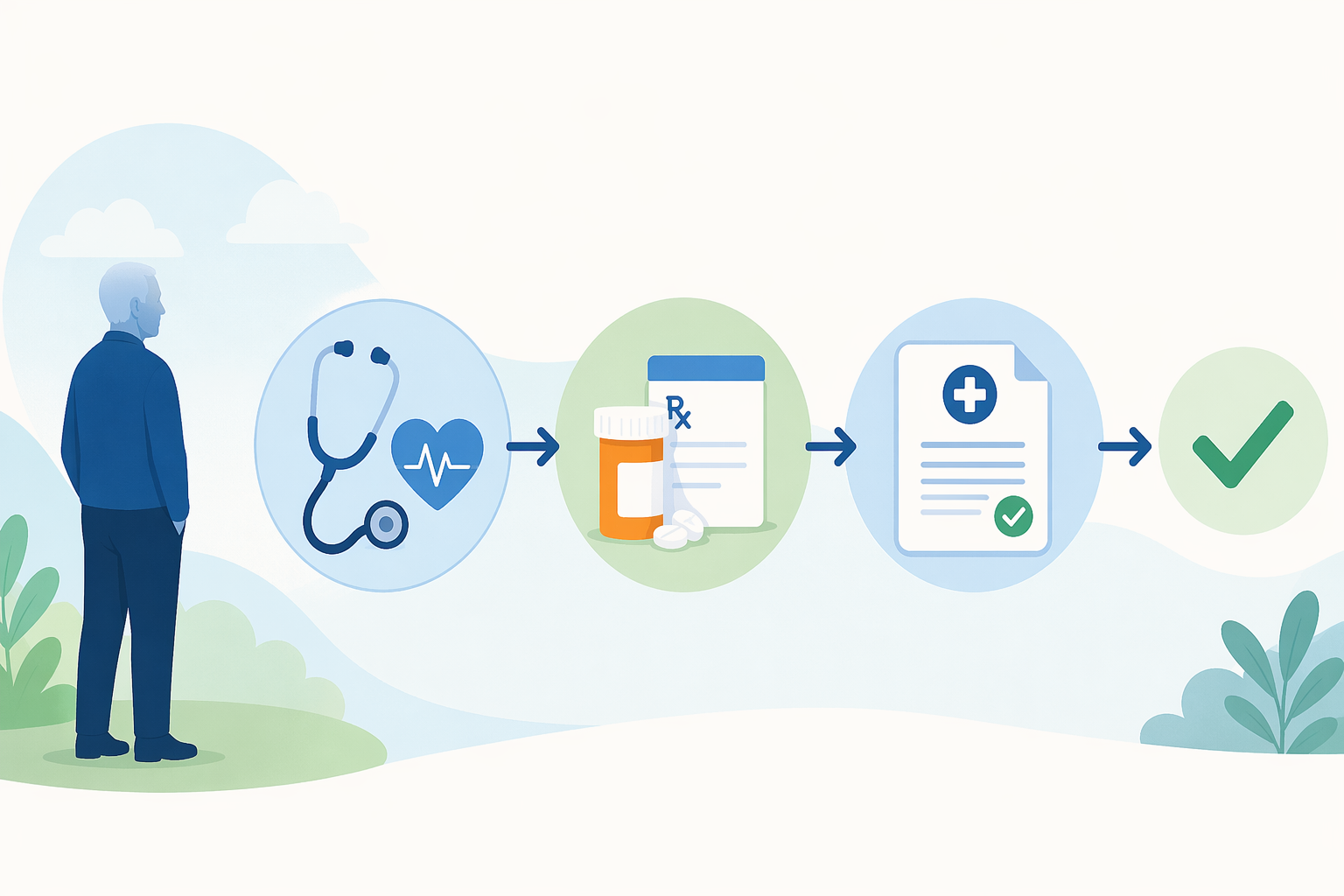
Why the Pill Form Matters, and Where It Does Not
Enlicitide is an oral PCSK9 inhibitor. That means it targets the same cholesterol-lowering pathway as injectable PCSK9 drugs, but it is taken as a once-daily pill rather than an injection.[1] For many older adults, that is not a small convenience. Injections can involve storage questions, training, hand strength, vision issues, needle reluctance, and delays while waiting for specialist offices to handle paperwork.
The pill form may also change who can start the conversation. Enlicitide can be prescribed by a primary care provider, which matters for seniors who see their primary doctor reliably but wait months for cardiology appointments or live far from a specialist.[5] Still, primary-care-prescribable is not the same as appropriate for everyone. The doctor still has to match the drug to the parent’s cardiovascular risk, current medicines, kidney and liver considerations, side-effect history, and insurance rules.
It is fair to bring up the practical side directly. If your parent has skipped injectable medication because of needle anxiety, storage problems, dexterity issues, or difficulty getting to specialist visits, say that plainly. Those details do not replace medical criteria, but they help the doctor understand why an oral option may be more usable for this particular person.
Prior Authorization May Be the Real Waiting Room
Two days after FDA approval, it is too early to assume smooth insurance coverage. The list price has been reported at $315 per month, lower than the reported monthly prices for injectable PCSK9 drugs such as Repatha and Praluent, but list price is not the same as what a Medicare beneficiary pays at the pharmacy counter.[6] The plan’s formulary tier, deductible status, coinsurance, and utilization rules will decide the first real bill.
For 2026, Medicare Part D has a $2,100 annual out-of-pocket cap, so a senior who already reaches that cap through other covered medications may owe no additional out-of-pocket cost after the cap is reached.[7] That is helpful, but it does not answer whether Lipfendra will be on the plan formulary, whether it will require prior authorization, or how much the patient pays before reaching the cap.
Expect the insurer to ask for the same kind of information it already asks for with PCSK9 injectables: diagnosis, LDL level, statin use or statin intolerance, and sometimes ezetimibe use.[4] A denial does not always mean the parent is medically ineligible. Sometimes it means the request was missing a lab result, a diagnosis code, a medication trial, or a note explaining why the usual statin requirement does not apply.
| Prior Authorization Item | What To Have Ready |
|---|---|
| Diagnosis | ASCVD history, HeFH documentation, or LDL ≥190 mg/dL history if applicable. |
| Current LDL | Most recent lipid panel, ideally with the date and whether the parent was taking treatment. |
| Current therapy | Medication list showing statin dose, ezetimibe, and other cholesterol medicines. |
| Past statin trials | Names, doses, dates, side effects, and reasons for stopping or lowering dose. |
| Insurance details | Medicare Part D plan card, pharmacy benefit information, and preferred pharmacy. |
If the doctor agrees enlicitide is reasonable, ask who handles the prior authorization and how the family will know if more records are needed. In some offices the clinician submits the request; in others, a pharmacy team, nurse, or centralized authorization staff member does it. A caregiver does not need to argue the case medically, but someone does need to answer the portal message when the office asks, “Which statins did she try?”
Questions to Bring to the Doctor
A good appointment question is specific enough for the doctor to answer without forcing the family into prescribing. Instead of “Can he get the new cholesterol pill?” try bringing the records and asking:
- Based on his ASCVD, HeFH, or LDL history, is he in a risk group where you would consider a PCSK9-targeting medicine?
- What LDL goal are you using for him, and is his most recent LDL still above that goal?
- Has he already had an adequate high-intensity statin trial, or is his current dose considered his maximum tolerated dose?
- If he is considered statin-intolerant, is that clearly documented in the chart?
- Would his insurer likely require ezetimibe before approving enlicitide?
- If you prescribe it, who in the office handles the prior authorization and appeal if needed?
For a parent who has bounced between primary care, cardiology, hospital stays, and multiple pharmacies, this conversation may take more than one visit. That is not failure. It is often the difference between a clean request and weeks of back-and-forth because the insurer cannot see the history the family knows exists.
What to Put in the Appointment Folder
Before the visit, collect the few items most likely to change the conversation:
- The most recent lipid panel, especially the LDL cholesterol result and date.
- Any older LDL result at or above 190 mg/dL, if that has ever appeared.
- Current cholesterol medications, including dose and how often your parent actually takes them.
- Past statins tried, including side effects, dose changes, stop dates, and whether more than one statin was attempted.
- Records of ASCVD, HeFH, heart procedures, stroke, peripheral artery disease, or other relevant cardiovascular diagnoses.
- Medicare Part D or other prescription insurance information, including the pharmacy benefit card.
Enlicitide is a credible new option for many older adults, particularly those who remain above LDL targets despite treatment or who have a documented reason they cannot tolerate statins. The senior trial representation is encouraging, the LDL reduction is meaningful, and the once-daily pill could remove real friction. The next step is still a prepared medical and insurance conversation, not an assumption that FDA approval turns into pharmacy pickup by next week.
References
- FDA approves first oral therapy that inhibits proprotein convertase subtilisin/kexin type 9 (PCSK9) to lower LDL cholesterol — FDA — fda.gov/drugs/news-events-human-drugs/fda-approves-first-oral-therapy-inhibits-proprotein-convertase-subtilisinkexin-type-9-pcsk9-lower
- Merck’s Lipfendra (enlicitide) is the first and only once-daily oral PCSK9 inhibitor approved by the U.S. FDA — Merck — merck.com/news/mercks-lipfendra-enlicitide-is-the-first-and-only-once-daily-oral-pcsk9-inhibitor-approved-by-the-u-s-fda/
- CORALreef Lipids Trial — NEJM — nejm.org/doi/abs/10.1056/NEJMoa2511002
- PCSK9 Inhibitor Insurance Coverage — Empirical Health — empirical.health/blog/pcsk9-inhibitor-insurance-coverage/
- Oral PCSK9 Inhibitor Lipfendra — Empirical Health — empirical.health/blog/oral-pcsk9-inhibitor-lipfendra/
- Merck wins US approval for cholesterol pill, setting up a test of pricing strategy — BioPharma Dive — biopharmadive.com/news/merck-lipfrendra-enlicitide-fda-approve-voucher-pcsk9/825377/
- New Cholesterol Drug May Make Heart Care Easier and Cheaper — Smart Senior Daily — smartseniordaily.com/new-cholesterol-drug-may-make-heart-care-easier-and-cheaper/
Questions to bring to a clinician or OT
This is not medical, legal, or a family's final decision — only a framework. Bring these questions to a clinician, occupational therapist, or your local Area Agency on Aging.
Find Local HelpRelated reading
Noticed something outdated or inaccurate on this page? Flag a correction. We review every report against CDC, NIA, and AARP HomeFit guidance before updating a page.