
Caregiver decision guide
How to Find an NHS Dentist for an Elderly Parent in Devon
This guide helps caregivers navigate Devon's NHS dental access crisis by explaining three mobility-dependent routes — practice visits for travel-capable parents, domiciliary care for housebound or care home residents, and urgent treatment via NHS 111 — and how to choose the right path for an elderly parent.
If you are finding an NHS dentist for an elderly parent in Devon, England, start with one uncomfortable fact: the normal advice may not work in the normal way. In the South West, only 62% of people who tried to get an NHS dental appointment succeeded, compared with 81% nationally, according to the 2026 GP Patient Survey reported by the BBC in July 2026.[1] That is survey evidence, not a live administrative count of every appointment, but it explains why a sensible search can still leave you with a notebook full of unanswered calls.
Devon’s local routes are also strained. Nearly 60,000 people were on Devon’s NHS dental waiting list as of September 2023, and local patient information published in 2025 says the Devon Dental Helpline is no longer adding new patients to that list.[2][3] Last reviewed for this article: July 19, 2026. Because that kind of access notice can change, check the latest local NHS and practice information before relying on any single phone number.
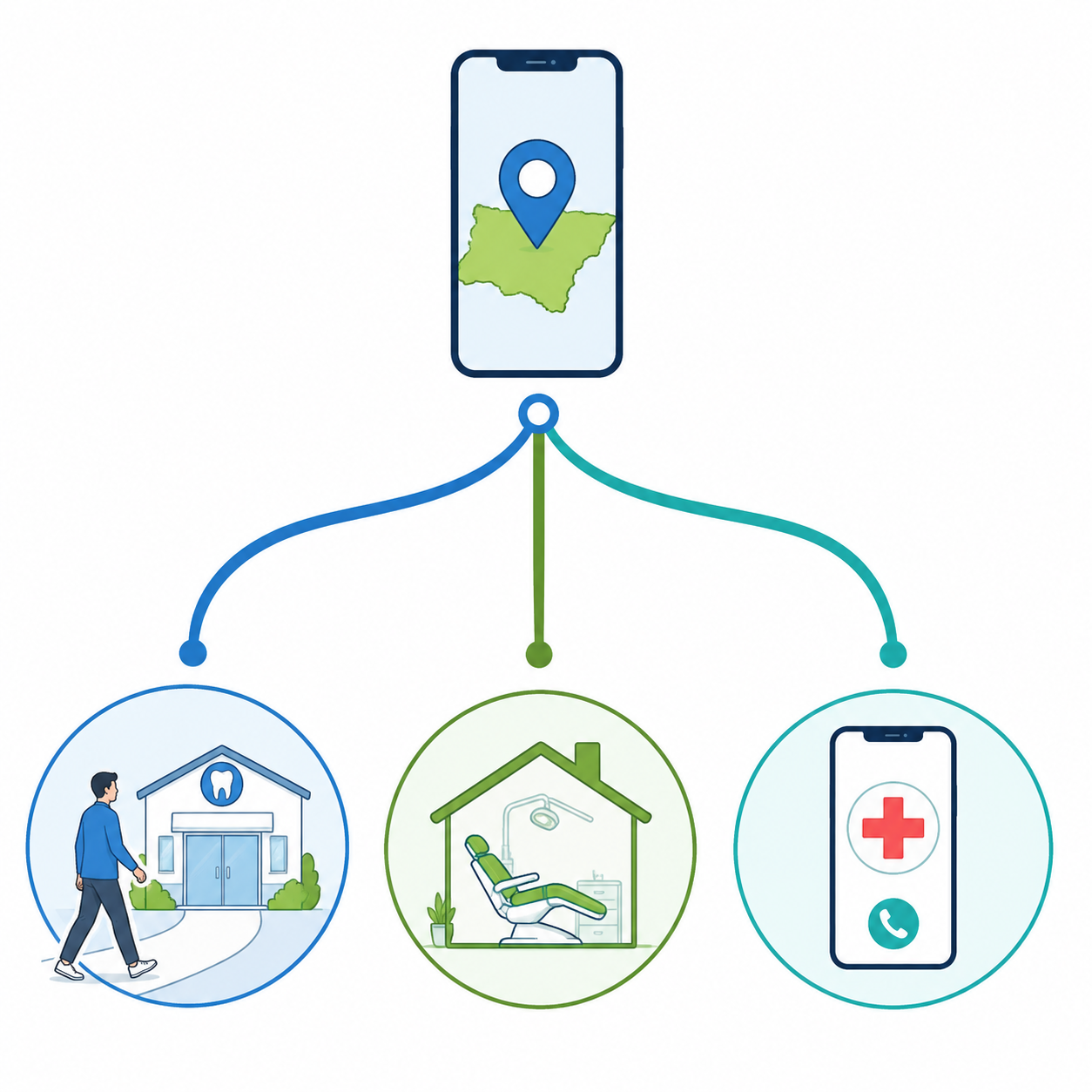
The useful first question is not “Which dentist is taking patients?” It is: can your parent travel, are they housebound or in a care home, or is this urgent enough for NHS 111? Those are different doorways. Mixing them up wastes time, and in dental pain, time is not a small thing.
| Your parent’s situation | Route to try first | What to avoid |
|---|---|---|
| Can travel to a dental practice, with or without help | Use NHS Find a Dentist, then call practices directly about NHS appointments and waiting lists | Do not assume they can register with an NHS dentist like a GP |
| Housebound, bedbound, or unable to manage a practice visit | Ask about domiciliary dental care and referral-only community dental services | Do not assume a named Devon provider covers every postcode |
| In a care home | Ask the care home about oral health assessment, daily mouth care, and referral routes | Do not accept vague “we’ll monitor it” answers if there is pain, swelling, broken teeth, or eating difficulty |
| Severe pain, swelling, trauma, bleeding, or possible infection | Use NHS 111 for urgent dental advice | Do not keep phoning routine waiting lists first |
If Your Parent Can Travel to a Dental Practice
For a parent who can get to a practice, even with a lift, wheelchair taxi, or family member in the waiting room, the first route is still ordinary NHS practice access. It is just not as simple as typing in a postcode and believing every result is available.
Use the NHS “find a dentist” service as a starting list, not as proof. NHS guidance tells patients to search for practices and contact them directly about NHS appointments; it also makes clear that you do not register permanently with an NHS dentist in the same way you register with a GP.[4] A practice may have treated your parent before and still be unable to offer a new NHS course of treatment now.
That distinction matters when you are on the phone. “Are you taking NHS patients?” is too easy to answer with a flat no. Ask the narrower questions, and write down the answers.
- Are you offering any NHS appointments for adults at the moment?
- Do you have a waiting list for NHS treatment, and can my parent be added?
- If not, do you know when the position will be reviewed?
- Do you treat older patients with mobility, dementia, or medication issues?
- If my parent develops urgent pain while waiting, should we call you again or use NHS 111?
Devon NHS information points patients toward checking NHS dental availability, contacting practices, and using urgent routes where appropriate.[5][6] It does not mean every practice shown online has a place. Directory entries lag reality; reception teams know the current boundary.
Keep a simple call log: date, practice name, phone number, person spoken to if given, whether they provide NHS treatment, whether there is a waiting list, and what they told you to do if symptoms worsen. This is not bureaucracy for its own sake. If you later need a GP, care home nurse, social worker, community dental service, or NHS 111 adviser to understand what has already been tried, your notes save your parent from starting the story again.
If Your Parent Is Housebound or Cannot Safely Attend a Practice
A housebound parent is not just a travel-capable patient with a longer taxi ride. If they cannot transfer safely, become distressed outside the home, are bedbound, or live with advanced dementia, the practical question changes from “Which practice has a vacancy?” to “Who is commissioned or willing to provide care where this person is?”
Domiciliary dental care means dental assessment or treatment provided away from a dental surgery, usually in a person’s home or care home. It can be essential, but it is scarce. The Care Quality Commission’s Smiling Matters review reported that only 5% of NHS dental contracts included domiciliary provision.[7] That does not mean only 5% of housebound people need help; it means the commissioned route is narrow.
There are two broad kinds of doorway in Devon. Community dental services are NHS services for people who meet referral criteria; some are referral-only. Separately, some dental providers hold NHS contracts to deliver domiciliary care in defined local areas. The frustrating part is that a provider name on a page does not mean your parent’s postcode is covered, or that you can self-refer.
| Service or provider | Published route or coverage detail | Phone |
|---|---|---|
| Exeter Salaried Dental Service | Community dental service; referral-only route listed by Devon County Council | 01392 405718 |
| Plymouth Community Dental Service | Community dental service listed for Devon-area dental support | 01752 434664 |
| Torbay and South Devon Community Dental Service | Community dental service; Torbay and South Devon NHS information describes referral access | 01803 217777 |
| At Home Dental | NHS dentistry for Torbay and Exeter postcodes only, according to provider information | 0808 169 4546 |
| Torrington Dental Practice | Domiciliary provider listed for North Devon | 01805 623657 |
| Holsworthy Dental Centre | Domiciliary provider listed for West Devon | 01409 253684 |
| Marlborough Dental Centre | Domiciliary provider listed for the Ilfracombe area | 01271 862556 |
This is a working list, not a promise of access. The Devon County Council oral health page lists community and domiciliary dental contacts, Torbay and South Devon NHS Foundation Trust explains its community dental service, and At Home Dental publishes its Torbay and Exeter postcode limitation.[8][9][10] Before you spend a week chasing the wrong route, ask three things: do you cover this postcode, do you accept self-referrals, and what evidence do you need that the patient cannot attend a practice?
If the answer is “referral only,” ask who can refer. Depending on the service, it may need to come from a dentist, GP, health professional, care home nurse, or another professional involved in the parent’s care. Do not assume the GP can solve the dental problem clinically; the useful role may be confirming frailty, medical history, capacity concerns, or housebound status so the right dental service can triage the case.
When you call, describe function rather than only diagnosis. “Mum has dementia” is relevant, but “Mum cannot tolerate a waiting room, cannot follow instructions reliably, and has stopped chewing on one side” is more useful for triage. “Dad is elderly” is too broad; “Dad cannot transfer from bed to wheelchair without two carers” tells the service why ordinary practice access is not realistic.

What to Ask a Care Home
If your parent lives in a care home, ask for more than “we keep an eye on it.” NICE guidance says care home residents should have an oral health assessment on admission and daily mouth care recorded in their care plan.[11] That gives you a practical basis for questions.
- When was the last oral health assessment completed, and what did it record?
- Is daily mouth care in the care plan, including dentures if used?
- Has anyone noticed refusal of food, facial swelling, bleeding gums, broken teeth, loose dentures, or new distress during mouth care?
- Which dentist or community dental service does the home usually contact?
- If the home says NHS care is unavailable, have they tried NHS 111 for urgent symptoms or requested a referral route for a housebound resident?
Access problems in care homes are not imaginary. A 2026 care home dental care report states that one in four UK care homes said residents could never access NHS dental care.[12] Treat that as a warning about availability, not as a reason to stop asking. The care home still has responsibilities around assessment, daily support, recording concerns, and escalating pain or suspected infection.
When to Stop Searching and Use NHS 111
If your parent has urgent dental symptoms, do not keep working down a practice spreadsheet as though this is a routine check-up. NHS guidance directs people who need urgent dental treatment and do not have a dentist to use NHS 111.[4] Healthwatch gives the same practical steer for people struggling to find NHS dental care.[13]
Use NHS 111 if there is severe pain, swelling, trauma, bleeding that will not stop, signs of infection, or a broken tooth or denture problem that is stopping your parent from eating, drinking, sleeping, or taking medication. If there are symptoms that look life-threatening, such as severe facial swelling affecting breathing or swallowing, treat that as an emergency rather than a dental access problem.
Have the basics ready before calling: your parent’s NHS number if you have it, address and postcode, current medications, allergies, relevant diagnoses, whether they can travel, whether they are in a care home, and what you have already tried. If dementia or communication difficulty is part of the situation, say so early. A parent who cannot explain pain reliably may need a different level of caution.
Dementia, Consent, and Pain That Does Not Come With a Clear Complaint
Dental need is easy to miss when an older person cannot say “this tooth hurts.” Watch for changed eating, pulling at the face, refusing dentures, disturbed sleep, aggression during mouth care, weight loss, bad breath, drooling, or sudden reluctance to take tablets. None of those signs proves a dental problem by itself, but they are enough to justify asking for an oral assessment.
For a parent who may lack capacity to consent to dental treatment, decisions must be handled under the Mental Capacity Act framework. NHS England’s oral health framework for an ageing population discusses consent, capacity, and the need to support oral health for older people, including those in care settings.[14] In practice, tell the dental service who has legal authority if there is a health and welfare lasting power of attorney, and bring the document or access code if asked.
If there is no power of attorney, that does not mean no care can be given. It means the professionals must assess capacity for the specific decision and, if needed, make a best-interests decision. The caregiver’s job is to provide the facts: what the parent is usually like, what has changed, what they previously wanted, and what practical risks now exist.
Do Not Assume Dental Care Is Free Because Your Parent Is Over 60
This catches families out. In England, being over 60 does not automatically make NHS dental treatment free. Age UK explains that free NHS dental treatment depends on qualifying benefits or other exemption rules, not age alone.[15]
From April 2026, NHS dental charges in England are £27.90 for Band 1, £76.60 for Band 2, and £332.10 for Band 3 treatment.[15] Those bands matter if your parent is on a fixed income and delays care because everyone assumed the bill would be unaffordable, or free, without checking.
Pension Credit Guarantee Credit is one important gateway to free NHS dental treatment, and the NHS Business Services Authority also points people toward help through the NHS Low Income Scheme, including HC2 and HC3 certificates.[16] The Department for Work and Pensions estimated in October 2025 that about 910,000 eligible households were not claiming Pension Credit.[17] That figure is UK-wide, not Devon-specific, but it is large enough to make a benefits check worth doing before a parent refuses treatment on cost grounds.
A Practical Order of Calls
When everything feels urgent, order helps. It does not fix the access shortage, but it stops the shortage from making you chase the wrong door.
- Decide whether this is urgent. Severe pain, swelling, trauma, bleeding, suspected infection, or inability to eat or take medication belongs with NHS 111 rather than routine waiting lists.
- Decide whether your parent can realistically travel to a practice. Be honest about transfers, confusion, continence, distress, and transport.
- If they can travel, use NHS Find a Dentist as a starting list and call practices directly about NHS appointments and waiting lists.
- If they cannot travel, ask about domiciliary care, community dental referral criteria, postcode coverage, and who is allowed to refer.
- If they are in a care home, ask for the oral health assessment, daily mouth care plan, usual dental referral route, and written record of any symptoms.
- Check NHS dental cost help before assuming treatment is free or unaffordable.
- Keep the call log, referral attempts, dates, and names together. Devon access details change, and documented persistence is easier to escalate than a half-remembered chain of calls.
The hard part is accepting that “find a dentist” is not one task in Devon. It is a routing decision: practice access if your parent can travel, domiciliary or community dental referral if they cannot, and NHS 111 when symptoms are urgent. Start there, write everything down, and recheck local information before assuming yesterday’s answer is still today’s rule.
References
- South West worst for NHS dentist access, data says, BBC News, July 2026.
- Nearly 60,000 patients on Devon NHS dental services waiting list, Exeter Observer, September 15, 2023.
- NHS Dentist, Mount Pleasant Health Centre.
- How to find an NHS dentist, NHS.
- NHS dental care, MyHealth Devon, 2025.
- NHS dental care, One Devon.
- Smiling Matters: Oral health care in care homes, Care Quality Commission.
- Oral health for adults, Devon County Council.
- Community Dental Service, Torbay and South Devon NHS Foundation Trust.
- NHS Dentistry for Torbay and Exeter, At Home Dental.
- Oral health for adults in care homes, NICE, July 2016.
- Care Home Dental Care UK 2026, Dentists Closeby.
- How can you find an NHS dentist?, Healthwatch, August 22, 2025.
- Framework for maintaining the oral health of our ageing population, NHS England.
- Dental treatment and care for over 60s, Age UK.
- Free NHS dental treatment, NHS Business Services Authority.
- Pension Credit take-up statistics financial year 2023 to 2024, Department for Work and Pensions, October 2025.
Questions to bring to a clinician or OT
This is not medical, legal, or a family's final decision — only a framework. Bring these questions to a clinician, occupational therapist, or your local Area Agency on Aging.
Find Local HelpRelated reading
Noticed something outdated or inaccurate on this page? Flag a correction. We review every report against CDC, NIA, and AARP HomeFit guidance before updating a page.