
Caregiver decision guide
How to Coordinate Financial Planning as a Senior Couple
This guide helps senior couples coordinate the four key financial decisions in retirement — Social Security, Medicare, income budgeting, and retirement timing — to maximize combined benefits, minimize costs, and protect both partners.
A senior couple cannot answer “When should we retire?” by looking at one spouse’s Social Security statement, one Medicare card, or one investment balance. The useful question is plainer: if both of you stop working, and then one of you gets sick or dies first, does the household still work?
That is the heart of financial planning for senior couples. Social Security claiming, Medicare enrollment, retirement income, and retirement timing all land on the same kitchen table. Treating them as separate decisions is how a couple can make four reasonable choices that still leave one spouse exposed.

Put the Four Decisions on One Page
Before choosing a retirement date or a Social Security claiming age, write the couple’s main moving parts in one place. The point is not to build a perfect forecast. It is to see which choice changes another choice.
| Decision | What to write down for each spouse | Why it matters as a couple |
|---|---|---|
| Social Security | Estimated benefit at 62, full retirement age, and 70; spousal or survivor benefit possibilities | One spouse’s claiming age can affect the other spouse’s survivor income later. |
| Medicare | 65th birthday month, current coverage, Part B timing, expected premiums, possible IRMAA exposure | Medicare is individual coverage, but the bills and income thresholds can hit the household. |
| Monthly income floor | Essential housing, food, insurance, taxes, utilities, healthcare, transportation, and debt costs | A couple needs to know what income must continue even after the first spouse dies. |
| Retirement timing | Preferred retirement date, realistic backup date, employer health coverage, pension or 401(k) access | Retiring together may feel right, but staggered timing can sometimes protect coverage or income. |
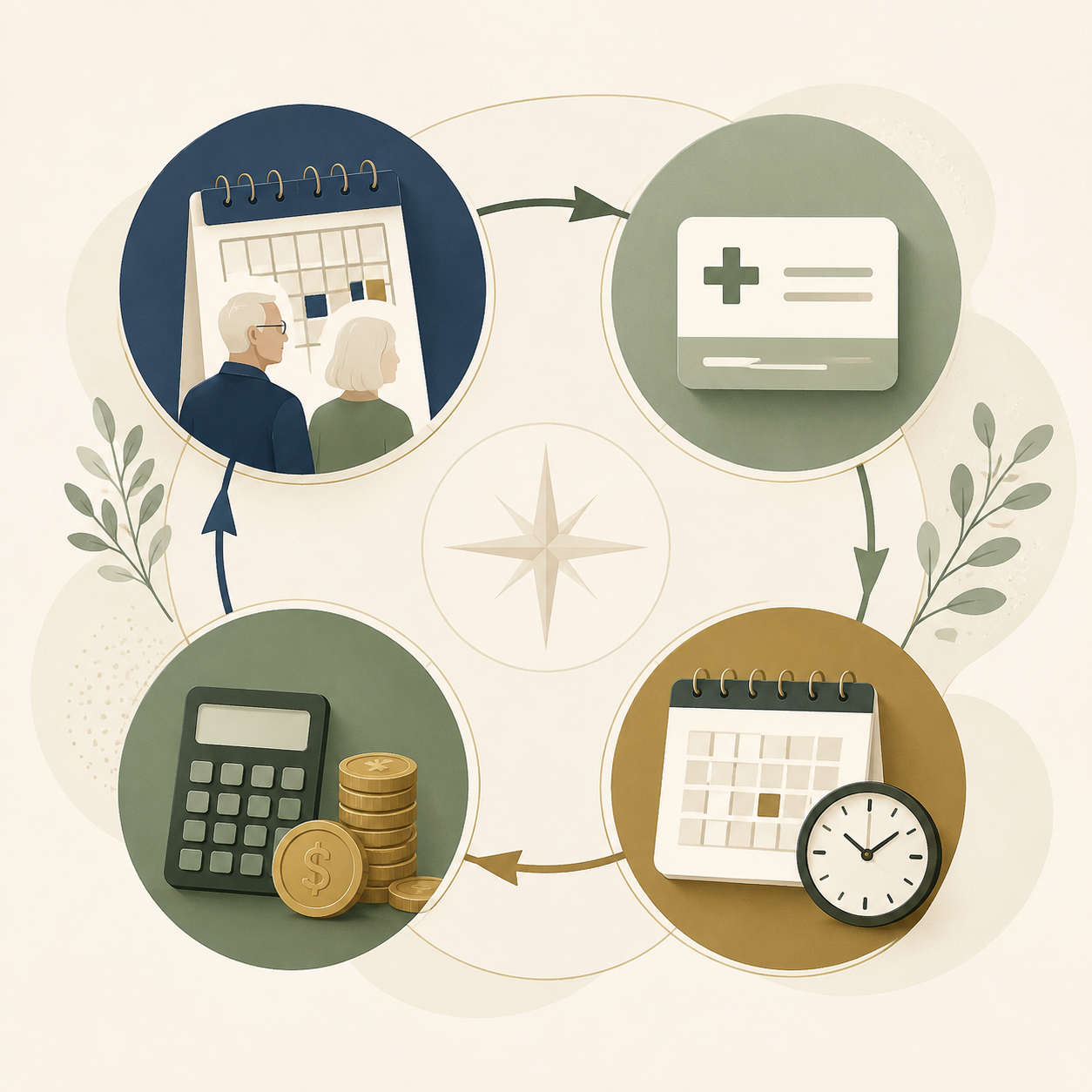
Start with the page, not with the product. A pension election, an annuity quote, a Medicare Advantage brochure, or a brokerage withdrawal plan may all be useful later. But first, both partners should be able to point to the same sheet of paper and say, “This is what pays the bills, this is what changes if one of us is alone, and this is where we need advice.”
Find the Shared Income Floor Before You Talk About Lifestyle
Retirement articles often begin with travel, hobbies, or a cheerful percentage of current income. A couple needs something less glossy and more useful: the monthly amount that must be covered whether both spouses are healthy, one spouse needs care, or one spouse is widowed.
The average retired couple receives roughly $2,900 a month combined from Social Security, and Social Security is often described as replacing about 40% of pre-retirement income for the average worker.[1] That is enough to matter greatly, but usually not enough to settle the whole budget.
A common retirement-income planning range is 70% to 85% of pre-retirement income, and the 4% withdrawal rule is often used as a starting guideline rather than a promise.[2] For a couple, the better first worksheet is not “Can we afford retirement?” It is this:
- What expenses continue if one spouse dies?
- Which income sources stop, shrink, or change after the first death?
- Which bills are fixed enough that the surviving spouse cannot easily reduce them?
- Which accounts can be tapped without a tax surprise or penalty?
- Who knows the passwords, account locations, insurance policies, and adviser names?
This is where the quieter spouse needs a real seat at the table. If one partner has always handled the investments, the other still needs to know which checks arrive each month, which premiums are deducted automatically, and which account would pay an emergency bill. Knowing is not meddling. It is protection.
Treat Social Security as a Lifetime-and-Survivor Decision
Social Security claiming is the place where couples most often need to slow down. The question is not simply, “When do I get the most?” It is, “What combination gives us enough income while both of us are alive, and what protects the survivor after one benefit goes away?”
For married couples, spousal benefits can be up to 50% of the higher earner’s full retirement age benefit, and survivor benefits can be up to 100% of the deceased spouse’s benefit.[3] Those two rules make the higher earner’s claiming age a household decision, especially when one spouse’s own benefit is much smaller.
Fidelity has estimated that if the higher-earning spouse delays claiming from 62 to 70, it can increase the surviving spouse’s lifetime benefits by up to 22%.[4] “Up to” is doing real work there. It is not a guarantee for every couple. Health, life expectancy, cash needs, age difference, and work status all matter. But the direction is important: when the higher earner delays, the larger survivor benefit may also be larger.
That can be hard to accept when both spouses are tired of working, or when one spouse wants to claim simply because “it’s my money.” It is their money, but marriage turns the claiming date into a shared risk decision. If the lower-benefit spouse is likely to be the survivor, the higher earner’s early claim may be felt years later by the person left paying the property tax, the electric bill, the supplemental insurance premium, and the grocery bill on one income.
A simple Social Security worksheet for two
Gather both Social Security estimates and put these numbers side by side:
- Each spouse’s estimated benefit at 62, full retirement age, and 70.
- Each spouse’s expected monthly income if both are alive.
- The estimated monthly income for the surviving spouse under each claiming combination.
- The number of months savings would need to bridge if one spouse delays claiming.
- The health or caregiving facts that might make waiting unrealistic.
A household with plenty of savings may be able to let the higher earner delay. A household with limited savings, poor health, or job loss may not. Either way, the couple should make the trade-off knowingly. The problem is not claiming early. The problem is claiming early without checking what it does to the survivor.
Medicare Is Individual Coverage, but the Budget Is Shared
Medicare can sound like the moment healthcare becomes simple. It is not simple enough to leave off the couple worksheet.
Each spouse has separate Medicare coverage and pays separate Part B premiums. AARP reported the standard Part B premium as $174.70 per month per person in 2024, and high-income couples filing jointly faced IRMAA surcharges starting at $206,000 in adjusted gross income.[5] Those figures are dated planning anchors, not current promises; premiums and thresholds are adjusted over time.
The couple mistake is easy to make: one spouse turns 65, enrolls correctly, and everyone assumes Medicare has been handled. But the other spouse may still be on employer coverage, may need a separate enrollment window, or may face a different premium decision. If the older spouse retires and the younger spouse loses employer coverage before Medicare eligibility, the gap can be expensive.
Premium-free Part A may be available based on a spouse’s work record, which can help a lower-earning spouse who did not qualify alone.[6] That is exactly the kind of rule couples should check before assuming one partner’s thinner work history means fewer options.
Check the Medicare timeline before choosing the retirement date
For each spouse, write down the 65th birthday month, current insurance source, whether active employer coverage exists, expected Part B timing, prescription coverage, and whether joint income could trigger IRMAA. If one spouse is still working mainly for health insurance, that belongs in the retirement-date conversation, not in a separate Medicare folder.
Healthcare savings estimates also deserve a place on the same page. Fidelity estimated that a 65-year-old couple retiring in 2024 would need about $330,000 in after-tax savings for healthcare costs in retirement.[7] That estimate changes from year to year and does not mean every couple will spend that exact amount. It does mean “we’ll have Medicare” is not a complete healthcare budget.
Couples should also separate routine healthcare costs from care needs that can disrupt the whole household. Long-term care, home care, and family caregiving can change withdrawals, housing decisions, and the healthier spouse’s daily life. If care costs are already part of the discussion, it is worth reading more specifically about the true cost of long-term care in 2026, the hidden economics of long-term care, and how to pay for in-home care in 2026.
Retirement Timing Has to Cover Income and Insurance
Many couples imagine retiring together because they have waited years for the same calendar to open. There is nothing wrong with wanting that. But the math should at least be allowed to speak before the date is circled in ink.
Equitable, citing EBRI data, reported average retirement ages of 64.7 for men and 62.1 for women. The same research discussion noted that 46% of retirees leave the workforce earlier than planned, typically because of health or disability.[8] That second number is the one to underline. A couple may plan a neat retirement sequence, then one diagnosis, layoff, or caregiving need moves the date forward.
That is why a couple should test at least three dates, even if they hope to use only one:
- The preferred date: when both spouses would like work to end.
- The protected date: when Social Security, Medicare, pension choices, and savings line up with the least strain.
- The forced date: what happens if one spouse must stop working earlier than planned.
The forced-date test is not pessimism. It is a kindness to the spouse who would otherwise have to make decisions in a hospital hallway, during a job loss, or after a death certificate is ordered.
When retiring together costs too much
If retiring together would force both spouses to claim Social Security early, lose employer health coverage before Medicare is ready, or draw heavily from savings during a down market, consider whether one spouse working longer changes the picture. The answer may still be no. Health, burnout, caregiving, and time together matter. But it should be a choice made with both the monthly budget and the survivor budget visible.
Sometimes the better compromise is not full-time work. It may be part-time work, delaying only the higher earner’s Social Security, using savings for a short bridge, or changing the retirement date by months rather than years. A licensed financial or tax professional can help test the tax and withdrawal effects, but the couple still needs to bring the household facts.
Build a Budget That Can Bend Without Breaking
A couple’s retirement budget should not be a single pretty monthly number. It should show what can be reduced, what cannot, and what becomes harder after the first spouse dies.
| Budget line | Couple question to answer |
|---|---|
| Housing | Can one spouse afford the home alone, including taxes, insurance, maintenance, and utilities? |
| Healthcare | Are both Medicare premiums, drug costs, supplemental or Advantage plan costs, dental, vision, and hearing expenses included? |
| Withdrawals | Which accounts are used first, and what happens if markets are down? |
| Taxes | Will required withdrawals, Roth conversions, pension income, or investment gains affect Medicare premiums or taxable income? |
| Care needs | What savings, insurance, family help, or home changes would pay for care if one spouse needs help with daily living? |
| Survivor income | Which income disappears or changes after the first death? |
Withdrawal rules need special care because a surviving spouse may have less income but many of the same bills. A fixed withdrawal percentage can be a useful starting point, but real households often need flexibility: lower withdrawals in bad market years, larger withdrawals for medical costs, and tax planning before required distributions or Medicare premium surcharges become a surprise.
Adult children helping parents should be careful here. The job is not to take over unless safety requires it. A better first role is to help gather statements, write down due dates, compare Medicare timelines, and ask whether both spouses understand the plan. If one parent has always handled the money, the other parent may need patience, not a lecture.
Make the Plan Usable If One Spouse Cannot Manage It
A retirement plan that only one spouse can operate is not finished. The account list, beneficiary forms, insurance policies, passwords, bill schedule, tax records, and professional contacts should be findable by the other spouse or by the trusted person who would step in.
This is where estate planning belongs in the couple’s financial conversation. Not as a gloomy detour, and not as something to postpone until everyone feels ready. The National Council on Aging’s estate planning checklist notes core documents older adults should consider, including a will, powers of attorney, advance directives, and beneficiary designations.[9] Beneficiary forms deserve special attention because retirement accounts and life insurance generally pass according to those forms, not according to a casual family understanding.
The Consumer Financial Protection Bureau also provides tools for financial security conversations in later life, including resources that can help older adults and families talk about money, decision-making, and protection from financial harm.[10] Those tools can be useful when an adult child is helping, or when one spouse is ready to organize paperwork and the other spouse is reluctant.
The practical documents to gather are ordinary, but they matter:
- Both Social Security estimates and actual claiming dates, once chosen.
- Medicare cards, plan details, premium notices, drug coverage, and IRMAA notices if any.
- Pension election paperwork, especially survivor benefit choices.
- Retirement account statements, beneficiary confirmations, and withdrawal instructions.
- Insurance policies, including life, long-term care, homeowners, auto, and supplemental health coverage.
- Legal documents and contact information for financial, tax, Medicare, and legal advisers.
The Next Conversation to Have Together
A senior couple does not need to solve every retirement question in one sitting. One good sitting is enough to stop pretending the decisions are separate.
- Gather both Social Security estimates and compare claiming ages for both lifetime income and survivor income.
- Write down both Medicare timelines, including Part B timing, prescription coverage, expected premiums, and possible IRMAA exposure.
- Build a shared monthly income floor that includes healthcare, taxes, insurance, housing, and the bills that continue for a surviving spouse.
- Compare preferred retirement dates with protected and forced-date scenarios.
- List care risks, including home care or long-term care, and decide what savings, insurance, or family support could realistically cover.
- Mark the questions that need a licensed financial planner, tax professional, Medicare counselor, or estate-planning attorney.
The aim is not to predict retirement perfectly. It is to remove the avoidable gaps that appear when two people plan as if they are financially separate. Coordination is how one spouse protects the other while there is still time to choose.
References
- Social Security 2025 Fast Facts, Social Security Administration, 2025.
- Retirement Planning for Couples: A Checklist, New York Life.
- Social Security Strategies for Married Couples, Vanguard.
- Social Security tips for couples, Fidelity.
- How Does Marriage and Joint Income Affect Medicare?, AARP.
- How Do People Pay for Health Care in Retirement?, National Council on Aging.
- 2024 Retiree Health Care Cost Estimate, Fidelity, 2024.
- Retirement planning solo vs. coupled: What’s different?, Equitable, 2024.
- Estate Planning Checklist for Older Adults, National Council on Aging.
- Tools for Financial Security in Later Life, Consumer Financial Protection Bureau.
Questions to bring to a clinician or OT
This is not medical, legal, or a family's final decision — only a framework. Bring these questions to a clinician, occupational therapist, or your local Area Agency on Aging.
Find Local HelpRelated reading
Noticed something outdated or inaccurate on this page? Flag a correction. We review every report against CDC, NIA, and AARP HomeFit guidance before updating a page.