
Caregiver decision guide
How to Protect Seniors From Fire Emergencies at Home
A systematic room-by-room fire safety audit helps family caregivers address the specific vulnerabilities that make seniors 2.5 times more likely to die in a home fire. This guide covers prevention checks, escape planning, and when professional help is needed.
Start at the front door with your shoes still on, because this is not a paperwork exercise. The question is whether your parent can avoid starting a fire, hear or recognize danger early, and get out before smoke and heat make the house impossible to cross.
That urgency is not theoretical. Adults 65 and older have 2.5 times the fire death risk of the general population, and adults 85 and older have 3.4 times the risk; USFA data for 2014-2023 also show the older-adult fire death rate increased 26% over that decade.[1] Fire also moves faster than most family rescue plans. Ready.gov warns that a small flame can become a major fire in less than 30 seconds, conditions can become life-threatening in about 2 minutes, and a home can be engulfed in flames in 5 minutes.[2]
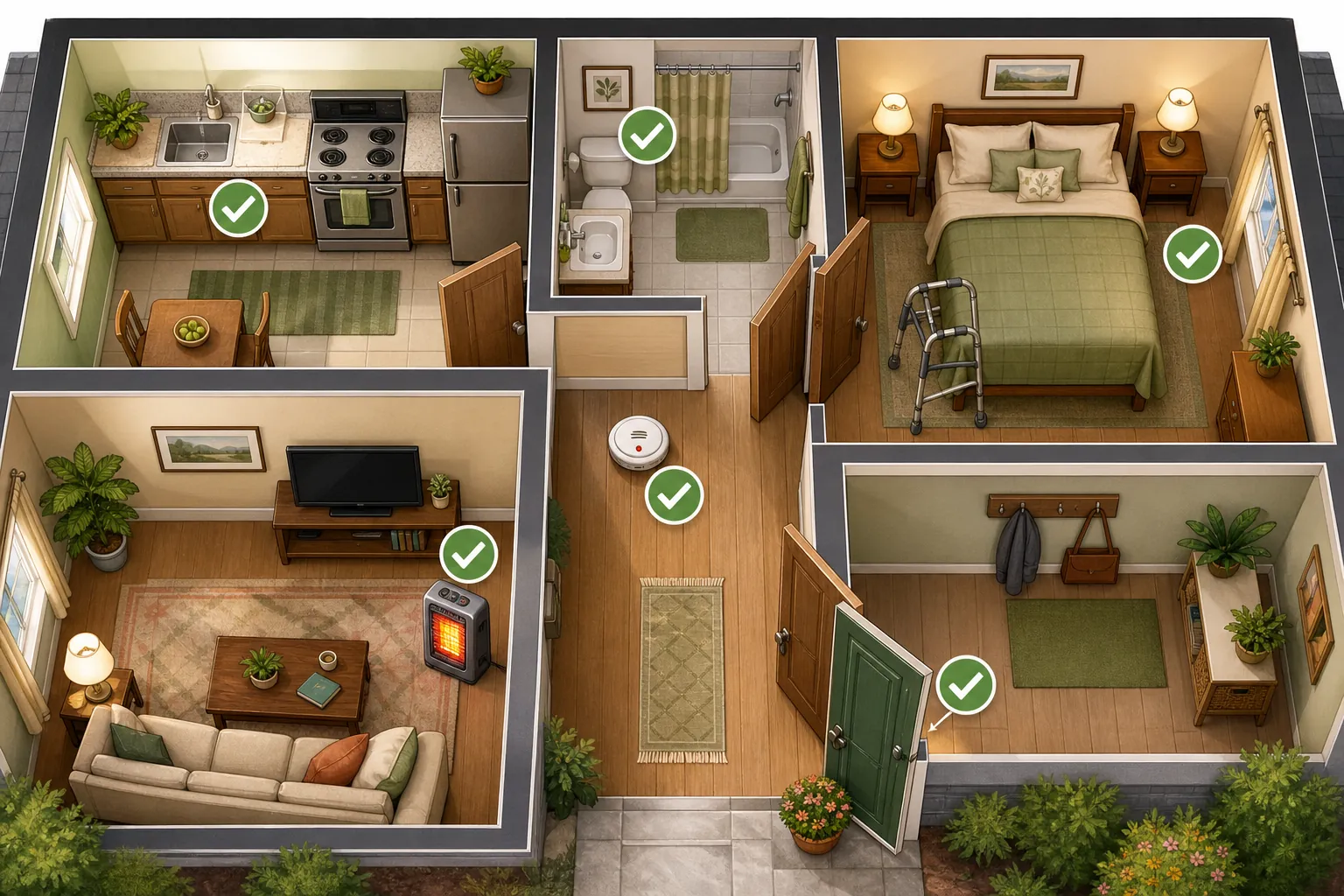
So the useful version of “how to protect seniors during fire emergencies” is not simply “install smoke alarms.” It is a room-by-room audit that asks four things in every space: what could ignite, how would the senior be alerted, can the senior physically leave, and what has changed enough that living alone may no longer be safe.
What This Audit Has To Solve
A senior’s fire risk usually sits in ordinary objects: the towel beside the stove, the recliner too close to a heater, the walker left across the bedroom path, the smoke alarm that chirps loudly in the hallway but cannot be heard from a closed bedroom. Treat the audit as a walk-through, not a lecture.
- Prevent ignition: remove the most likely sources of flame, heat, and fuel before anyone has to react.
- Detect fire in time: confirm alarms are present, working, and actually noticeable to the person who lives there.
- Make escape physically possible: check paths, doors, stairs, mobility aids, lighting, and locks from the senior’s point of movement.
- Know when the plan has failed: cognitive decline, hearing loss, or mobility limits may make supervision or home modification necessary.
If your parent also faces outdoor fire risk, keep this home-fire audit separate from wildfire evacuation planning. A separate senior wildfire preparedness guide can cover alerts, go-bags, transportation, and evacuation timing. Inside the home, the first pass is simpler: walk, touch, test, move, and write down what you cannot fix today.
Begin In The Kitchen, Where Small Compromises Add Up
The kitchen deserves the longest stop because cooking is the leading cause of fire injuries among adults over 65, with unattended cooking, loose sleeves, and forgotten stovetops among the mechanisms highlighted in older-adult fire safety guidance.[3][4] This is also the room where a caregiver can often lower risk without taking away independence.
Stand at the stove and look within arm’s reach. Move dish towels, paper towels, mail, potholders, plastic containers, wooden utensils, curtains, and grocery bags away from burners. If your parent sets items on the stovetop because counter space is limited, clear counter space somewhere else; scolding will not change the layout that caused the habit.
Then watch how cooking actually happens, respectfully. Does your parent leave the room while a pan is heating? Do sleeves hang over the front burner? Are oven mitts frayed or too thin? Are knobs hard to read? Does the person turn on the wrong burner because the markings are worn? Each answer points to a different fix: brighter markings, shorter sleeves or fitted cooking clothes, a timer placed where it will be heard, or a rule that frying and broiling happen only when someone else is home.
| Kitchen check | What to do during the audit |
|---|---|
| Combustibles near heat | Clear towels, paper, packaging, curtains, and utensils from the stovetop and toaster area. |
| Unattended cooking | Ask what usually pulls the senior away from the stove, then remove that interruption or change the cooking routine. |
| Loose clothing | Check sleeves, robes, and scarves used while cooking; keep fitted layers available near the kitchen. |
| Knobs and controls | Confirm the senior can see, grip, and understand which burner or appliance is on. |
| Alarm audibility | Test whether the kitchen or hallway alarm can be heard from the places the senior actually sits. |
If there has already been a near-miss — a scorched pan, a burner left on overnight, food repeatedly forgotten in the oven — do not file it under “Mom is getting careless” or “Dad is stubborn.” Write down the pattern. A single accident may need a better setup. Repeated events, especially when the person cannot explain what happened or cannot remember the safety rule later, belong in the later conversation about supervision.
Check The Living Room For Heat, Cords, And The Real Listening Distance
The living room is often where the senior spends the most time, and that matters for detection. A smoke alarm that sounds in the hall is not enough if your parent naps in a recliner with the television loud, hearing aids out, or a closed door between them and the alarm.
Test from the chair, not from the hallway. Sit where your parent sits. Turn on the television at the usual volume. Close the doors that are normally closed. Then test the alarm with warning and consent, or use the test feature while another person stays with your parent. If the sound is not unmistakable, the home needs an alerting adaptation, not a reminder to “listen harder.”
Ready.gov notes that smoke and toxic gases kill more people than flames, and older adults with hearing, vision, mobility, or cognitive changes may have less time to interpret what is happening and move.[2] For someone who cannot reliably hear a standard alarm, ask about alarms with strobe lights, bed shakers, or other accessible alerting features. The right device depends on the person’s hearing, sleep pattern, and home layout.
Now look at heat sources. Space heaters, fireplaces, overloaded outlets, extension cords under rugs, and chargers crowded behind furniture all deserve attention. Keep anything that can burn away from heat. If a space heater is necessary, it should be stable, placed where a walker or foot will not knock it over, and used according to the manufacturer’s instructions. If cords are warm, cracked, pinched under furniture, or daisy-chained through power strips, stop using them and have the electrical load reviewed.
Make The Bedroom Work At 2 A.M.
Night is when a polite escape plan falls apart. Glasses are on the dresser. Hearing aids are charging across the room. The cane is in the hallway. The walker is folded because it looked neater. The bedroom audit should assume stiffness, darkness, sleep inertia, and fear.
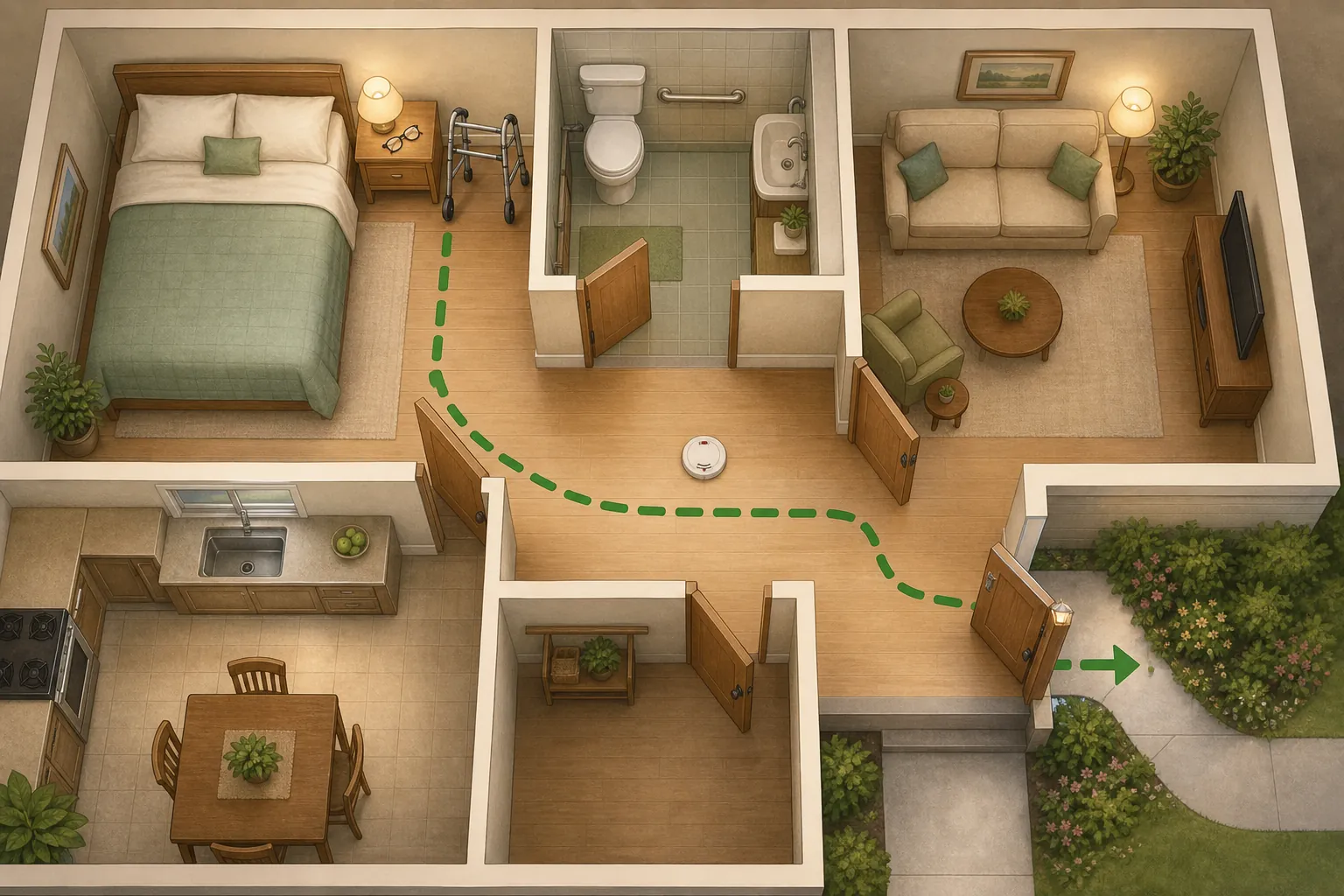
Massachusetts fire safety guidance for seniors specifically recommends keeping eyeglasses, canes, walkers, and hearing instruments next to the bed at night.[5] That is not a convenience detail. It is the difference between standing up and moving, or spending the first minute of a fire searching for the tools needed to escape.
- Place glasses, hearing aids or hearing devices, phone, cane, walker, and slippers within easy reach from the sleeping position.
- Clear the path from bed to door wide enough for the mobility aid used at night, not the one used on a good afternoon.
- Remove throw rugs, low baskets, oxygen tubing slack, shoes, and furniture corners that catch feet or walker legs.
- Check that bedroom doors and windows open easily from the inside, including for hands with arthritis or weak grip.
- Use lighting that can be activated without crossing the room.
Ready.gov also advises sleeping with the bedroom door closed because a closed door can slow the spread of fire and smoke.[2] That only helps if the alarm can still alert the sleeper and the person can open the door and leave. Test both conditions. A closed-door habit paired with an inaudible alarm is not protection.
Walk Every Exit Path With The Mobility Aid
Do not inspect hallways with your eyes only. Put the walker, cane, rollator, or wheelchair in the path and move from bedroom to exterior door. If your parent uses different aids at different times, test the one used when tired, dizzy, or newly awake.
USFA guidance tells older adults who use a walker or wheelchair to check all exits and make sure they can get through the doorways.[3] That means interior doors, bedroom doors, bathroom doors, storm doors, thresholds, and the final exterior door. A path that narrows at the laundry basket or a table leg is not an escape path; it is a bottleneck waiting for a bad night.
Look for the small things that cost seconds: deadbolts that require a key from the inside, a storm door that sticks, a hallway table that forces a walker sideways, a pet gate, a rug edge, shoes by the door, poor lighting, or a step down that is hard to see. Security bars on windows or doors must have emergency release devices that can be opened from inside; otherwise they may block escape at the same time they block intruders.[3]
If the route fails because doorways are too narrow, the bedroom is on the wrong floor, or thresholds stop the mobility aid, this becomes a home modification issue rather than a housekeeping issue. A room-by-room cost guide for aging-in-place home modifications can help you separate weekend fixes from contractor-level changes.
Bathrooms, Laundry Areas, And Utility Spaces Still Count
These rooms may not feel like the center of a fire plan, but they often hold the mechanical and electrical problems caregivers miss. In the laundry area, clean lint from the dryer filter and the surrounding floor, and make sure the vent path is not crushed or clogged. In utility spaces, keep storage away from water heaters, furnaces, electrical panels, and any appliance that produces heat.
In the bathroom, the fire question is usually connected to escape. Can your parent get out quickly after bathing, when balance is worse and floors are damp? Are towels or robes placed over heaters? Is an electric heater used because the room is cold? Are cords for grooming devices kept away from water and unplugged when not in use? Fix what you can, and flag anything electrical that looks improvised.
Build The Escape Plan Around What Your Parent Can Actually Do
A family promise to “come right over” is emotionally comforting and operationally weak. If life-threatening conditions can develop in about 2 minutes, the person inside the house must have a plan that works before help arrives.[2] Mass.gov advises seniors to plan to get out in 3 minutes or less, a target that acknowledges mobility limits while still treating time as scarce.[5]
Practice once when everyone is calm. Start in the bedroom. Have your parent get up, collect the mobility aid and glasses, open the door, move through the route, unlock the exit, and reach the outdoor meeting spot. Do not rush them the first time; observe. Then decide whether the plan works within the time target, and what failed if it did not.
| If the drill shows this | Treat it as this kind of problem |
|---|---|
| The alarm is not heard or understood | Detection failure; look at accessible alarms and professional guidance. |
| The senior cannot find glasses, hearing aids, or the walker | Bedside setup failure; relocate essential items within reach. |
| The route is blocked or too narrow | Environmental failure; clear, widen, relocate furniture, or consider modification. |
| Locks, bars, or doors cannot be opened | Exit hardware failure; repair or replace before relying on that route. |
| The senior forgets the plan during practice | Cognitive safety concern; supervision may be needed. |
Choose two ways out of each sleeping area when possible. Pick an outside meeting place that does not require crossing the driveway or standing in the street. If your parent uses a medical alert device or cell phone, decide where it stays at night and whether they can use it under stress. For broader emergency planning around power outages, storms, and medical equipment, a separate guide to severe weather safety for elderly adults with medical needs can sit alongside this fire plan.
When Cognitive Decline Changes The Fire Plan
This is the part families often postpone because it feels like a judgment on the person. It is not. Fire safety depends on recognizing danger, remembering what to do, and starting movement quickly. If your parent repeatedly disables alarms, leaves burners on, hides evidence of small fires, cannot follow a simple practiced route, or becomes confused by the sound of an alarm, the problem is no longer solved by another checklist on the refrigerator.
Name the threshold plainly: the house may still be beloved, and the person may still be capable in many areas, but independent living may not be safe without more supervision or physical changes. That conversation belongs with the senior, family decision-makers, health professionals when appropriate, and anyone responsible for daily care.
Ask For A Second Set Of Trained Eyes
Some fixes are obvious. Others are not, especially when you have walked through the same house for years and stopped seeing the risks. Call the local fire department’s non-emergency number and ask whether they offer home fire safety visits or smoke alarm assistance for older adults. Availability varies by jurisdiction, so ask what is offered locally rather than assuming a program exists.
The American Red Cross also provides preparedness guidance for older adults and runs the Sound the Alarm program in many communities, focused on smoke alarm installation and home fire safety education.[6] If your parent has hearing loss, mobility limitations, oxygen equipment, or cognitive changes, say so when you ask for help; the useful advice is the advice matched to the person in the house.
End the audit with four written notes: what you fixed today, what must be bought or installed, what requires a professional, and what failed during the escape drill. If alarms cannot be perceived, exits cannot be used, cooking cannot be made safe, or cognitive decline prevents following even a simple escape plan, the next protective step may be supervision, home modification, or a serious conversation about whether living alone is still safe.
References
- USFA: Older Adult Fire Death Risk (2014-2023)
- Ready.gov: Home Fires
- USFA: Fire Safety for Older Adults
- NFPA: Safety tips for older adults
- Mass.gov: Fire Safety for Seniors
- American Red Cross: Older Adults Emergency Preparedness
Questions to bring to a clinician or OT
This is not medical, legal, or a family's final decision — only a framework. Bring these questions to a clinician, occupational therapist, or your local Area Agency on Aging.
Find Local HelpRelated reading
Noticed something outdated or inaccurate on this page? Flag a correction. We review every report against CDC, NIA, and AARP HomeFit guidance before updating a page.