
Caregiver decision guide
Survival Tips for the First 90 Days of Elderly Stroke Recovery
A structured timeline for family caregivers navigating the first 90 days after an elderly parent's stroke — covering what to expect during rehabilitation, how to prevent complications and re-hospitalization, and when to seek help for post-stroke depression and fall risks.
The discharge folder usually looks more official than it feels. There may be a medication list, a few therapy orders, a follow-up appointment, and instructions to come back if symptoms worsen. What it rarely gives you is a livable plan for the first night, the first shower, the first missed exercise session, or the first time your parent says they are too tired to get out of bed.
For elderly stroke recovery, the first 90 days matter because the brain and body are doing their fastest work early. Data cited from the Copenhagen Stroke Study suggests that about 70% of functional recovery occurs in the first three months after stroke, though that is a population-level pattern, not a promise for any one person.[1] The American Stroke Association also notes that the most rapid recovery usually happens within the first three to four months, while gains can continue later, sometimes into the second year.[2]
That is the useful way to read the statistic: not as pressure, and not as false hope, but as a reason to make the next 90 days visible. Put the calendar where everyone can see it. Know who is managing medications. Make the bathroom safer before the first close call. Ask what each therapy appointment is trying to improve. Watch mood as closely as walking. Stroke survival tips for elderly care are not about doing everything perfectly. They are about reducing the number of preventable things that go wrong while recovery is most active.

The First 90 Days, In Plain Terms
A useful 90-day plan does not need to predict exactly how much your parent will recover. It needs to organize what you are watching and what you are responsible for at each point.
| Time at home | Main caregiver job | What deserves attention |
|---|---|---|
| Week 1 | Make the home survivable and the care plan visible | Medication setup, fall risks, swallowing or eating problems, follow-up appointments, urgent warning signs |
| Weeks 2-4 | Build the rehab rhythm without exhausting the household | Therapy attendance, daily practice, fatigue, pain, new weakness, caregiver overload |
| Months 2-3 | Check whether recovery, safety, and mood are holding together | Functional gains, home independence, depression, social withdrawal, caregiver distress, next-phase planning |
Some parents move faster than this outline. Some move more slowly. A severe stroke, memory problems, frailty, vision changes, poor balance, or limited access to rehabilitation can change the pace. The timeline is still useful because it tells you what should not be left vague.
Week 1: Make The House Safer Before You Try To Make Life Normal
The first week is not the time to prove that your parent can “get back to normal.” It is the time to slow the household down enough that no one has to improvise during a transfer, a bathroom trip, or a medication dose.
Secondary prevention starts immediately. Nearly 1 in 4 strokes occur in people who have had a previous stroke, according to the CDC.[3] That does not mean you should live in fear of every symptom. It means the medication list, blood pressure plan, follow-up appointments, and lifestyle instructions are not “later” tasks. They are part of surviving the first stretch at home.
Before the first night, make one person responsible for reconciling the medication list. Hospital medication changes can be confusing: old pills may still be in the cabinet, new prescriptions may have similar names, and dosing times may not match the family’s normal routine. If anything is unclear, call the discharging unit, primary care office, neurologist, pharmacist, or home health nurse before guessing.
- Put all current medications in one place and separate them from discontinued bottles.
- Use a pill organizer only after the medication list has been checked against the discharge instructions.
- Write down dose times in ordinary language, such as “with breakfast” or “bedtime,” if the clinician agrees.
- Ask what side effects should trigger a call, especially dizziness, bleeding concerns, confusion, or unusually low blood pressure.
- Keep the pharmacy number, primary care number, neurologist number, and emergency instructions on the refrigerator or another visible place.
Do the same kind of plain organizing for appointments. Your parent may need primary care, neurology, rehabilitation therapy, home health, cardiology, speech therapy, or other follow-up depending on the stroke and hospital findings. One early caregiver mistake is assuming that “they will call us” means the appointment is handled. Put every expected call and appointment on one calendar. If a referral has no date attached, treat it as unfinished.
The bathroom is usually the first danger zone
Stroke reduces mobility in more than half of survivors age 65 and older, which is why fall prevention belongs in the first week, not after a fall happens.[3] The problem is not only weakness. It can be balance, neglect on one side, dizziness, poor vision, slowed reaction time, impulsivity, fatigue, or the simple fact that the bathroom floor is unforgiving.
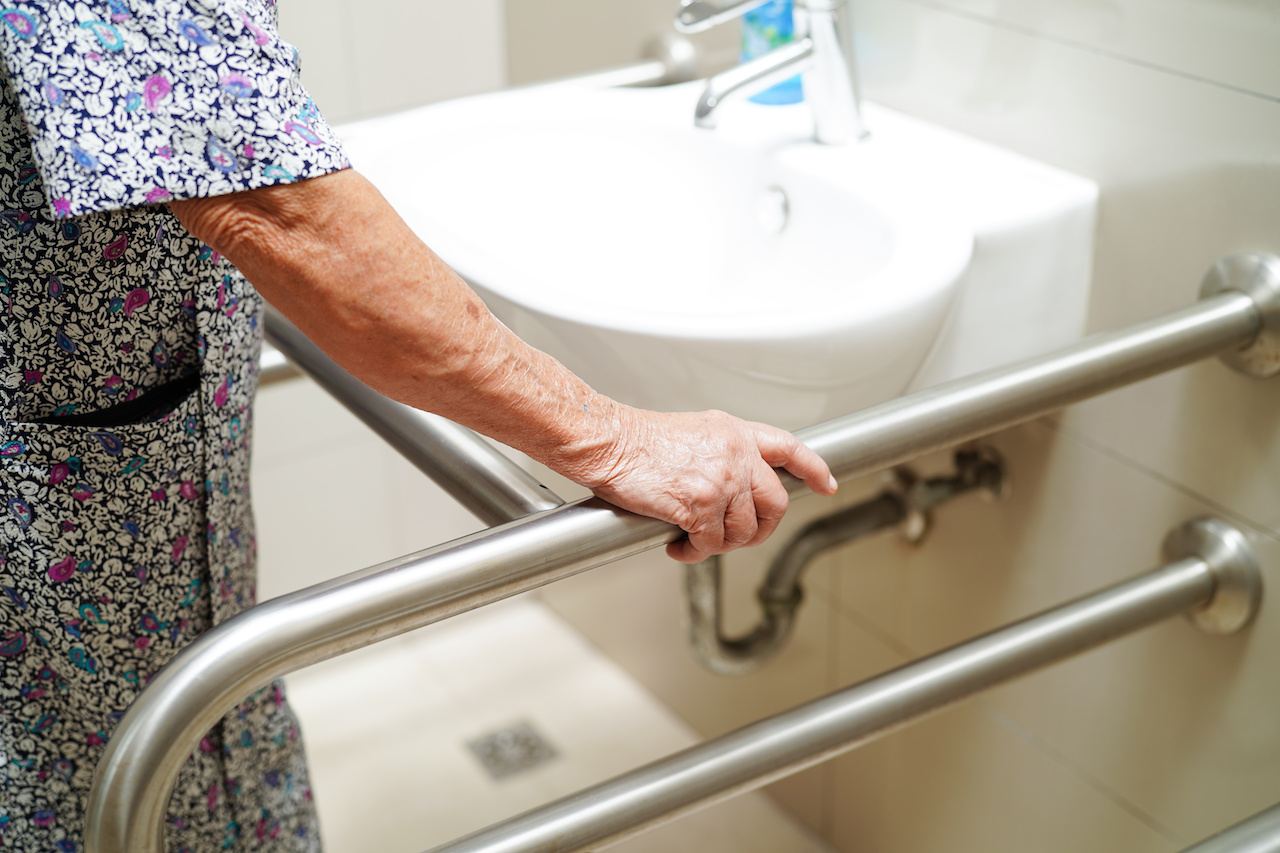
AARP’s caregiver guidance for stroke recovery emphasizes practical home changes such as clear pathways, bathroom grab bars, and arranging a bed on the ground floor if stairs are unsafe or exhausting.[4] These changes can feel excessive on day one, especially if your parent is proud or private. Make them anyway when risk is obvious. A fall in the first week can steal strength, confidence, and therapy time.
- Clear the path from bed to bathroom, kitchen, and main chair; remove loose rugs, cords, low tables, and clutter.
- Add night lights before the first overnight bathroom trip.
- Use grab bars rather than towel racks for support; towel racks are not built for body weight.
- Ask the therapist which side is safer for transfers and whether your parent should use a walker, cane, gait belt, shower chair, raised toilet seat, or bedside commode.
- Do not let pride decide stair use. If stairs are unsafe, set up sleeping space on the main floor when possible.
The American Stroke Association’s fall prevention guidance is direct about reviewing medications, vision, footwear, walking aids, home hazards, and exercise with the care team.[5] That review is not busywork. Dizziness from a medication, a bad shoe, or a poorly fitted walker can undo an otherwise careful plan.
Know what is an emergency before you are scared
Keep emergency signs written down. If your parent has face drooping, arm weakness, or speech difficulty, the FAST warning signs point to calling emergency services rather than waiting to see whether symptoms pass.[2] Also treat sudden new confusion, sudden trouble seeing, sudden severe headache, sudden trouble walking, or sudden worsening of stroke symptoms as urgent unless the care team has given you a different instruction.
Not every problem is a 911 problem, but many deserve a same-day call. Fever, coughing during meals, repeated choking, new shortness of breath, a painful swollen calf, repeated falls, new pressure sores, uncontrolled pain, medication refusal, or a sudden change in alertness should not be quietly absorbed into family life. When in doubt, call the clinician responsible for post-discharge care and say clearly: “This is a recent stroke patient, discharged on this date, and this is what changed.”
Weeks 2-4: Build A Rehab Rhythm That Can Survive Real Life
By the second week, the adrenaline often drops. Family members return to work. Visitors stop bringing food. Your parent may look better in one moment and worse the next. This is where a lot of recovery plans become vague: therapy happens when someone can drive, exercises happen when everyone remembers, and meals happen around exhaustion.
Do not try to become the therapist. Your job is to protect the conditions that let therapy work: attendance, safe practice, enough rest, and honest feedback to the care team. The American Stroke Association advises caregivers to ask the rehabilitation team what the survivor can do independently, what requires help, and what exercises or activities should be practiced between sessions.[6]
- Keep a visible weekly schedule with therapy visits, medication times, meals, rest periods, and follow-up calls.
- Ask each therapist for the top two or three home exercises that matter most right now.
- Write down what changes after practice: more fatigue, better transfers, pain, frustration, dizziness, coughing, or refusal.
- Tell the therapist what the home is actually like, including stairs, narrow bathrooms, pets, clutter, and whether the caregiver can safely assist.
- Use fatigue as information, not as a moral failure. Stroke recovery work is tiring, especially for older adults.
A small notebook can do more good than a complicated app if everyone will actually use it. Track the date, therapy completed, walking or transfer changes, eating concerns, mood changes, sleep, blood pressure if instructed, falls or near-falls, and questions for the next appointment. The point is not to create a perfect medical record. It is to keep important changes from disappearing into a hard week.
If your parent refuses exercises, first check whether the assignment is too hard, too painful, too confusing, or too humiliating. A person who used to run a household may not tolerate being corrected like a child. Ask the therapist to demonstrate the safest wording and the amount of help you should provide. Sometimes the best caregiver sentence is not “You have to do your exercises.” It is “The therapist said this one helps with getting out of the chair. Let’s do that one before lunch, then stop.”
Progress is often uneven
Early recovery can look jagged. A parent may stand better on Monday, sleep through Tuesday, speak more clearly in the morning, then struggle at dinner. That pattern does not automatically mean recovery is failing. Fatigue, poor sleep, infection, medication effects, dehydration, pain, depression, or overstimulation can make function look worse.
The practical question is whether the change is sudden, severe, or persistent. Sudden new neurological symptoms need urgent attention. A slower pattern should still be reported if it changes safety or participation: more falls, less eating, skipped therapy, new swallowing trouble, increasing confusion, new incontinence, or staying in bed most of the day. The care team cannot adjust what it does not know.
Keep Prevention In The Same Plan
Rehabilitation and prevention run at the same time. One is about regaining function; the other is about reducing the chance of another stroke. They compete for attention in the house, but they cannot be separated in the care plan.
For the caregiver, secondary prevention usually means making sure the plan is understandable enough to follow. If the discharge papers mention blood pressure control, cholesterol medication, blood thinners or antiplatelet medication, diabetes management, smoking cessation, diet changes, activity, or sleep apnea evaluation, ask who is responsible for each item and when it will be checked. Reviews of secondary stroke prevention emphasize lifestyle modification as part of reducing recurrent stroke risk, but lifestyle instructions only help if they become specific enough for the household to carry out.[7]
This is where caregivers often feel the weight of the job. In one NIH-indexed study of stroke survivor caregivers, reported figures included 65% experiencing moderate-to-severe caregiver burden and an 81% job loss rate, though those figures should be read as study-specific rather than universal for every family.[8] The important point is less the exact number and more the permission it gives you to treat coordination as real work. Calling insurance, arranging rides, filling pillboxes, watching symptoms, and persuading a tired parent to practice standing are not small tasks.
Months 2-3: Check Function, Mood, And The Caregiver’s Capacity
By the second and third months, the house may no longer feel like an emergency room. That can be a relief, but it can also hide problems. People assume the shock should be over. Your parent may be expected to “try harder.” The caregiver may be expected to have figured it out. This is exactly when mood, motivation, and exhaustion need attention.
Post-stroke depression is common enough that it should be on the checklist, not treated as a surprising personality change. The American Stroke Association states that post-stroke depression affects about 30% to 50% of stroke survivors.[9] It can show up as sadness, loss of interest, irritability, hopelessness, sleep changes, appetite changes, low energy, withdrawal, or not wanting to participate in rehabilitation.
Depression after stroke is not the same as being appropriately upset about a frightening medical event. A parent can be grieving and still engaged. What should raise concern is a pattern that blocks eating, therapy, hygiene, sleep, conversation, or safety. If your parent repeatedly says there is no point, refuses most activity, cries often, becomes unusually angry, or seems emotionally flat, bring it to the physician or rehabilitation team. Do not wait for the next routine appointment if safety is involved.
Caregivers need the same seriousness. Watching a parent change day by day can produce guilt, fear, resentment, sleep loss, and a strange loneliness even in a full house. Research from Michigan Medicine reported that nearly 30% of caregivers for severe stroke survivors experienced psychological distress, which is another reminder that the caregiver is not outside the injury’s blast radius.[10]
- If your parent’s mood changes, describe behaviors rather than arguing over labels: “She stopped eating breakfast,” “He refuses therapy,” or “She cries every evening.”
- Ask the clinician whether depression screening, counseling, medication review, treatment, sleep evaluation, or social work support is appropriate.
- If there is talk of self-harm, wanting to die, or being unsafe alone, treat it as urgent and seek immediate help.
- If the caregiver is no longer sleeping, working safely, or thinking clearly, that is also a care-plan problem, not a private weakness.
The three-month review should be practical
Around the end of the first 90 days, ask for a direct functional review. Not a vague “How are we doing?” but a list of what has changed and what still creates risk.
- Can your parent get in and out of bed safely?
- Can they use the bathroom safely during the day and at night?
- Can they eat and drink without coughing, choking, or avoiding meals?
- Can they take medications correctly without supervision?
- Can they be left alone, and if so, for how long?
- Are mood, sleep, and motivation helping rehabilitation or blocking it?
This review helps decide what comes next: continued outpatient therapy, more home health, equipment changes, respite support, a medication review, a depression evaluation, a driving discussion, or a higher level of care. Some families avoid these conversations because they feel like bad news. In practice, clear limits are safer than pretending independence has returned before it has.
What To Keep Visible Until Day 90
The first 90 days do not need a perfect binder. They need a few things that are impossible to miss.
- A medication list that matches what the clinician actually wants taken now.
- A calendar with therapy appointments, medical follow-ups, transportation, and caregiver coverage.
- Emergency warning signs and phone numbers posted where the household can find them.
- A fall-prevention setup that changes as strength and balance change.
- A short daily note on walking, transfers, eating, sleep, mood, pain, and falls or near-falls.
- A standing question for every appointment: “What should we keep doing, stop doing, or report immediately?”
There is no clean finish line at day 90. Some gains continue after the fastest recovery window, and some families are still dealing with major disability, grief, and decisions they did not want to make. But the early window is where organization matters most. Keep the schedule visible, the walking path clear, the medication plan checked, the warning signs obvious, and the emotional temperature monitored. That is a real job. It is also the part you can make less chaotic.
References
- Elderly Stroke Rehabilitation: Overcoming the Complications and Its Associated Challenges, PMC, 2018.
- 15 Things Caregivers Should Know After a Loved One Has Had a Stroke, American Stroke Association.
- Stroke Facts, CDC.
- What You Need to Know as a Caregiver for Someone Who Had a Stroke, AARP.
- Preventing Falls, American Stroke Association.
- 6 Tips for the Best Possible Stroke Recovery, American Stroke Association.
- Lifestyle Modification for Secondary Stroke Prevention, PMC.
- Caregiver Burden in Caregivers of Stroke Survivors, NIH PMC.
- Depression and Stroke, American Stroke Association.
- Nearly 30% of caregivers for severe stroke survivors experience psychological distress, Michigan Medicine.
Questions to bring to a clinician or OT
This is not medical, legal, or a family's final decision — only a framework. Bring these questions to a clinician, occupational therapist, or your local Area Agency on Aging.
Find Local HelpRelated reading
Noticed something outdated or inaccurate on this page? Flag a correction. We review every report against CDC, NIA, and AARP HomeFit guidance before updating a page.