
Caregiver decision guide
Is a River Cruise Safe for Your Elderly Parent?
River cruises lack onboard medical care and present unique fall risks that many families overlook. This guide helps caregivers assess whether a river cruise is safe for their elderly parent and outlines essential preparations like travel insurance, mobility assessment, and choosing an accessible ship.
The first safety question is not whether the river is calm or whether the ship stays close to shore. It is this: if your parent falls, develops chest pain, becomes acutely confused, or cannot safely get back across a gangway, who can help, how fast, and what level of care is actually available onboard?
That question matters because river cruise safety for elderly passengers is different from ocean cruise safety in a way many families do not discover until late in the booking process. Ocean cruise ships commonly have medical centers. River cruise ships generally do not. A JEMS article on riverboat health care guidelines notes that the U.S. National Defense Authorization Act for Fiscal Year 2023 exempted riverboats from federal medical care regulations, leaving no legal requirement for onboard medical provision on these vessels.[1]
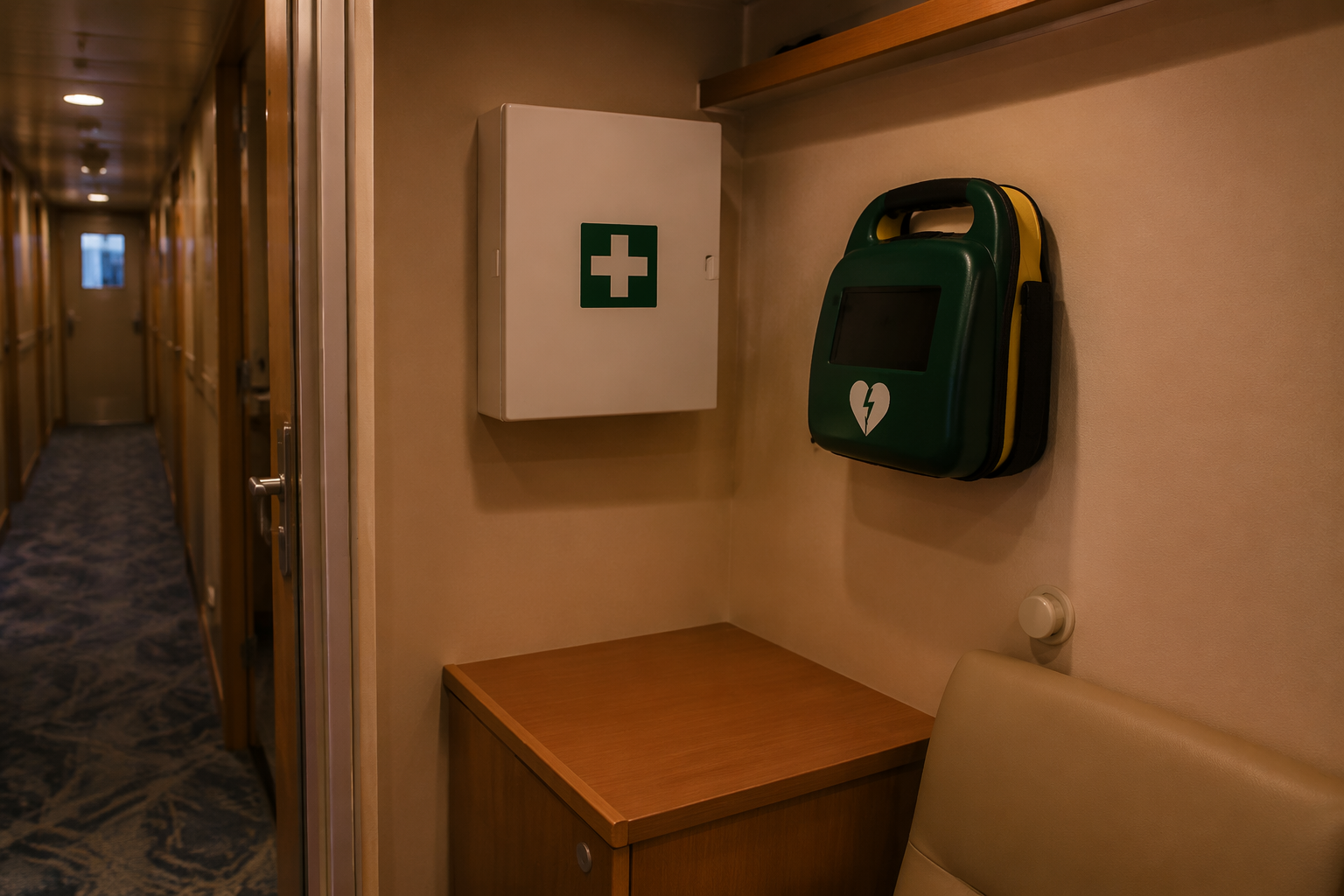
That does not make every river cruise unsafe for an older parent. It does mean the family has to stop treating “close to land” as a safety plan. A river ship may have a first-aid kit and an AED. It may have crew trained to respond to emergencies. It may be able to call local emergency services. None of that is the same as having a doctor, nurse, infirmary, lab testing, oxygen support, or acute-care capability onboard.
The risk is not usually the river. It is the transfer.
When families picture danger on a cruise, they often picture rough water, infection outbreaks, or a dramatic evacuation. For river cruising, the more ordinary danger deserves more attention: the moment your parent steps from ship to shore, from one rafted vessel to another, from a wet deck to a stair, or from a cobblestone street back to the gangway after a long excursion.
Medjet, writing from its travel-assistance and transport perspective, identifies slip-and-fall injuries as “the Grand Champion” of river cruise dangers. It points to unstable gangways, ships docked three or four abreast that require passengers to cross through other vessels, wet decks, and cobblestone streets in port towns.[2] That is not a population-wide injury rate, and it should not be treated as one. There is no comprehensive, peer-reviewed surveillance system that tells families exactly how often elderly river cruise passengers fall. But the pattern is practical enough to take seriously because it matches the physical design of the trip.
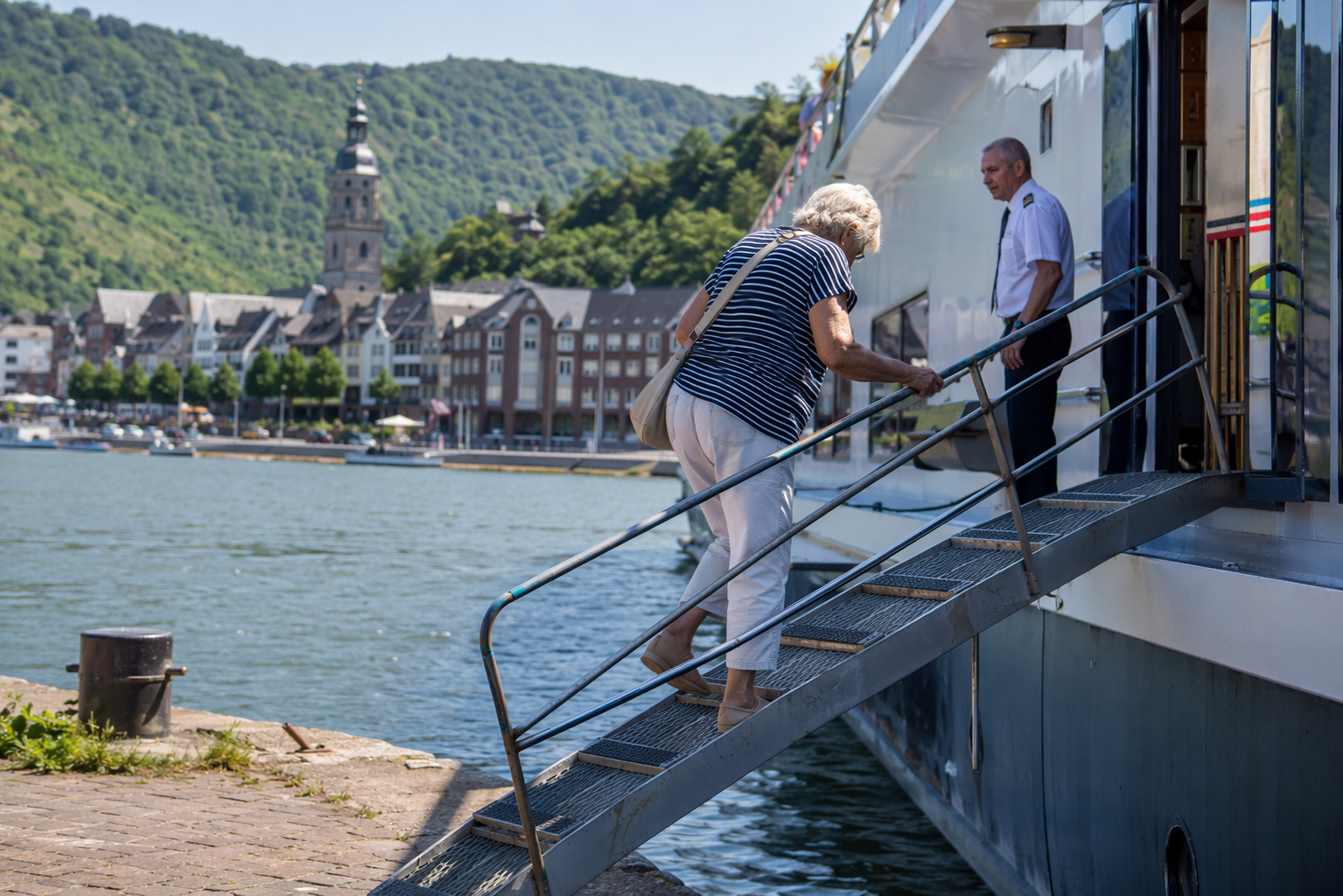
A parent who walks well at home may still struggle with a moving gangway. A parent who uses a cane confidently on flat sidewalks may not have both hands free when the ship shifts. Medjet specifically warns that rogue waves from passing ships can cause sudden movement on gangways and advises passengers with balance issues to keep both hands free when using them.[2] That one detail changes the packing list: no shoulder bag sliding off one arm, no tote in one hand, no camera strap competing with the rail.
Before booking, separate desire from functional readiness
Wanting the trip still matters. An elderly parent is not a fragile object to be stored at home because stairs exist somewhere in Europe. But desire and readiness are not the same thing. The honest assessment starts with what your parent can do on a difficult day, not on the best morning after coffee, good sleep, and no swelling in the knees.
- Can your parent walk from cabin to dining room without rushing, leaning heavily on furniture, or becoming short of breath?
- Can they climb a flight of stairs if an elevator does not serve the deck they need?
- Can they step across a threshold or gangway while the surface moves slightly?
- Can they stand in a slow line after an excursion without needing to sit immediately?
- Can they manage toileting, medication timing, glucose checks, compression garments, hearing aids, or oxygen equipment without a routine falling apart?
- If they use a walker, wheelchair, or scooter, can the exact ship and cabin accommodate it rather than merely “welcome” it?
The most useful medical clearance visit is not a ceremonial “Is Mom allowed to travel?” appointment. It is a planning appointment. Bring the itinerary, flight schedule, cruise line emergency policy if available, medication list, diagnoses, mobility aids, and the name of every country on the route. Ask what would turn a manageable chronic condition into a travel emergency. Diabetes, hypertension, heart disease, kidney disease, anticoagulant use, cognitive impairment, recent falls, and recent medication changes all deserve specific discussion.
For a parent with diabetes, that might mean discussing meal timing, hypoglycemia treatment, carrying supplies during excursions, and what happens if luggage is delayed. For a parent with hypertension or heart disease, it may mean asking what symptoms require immediate care rather than waiting until the ship reaches the next scheduled port. For a parent with mild cognitive impairment, it may mean deciding whether they can safely navigate a small ship and unfamiliar port bathrooms without one person assigned to stay with them.
A river ship is not a floating clinic
This is the part of river cruising that families need to hear plainly. If your parent has a medical emergency onboard, the ship’s role is usually to provide basic immediate response and coordinate help on land. It is not to diagnose and treat a complex medical event in the way an ocean ship’s medical center might attempt. The JEMS riverboat health care guidelines discussed in 2023 were presented as a risk-reduction tool, not as evidence that such standards are already required across the industry.[1]
A first-aid kit can help with minor injuries. An AED can be critical in a cardiac arrest. Crew training can matter. But none of these answer the caregiver’s harder questions: Who evaluates possible stroke symptoms? Who monitors chest pain? Who manages a fall with a suspected hip fracture? Who handles acute confusion that could be infection, dehydration, medication interaction, low blood sugar, or something worse?
The answer may be a local clinic or hospital in the country where the ship can dock or where emergency services can reach the passenger. That can work well in some places and feel frighteningly uneven in others. Passenger accounts on Cruise Critic forums describe real medical emergencies during river cruises and concerns about hospital quality in foreign ports.[6] Those accounts are not a scientific sample, and they should not be used to claim that foreign hospitals are uniformly unsafe. They are useful because they make one thing concrete: when care is needed, your parent may enter a local health system you did not research before booking.
That is why the pre-trip file should include more than passport copies. It should include a current medication list with generic drug names, allergies, diagnoses, implant information, physician contacts, recent major procedures, baseline mobility status, advance directive information if your family uses it, and emergency contacts who can answer the phone across time zones. Keep a paper copy with the traveler and a digital copy accessible to the caregiver.
Medicare is not the backup plan abroad
For U.S. families, insurance deserves its own uncomfortable conversation. Aardy notes that Medicare does not cover medical care outside the United States or on foreign-flagged vessels, and it recommends at least $100,000 in emergency medical coverage and $250,000 in medical evacuation coverage for senior cruise travelers.[3] The exact policy should be reviewed before purchase, not after a fall in port.
The phrase “travel insurance” is too broad to be reassuring by itself. Some policies are built mainly around trip cancellation. Others include stronger emergency medical and evacuation benefits. Some exclude pre-existing conditions unless the policy is bought within a required time window after the first trip payment. Some require calling the assistance line before arranging care when possible. Some evacuation benefits move the traveler to the nearest adequate facility, not necessarily home or to the hospital the family would choose.
- Emergency medical limit: Is it high enough for hospital care abroad?
- Medical evacuation limit: Does it meet or exceed the recommended senior cruise minimum?
- Pre-existing conditions: Is there a waiver, and what deadline applies?
- Evacuation destination: Nearest adequate facility, hospital of choice, or home hospital?
- Companion coverage: Will a caregiver’s lodging, transport, or return travel be covered if the parent is hospitalized?
- Required procedure: Who must be called before treatment, transfer, or evacuation?
This is not the place to save a small amount of money by assuming nothing will happen. If the family cannot afford appropriate medical and evacuation coverage for a medically vulnerable parent, the trip may be more expensive than it appears.
Accessibility claims have to be checked ship by ship
River cruise accessibility is not one thing. It varies by cruise line, vessel, cabin category, itinerary, water level, docking arrangement, and port infrastructure. A general statement that a cruise line “accommodates guests with mobility limitations” is not enough for a parent who uses a wheelchair, walker, rollator, cane, or needs a shower seat.
Cruise Critic’s accessible river cruise guide notes that river ship elevators often do not reach every deck, commonly missing areas such as the sun deck or main deck, and that cabin doors are frequently too narrow for wheelchairs.[4] Cruise Specialists similarly cautions that mobility issues require detailed planning because river ships and shore arrangements may not support the same access expectations travelers bring from hotels or larger ocean ships.[5]
That means the family has to ask about the exact ship name, not just the brand. It also means asking for measurements and operational details in writing. If a parent cannot walk safely without a mobility device, “the crew will help” is not a plan. Crew members may not be permitted or able to lift passengers. A wheelchair that fits through the cabin door may still be difficult to turn inside the cabin. A scooter that works in an airport may be impractical in a narrow corridor. A beautiful sun deck is not accessible if the elevator stops below it and the remaining route is stairs.
| Verify before deposit | Why it matters |
|---|---|
| Cabin doorway width and bathroom layout | A wheelchair or walker may not fit even when the ship is described as accessible. |
| Elevator service to each deck | Some decks may require stairs, including outdoor viewing areas. |
| Gangway angle and assistance policy | Steep or moving gangways can become the highest-risk part of the day. |
| Rafted docking frequency | Passengers may need to cross through other ships to reach shore. |
| Wheelchair or scooter storage rules | Devices may not be allowed to block corridors or cabin exits. |
| Shower entry, grab bars, and seating | Bathroom falls are a predictable risk after long travel days. |
| Excursion terrain | Cobblestones, slopes, stairs, and long standing periods can undo an otherwise suitable ship choice. |
Some cruise lines have offered accessible staterooms, while others have had limited or no accessible cabin inventory. Cruise Critic has identified American Cruise Lines, CroisiEurope, and Scenic among lines with accessible staterooms, while noting that Viking and Avalon Waterways have not offered them in the same way.[4] River Cruise Advisor also emphasizes that accessibility varies significantly by line and ship.[7] Because fleet details and policies change, these examples should be treated as a prompt for verification, not as a permanent buying guide.
The shore plan can make or break the trip
A river cruise may look easier than a land tour because the hotel moves with you. That advantage is real. Unpacking once can spare an older parent from repeated hotel transfers. Meals are nearby. Resting in the cabin is possible. But the port day still asks the body to do work: stairs, uneven pavement, museum standing time, buses, bathrooms, heat, rain, and the pressure to keep up with a group.
The safest shore plan is usually not the one that squeezes in every included excursion. It is the one that decides in advance which outings are essential, which are optional, and what the parent will do instead if the gangway is steep, the weather is poor, or their legs are not reliable that morning.
- Ask whether each excursion has stairs, cobblestones, steep grades, long standing periods, or limited seating.
- Choose slower-paced or panoramic options when the destination matters more than walking every block.
- Plan at least one no-excursion recovery block after long flights or intense port days.
- Keep medication, water, snacks, mobility aids, and emergency information with the parent during shore time.
- Decide who stays with the parent if they return to the ship early or need local care.
There is also a dignity issue here. If every day becomes a negotiation in public — “Can you make it?” “Are you sure?” “Hurry, the group is leaving” — the vacation becomes another setting where the parent feels managed. Better to build a lighter itinerary from the start than to buy the fantasy version and spend the trip trimming it under stress.
When a river cruise may be a reasonable choice
A river cruise can be a good fit for an elderly parent who is medically stable, has had a recent medication and travel-risk review, can manage basic transfers safely, understands their own limits, and has a caregiver or companion who can help without becoming the only safety system. It is especially promising when the ship, cabin, and itinerary have been matched to the parent’s actual abilities rather than to what the family hopes they can manage.
It may also work for a parent with chronic conditions if those conditions are stable and the family has planned for predictable problems. A person with diabetes does not need to stop traveling simply because glucose management takes effort. A person with hypertension does not need every meaningful trip canceled. But chronic conditions become more consequential when the usual pharmacy, doctor, food schedule, bathroom routine, and emergency department are no longer nearby.
When postponing is the safer decision
Postponing is not failure. It is sometimes the decision that preserves the possibility of a better trip later. A recent unexplained fall, new confusion, unstable blood pressure, recent hospitalization, medication changes causing dizziness, uncontrolled diabetes, worsening shortness of breath, or a new need for hands-on transfer help should slow the booking process down.
The same is true when the cruise line cannot answer specific access questions, the desired ship has no suitable cabin, the insurance does not cover the parent’s real medical risk, or the itinerary depends on daily walking the parent is unlikely to tolerate. In those cases, the kindest answer may be a different trip: a domestic river cruise with easier medical access, a resort with accessible rooms and nearby hospitals, a shorter city stay, or a family gathering built around the parent’s current stamina.
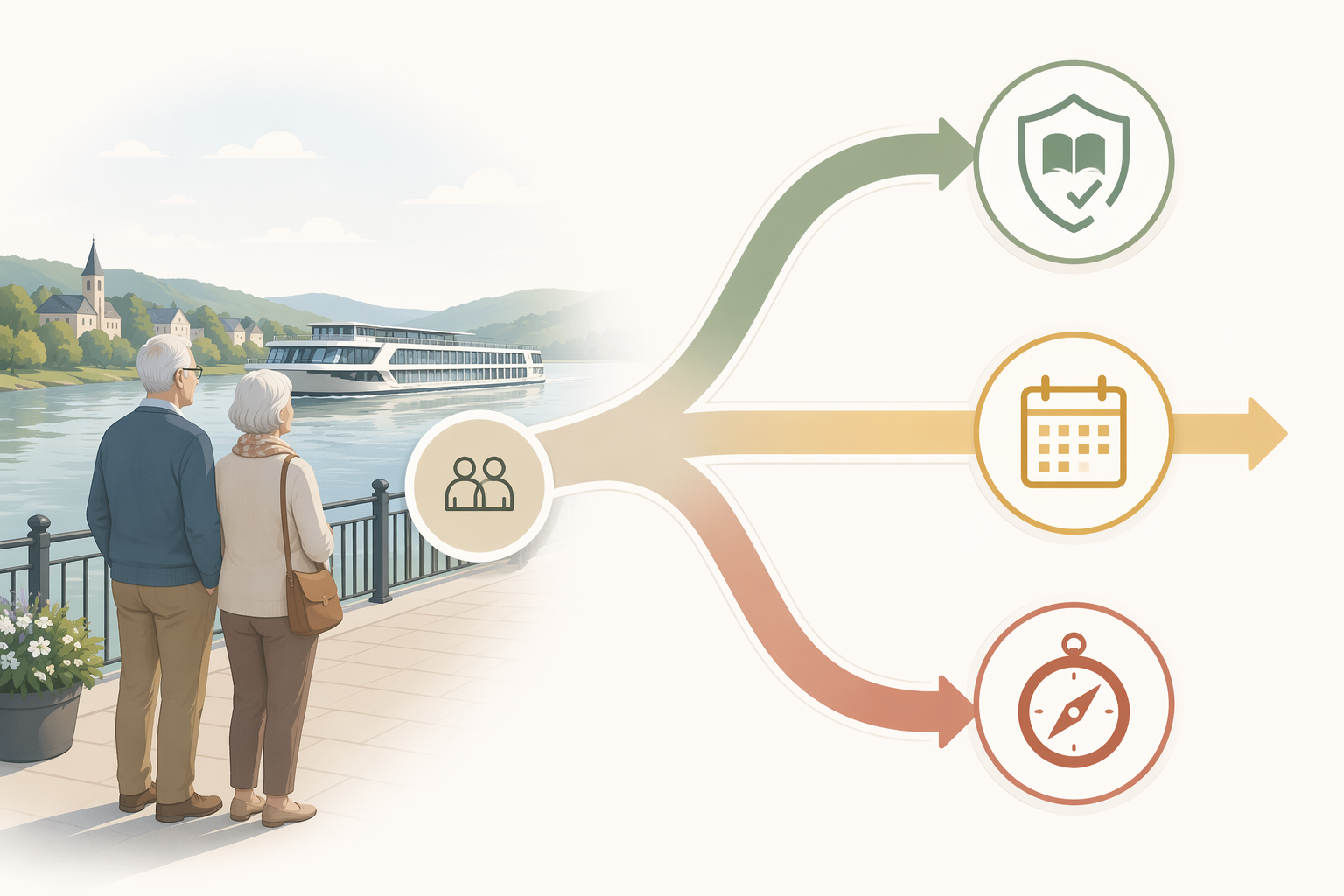
The three-decision framework
Before paying a deposit, put the decision into one of three categories. This keeps the conversation from drifting into either fear or wishful thinking.
| Decision | Use this answer when |
|---|---|
| Book with safeguards | The parent is medically stable, mobility needs match the exact ship and itinerary, insurance is strong, and the family has a realistic emergency plan. |
| Postpone | A recent fall, new symptom, unstable condition, or medication change needs evaluation before travel risk can be judged. |
| Choose a different trip | The ship, ports, insurance, or medical-access reality does not fit the parent’s current functional level. |
The decision should survive three tests. First, the parent’s health and mobility have been assessed honestly. Second, everyone understands that the river ship is not a floating clinic. Third, the itinerary, ship design, insurance, and shore plan match the parent as they are now.
Pre-booking checklist for caregivers
- Schedule a medical clearance visit using the actual itinerary, not a vague travel plan.
- Review medications, chronic conditions, fall history, cognition, hydration risks, and emergency symptoms with the clinician.
- Confirm whether the ship has any onboard medical staff; do not assume an infirmary exists.
- Buy travel insurance with strong emergency medical and medical evacuation coverage, and check pre-existing condition rules.
- Verify the exact ship, cabin, doorway width, bathroom layout, elevator access, and mobility-device policy in writing.
- Ask about gangways, rafted docking, tendering if applicable, stairs, and whether crew can physically assist passengers.
- Screen every desired excursion for terrain, pace, seating, bathrooms, heat exposure, and distance from medical help.
- Prepare a paper and digital medical file with medications, diagnoses, allergies, physician contacts, insurance details, and emergency contacts.
- Decide who has authority to cancel an excursion, call for care, stay behind in port, or end the trip early if the parent’s condition changes.
A safe river cruise for an elderly parent is not the one with the prettiest itinerary or the most reassuring brochure language. It is the one where the family has already looked at the hard parts — the gangway, the missing infirmary, the foreign hospital, the narrow bathroom door, the long walk back from town — and still has a plan that protects both the parent’s safety and their right to enjoy the trip.
References
- Riverboat Health Care Facility Guidelines: A New Tool for Health Risk Reduction on Riverboats, JEMS
- Top 5 River Cruise Dangers, Medjet, April 4, 2025
- Best Cruise Insurance for Seniors, Aardy
- A Guide to Accessible River Cruises, Cruise Critic, July 2024
- Mobility Issues and River Cruising, Cruise Specialists
- Medical services on River Cruises, Cruise Critic Forums
- River Cruise Accessibility, River Cruise Advisor
Questions to bring to a clinician or OT
This is not medical, legal, or a family's final decision — only a framework. Bring these questions to a clinician, occupational therapist, or your local Area Agency on Aging.
Find Local HelpRelated reading
Noticed something outdated or inaccurate on this page? Flag a correction. We review every report against CDC, NIA, and AARP HomeFit guidance before updating a page.