
Caregiver decision guide
3 Warning Signs of a Grandparent Scam Every Caregiver Should Know
Grandparent scammers follow a predictable three-part script—a fake emergency, a demand for secrecy, and a request for untraceable payment. This guide breaks down each red flag so caregivers can teach their parents to recognize the pattern and hang up before losing money.
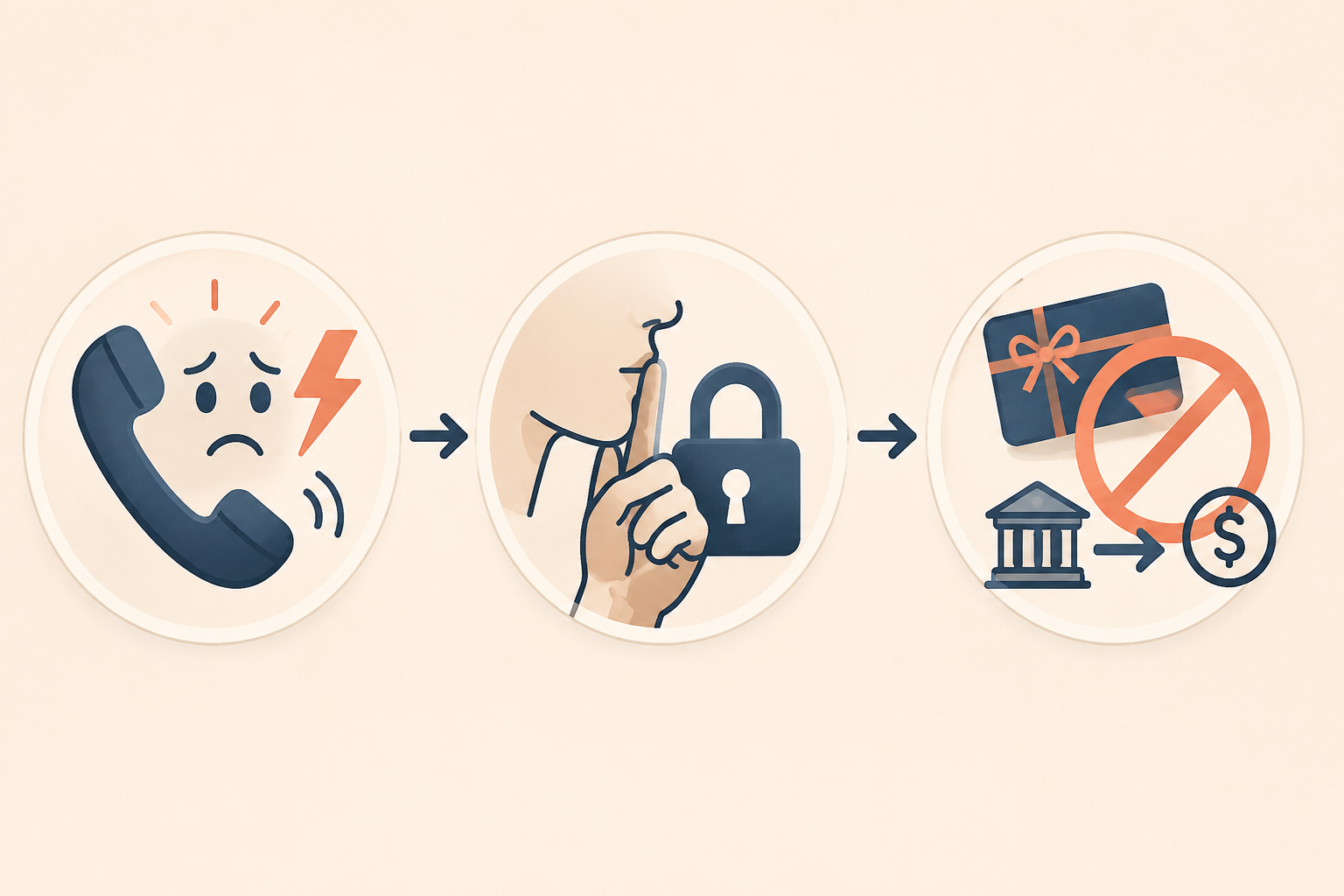
The most useful grandparent scam warning signs for older parents are not hidden in the technology. They are in the order of the call. First comes an emergency. Then comes a reason not to tell anyone. Then comes a payment method that is hard to trace. If any two of those arrive together, the safest family rule is simple: hang up and verify through a phone number you already know.
That rule deserves a place on the refrigerator now because the pressure on older adults is real. The FTC reported that from 2020 to 2024, reports from older adults who lost $10,000 or more to imposter scams increased more than fourfold.[1] The FBI said people over 60 reported $7.7 billion in cyber-fraud losses in 2025, up 59% from 2024, with an average loss of more than $38,000 per victim; 12,400 victims in that age group lost at least $100,000 each.[2]
Those numbers are large enough to make families anxious, but anxiety is not a plan. A plan is knowing what the call sounds like before it lands in the kitchen, the car, or the bedroom at night.
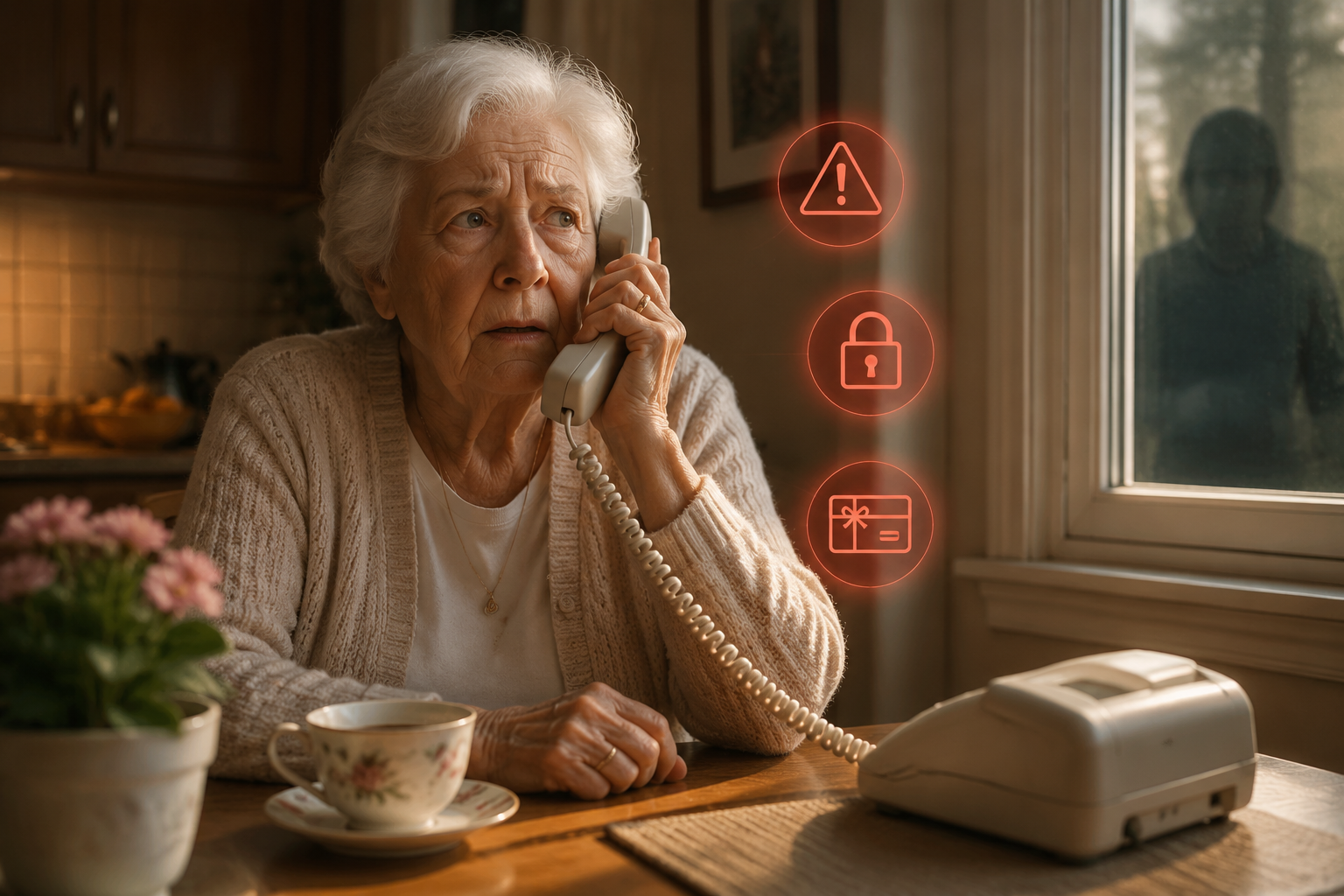
The call usually moves in three acts
A grandparent scam works because it borrows a family reflex. A person hears a young voice in trouble and starts trying to help before the details line up. The scammer does not need the whole family history. Often, the caller only needs the older adult to fill in the first blank.
| What happens | What it may sound like | What the family rule should be |
|---|---|---|
| Fake emergency | “Grandma, I’m in trouble.” “I had an accident.” “I’m at the police station.” | Do not confirm names or details. Slow the call down. |
| Secrecy demand | “Please don’t tell Mom and Dad.” “I’m embarrassed.” “You’re the only one I can call.” | Treat secrecy as a red flag, not as a family favor. |
| Untraceable payment | “Send gift cards.” “Wire the money.” “Use a crypto machine.” | Hang up. Call back through a saved number. |
The weakness is the sequence. Scammers can change the courthouse, the hospital story, the supposed lawyer’s name, or the amount. They have a harder time changing the structure, because the structure is what moves the victim from concern to isolation to payment.
Warning sign 1: the emergency asks your parent to react before thinking
The opening is usually designed to make the older adult do two things at once: feel alarmed and supply information. One common version begins with something like, “Hi Grandma, it’s me, your favorite grandchild.” If the grandparent answers, “Jake?” the scammer now has Jake. From there, the caller can become Jake in trouble.[4][5]
The story does not have to be polished. In fact, the messiness helps. A muffled voice can be explained as a broken nose, crying, poor reception, or a phone call from a jail or hospital. The Federal Communications Commission warns that grandparent scams may use caller ID spoofing and may involve someone posing as a lawyer on speakerphone to make the emergency feel official.[3]
That handoff matters. A frightened “grandchild” gets the grandparent emotionally hooked; the “lawyer,” “public defender,” “police officer,” or “bail bondsman” gives the call a procedure. Suddenly the older adult is not just comforting a grandchild. They are being told there is a deadline, a case number, a judge, a hospital bill, or a bail payment. The scammer has moved the call from love into logistics.
A former scammer interviewed by CBS News described the business plainly, saying a successful caller might hit only “one out of 50” attempts but still make “$10,000 a day.”[6] That is a useful reminder for caregivers: the script does not need to fool everyone. It only needs to catch one person on one bad afternoon.
This is also where families can make their first practical change. Do not teach an older parent to test the call by listening harder. Teach them not to give the caller a name. If a caller says, “It’s your grandson,” the answer should not be, “Michael?” It should be, “Which grandson?” or better, “I’m hanging up and calling you back.”
AI voice cloning changes the sound, not the rule
Voice cloning deserves attention, but it should not make families feel defenseless. Reports have described scammers using short social media audio clips and inexpensive tools to imitate a person’s voice, and the FCC has ruled that AI-generated robocalls are illegal.[7][3] That means “it sounded like him” is no longer a safe test by itself.
The better test is the script. A real grandchild may sound upset. A real emergency may be confusing. But when the call quickly adds secrecy and a hard-to-trace payment method, the family should stop evaluating the voice and start recognizing the pattern.
Warning sign 2: the caller turns secrecy into proof of love
The secrecy line is often the part that hurts later. It is not only a tactic to keep an adult child, spouse, banker, or caregiver out of the conversation. It tells the grandparent that silence is the loving thing to do.
The FCC’s consumer alert gives the classic version: “Please don’t let mom and dad know.”[3] Other versions lean on embarrassment, fear, or family rank: “I’ll be in so much trouble.” “Dad will kill me.” “You’re the only one I trust.” “Please, I’m begging you.”
This is the moral trap. Many older adults are proud of being the steady person in the family. They have paid bills, covered emergencies, kept confidences, and rescued children and grandchildren before. The scammer uses that history. The message underneath the words is: if you ask for help, you are betraying me.
Caregivers should name that trap before a scammer does. A good family script sounds respectful, not supervisory: “If someone says not to tell me, that is the moment I want you to tell me. You will not be in trouble. We will just verify.”
That sentence matters because shame is part of the scam’s afterlife. Once money is sent, many older adults delay telling anyone because they feel foolish or afraid of losing independence. A caregiver who wants to prevent the next loss has to leave room for the first confession. “I’m glad you told me” will do more good than a lecture about why they should have known.
Warning sign 3: the payment method is built to disappear
By the time the caller asks for money, the grandparent may already feel responsible for solving the crisis. That is why the payment request should be treated as a stop sign, not as a detail to negotiate.
- Gift cards: buying cards, reading numbers over the phone, or sending photos of card backs.
- Wire transfers: moving money quickly to a person, business, or account the family does not know.
- Cryptocurrency: using an app, website, ATM, kiosk, or “special instructions” from the caller.
- Cash pickup or shipping: handing money to a courier or mailing cash because the caller says it is urgent.
The exact method can change. The judgment should not. A real hospital, court, police department, or family member should not need a scared grandparent to buy gift cards in a parking lot or rush money through a channel that cannot be easily reversed.
This is where the two-red-flag rule earns its keep. Emergency plus secrecy: hang up. Secrecy plus gift cards: hang up. Emergency plus wire transfer: hang up. The family does not need to finish the conversation to gather evidence. The next call should be to the grandchild, the grandchild’s parent, or another known family number already saved in the phone.
How to teach the rule without making your parent feel managed
The hardest part is not explaining the scam. It is explaining it in a way an older parent will actually use while their heart is pounding. A long fraud lecture may be accurate and still useless. The rule has to be short enough to rehearse before dinner is over.
Try this wording: “If someone calls saying a grandchild is in trouble, and they tell you not to tell anyone, hang up. If they ask for gift cards, a wire transfer, crypto, or cash, hang up. Then call us back from your saved contacts. No one will be mad.”
That last sentence is not decoration. It answers the fear that scammers exploit: fear of making trouble, fear of embarrassing the grandchild, fear of being judged by adult children. If a parent believes the caregiver’s first response will be scolding, the scammer’s secrecy demand has more power.
- Save key family numbers in the phone under clear names, not nicknames the parent may not recognize under stress.
- Put the rule near the phone: “Emergency + secrecy = hang up and call back.”
- Agree on a family verification phrase if it will be remembered, but do not rely on it as the only defense.
- Practice one short call out loud, including the awkward part where the parent hangs up.
- Make it explicit that checking is not disloyal. It is the family procedure.
A practice call can be brief. One person says, “Grandma, I’m in trouble, please don’t tell Mom.” The older adult says, “I’m hanging up and calling you back.” Then they actually press the button and call a saved number. The physical act matters. Under pressure, people fall back on what they have already done.
If money was sent or almost sent
If your parent already bought cards, wired money, withdrew cash, or started a crypto transaction, move quickly and keep the conversation calm. The first goal is to interrupt the transfer or preserve whatever records still exist. The second goal is to keep your parent talking to you.
- Call the bank, credit union, brokerage, wire service, gift card issuer, or crypto platform immediately and say fraud is suspected.
- Keep receipts, card numbers, phone numbers, voicemails, texts, emails, shipping labels, and transaction confirmations.
- Call the real grandchild or the grandchild’s parent using a saved number, not a number supplied by the caller.
- Report the incident to the appropriate fraud-reporting channels and local law enforcement if money was lost or a courier came to the home.
- After the immediate calls, revisit phone settings, contact lists, and family procedures without framing the parent as the problem.
For investment and brokerage accounts, there is one additional protection caregivers often miss. FINRA Rule 4512 requires brokerages to ask customers for a trusted contact person, giving firms someone to reach if they suspect exploitation or cannot contact the account holder.[8] A trusted contact does not automatically get authority to trade or withdraw money. It is a safety contact, which makes it easier to present to a parent as a backup rather than a takeover.
The household protocol can stay plain: hang up, call the grandchild or the grandchild’s parent back using a saved number, contact the financial institution if money moved or nearly moved, and use trusted-contact protections where they are available. The scam loses force when the family stops debating the performance and starts recognizing the script.
References
- “False alarm, real scam: how scammers are stealing older adults’ life savings,” Federal Trade Commission, Aug. 2025
- “Scammers Target Older Adult Victims,” Federal Bureau of Investigation, May 2026
- “Grandparent Scams Get More Sophisticated,” Federal Communications Commission
- “8 Tips to Help You Spot Imposter Scams,” National Council on Aging
- “Grandparent/Family Emergency Scam,” Michigan Attorney General Consumer Protection
- “Grandparent scam explained by former scammer: What you need to know,” CBS News
- “AI grandkid voice clone scam,” Yahoo News
- “FTC Report: Seniors Lost Billions To Scams—Key Insights And Prevention Tips,” Forbes, Dec. 16, 2025
Questions to bring to a clinician or OT
This is not medical, legal, or a family's final decision — only a framework. Bring these questions to a clinician, occupational therapist, or your local Area Agency on Aging.
Find Local HelpRelated reading
Noticed something outdated or inaccurate on this page? Flag a correction. We review every report against CDC, NIA, and AARP HomeFit guidance before updating a page.