
Caregiver decision guide
Heart Attack on Plane Prevention for Seniors
A timeline-based prevention checklist for caregivers whose senior parent has heart disease and is planning air travel. Covers pre-flight medical clearance, in-flight precautions, and onboard emergency resources.
Heart attack on plane prevention for seniors starts before anyone buys the ticket. A commercial cabin is pressurized, but not to sea level; the CDC and American Heart Association describe the cabin environment as roughly equivalent to 6,000–8,000 feet of altitude, which can lower blood oxygen and make the heart work harder.[1][2] That does not mean an older parent with heart disease cannot fly. It does mean the flight has to be treated as part of the medical plan, not just part of the vacation.
The useful question is not “Is flying dangerous?” It is: what has to be checked before booking, what has to be carried onto the plane, and what should happen if symptoms start at 34,000 feet? In-flight medical emergencies occur on about 1 in 604 commercial flights, and cardiac symptoms are the most common reason flights divert.[1] That is enough reason to prepare carefully, without turning the trip into a family trial.
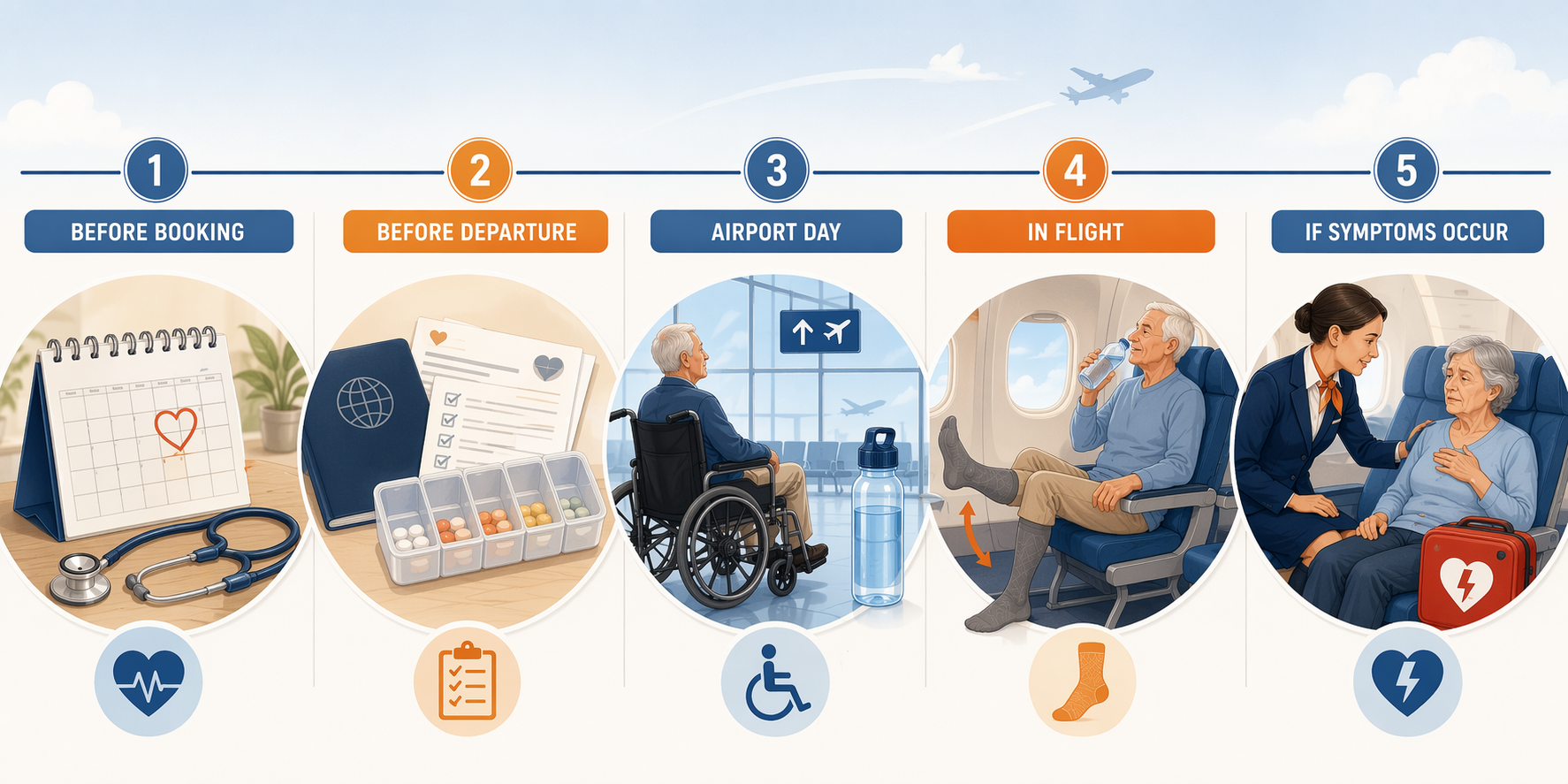
The Flight-Safety Timeline
| When | What to do | Why it matters |
|---|---|---|
| Before booking | Get medical clearance from the cardiologist or primary clinician, especially after recent symptoms, hospitalization, surgery, oxygen changes, or a new diagnosis. | This is the point where the trip can still be changed without panic. |
| After booking, before departure | Arrange airline medical clearance if required, request mobility assistance, confirm oxygen rules if relevant, organize medications, and prepare documents. | Airline rules and medical equipment needs cannot reliably be solved at the gate. |
| Airport day | Build in time, reduce walking strain, keep food and water steady, and keep medications in the carry-on, not checked baggage. | The airport can be harder on a senior heart patient than the flight itself. |
| In flight | Encourage water, movement every 1–2 hours when safe, leg exercises, and compression stockings if advised; avoid alcohol and excess caffeine. | Prevention depends on small behaviors repeated before symptoms appear. |
| If symptoms occur onboard | Call the flight crew immediately, say there is a possible cardiac problem, and make medications and medical history available. | U.S. carrier aircraft have emergency resources, but crew cannot use what they do not know about. |
Before Booking: Do Not Guess About Clearance
The cleanest time to ask whether a senior with heart disease is safe to fly is before the fare is paid. A rushed call two days before departure tends to produce vague answers because the clinician may not have the full itinerary, the parent may minimize symptoms, and the caregiver is already trying to rescue the trip.
For an older adult with coronary artery disease, pre-travel assessment is not just a cautious family habit. A GRADE-based review on older travelers gives a strong recommendation, based on moderate-quality evidence, that elderly passengers with a history of coronary artery disease be evaluated for acute or recent cardiac diagnoses before travel.[3] That evaluation is especially important if there has been chest pain, shortness of breath, fainting, medication changes, a recent hospital stay, a recent procedure, or a change in exercise tolerance.
Bring the itinerary into the medical conversation. A one-hour nonstop flight with a short airport walk is not the same caregiving task as two connections, a long security line, a red-eye, and a hotel check-in after midnight. The clinician needs to know the flight length, layovers, destination altitude if relevant, whether oxygen is used at home, and whether the parent can walk the expected distance without symptoms.
- Ask whether the parent is medically stable enough to fly on the planned dates.
- Ask whether any recent cardiac event, surgery, hospitalization, or new symptom changes the timing.
- Ask whether cabin pressure, walking distance, dehydration, or long sitting creates a specific concern for this parent.
- Ask whether compression stockings are appropriate, and what strength or type should be used.
- Ask whether nitroglycerin, aspirin, oxygen, anticoagulants, diuretics, or other medications require special instructions for the travel day.
- Ask what symptoms should trigger canceling, delaying, calling emergency services before departure, or alerting the crew in flight.
This is also where pride has to be handled carefully. A wheelchair request at the airport is not a declaration that someone is frail. It is a way to conserve cardiac reserve for the actual trip. If a parent can walk to the mailbox but not across a large terminal with a bag and a boarding deadline, that is not a character flaw. It is information.
Recent Procedures and Hospitalization Need Extra Caution
Recent cardiac surgery or hospitalization moves the trip out of ordinary planning and into medical-clearance territory. The American Heart Association notes guidance that patients with recent bypass surgery should not fly within 10 days because trapped gas in the body can expand during flight.[4] Other cardiac conditions may have different waiting periods, and organizations including IATA and the British Cardiovascular Society publish condition-specific guidance; the practical point for families is simple: do not substitute a family calendar for a medical clearance window.
Some airlines also require medical clearance for passengers with recent hospitalization, recent surgery, unstable medical conditions, or a need for supplemental oxygen, and coordination may be required at least 48 hours before travel.[5] If oxygen is part of the plan, assume the airline has its own forms, device rules, battery requirements, and deadlines. The airport counter is the wrong place to discover that the equipment is not approved.
After Booking: Put the Medical Plan Where You Can Reach It
Once the clinician has cleared the trip, the work becomes less dramatic and more clerical. That clerical work matters. During a cardiac scare, nobody wants to search a checked suitcase for nitroglycerin, argue over the medication list, or rely on a parent who is embarrassed, frightened, and trying to remember exact doses.
- Carry all heart medications in the personal item under the seat, not in an overhead bin and never in checked baggage.
- Pack more medication than the exact trip length in case of delays.
- Keep medications in original labeled containers when possible, with a current medication list.
- Write down diagnoses, allergies, implanted devices, recent procedures, clinician contact information, and emergency contacts.
- Confirm whether aspirin or nitroglycerin is prescribed or recommended for this parent, and when it should or should not be used.
- Request wheelchair or cart assistance early if terminal distance, connection time, or fatigue could become a problem.
The carry-on setup should be boringly obvious to the person traveling with the parent: medication here, water here, documents here, phone charger here. If another family member has to step in, the system should still make sense. A beautiful pill organizer in a rollaboard across the aisle is not accessible enough during a medical problem.
Harvard Health’s travel advice for people with heart-related risks emphasizes practical preparation: carry medications, know how to manage time zones, and plan ahead for medical needs rather than assuming travel routines will take care of themselves.[6] That is the right level of preparation for most families: not alarmist, just specific.
Airport Day: Protect Energy Before the Plane
Airport day is where many good plans get quietly undone. A parent skips water to avoid the restroom. Breakfast becomes coffee and a pastry. The family parks far away because everyone is “fine.” Then the gate changes, the walking distance doubles, and the person with heart disease is trying to keep pace while pretending not to be winded.
Build the day around pacing. Arrive early enough that the parent is not forced into a fast walk. Use mobility assistance if it was requested. Keep the personal item with medications on the same side of security as the traveler at all times. Choose food that does not create a salt-and-sugar ambush right before boarding, especially if fluid balance, blood pressure, or diabetes is part of the medical picture.
- Before leaving home: confirm medications, documents, water bottle, compression stockings if advised, and emergency contacts.
- At security: keep medications and medical devices with the traveler, not separated into someone else’s bag.
- At the gate: refill water, use the restroom, and avoid boarding already dehydrated.
- During delays: keep the medication schedule, eat sensibly, and do short walks or seated leg movements if safe.

In Flight: The Prevention Work Is Mostly Small and Repeated
Once seated, the goal is to prevent predictable strain: dehydration, immobility, missed medication, and delayed reporting of symptoms. The CDC and other travel-medicine guidance connect long sitting with clot risk, and common recommendations include movement every 1–2 hours when safe and compression stockings when appropriate.[1] These steps are often discussed as deep vein thrombosis prevention, but for an older heart patient they also keep the flight from becoming a long, dry, motionless stress test.
Water should be visible, not theoretical. If the bottle is in the bag under the seat, it will be used. If it is in the overhead bin, it may as well be in another terminal. Alcohol and excess caffeine are poor bargains on travel day because they can worsen dehydration and sleep disruption. That does not require scolding a parent like a child; it does require deciding before the cart arrives what “just one” means for this person’s condition and medication plan.

Movement does not have to be theatrical. If the seatbelt sign is off and walking is safe, a slow aisle walk every 1–2 hours is usually the clearest option. If walking is not practical, ankle circles, heel raises, toe raises, and gentle knee lifts keep the legs active. The caregiver’s job is not to nag every few minutes; it is to set the expectation early, then make the next movement easy.
- Keep the medication bag under the seat, with rescue medication easy to identify.
- Drink water steadily rather than waiting until the parent feels thirsty.
- Avoid alcohol and limit caffeine unless the clinician has said otherwise.
- Move every 1–2 hours when safe, or do seated leg exercises when walking is not possible.
- Wear compression stockings if they were recommended, fitted, and tolerated before the trip.
- Report chest pressure, unusual shortness of breath, faintness, sweating, confusion, or symptoms that feel different from the parent’s baseline.
Compression stockings are worth a special note because they are one of those precautions older adults may resist for reasons that are not really medical. They can feel unattractive, fussy, or like a public announcement of age. If they are medically appropriate, the best time to solve that problem is before departure: try them at home, confirm the fit, and choose clothing that makes them easier to wear without a scene at the gate.
If Symptoms Start Onboard, Call the Crew Early
A senior who does not want to “make a fuss” can lose valuable time by waiting to see if chest pressure, breathlessness, faintness, or sweating passes. On a plane, the correct threshold is lower. Call the flight attendant early and say plainly that the passenger has heart disease and may be having cardiac symptoms. Do not soften it into “not feeling well” if the concern is cardiac.
There are real resources onboard. The FAA requires automated external defibrillators and emergency medical kits on U.S. carrier aircraft with at least one flight attendant; the CDC Yellow Book lists emergency-kit contents that include aspirin 325 mg, nitroglycerin 0.4 mg, epinephrine, atropine, lidocaine, a bronchodilator, and 50% dextrose.[1] Flight attendants are trained in CPR and AED use, and aircraft can contact ground-based physician-staffed medical communication centers by satellite.[1]
Those resources are reassuring, but they are not a reason to be casual before the trip. The crew still needs fast information: the medication list, allergies, diagnoses, recent procedures, whether nitroglycerin or aspirin is prescribed, and what has already been taken. If a medical volunteer responds, the Aviation Medical Assistance Act of 1998 provides liability protection for volunteers on U.S. domestic flights except in cases of gross negligence.[1] The family’s contribution is to make the situation legible quickly.
Verywell Health, citing Hammadah et al. 2017, reports that cardiac events account for 8% of in-flight medical emergencies but are the most common cause of in-flight death.[7] That figure should not be stretched into a prediction for any one senior traveler. It does explain why chest symptoms deserve a direct response, even if the parent is embarrassed and the seatmates are watching.
After Landing: Do Not Spend the First Day Recovering From the Flight
The flight plan should extend through arrival. Seniors over 60 may have more difficulty recovering from jet lag because melatonin rhythms become decreased and more irregular with age.[8] For a parent with heart disease, that is not mainly a sleep trivia point. It affects medication timing, hydration, meal timing, fatigue, and how ambitious the first day should be.
A sensible arrival day is usually lighter than the family wants it to be. Pick up bags, hydrate, eat, take medications on the planned schedule, and leave room for rest. The point of all this planning is not to shrink the trip around illness. It is to keep one preventable problem from taking the trip away.
References
- Perspectives: Responding to Medical Emergencies When Flying, CDC Yellow Book 2026.
- Want to stay healthy when you fly? Here's the plane truth, American Heart Association, 2025.
- Travel Medicine in the Elderly: A Review of the Evidence, Lee et al., 2017.
- Travel and Heart Disease, American Heart Association.
- What To Know if You're Flying With Heart Problems, Cleveland Clinic, 2025.
- Travel tips for people with heart related risks, Harvard Health.
- Flying With a Heart Condition, Verywell Health.
- Jet lag and air travel: implications for performance, Waterhouse et al., 2007.
Questions to bring to a clinician or OT
This is not medical, legal, or a family's final decision — only a framework. Bring these questions to a clinician, occupational therapist, or your local Area Agency on Aging.
Find Local HelpRelated reading
Noticed something outdated or inaccurate on this page? Flag a correction. We review every report against CDC, NIA, and AARP HomeFit guidance before updating a page.