
Caregiver decision guide
Your LA28 Refund Email Might Be a Scam. Here's How to Check
LA28 has started issuing legitimate tax refund emails for certain Olympic tickets, but scammers are already using the same format to steal personal information. This guide shows seniors exactly how to tell the difference and what to do if they receive a refund email.
If you or a parent received an email with the subject line “Official LA28 Ticket Tax Refund,” do not panic and do not rush. The refund email can be real: LA28 began sending legitimate tax refund emails on July 17, 2026, for certain Olympic ticket purchases. The safest detail is also the simplest one: a real refund does not require immediate action, because recipients can claim it online or simply wait for a mailed check. [1]
That matters because this is exactly the kind of email scammers like to copy. It arrives unexpectedly. It mentions a refund. It gives a link. It asks the recipient to do something. A careful person could still wonder whether clicking is safe.
Check these four things before clicking anything
Start with the facts that are hardest for a scammer to hide in plain sight: the venue, the refund amount, the requested action, and the level of pressure. As of July 19, 2026, the publicly reported LA28 tax refunds apply to purchases at Intuit Dome for amounts under $11 and Columbus football for amounts under $40. [1]
| What you see | More likely to be legitimate | Treat as suspicious |
|---|---|---|
| Subject line | “Official LA28 Ticket Tax Refund” | Similar wording with misspellings, extra urgency, or a different organization name |
| Venue | Intuit Dome or Columbus football, based on the current reported list | A different venue, unless LA28 has officially updated the refund list |
| Amount | Under $11 for Intuit Dome or under $40 for Columbus football | A larger refund amount, especially one large enough to feel exciting |
| What the email asks for | A choice to claim online or wait for a mailed check | Bank account details, Zelle information, card numbers, passwords, or verification codes |
| Tone | No deadline pressure | “Act now,” “last chance,” “refund will be lost,” or any threat that makes the recipient rush |
The amount check is useful because the real refunds described so far are small. A message promising a $150 or $600 Olympic ticket refund may feel more worth chasing, but that is exactly why it deserves extra suspicion unless LA28 has publicly added that venue and amount category.
One caveat: the refund situation is only two days old as of July 19, 2026. The affected venue list or amounts may change. If something does not match the current Intuit Dome or Columbus football details, do not solve that uncertainty through the email link. Verify through LA28 directly.
What to do with the email today
For a tired caregiver or an older adult who just wants the afternoon to calm down, the safest set of steps is short.
- Do not enter bank account, Zelle, debit card, credit card, Social Security, password, or one-time code information through a refund email.
- Compare the venue and amount with the current known refund details: Intuit Dome under $11, or Columbus football under $40.
- If you want to check online, open a new browser window and type tickets.la28.org yourself. Do not rely on the email button.
- If you do not want to deal with the email, wait for the mailed check. That is a valid option, not a mistake.
- If the email creates pressure, delete it or set it aside and verify later through LA28’s official ticketing site.
LA28’s ticket terms identify tickets.la28.org as the authorized ticketing platform. [2] That does not mean every message that mentions LA28 is safe. It means the safest way to check is to leave the email and go directly to the known site.
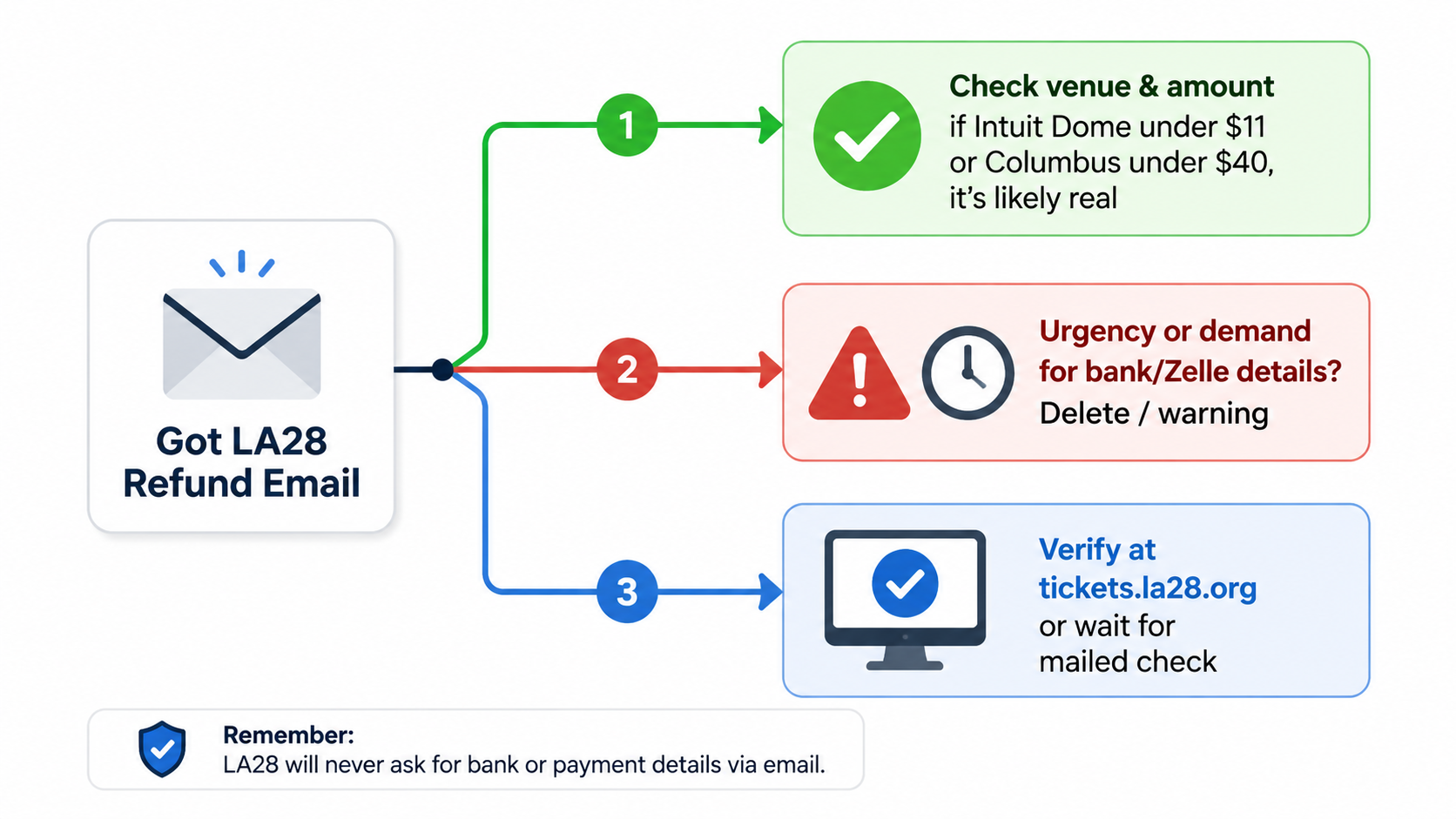
If the email looks real but asks for financial details
Stop there. A real refund process should not make someone hand over sensitive financial details just because an email says time is running out. If a parent has already started filling something out, interrupt gently. The useful sentence is not “How could you click that?” It is “Let’s pause before we send anything.”
If no financial information has been submitted, there may be nothing more to clean up. Close the page, delete the message if it feels suspicious, and verify only by going directly to LA28’s official ticketing platform.
If the email matches the known refund details
Matching the subject line, venue, and small refund amount is reassuring, but it is not a reason to hurry. Choose between two calm options: verify online by typing the LA28 ticketing address yourself, or wait for the mailed check. For many families, the mailed check is the cleanest choice because it removes the link-clicking decision entirely.
| Option | Best when | What not to do |
|---|---|---|
| Wait for the mailed check | The recipient is unsure, tired, anxious, or does not need the money immediately | Do not let an email convince anyone that waiting is unsafe |
| Verify online through LA28 | A caregiver or ticket purchaser wants to check the refund status now | Do not click a refund link from an email; type tickets.la28.org directly |
| Delete or ignore the email | The venue, amount, or tone does not match the known LA28 refund pattern | Do not reply, call numbers in the message, or send payment information |
Why this deserves care, not embarrassment
The uncomfortable part is that legitimate organizations sometimes send messages that look very close to scam messages: an unexpected refund, a link, and a request to act. That puts the burden on the recipient, often at the worst possible moment.
California Attorney General Rob Bonta issued a consumer alert on April 27, 2026, warning Californians about LA28 ticket scams. [3] That alert was about ticket scams broadly, not proof that this specific refund email is fake. It does confirm that LA28-related messages are already a sensible place to slow down and verify.
The stakes are real. In calendar year 2025, adults age 60 and older reported $7.7 billion in fraud losses, and phishing and spoofing was the top complaint type for older adults, with more than 48,000 reports. [4] Those are 2025 figures, not a measurement of LA28 refund scams in 2026, but they explain why a small refund email is worth treating carefully.
It is also worth dropping the idea that only careless people fall for scams. In a 2026 FBI case study, a criminology professor with decades of law enforcement knowledge lost more than $500,000 to a government impersonation scam. [5] If someone trained around crime and law enforcement can be manipulated, an older adult who opened a plausible Olympic refund email in good faith should not be treated as foolish.
The one-minute family rule
If you need a sentence to send to a parent, use this:
“The LA28 refund may be real, but you do not have to click anything. If it asks for bank, Zelle, card, password, or code information, stop. If you are unsure, wait for the mailed check or let me help you check by typing tickets.la28.org into the browser.”
That rule protects the refund without turning every email into an emergency. The email can wait. The check can arrive by mail. Verification can happen through the official LA28 ticketing site, not through pressure built into a message.
References
- Olympics refund, LAist, July 17, 2026
- Terms and Conditions, LA28
- All That Glitters Isn’t Gold: Attorney General Bonta Warns Californians of LA 2028 Ticket Scams, California Department of Justice, April 27, 2026
- FBI, FTC: Older Adults Lost Billions to Scammers in 2025, AARP
- Scammers Target Older Adult Victims, FBI, May 15, 2026
Questions to bring to a clinician or OT
This is not medical, legal, or a family's final decision — only a framework. Bring these questions to a clinician, occupational therapist, or your local Area Agency on Aging.
Find Local HelpRelated reading
Noticed something outdated or inaccurate on this page? Flag a correction. We review every report against CDC, NIA, and AARP HomeFit guidance before updating a page.