
Caregiver decision guide
Why lung cancer is often missed in seniors and what caregivers can do
Lung cancer is commonly delayed or missed in older adults because symptoms overlap with COPD and pneumonia, chest X-rays miss most early tumors, and age bias reduces diagnostic urgency. This guide explains the underlying mechanisms and gives family caregivers practical steps to advocate for timely screening and accurate diagnosis.
The hard part is that the first explanation may be reasonable. An older parent with COPD can cough. Someone with asthma can wheeze. Pneumonia can leave a person tired and short of breath for longer than the family expects. Heart failure can make a walk to the mailbox feel like a climb. None of that is rare, and none of it means lung cancer is the most likely answer.
That is also why lung cancer misdiagnosis in seniors is so difficult to recognize early. The problem is not always one dramatic mistake. More often, a changed symptom gets absorbed into an old label: “their COPD,” “another infection,” “getting older,” “probably pneumonia.” Lung cancer is largely a disease of older adults; the American Cancer Society says most people diagnosed are 65 or older, with an average diagnosis age of about 70, and estimates about 229,410 new lung cancer cases in the United States in 2026.[1]
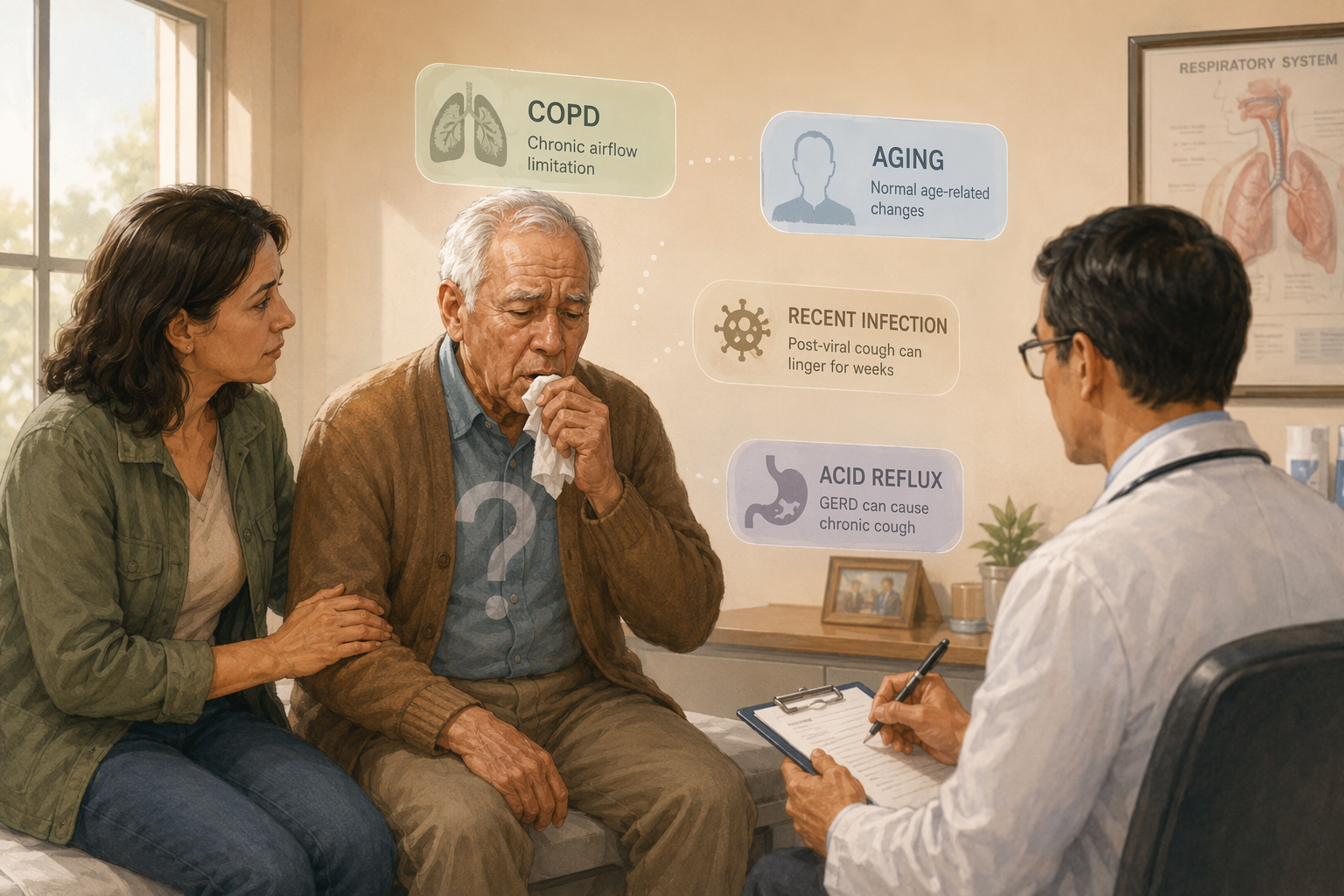
There is no single trustworthy number that tells families, “This percentage of seniors with lung cancer are misdiagnosed.” The evidence is narrower than that. It shows delays linked to chronic respiratory disease, cancers missed on chest X-ray, low uptake of eligible screening, and less aggressive care among older adults in some datasets. Those narrower findings are still enough to explain why a caregiver’s notes can matter.
The first trap: a new pattern hiding inside an old diagnosis
COPD, asthma, pneumonia, heart failure, and lung cancer can all produce cough, breathlessness, fatigue, chest discomfort, and reduced activity. In a rushed appointment, the old condition often has an advantage: it is already in the chart. A clinician sees a familiar explanation, the family hears reassurance, and the visit moves on.
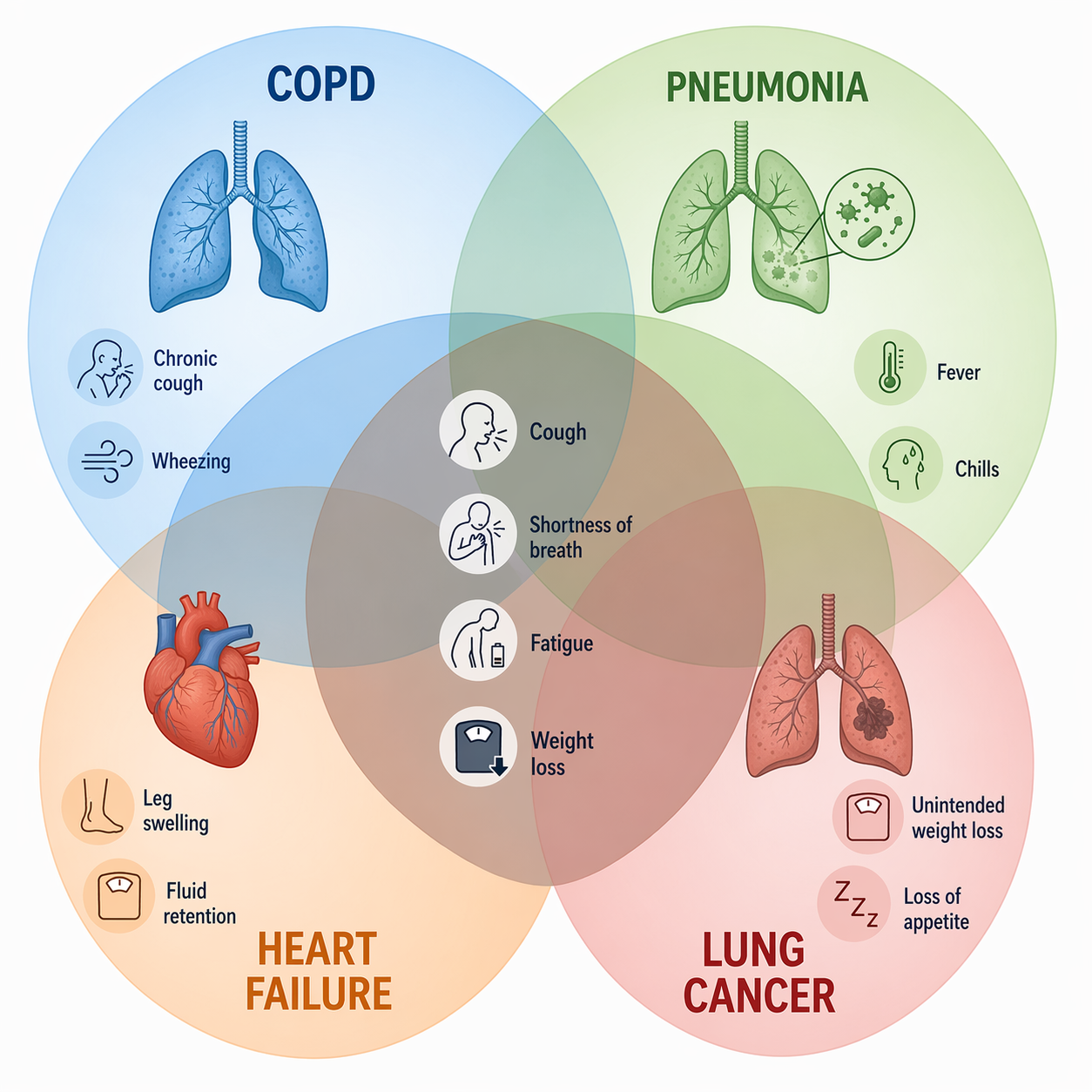
The question is not whether the parent has COPD or pneumonia. They may. The question is whether the current episode still behaves like the parent’s usual COPD or usual infection.
A 2024 study using English general practice and hospital records found that COPD was associated with an average 59-day delay in lung cancer diagnosis, and having two or more chronic respiratory conditions was associated with an additional 74-day delay. Those figures come from England, so they should not be treated as a direct measurement of U.S. care. But they make the mechanism visible: when respiratory illness is already present, lung cancer has more places to hide.[2]
This is where a caregiver can bring something useful without trying to become the doctor. “He has COPD” is background. “He used to stop once on the walk from the car; now he stops three times” is a change. “She coughs every winter” is background. “This cough sounds wetter, wakes her at night, and did not improve after the antibiotic” is a pattern. “He is tired” is vague. “He has lost weight and is leaving half his dinner” is harder to wave away.
Pneumonia deserves special attention because it can be both a real diagnosis and a clue. One patient can truly have pneumonia and still need follow-up if the infection keeps recurring, fails to clear as expected, or appears in the same part of the lung. MyLungCancerTeam notes that 50% to 70% of people with lung cancer develop pneumonia, and that recurrent pneumonia in the same location can signal an obstructing tumor.[3]
The most useful symptom list is the one tied to action. Persistent cough, coughing up blood, hoarseness, unexplained weight loss, chest pain that worsens with deep breathing, shortness of breath, fatigue, and recurrent infections are all recognized lung cancer symptoms.[4][5] In an older adult with chronic lung disease, the point is not to panic at every cough. It is to notice which symptoms are new, worse, persistent, unexplained, or out of character.
The second trap: a reassuring chest X-ray
Chest X-rays are common for a reason. They are quick, widely available, relatively inexpensive, and often appropriate when a clinician is checking for pneumonia, fluid, a collapsed lung, or another urgent explanation. But a chest X-ray is not the same thing as a low-dose CT scan, and a normal or unclear X-ray does not rule out lung cancer.
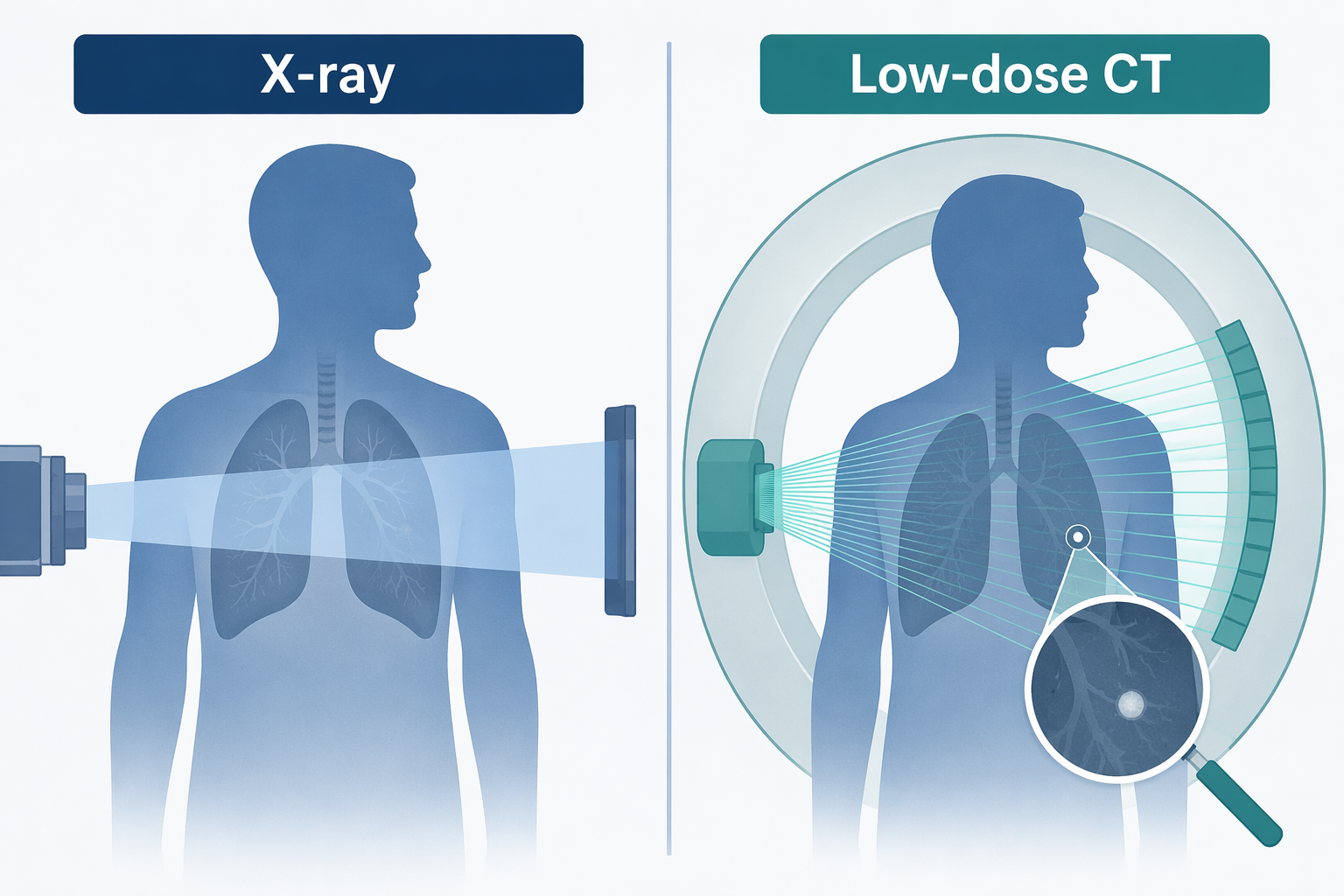
A radiology review published in Diagnostic and Interventional Radiology reported that approximately 90% of missed lung cancers occur on chest radiography, and that 20% to 30% of lung cancers visible in retrospect were initially missed on X-ray.[6] This is not a universal “miss rate” for every patient and every setting; it comes from a radiology review with a medicolegal focus. Still, it supports a practical point families need to understand: X-ray can miss cancers that CT later sees.
CT is different because it creates cross-sectional images rather than a flat projection. Low-dose CT is the test used for lung cancer screening in eligible people at high risk. Diagnostic CT may also be considered when symptoms, history, or an abnormal X-ray raise concern. Screening and diagnosis are not the same pathway, but both matter when an older parent has risk factors and persistent respiratory changes.
The caregiver’s job is not to demand a CT for every cough. The better question is specific: “Given that the X-ray was normal, what would make us consider CT if the cough or breathlessness continues?” Another useful version is: “If this is being treated as pneumonia or a COPD flare, when should we repeat imaging or reassess if he is not back to baseline?” Those questions leave room for medical judgment while making it harder for a single reassuring image to end the conversation too early.
The third trap: age lowering the urgency
Age changes medical decisions. That is not automatically bias. Frailty, kidney function, other illnesses, medications, cognition, transportation, and the patient’s own goals can all change what testing or treatment makes sense. A 90-year-old who wants comfort-focused care should not be pushed through a workup they do not want.
But age can also quietly lower diagnostic urgency before anyone has actually discussed goals, risks, or options. In a Korean study of non-small cell lung cancer, age over 80 was associated with much higher odds of receiving no treatment compared with patients in their 50s, with an odds ratio of 16.55. The study reflects a specific healthcare context, but it is consistent with a broader concern: older adults can receive less aggressive cancer evaluation and care.[7]
For a caregiver, the useful distinction is between individualized caution and dismissal. Individualized caution sounds like, “Here are the risks of CT contrast,” or “Here is how treatment options would change given his heart disease.” Dismissal sounds like, “At his age, these things happen,” without a plan for what would trigger reassessment.
What caregivers can track before the next appointment
A good note does not need medical language. It needs dates, baselines, and changes. Bring one page if possible; long narratives are easy to skim under pressure.
| What to track | Why it matters | How to say it |
|---|---|---|
| Change from baseline | A chronic symptom becomes more concerning when it changes in character, duration, or severity. | “This is not his usual COPD cough. It started three weeks ago and wakes him at night.” |
| Breathing capacity | Shorter walking distance, more rest breaks, or new breathlessness at rest can show decline. | “She used to climb the porch steps without stopping. Now she stops halfway.” |
| Weight and appetite | Unexplained weight loss can be missed if no one records it. | “His pants are loose and he is eating about half his usual dinner.” |
| Infections | Repeated pneumonia, slow recovery, or same-location pneumonia should prompt follow-up questions. | “This is the second pneumonia this season. Was it in the same area of the lung?” |
| Treatment response | Symptoms that persist after antibiotics, inhalers, or steroid treatment may need reassessment. | “After finishing treatment, what should improve, and by when?” |
| Risk history | Smoking and occupational exposures affect screening eligibility and diagnostic suspicion. | “He smoked for about this many years and worked around this exposure, if that changes the plan.” |
If the parent has memory problems, minimizes symptoms, or says “I’m fine” in the exam room, the caregiver’s written timeline becomes even more important. It gives the clinician something more reliable than everyone trying to reconstruct three months of coughing in six minutes.
Ask about screening, but do not confuse it with diagnosis
Lung cancer screening is for people at high risk who do not necessarily have symptoms. It is not the same as evaluating a persistent cough, abnormal X-ray, recurrent pneumonia, or new shortness of breath. Still, screening eligibility is a practical checkpoint many families never hear about.
The American Lung Association summarizes current criteria this way: the U.S. Preventive Services Task Force recommends annual low-dose CT screening for adults ages 50 to 80 with a 20 pack-year smoking history, and Medicare covers screening for ages 50 to 77 under the same pack-year criteria when other requirements are met.[8]
Despite those recommendations, screening remains underused. The American Cancer Society reported in 2025 that only about 1 in 5 eligible adults in the United States is screened for lung cancer.[9] That is not proof that any one patient’s doctor missed something. It does mean families should not assume eligibility has already been checked.
A simple appointment question is enough: “Does my parent meet the criteria for annual low-dose CT lung cancer screening?” If the answer is no, ask why. If the parent has symptoms, ask separately: “Since this is a symptom, are we talking about screening or diagnostic imaging?” That distinction prevents a common muddle where a symptomatic person is told they do not qualify for screening and the diagnostic question gets lost.
Questions that push past premature closure without accusing anyone
Most caregivers do not want a confrontation. They want a plan that says what is being watched, what should improve, and what happens if it does not. These questions are useful because they ask for the clinician’s threshold rather than pretending the family already knows the answer.
- “What diagnosis are we treating today, and what findings would make you reconsider it?”
- “If this is a COPD flare or pneumonia, when should the cough, breathing, fever, or energy level be back near baseline?”
- “If symptoms persist after treatment, should we repeat imaging or consider CT?”
- “Was the pneumonia in the same part of the lung as last time?”
- “Does his smoking history or work exposure change the level of concern?”
- “Should we be using a lung cancer screening pathway, a diagnostic pathway, or both?”
The follow-up date matters as much as the question. “Call if worse” can be appropriate for mild problems, but it is not much of a safety net for a frail parent who underreports symptoms. A clearer plan is: “If he is not back to baseline by this date, we will call, return, repeat imaging, or discuss CT.”
When to ask again
Ask again when the story changes. Ask again when the treatment worked last year but not this time. Ask again when pneumonia recurs, especially in the same area. Ask again when the X-ray is reassuring but the person in the chair still cannot walk the distance they walked last month. Ask again when weight loss, hoarseness, coughing blood, chest pain with deep breathing, or persistent fatigue gets treated as background noise.
None of this means a caregiver can diagnose lung cancer. It means the caregiver can keep the old label from swallowing the new facts. In seniors, that can be the difference between “common for his age” and “not yet explained.”
References
- Key Statistics for Lung Cancer, American Cancer Society,
- COPD, Respiratory Conditions Delay Lung Cancer Diagnosis, Respiratory Therapy, 2024,
- Conditions Lung Cancer Can Be Mistaken For, MyLungCancerTeam,
- Signs and Symptoms of Lung Cancer, American Cancer Society,
- Lung cancer - Symptoms and causes, Mayo Clinic,
- Missed lung cancer: when, where, and why?, Diagnostic and Interventional Radiology, 2017,
- Factors Affecting Treatment Selection and Overall Survival in Patients with Advanced Non-small Cell Lung Cancer, Cancer Research and Treatment, 2019,
- Medicare Coverage for Lung Cancer Screening FAQ, American Lung Association,
- Lung Cancer Screening Rates Remain Low Among Eligible Adults, American Cancer Society, 2025
Questions to bring to a clinician or OT
This is not medical, legal, or a family's final decision — only a framework. Bring these questions to a clinician, occupational therapist, or your local Area Agency on Aging.
Find Local HelpRelated reading
Noticed something outdated or inaccurate on this page? Flag a correction. We review every report against CDC, NIA, and AARP HomeFit guidance before updating a page.