
Caregiver decision guide
How to Choose a Magnifying Mirror for Seniors with Low Vision
Choosing the right magnifying mirror for a senior with low vision means focusing on stability, front-facing LED lighting, and the correct magnification range — not the highest number available. This article explains what to look for and why 5x to 7x magnification works best for daily grooming tasks.
The best magnifying mirror for seniors with low vision is usually not the strongest one on the shelf. For daily grooming, start with three things: a stable base or secure wall mount, front-facing LED lighting, and 5x-7x magnification. That range gives enough enlargement for shaving, makeup, tweezing, and checking the face without forcing the person to crowd the mirror or search through a tiny circle of vision.
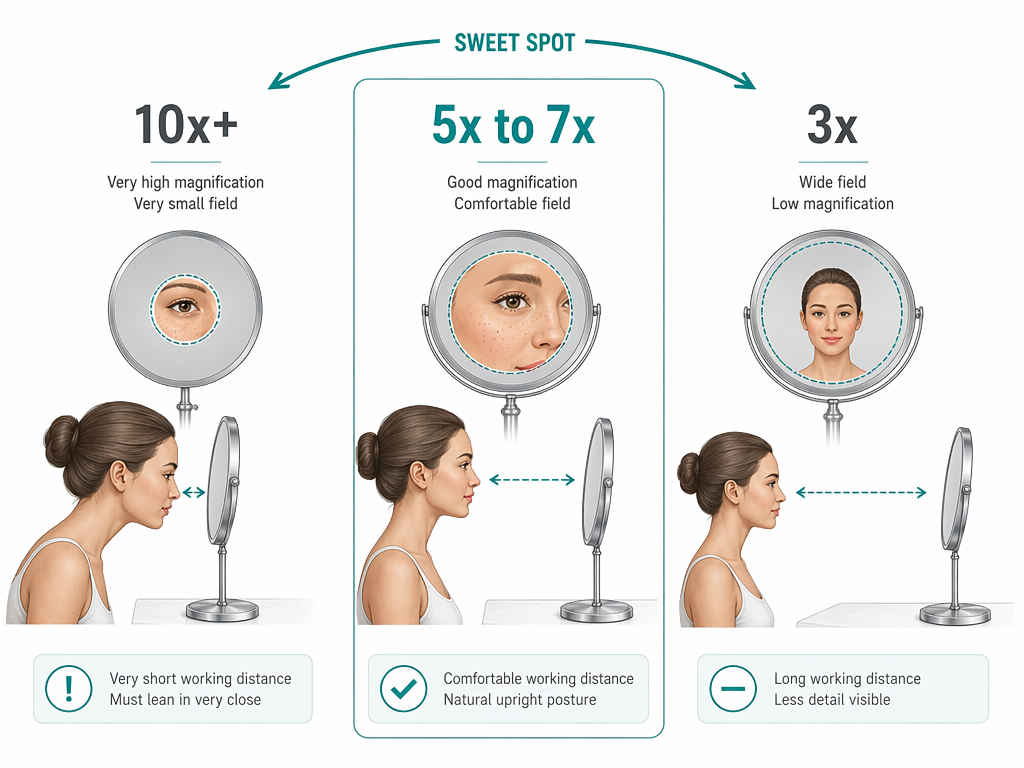
Higher magnification can be useful, but it changes how the mirror behaves. AllAboutVision explains that as magnification increases, the field of view gets smaller and the working distance gets shorter; in practice, that means the face has to move closer to the mirror and less of the face is visible at once.[1] For an older adult with hand tremor, neck stiffness, reduced stamina, or balance concerns, that tradeoff can turn a helpful object into one more thing that demands effort.
Why 10x Is Not the Default Answer
A 10x or stronger mirror sounds reassuring because the number is bigger. It may even look impressive in a product photo. The problem appears when someone tries to use it for an ordinary morning routine. At high magnification, the usable viewing area narrows. A cheek, eyebrow, or patch of skin may fill the mirror while the rest of the face disappears from context. The person may need to lean forward, lift the chin, adjust the chair, or keep repositioning the mirror to find the right spot.
That is tolerable for a short precision task. If someone needs to remove one stray hair or inspect a small area for a few seconds, 10x can have a place. It is less forgiving as a daily-use mirror, especially for grooming tasks that require both detail and orientation: shaving around the mouth, applying eyeliner, trimming a mustache, checking whether makeup is blended, or seeing both sides of the face well enough to stay even.
The 5x-7x range is a compromise in the best sense of the word. It enlarges the face enough to help with age-related near-vision difficulty, but it usually preserves a more usable field of view and a more comfortable working distance than stronger mirrors. For many seniors, that means less hunting for the right angle and less leaning toward glass.
| Magnification | Best use | Main drawback |
|---|---|---|
| 3x | Mild enlargement when lighting is the bigger problem | May not provide enough detail for close grooming |
| 5x-7x | Daily grooming, shaving, makeup, face checks | Still requires good lighting and stable positioning |
| 10x and higher | Short precision tasks such as tweezing | Narrower view and shorter working distance |
The Mirror Has to Let the Person Stay Upright
A magnifying mirror is not only an optical tool. It is also a posture tool. If it makes someone hunch over the sink, brace one hand on the counter, or hold the mirror steady while trying to shave with the other hand, it has already failed part of the job.
The Macular Society notes that a stable, well-positioned mirror can support comfortable posture and reduce strain, and that wall-mounted or heavy-base mirrors help prevent wobble during close tasks.[2] That matters because grooming is full of small movements. A hand moves toward the eye with mascara. A razor follows the jawline. Tweezers need a steady target. If the mirror shakes every time the counter is touched, the person compensates with their neck, shoulders, grip, or patience.
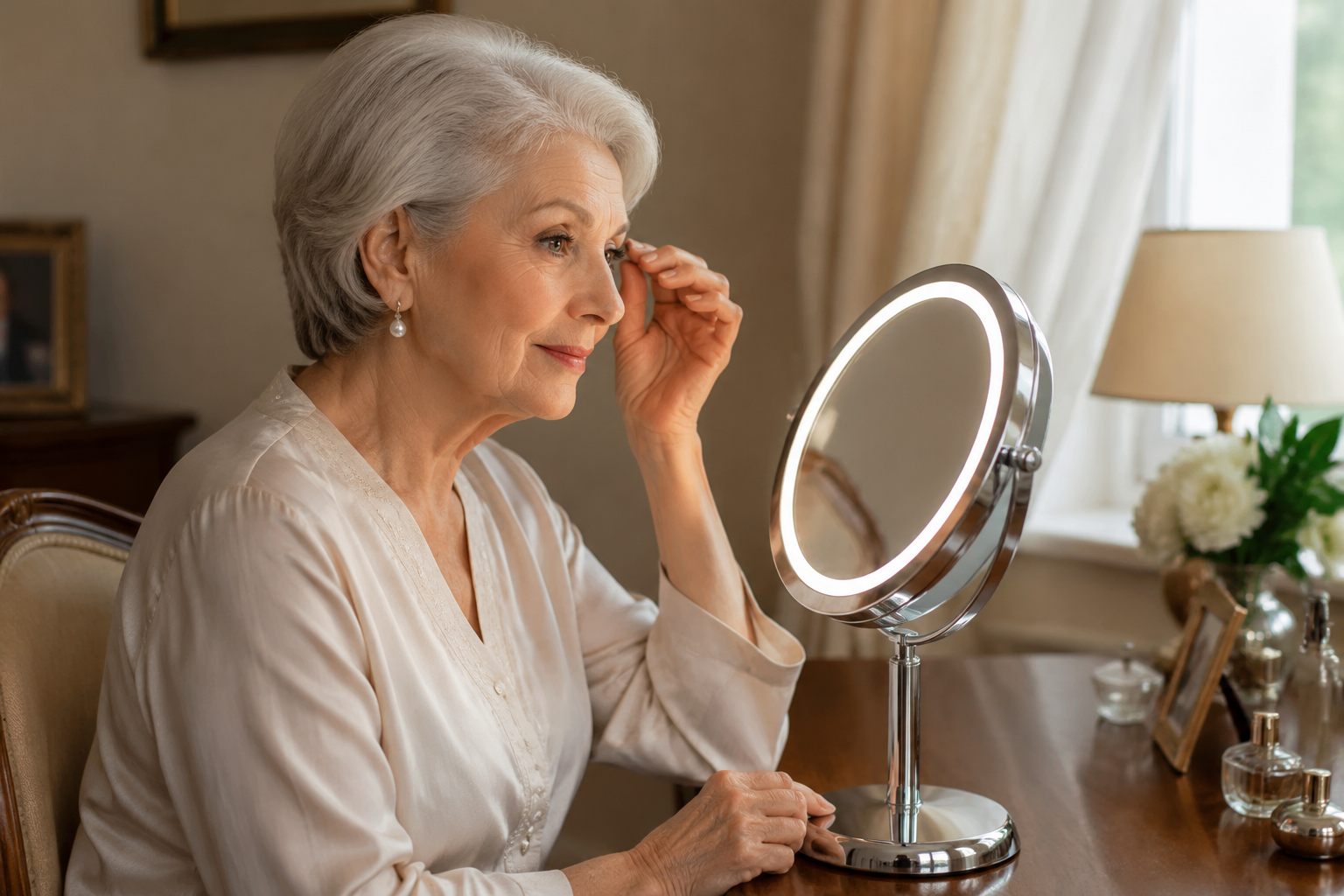
A good setup keeps the face close enough to see but far enough that the person can breathe, blink, and move normally. At a bathroom sink, that may mean a wall-mounted extension mirror that pulls forward and stays where it is placed. At a vanity or bedroom table, it may mean a heavy-base tabletop mirror with enough height to meet the face instead of making the face chase the mirror. For someone who tires easily, a seated setup may be better than a sink setup, even if the bathroom has the brighter light.
This is also where appearance deserves a little respect. A mirror that looks like a normal grooming tool is more likely to stay on the vanity and be used every day. If a senior dislikes something that looks clinical, bulky, or embarrassing, the technically better product may end up in a drawer.
Front-Facing Light Matters More Than Extra Features
Bathroom lighting often comes from above. That is convenient for the room and unkind to the face. Overhead light casts shadows under the brow, nose, and chin, exactly where many grooming tasks need detail. A senior may lean closer not because the magnification is too weak, but because the usable light is arriving from the wrong direction.
A 2026 LunaLondon article cites RNIB guidance that by age 60, many people need roughly three times more light for close tasks than they did at age 20.[3] Because that statistic is reported through a commercial mirror site rather than directly verified here from the original RNIB page, it should be treated as a useful directional claim, not as a settled specification. The practical point is still sound: older eyes often need more even task lighting, and a front-lit mirror can remove shadows that a ceiling fixture leaves behind.
Look for LEDs that shine toward the face rather than decorative lighting around the frame that mostly glows outward. A dimmable setting is useful when glare is a problem. Adjustable color temperature can also help, especially when warm light feels comfortable but a cooler setting makes contrast easier for a specific task. What matters is not that the mirror has the most lighting modes; it is that the light lands evenly on the face without making the person squint.
Commercial buying guides often describe age-related presbyopia, reduced contrast sensitivity, and glare intolerance as reasons standard bathroom mirrors become difficult for close grooming.[4] Those observations are plausible and consistent with clinical guidance, but product pages have a selling purpose. Use them for practical reminders, not as proof that a particular brand or luxury model is necessary.
Match the Mirror to the Place It Will Actually Be Used
Before comparing product listings, watch the routine the mirror is supposed to support. The right answer changes if the person shaves standing at a sink, applies makeup seated at a vanity, checks skin in a bedroom with better daylight, or needs to bring the mirror close without bending.
- For sink use, favor a secure wall-mounted mirror with an extension arm that holds position and does not drift.
- For seated grooming, choose a heavy-base tabletop mirror tall enough to keep the neck neutral.
- For shared bathrooms, make sure the mirror can be moved or folded away without becoming awkward or loose.
- For cordless models, check whether charging will be easy to remember and whether the mirror remains stable when unplugged.
- For small counters, avoid lightweight mirrors that tip when adjusted or crowd the space needed for grooming tools.
A mirror can also create small safety problems when it is poorly placed. A cord stretched across a vanity, a suction cup that lets go, or a mirror that encourages leaning over a wet sink is not just inconvenient. It adds one more moment of instability to a task the person is trying to do independently. This does not make a magnifying mirror a fall-prevention device; it simply means the setup should not ask the body to compensate for bad design.
When Low Vision Conditions Change the Choice
The American Academy of Ophthalmology includes magnifying mirrors among non-optical low vision devices that can help with grooming and personal care.[5] That is a useful endorsement of the category, not a guarantee that one mirror can solve every kind of vision loss.
Different eye conditions can make different features more important. With age-related macular degeneration, central vision loss may make it hard to see facial detail even with enlargement, so contrast, lighting, and sometimes electronic magnification may matter more than another jump in mirror power. With cataracts, glare can be a major barrier, so adjustable brightness and color temperature may be more useful than a very bright fixed light. Diabetic retinopathy and glaucoma can affect vision in ways that make lighting, contrast, field awareness, and professional low vision guidance especially important.[5]
This is the point where shopping has to give way to assessment. If a senior cannot recognize central facial details, repeatedly misses areas while shaving or applying makeup, sees better only by using eccentric viewing, or gives up grooming tasks even with a stable 5x-7x lighted mirror, the next purchase should not automatically be a stronger mirror. A low vision evaluation or vision rehabilitation referral can identify whether lighting changes, optical aids, electronic magnifiers, task training, or other supports are more appropriate.
A Simple Buying Rule
Choose the mirror that lets the senior sit or stand in a natural position, see enough of the face to stay oriented, and receive even light from the front. For most daily grooming, that points to a 5x-7x LED mirror with a stable base or secure wall mount. Add a 10x side only if there is a specific short task that needs it.
If that setup still does not make grooming manageable, the answer is not more magnification. It is professional low vision support.
References
- Magnifiers for Low Vision, AllAboutVision, 2026 update.
- Low vision aids, Macular Society.
- Best Magnifying Mirror for Elderly Aging Vision, LunaLondon, 2026.
- Finding Right Mirror for Older Eyes, Impressions Vanity Co.
- Low Vision Assistive Devices, American Academy of Ophthalmology.
Questions to bring to a clinician or OT
This is not medical, legal, or a family's final decision — only a framework. Bring these questions to a clinician, occupational therapist, or your local Area Agency on Aging.
Find Local HelpRelated reading
Noticed something outdated or inaccurate on this page? Flag a correction. We review every report against CDC, NIA, and AARP HomeFit guidance before updating a page.