
Caregiver decision guide
The Anti-Aging Secret for Seniors Isn't Surgery – It's Strength
The most effective anti-aging intervention without surgery isn't a cream or supplement — it's preserving the physical capacity to move freely. This article explains how strength, balance, and aerobic exercise work together to reduce fall risk, delay cognitive decline, and extend healthspan, backed by evidence from Stanford, AARP, and Harvard.
People searching for anti-aging secrets for seniors without surgery usually do not need another promise in a jar. They need something less glamorous and far more decisive: more years of getting up from a chair without help, walking across a room without fear, stepping into the shower safely, and recovering from a small stumble before it becomes a life-changing fall.
Cosmetic procedures, creams, and supplements may have their place for people who want them. But they do not answer the question that quietly governs later life: can the body still do what daily life asks of it? Harvard Health draws a useful distinction between lifespan and healthspan — not just how long someone lives, but how much of that life is spent in good health and function.[1] For older adults and the families who care about them, that is where the real anti-aging conversation belongs.
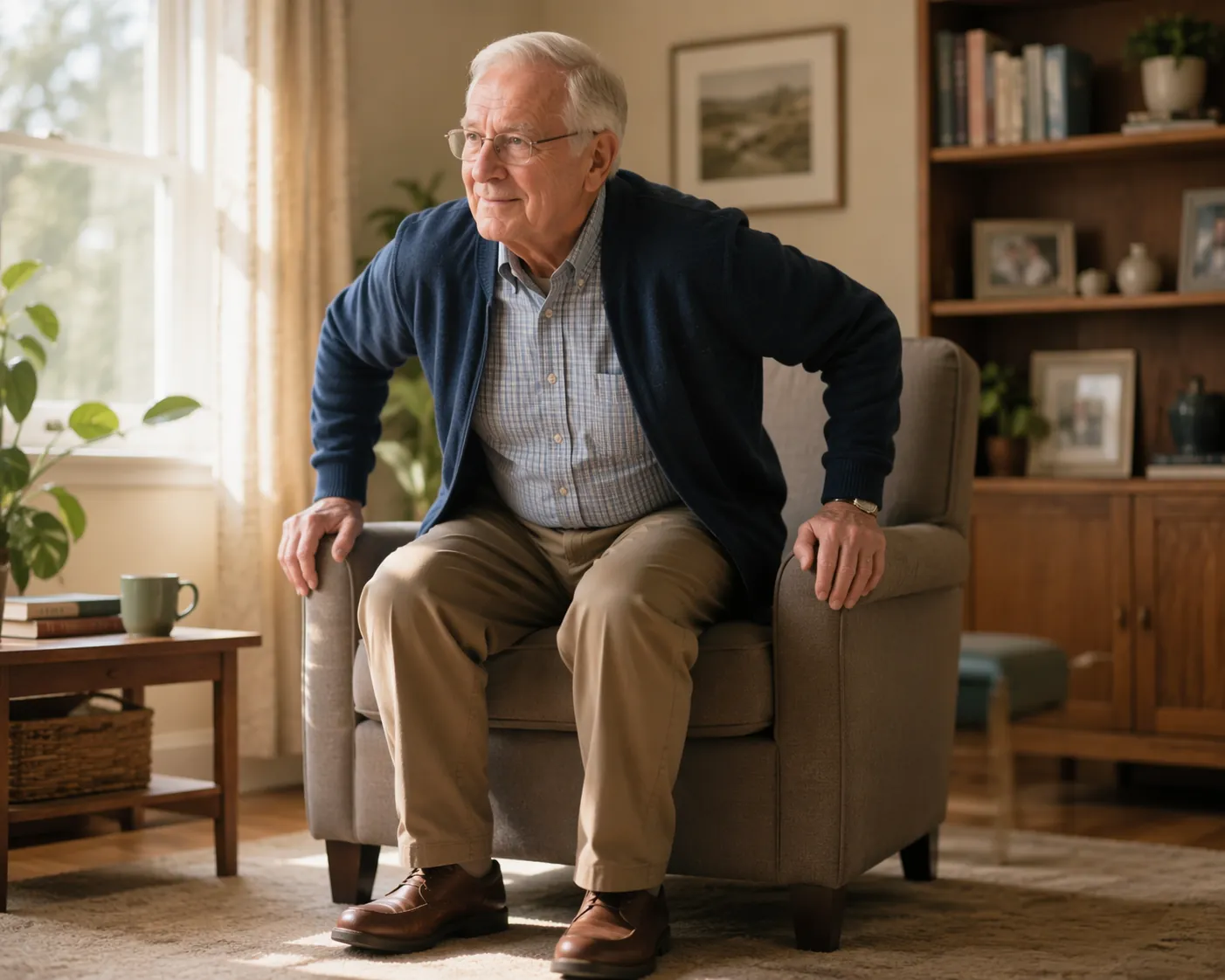
The anti-aging result that matters most is functional mobility
Functional mobility is not gym language. It is home language. It is the strength to stand from the toilet, the balance to turn in a hallway, the stamina to finish a grocery trip, and the flexibility to put on shoes without holding your breath. When those abilities shrink, independence shrinks with them.
That decline can feel sudden from the outside. A parent who seemed fine last winter is now pushing up with both hands to leave a chair, hesitating at curbs, or avoiding the basement stairs. But one reason the change looks sudden is that muscle loss has often been accumulating for decades. AARP notes that muscle mass declines about 3% to 8% per decade after age 30, with the rate accelerating after 60.[2] Stanford Medicine also emphasizes strength, balance, aerobic movement, and flexibility as core habits for aging successfully in the 60s, 70s, and beyond.[3]
This is why strength is not a vanity project for seniors. It is the infrastructure underneath aging in place. The question is not whether someone can lift heavy weights. The question is whether their legs, hips, trunk, and arms can keep supporting the ordinary movements that make a home livable.
Strength training protects the movements seniors use all day
The most useful senior strength exercises often look almost too plain to be called exercise. A controlled sit-to-stand trains the same pattern needed to rise from a dining chair. A wall push-up trains the arms, shoulders, and trunk without getting down on the floor. A step-up, done safely, resembles the work of stairs and curbs. These are not lesser versions of fitness. They are practice for daily independence.
AARP’s exercise guidance for older adults names strength training as one of the four types of exercise people need as they age and includes accessible movements such as sit-to-stands and wall push-ups.[2] The practical value is easy to see: stronger legs reduce the effort required to stand, stronger hips help steady the body when weight shifts, and stronger arms make it easier to use railings, carry light objects, or control a descent into a chair.
For families, one of the earliest warning signs is not a dramatic fall. It is the small substitution: rocking forward several times before standing, grabbing furniture on the way to the kitchen, skipping outings because the parking lot feels too far away. Those substitutions are understandable. They are also a signal that strength work may need to become part of the weekly routine, not as punishment, but as maintenance.
This matters even more when weight loss enters the picture. Older adults who lose weight without protecting muscle can become lighter but less capable. Anyone using or considering newer weight-loss medications should talk with a clinician about preserving muscle; families may also want to read more about what to watch for with GLP-1 weight loss in older adults. The goal is not just a lower number on a scale. It is keeping enough strength to live well in the body that remains.
Strength training does not have to look conventional to be useful, either. Some seniors enjoy resistance bands, water exercise, light dumbbells, supervised gym programs, or even more playful forms of strength and coordination. The point is progressive, appropriate resistance. For readers curious about less expected options, pole dancing for senior strength and independence is a reminder that older adults do not need to be treated as fragile by default.
Balance is where fall risk becomes visible
Balance has a way of revealing what strength alone can hide. A person may still walk reasonably well in a straight line but struggle when turning, stepping around a pet, reaching into a cabinet, or standing in the dark. Those are the moments when daily life stops being predictable.
Stanford Medicine highlights a simple finding that is hard to ignore: among adults ages 51 to 75, inability to stand on one leg for 10 seconds was associated with higher all-cause mortality, and balance can be improved with brief daily practice.[3] That does not mean a home balance test diagnoses anyone’s future. It means balance is a meaningful signal, and it is one families can understand without a lab report.
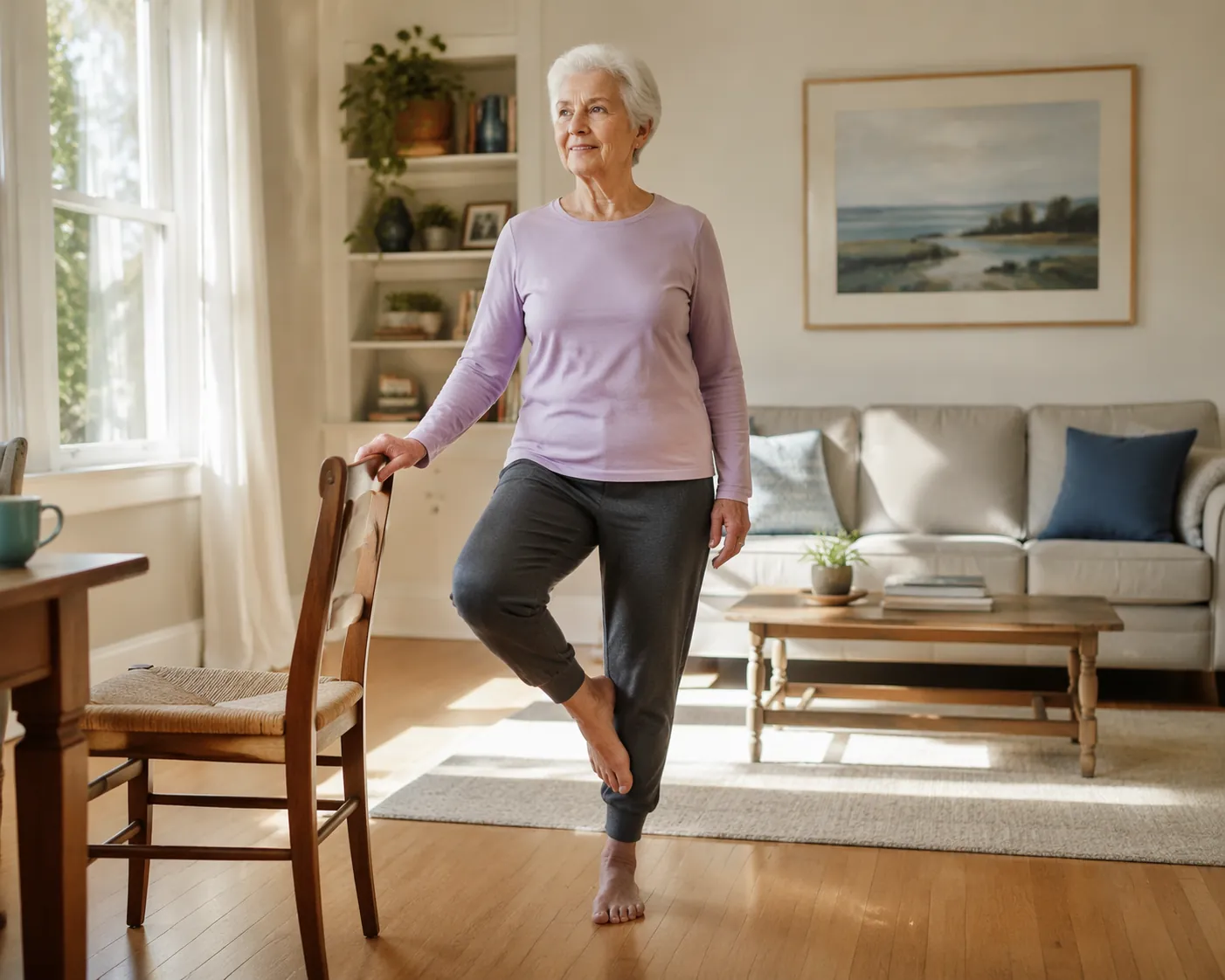
The safest balance work usually begins with support nearby: a sturdy chair, a countertop, a wall, or a trained professional if someone is already unsteady. Standing with feet closer together, shifting weight from side to side, practicing heel-to-toe stance, or briefly lifting one foot while holding support can all be scaled. What matters is that the practice matches the person’s current ability, not someone else’s idea of what aging should look like.
For a more structured path, a staged balance and strength progression ladder can help families avoid the two common mistakes: making exercises so easy they change nothing, or making them so hard they create the very risk they are supposed to reduce.
Aerobic movement keeps the engine available
Strength helps a person rise. Balance helps them stay steady. Aerobic movement helps them keep going. Walking, cycling, swimming, water aerobics, dancing, and other rhythmic activities support the heart, lungs, circulation, and stamina that make daily life less exhausting. A senior who has enough endurance for a neighborhood walk may also have more reserve for appointments, errands, social visits, and recovery after illness.
Harvard Health describes movement as one of the major pillars of longevity, alongside nutrition, sleep, stress reduction, and social connection.[4] That broader frame is important because exercise is not a standalone cure for aging. It works best as part of a life that also protects recovery, nourishment, relationships, and medical care.
Still, aerobic activity earns its place because it makes independence more durable. A person may have enough leg strength to stand once but not enough stamina to cook dinner afterward. They may manage a short hallway but avoid the mailbox, then the sidewalk, then the family gathering. Endurance is often what turns a capability into a routine.
Flexibility is the comfort layer, not the whole plan
Flexibility does not carry the whole anti-aging argument, but it does remove friction from daily movement. Stiff ankles can make walking feel less secure. Tight hips can change how someone rises from a chair. Limited shoulder mobility can make dressing, bathing, and reaching overhead more difficult.
Gentle stretching, range-of-motion work, and mobility exercises are most useful when they support real tasks: turning the head while walking, reaching a shelf, stepping into a car, or moving comfortably enough to keep exercising. Flexibility should not replace strength or balance work. It should make those things easier to continue.
The brain belongs in the mobility conversation
Once movement is understood as independence infrastructure, the cognitive piece fits naturally. Exercise is not only about avoiding falls or maintaining muscle. A 2025 JAMA Network Open study found that higher physical activity in late life was correlated with more than 40% lower dementia risk.[5] That is an association, not proof that exercise alone prevents dementia in an individual person. But it is strong enough to make movement one of the most serious non-surgical tools families should take seriously.
This is where quick-fix anti-aging claims tend to look thin. A cream cannot build the confidence to cross a room. A supplement cannot practice weight shifts. A cosmetic procedure cannot train the heart, legs, vestibular system, and brain to work together during a turn. Movement asks more of a person, but it also gives more back.
A safe starting framework for seniors and caregivers
The best starting point is not an ambitious program printed from the internet. It is a realistic look at what the person can do today, what feels unsafe, and what support is needed. For some seniors, that may mean beginning with chair-based strength work. For others, it may mean supervised physical therapy, a walking plan, or a class designed for older adults.
| Training area | What it protects | Simple starting idea |
|---|---|---|
| Strength | Standing, stair use, carrying, fall recovery | Supported sit-to-stands or wall push-ups |
| Balance | Turning, reaching, stepping around obstacles | Supported weight shifts or brief one-leg practice |
| Aerobic movement | Stamina, heart health, daily energy | Short, comfortable walks or water exercise |
| Flexibility | Comfort, reach, stride, ease of dressing | Gentle range-of-motion work |
A caregiver can help without turning every conversation into a warning. Instead of saying, “You’re going to fall,” try tying the habit to something the older adult already wants: getting back to the garden, walking into church without scanning for the nearest chair, traveling to a grandchild’s event, or staying in the home they know.
After a fall or near-fall, the conversation needs to become more concrete. Review lighting, rugs, footwear, medications, vision, bathroom setup, stairs, and the route between the bed and toilet. A complete fall prevention handout for seniors and caregivers can make that review less emotional and more systematic. If a fall has already happened, families should also know what to watch for afterward; senior health care after a fall deserves prompt attention because the effects are not always obvious in the first few minutes.
Mobility aids should be treated the same way: not as surrender, and not as decoration. A cane or rollator that is poorly fitted can create new problems; one that is well matched can preserve walking, confidence, and participation. If a rollator is part of the plan, use a practical 5-step rollator fit test rather than guessing at height, brake use, and posture.
It is not too late to start, but it should be done wisely
One of the most encouraging pieces of this whole subject is that the window does not close at 65, 75, or after years of inactivity. Johns Hopkins Medicine states that it is never too late to benefit from healthier habits, including exercise, and that people can gain measurable fitness and independence benefits even after long periods of inactivity.[6]
The safety boundary matters. Seniors, especially those with heart disease, diabetes, neuropathy, dizziness, recent surgery, osteoporosis, vision changes, or a history of falls, should talk with a physician, physical therapist, or appropriate clinician before starting a new exercise routine. Common medications, including statins, beta-blockers, and others, can affect exercise tolerance, muscle symptoms, dizziness, or fall risk, so the plan should fit the person rather than force the person to fit the plan.
The strongest non-surgical anti-aging strategy is not pretending the body is younger. It is protecting the capacity to move through daily life with enough strength, balance, stamina, and comfort to keep choosing where and how to live.
References
- Lifespan vs. healthspan: Why how you age matters more than how long you live, Harvard Health
- 4 Types of Exercise You Need as You Age, AARP
- Five healthy habits for successfully aging in our 60s and 70s — and beyond, Stanford Medicine, January 2026
- The 5 pillars of longevity, Harvard Health
- JAMA Network Open study on late-life physical activity and dementia risk, JAMA Network Open, 2025
- It's Never Too Late: Five Healthy Steps at Any Age, Johns Hopkins Medicine
Questions to bring to a clinician or OT
This is not medical, legal, or a family's final decision — only a framework. Bring these questions to a clinician, occupational therapist, or your local Area Agency on Aging.
Find Local HelpRelated reading
Noticed something outdated or inaccurate on this page? Flag a correction. We review every report against CDC, NIA, and AARP HomeFit guidance before updating a page.