
Caregiver decision guide
Managing Senior Skin Inflammation During Rainy Season
Learn why humid weather triggers skin flare-ups in older adults and how a simple daily routine can prevent most cases. Includes clear guidance on when to call a doctor.
The pattern usually shows up before anyone has a name for it. The weather stays damp for several days. Towels do not dry all the way. Shoes feel clammy. A parent starts scratching under the breast, in the groin fold, between the toes, under the belly, or along a waistband. Then comes the familiar 9 p.m. question: is this ordinary irritation, fungus, infection, or something that can safely wait until morning?
Treating skin inflammation in seniors during rainy or persistently humid weather starts with understanding that high humidity changes the skin environment, especially in older bodies. It is not proof that bathing was done badly or that someone was careless with laundry. In one study discussed by AARP, 75.7% of adults age 70 and older had at least one skin condition requiring treatment, and 39.1% had three or more at the same time.[1] That study involved 552 fair-skinned Finnish adults ages 70 to 93, so it should not be treated as a perfect map of every older adult in the United States. Still, it is a useful reminder: senior skin problems are common enough that caregivers should not start from blame.
Why Humid Weather Makes Older Skin Flare
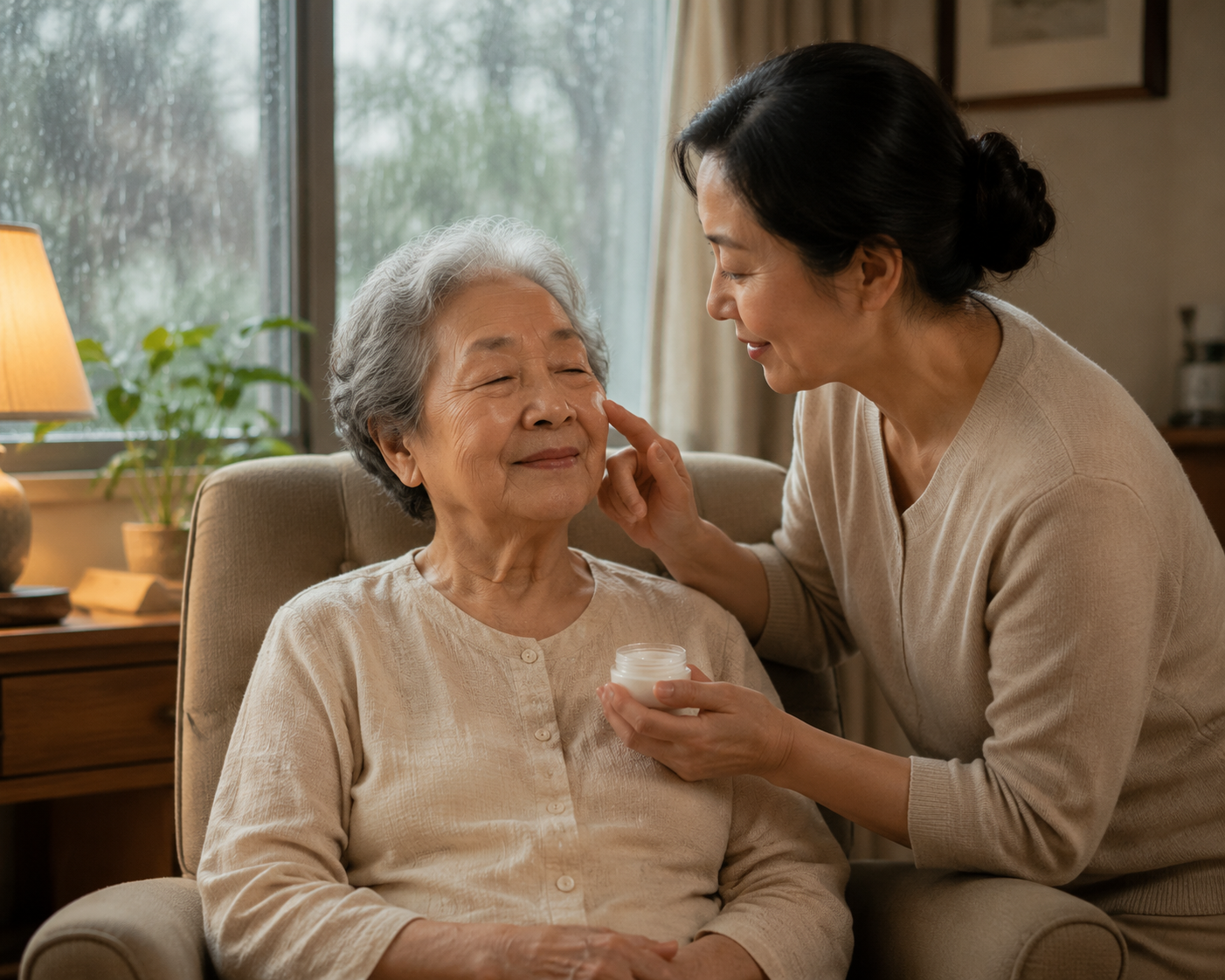
Older skin has less margin for error. With age, the epidermis becomes thinner and sebum production decreases, so the surface is less able to protect itself from friction, soap residue, damp fabric, and repeated wiping. At the same time, thermoregulatory sweating declines by roughly 25% after age 60, which means an older adult may hold onto more heat even while sweating less efficiently.[2]
That is the rainy-week paradox. A senior may not look sweaty the way a younger person does, yet moisture can still sit where skin touches skin or where fabric traps dampness: under breasts, in the groin, under the abdomen, between toes, inside socks, in shoes, under incontinence briefs, and along elastic waistbands. Heat softens the skin surface. Moisture lingers. Friction repeats with every transfer, step, brief change, or shift in a chair. The result can be redness, itching, burning, peeling, cracking, or a rash that seems to appear faster than the caregiver expected.
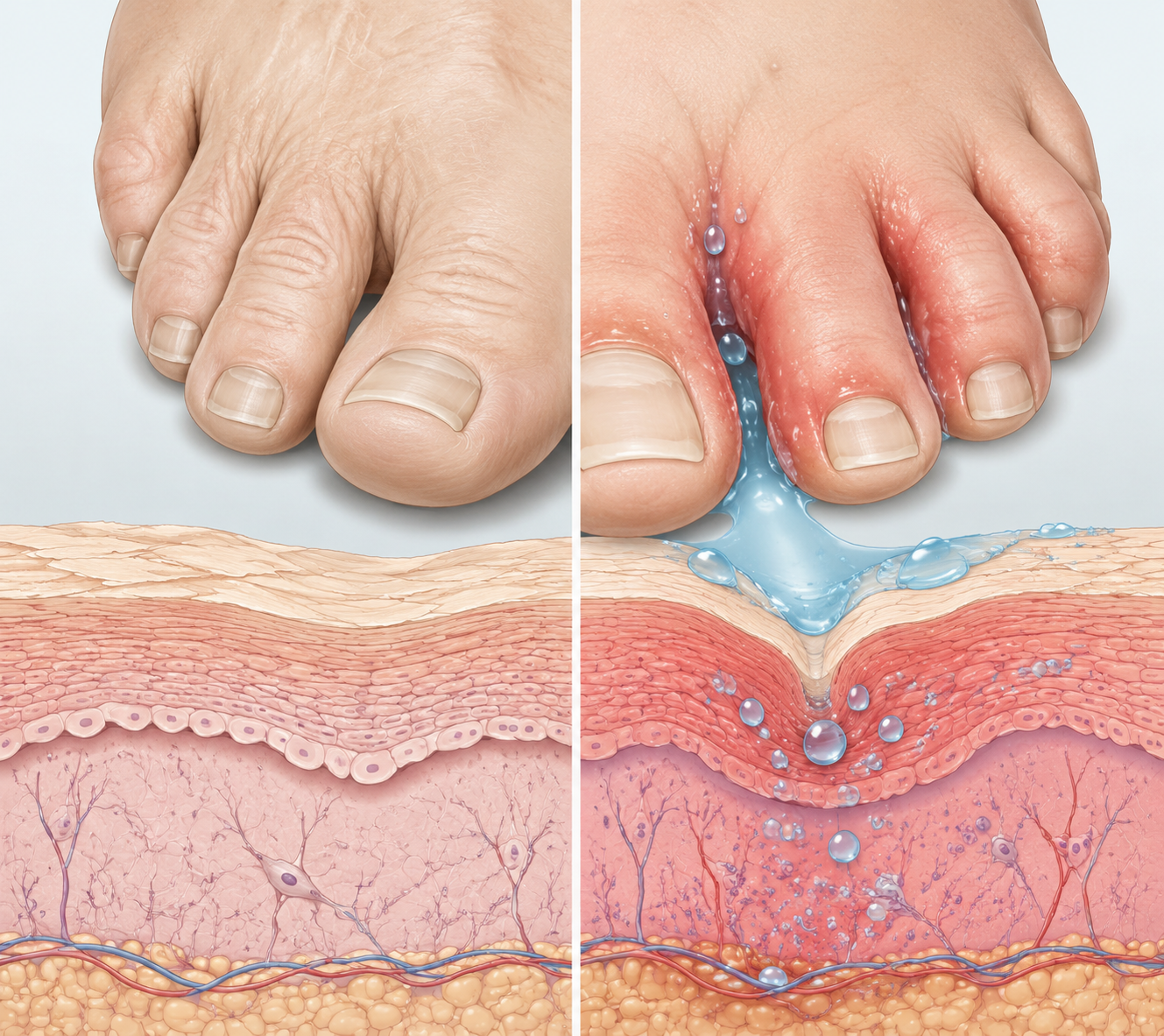
This is why the usual advice to “keep the skin dry” sounds simpler than it is. Drying a fold after bathing is one task. Keeping feet dry inside shoes is another. Managing towels, bedding, briefs, socks, laundry timing, room humidity, bathing resistance, and a parent’s embarrassment about being examined are all separate tasks. The goal is not constant inspection. The goal is a routine that lowers moisture and friction without turning daily care into a body search.
What To Look For Today
A caregiver does not need to diagnose every rash, but pattern recognition helps decide what to do next. Four problems are especially worth keeping in mind during extended high-humidity periods. They overlap, and they can look different depending on skin tone. In darker skin, inflammation may appear as darkening, purple-gray change, warmth, swelling, scaling, tenderness, or texture change rather than bright red color.
| What you notice | What it may suggest | What to do first |
|---|---|---|
| Irritated, sore, itchy, or burning skin where skin rubs skin, especially under breasts, belly folds, groin folds, or between buttocks | Intertrigo, especially when heat, friction, and trapped moisture are present | Clean gently, dry carefully, reduce friction, keep fabric breathable, and watch for signs of secondary infection |
| Itching, peeling, scaling, cracking, or soggy skin between the toes or on the soles | Tinea pedis, commonly called athlete’s foot | Dry between toes, change socks, air shoes, consider an OTC antifungal for uncomplicated cases, and check for nail changes |
| Dry, cracked, itchy, rough skin, often on lower legs or arms | Asteatotic eczema or very dry older skin | Use gentle cleansing and a light moisturizer on dry areas, but avoid trapping sweat in already damp folds |
| Beefy-looking rash in a fold, sometimes with small surrounding spots, soreness, odor, or persistent moisture | Possible candidal infection, often after intertrigo has created a damaged, moist area | Call a clinician if it is spreading, painful, recurrent, or not improving with basic moisture control |
Intertrigo deserves special attention because it sits at the center of the humid-weather problem. It is inflammation caused by skin rubbing against skin in warm, moist areas. StatPearls describes it as most prevalent in hot and humid environments, with heat, moisture, and friction driving the irritation; Candida species are the most common secondary infectious cause.[3] Cleveland Clinic similarly describes intertrigo as a rash that develops in skin folds because trapped moisture and friction break down the skin barrier.[4]
Tinea pedis also deserves more than a passing mention. In the same older-adult skin condition data discussed by AARP, tinea pedis affected 49% of adults age 70 and older, making it the most common condition in that group.[1] It is not just a locker-room problem. A parent who wears the same shoes daily, cannot dry between toes easily, has thick nails, or resists foot checks can keep re-seeding the same damp environment.
Dry eczema can confuse the picture because humidity does not always mean the skin is well hydrated. AARP reports asteatotic eczema in 21% of adults age 70 and older in the same dataset.[1] A caregiver may see dry, cracked lower legs and reach for a heavy ointment, which can be helpful on truly dry exposed skin. But in a sweating fold, under a tight waistband, or between toes, a heavy occlusive layer can trap dampness and worsen irritation. The location matters.
The Daily Routine That Actually Carries the Weight
The routine does not have to be elaborate. It does have to be consistent, especially when humidity lasts for several days and nothing in the house seems to dry completely. Think of it as a short moisture-control loop: cleanse gently, dry deliberately, reduce trapped heat, rotate fabrics and footwear, and check the few places most likely to break down.
Cleanse Without Scrubbing the Skin Raw
Use mild cleanser and lukewarm water on sweaty or irritated areas. Avoid harsh scrubbing, perfumed products, and repeated soaping of the same fragile skin fold. The point is to remove sweat, urine residue, stool residue, and skin debris without stripping the surface further. For caregivers who need a fuller bathing routine that protects privacy and cooperation, guidance on personal hygiene and bathing support for elderly parents is often more useful than another reminder to “bathe regularly.”
If a full bath is not realistic every day, clean the high-risk zones: under breasts, under the abdomen, groin folds, between buttocks, around incontinence products, under any brace or compression garment, and the feet. A washcloth, no-rinse cleanser, basin, or handheld shower can be enough when used gently and followed by careful drying.
Dry Folds and Feet as Their Own Step
Drying needs its own pause. Pat instead of rubbing. Lift a fold only as much as needed. Use a clean, soft towel and give the area a moment of air exposure before clothing goes back on. Between toes, use a separate dry corner of the towel or a soft cloth. If the skin is tender, press gently and stop before the wiping itself becomes the injury.
A hair dryer is sometimes used by caregivers, but it should be handled cautiously: only a cool setting, kept moving, and never on skin that has reduced sensation. For many families, a fan in the room for a few minutes after bathing is safer and less intrusive. The older adult should not be left chilled or exposed for long; dignity counts as part of the care plan, not an extra.
Choose Clothing That Lets Heat Leave
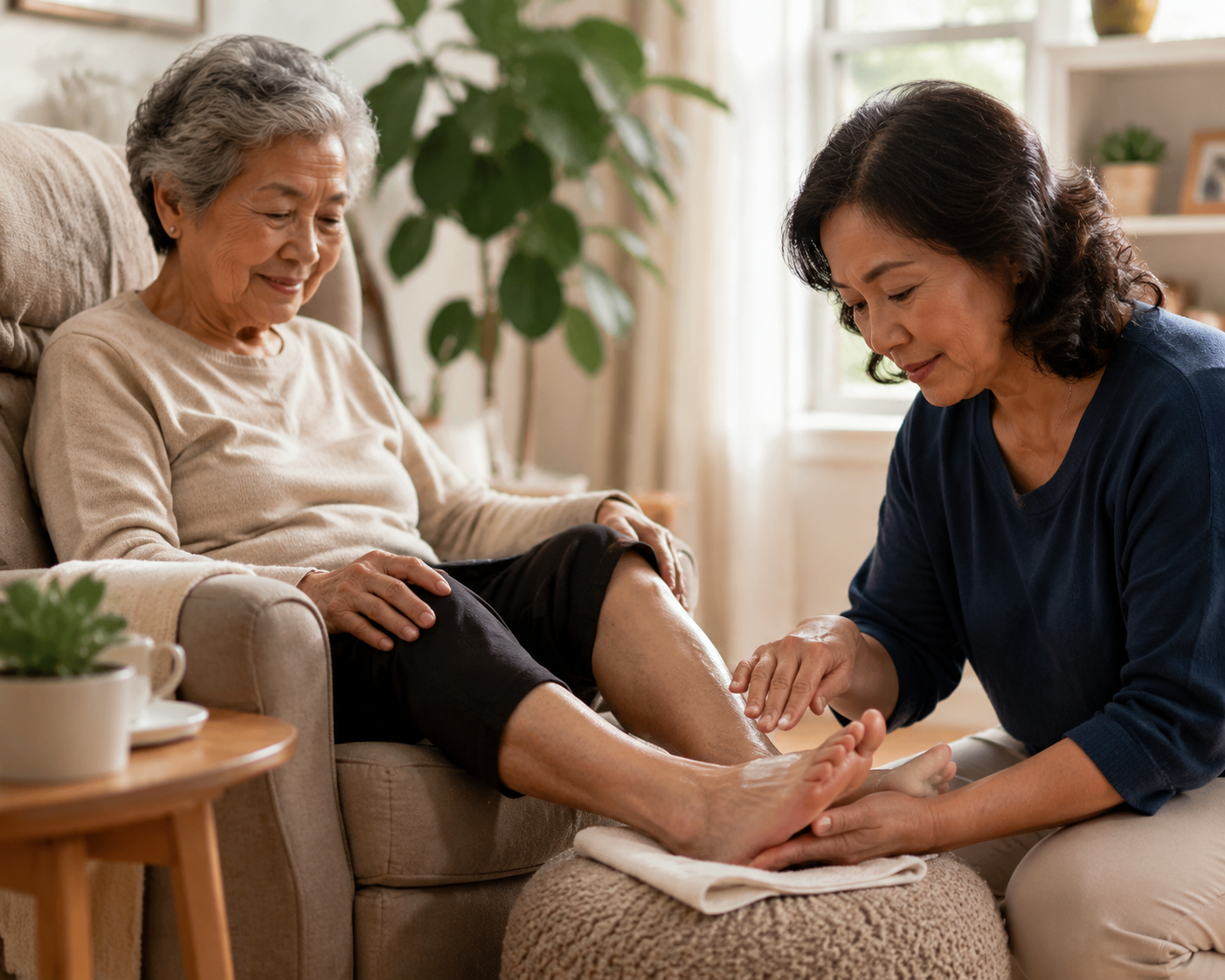
During humid stretches, tight synthetic waistbands, damp bras, heavy sleepwear, and non-breathable layers can keep the same area wet for hours. Soft cotton or moisture-wicking fabric, looser waistbands, and prompt clothing changes after sweating are practical skin care. If a parent sits much of the day, check whether fabric is bunching behind the knees, under the abdomen, beneath the breasts, or at the groin.
Incontinence products need the same attention. A brief that protects bedding can also hold warmth and moisture against the skin. Change promptly after wetness or stooling, cleanse gently, dry fully, and use barrier products only where they are needed. Too much product in a fold can become another damp layer.
Rotate Socks and Shoes
Feet are easy to neglect because many older adults do not want someone examining them, and some cannot bend safely to look. But rainy-season foot care is not optional if itching, peeling, cracking, or odor keeps returning. Put on fully dry socks. Change them when they become damp. Give shoes time to dry before wearing them again. If possible, rotate pairs rather than putting damp feet back into yesterday’s humid shoes.
For an uncomplicated case that looks like athlete’s foot, an over-the-counter antifungal such as clotrimazole or miconazole may help, but it has to be used consistently and for the full course. Stopping as soon as itching improves is one reason symptoms come back. Thick, yellow, crumbly, or distorted toenails may point to nail fungus, which AARP reports affects about 30% of seniors and can co-occur with tinea pedis.[1] Nail fungus is harder to manage at home and is worth discussing with a clinician, especially if there is diabetes, poor circulation, pain, or difficulty trimming nails safely.
Use Moisturizer by Location, Not Habit
Older skin often needs moisturizer, especially on dry lower legs, arms, and hands. Apply a light, fragrance-free moisturizer after bathing while the skin is slightly damp, then let it absorb before dressing. But do not automatically put heavy ointment into every fold during a humid spell. If an area is already warm, sweaty, and covered by fabric, thick product may trap moisture where the skin needs air.
This is one place where caregiving gets unfairly tricky: the same parent may have dry, cracked shins and a damp groin rash on the same day. Treating both areas the same way can make one of them worse. Dry exposed skin usually wants gentle moisture. Damp folded skin usually wants less friction, more air, and careful drying.
Check High-Risk Areas Without Turning It Into Surveillance
A daily check can be brief and respectful. Tie it to normal care: after bathing, before clean clothes, during sock changes, or while changing incontinence products. Ask first. Explain what you are checking for. Keep the room warm. Cover areas not being cleaned or dried. Many older adults are embarrassed by rashes, odor, fungal nails, incontinence irritation, or needing help with folds they cannot see.
Health in Aging’s caregiver guidance emphasizes watching for skin changes in older adults and getting help when problems do not improve or signs of infection appear.[5] At home, the useful version is simple: know what your parent’s usual skin looks and feels like, notice what changed, and avoid guessing too long when the change is spreading, painful, open, or unusual.
When Diabetes, Limited Mobility, or Bath Refusal Changes the Plan
Some households need more than a neat routine. Diabetes, limited mobility, cognitive changes, fear of falling, depression, pain, modesty, and bath refusal can all interfere with the exact steps that prevent moisture damage.
Diabetes Raises the Stakes Around Folds and Feet
With diabetes, be more cautious about both skin folds and feet. StatPearls notes that patients with diabetes have elevated pH in intertriginous skin folds, which increases susceptibility to Candida.[3] Diabetes can also make foot problems more consequential when circulation or sensation is reduced. A small crack between toes, a blister from a damp shoe, or an open spot under a callus deserves earlier medical attention than it might in a healthier adult.
For a parent with diabetes, do not cut corns, dig at nails, peel loose skin, or treat an open foot wound as a routine rash. Keep feet clean and dry, use clean socks, check inside shoes for dampness or rough seams, and call a clinician for any open sore, drainage, spreading redness, warmth, swelling, or pain.
Limited Mobility Means the Environment Has To Do More Work
If a parent cannot stand long, lift a leg, step safely into a tub, or dry between toes, the bathroom setup matters. A shower chair, handheld shower, nonslip surface, reachable towels, and seated drying time can make skin care possible without exhausting everyone. A more detailed guide to bathing assistance for elderly adults can help turn the routine into something safer and less rushed.
For someone who sits most of the day, also think beyond the bathroom. Damp clothing after a short walk, sweat under a cushion, a wet brief, or socks that stay on from morning to night can keep skin inflamed even when bathing is done correctly. Repositioning, breathable seat covers, dry clothing changes, and scheduled foot airing can matter as much as the bath itself.
Bath Refusal Needs a Smaller Doorway
When a parent refuses bathing, arguing about hygiene often makes the next bath harder. The reason may be fear of falling, feeling cold, pain, depression, loss of privacy, dementia, or embarrassment about needing help. In that situation, skin prevention may need to start with a smaller offer: “Let’s just wash and dry your feet,” or “Let me help with fresh underwear and a quick rinse.”
Caregivers dealing with repeated refusal may need strategies specific to why an elderly parent refuses to bathe or dementia bathing refusal. For skin inflammation, the practical compromise is to protect the highest-risk areas first. Clean and dry folds, feet, and incontinence areas even on days when a full shower is not going to happen.
A Humid-Week Skin Routine
During extended high humidity, use a predictable rhythm instead of waiting for the rash to announce itself. The “rainy season” may mean Gulf Coast summer humidity, a Northeast stretch of wet heat, a damp Pacific Northwest week, or a stormy period anywhere. The routine is the same because the skin problem is the same: too much trapped moisture for too long.
- Morning: check folds and feet while dressing; put on dry socks and breathable clothing.
- After bathing or washing: pat folds dry, dry between toes, and let skin air briefly before clothing or briefs go back on.
- Midday if sweating or dampness is likely: change wet socks, underwear, bra, briefs, or waistband layers.
- Evening: look for new itching, odor, cracking, soreness, spreading color change, or open areas.
- Overnight: avoid overdressing; use breathable sleepwear and bedding that can dry fully between uses.
If the house itself stays damp, towels and shoes may be working against you. Hang towels where air moves. Do not reuse a towel that is still wet against irritated skin. Let shoes dry open. If safe and available, air conditioning, ventilation, or a dehumidifier can reduce the indoor moisture load. These are not luxury details when someone’s skin folds or feet are breaking down; they are part of moisture control.
What Can Usually Wait, and What Should Not
Mild irritation that is limited to a fold or between toes, without open skin, fever, pus, severe pain, or rapid spread, can often be watched briefly while moisture control improves. Clean gently. Dry better than usual. Reduce rubbing. Change damp fabric. Use an appropriate over-the-counter antifungal for an uncomplicated athlete’s foot pattern, following the product directions and completing the full course.
Do not ask yourself to diagnose infection by confidence alone. Call a doctor or other clinician if there is spreading redness or darkening, warmth, swelling, increasing pain, fever, pus, a foul odor with worsening rash, rapidly worsening skin, open sores, blisters, or red streaking. Call promptly for any diabetic foot wound, any open sore on a medically fragile parent, or any rash that is not improving despite careful moisture control.
The workable boundary is this: many humidity-triggered rashes improve when the skin is kept clean, dry, cool, and free from repeated friction, but a caregiver should not have to gamble when the skin looks infected, the foot is involved in diabetes, or the parent seems unwell. A routine can prevent a lot. It does not replace medical backup when the signs move past ordinary irritation.
References
- 8 Most Common Skin Conditions After You Turn 70, AARP
- How Humidity Makes Beating the Heat Harder for Older Adults, AARP
- Intertrigo, StatPearls, NCBI Bookshelf, updated 2024
- Intertrigo: What Is It, Causes, Symptoms & Treatment, Cleveland Clinic
- Caregiver Guide: Skin Problems, Health in Aging, American Geriatrics Society
Questions to bring to a clinician or OT
This is not medical, legal, or a family's final decision — only a framework. Bring these questions to a clinician, occupational therapist, or your local Area Agency on Aging.
Find Local HelpRelated reading
Noticed something outdated or inaccurate on this page? Flag a correction. We review every report against CDC, NIA, and AARP HomeFit guidance before updating a page.