
Caregiver decision guide
How Nurse Navigators Help Older Adults Join Clinical Trials
Clinical trial nurse navigators are oncology nurses who guide older adults through the research process, from eligibility to logistics. Learn what they do, why they help seniors overcome common barriers, and how family caregivers can request their support.
When an oncologist says, “There may be a clinical trial,” a family caregiver usually hears two things at once: a possible option, and a new pile of work. Who finds out whether Mom is eligible? Who explains the consent form in plain language? Who knows whether the study visit is in the same clinic or at a university center two hours away?
A clinical trial nurse navigator is meant to make that path less fragmented. In oncology, this is typically a registered nurse with cancer-care experience who helps patients and families move through trial awareness, education, eligibility screening, enrollment, logistics, and staying on the study after it begins. The navigator does not decide whether a trial is medically right for your parent; the oncologist and research team do that. The navigator helps make sure ordinary barriers do not quietly become the reason an older adult never gets considered.

Why Older Adults Often Need More Than a Trial Brochure
Older adults are central to cancer care, but they are still underrepresented in cancer research. A 2021 systematic review reported that adults age 70 and older make up 42% of the cancer population but only 24% of cancer clinical trial participants. The same review identified provider age bias as one barrier, meaning older adults may be less likely to be offered or encouraged toward trials because of assumptions about age rather than a full review of fitness, goals, and eligibility.[1]
That matters because clinical trial access often breaks down in small, practical places. In a survey of 300 seniors about early-phase cancer trials, 60% reported at least one barrier, 34% cited transportation, 21% were reluctant to travel to university centers, and 92% worried about receiving a placebo.[2] Another report from a Cancer Support Community study found that 98% of older adults reported at least one barrier to clinical trial participation.[3]
None of those numbers means every older adult should join a trial. A trial may not fit the diagnosis, stage, prior treatments, other medical conditions, travel capacity, or the patient’s own goals. But the data do show why a “just ask your doctor” approach is thin advice for families already managing appointments, medications, work schedules, and transportation.
If your family is also trying to understand how trials fit into prognosis and treatment planning, it may help to read about what cancer prognosis really means for seniors. The key point here is narrower: before a family can make a real decision, someone has to help them reach a point where the option is understandable.
What a Clinical Trial Nurse Navigator Actually Does
Professional oncology navigation articles describe the clinical trial navigator role across the full trial journey: increasing awareness, explaining study participation, helping with screening and enrollment steps, addressing barriers, and supporting retention once a patient is on study.[4][5] For caregivers, that workflow is more useful than a formal definition.
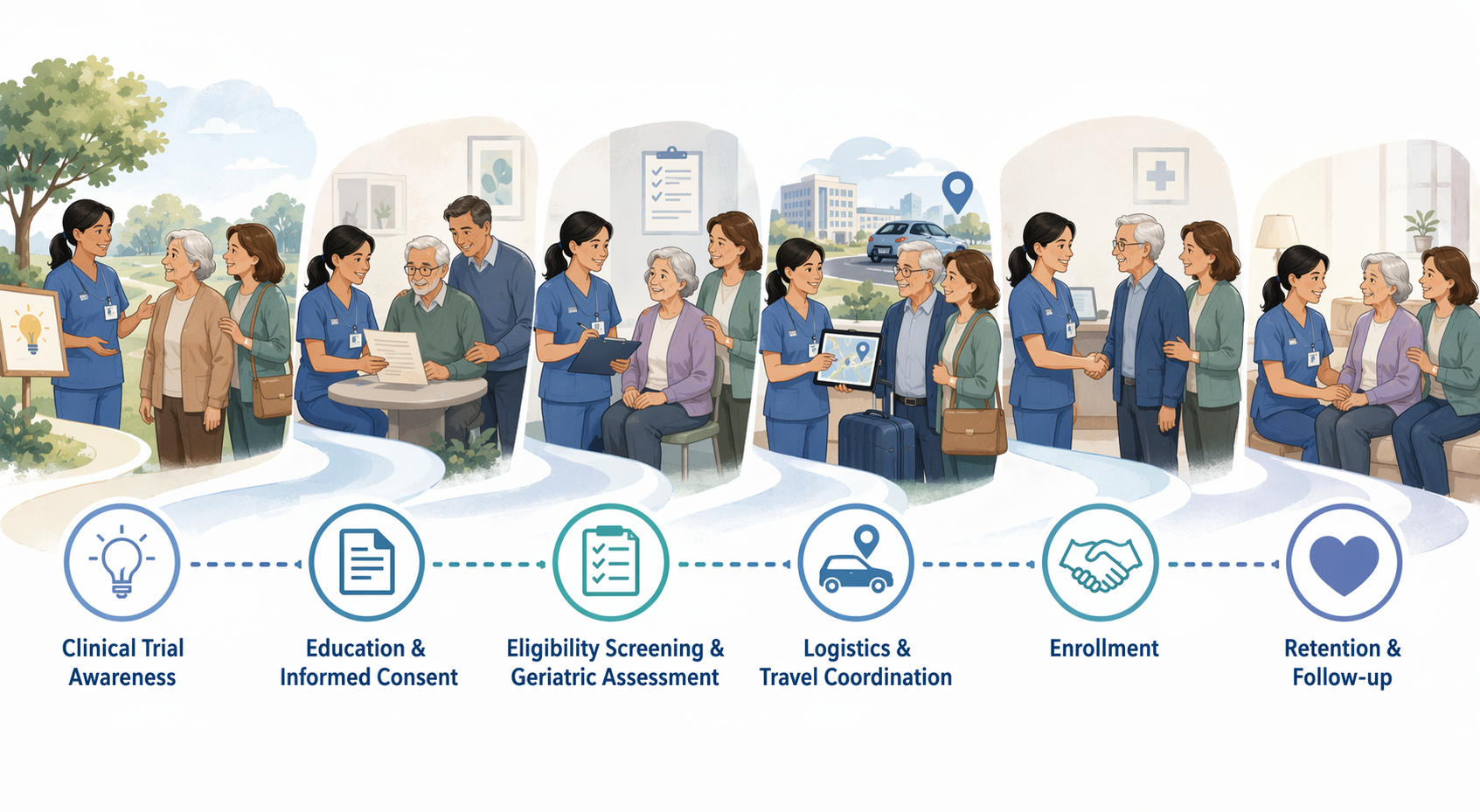
| Part of the trial journey | How the nurse navigator may help |
|---|---|
| Awareness | Identifies that a trial may exist and helps the family understand why it is being discussed. |
| Education and consent | Explains study basics, reviews questions, and helps the patient prepare for the research team’s consent conversation. |
| Eligibility screening | Helps gather records, clarify prior treatments, and flag age-related concerns that need review. |
| Logistics | Coordinates appointments, travel questions, parking, timing, and communication between offices. |
| Enrollment | Helps the family complete required steps without confusing the navigator’s role with the research team’s decision-making. |
| Retention and follow-up | Checks for symptoms, schedule strain, missed visits, and new barriers after the trial begins. |
Awareness: making sure the option is seen
Many families never reject a trial; they never get a clear look at one. A nurse navigator can help by asking whether trial options have been reviewed, checking whether a patient’s diagnosis and treatment history make a referral worth exploring, and connecting the treating oncology team with a research office when those teams are separate.
This is especially important for older adults because age-based assumptions can narrow the conversation too early. Age alone should not be treated as a complete treatment plan, whether the question is standard care or research participation. Families facing head and neck cancer decisions may recognize the same issue in why age alone shouldn’t guide tongue cancer treatment for seniors.
Education: slowing down the consent conversation
Clinical trial consent can be dense even for a healthy person sitting in a quiet room. For an older patient who is tired, hard of hearing, worried about disappointing family, or still absorbing a diagnosis, the paperwork can become a wall.
A navigator can help the patient and caregiver separate the big questions from the legal language: What is the purpose of the trial? What treatment or monitoring is different from usual care? How often are visits required? What side effects should be reported right away? Who answers questions after hours? If there is randomization or placebo, what does that actually mean in this study?
That last question deserves plain speech. In the senior survey noted earlier, 92% of respondents worried about placebo.[2] A navigator cannot erase that concern, and should not minimize it. The useful work is to help the family ask the research team exactly how the study is designed, whether all groups receive some form of active standard care, and what would happen if the cancer worsens.
Eligibility screening: gathering the details that decide the next step
Clinical trial eligibility is not just a yes-or-no question based on age. Research teams often need pathology reports, imaging results, lab values, prior treatment records, medication lists, performance status, and information about other medical conditions. For a caregiver, that can mean calling one hospital for a biopsy report, another clinic for infusion records, and a pharmacy for an updated medication list.
A nurse navigator can help identify what records are missing, who needs them, and whether the research team needs a geriatric-focused review of risks such as falls, frailty, memory problems, nutrition, or caregiver support. The navigator still does not “get someone into” a trial by persuasion. The value is cleaner information, fewer dropped handoffs, and a better chance that the decision is based on the patient’s actual situation.
Logistics: transportation, distance, and the appointment nobody can make
Transportation is not a side issue when the treatment center is far away or visits are frequent. In the survey of seniors considering early-phase cancer trials, transportation was cited by 34%, and 21% were reluctant to travel to university centers.[2] For an older adult who no longer drives, a “weekly visit” may really mean a daughter taking unpaid time off, a neighbor being available at 6 a.m., a wheelchair-accessible ride, and someone staying long enough in case labs are delayed.

This is where navigation becomes very concrete. The navigator may help map the study calendar before enrollment, clarify which visits must be in person, ask whether any labs or scans can be done closer to home, connect the family with transportation resources, and explain parking, check-in, and visit length. If your parent tires easily, the navigator can also help the team understand that a 7 a.m. appointment after a two-hour drive is not a small inconvenience.
Some families need more than trial-specific help. Area Agencies on Aging and local aging-service organizations may be part of a broader transportation or service plan; this guide to senior health services coordination explains that kind of non-trial navigation.
Communication: keeping the oncology team and research team from talking past each other
Families often discover that the “cancer team” is not one single team. The treating oncologist may be in one office, the trial coordinator in another, imaging in a hospital department, and the infusion nurse somewhere else. Each group may use different language for the same event: screening visit, baseline scan, research labs, standard-of-care labs, cycle one.
A nurse navigator can translate those handoffs into a workable sequence. Who orders the scan? Who calls with results? Does the oncologist need to approve a medication change before the research team can proceed? If the caregiver hears one instruction from the clinic and another from the trial office, the navigator can help reconcile the difference instead of leaving the family to guess.
The broader oncology navigation literature supports this kind of coordination work. A 2025 scoping review of 29 studies from 2000 through 2024 found that nurse navigation for older adults with cancer improved patient satisfaction, decreased distress, improved symptom management, and addressed care coordination barriers.[6] That review is not limited to clinical trial navigation, and much of this evidence is not randomized trial evidence. Still, it fits what caregivers feel on the ground: coordination changes whether care is usable.
Financial questions: finding the right person before bills become a surprise
Clinical trial costs can be confusing because different parts of care may be billed differently. Some study-related costs may be covered by the trial sponsor, while routine care costs may go through insurance. Travel, meals, lodging, parking, and missed work for a caregiver can still land on the family.
A navigator may not be the person who gives final insurance answers, but a good navigator knows who should. The practical questions are simple and worth asking early: Is there a financial counselor for trial patients? Are travel or lodging supports available? What will insurance be asked to cover? Are there assistance programs for parking, gas cards, or overnight stays? Families looking for broader support can also review financial resources for family caregivers.
Retention: staying on study after the first visit
Enrollment is not the finish line. An older adult may start a trial and then struggle with side effects, fatigue, transportation, confusion about the schedule, or a caregiver’s work conflict. When those problems are not noticed early, a missed appointment can turn into a withdrawal from the study or an urgent clinical problem.
The navigator’s job after enrollment may include checking whether symptoms are being reported to the right team, helping the family understand which side effects need urgent attention, confirming upcoming visits, and noticing when the patient has stopped asking questions. For some older adults, that quiet withdrawal is the first sign that the burden is becoming too much.
What the Evidence Can and Cannot Promise
Navigation is promising, but it is not magic. A national Clinical Trial Support Center run by The Leukemia & Lymphoma Society reported a 22.5% enrollment rate among patients who received a full trial search, nearly triple the roughly 8% national average cited in the study.[7] That result is encouraging, especially because it reflects matching and navigation rather than a brochure-only approach.
It also needs a careful reading. The people in that program had already sought out or accepted a clinical trial matching and navigation service, so they were not the same as every older adult in a general oncology clinic. The result should be treated as promising evidence from a self-selected population, not proof that navigation will produce the same enrollment rate everywhere.
The research base is also strongest in cancer care. Some hospitals use navigators in other complex diseases, but the evidence provided here is overwhelmingly oncology-focused. Even within oncology, not every cancer center has a dedicated clinical trial nurse navigator, and some centers divide the work among research nurses, trial coordinators, social workers, financial counselors, and general oncology navigators.
How to Ask for a Nurse Navigator
If no one has offered a navigator, it is still reasonable to ask. Use the words “clinical trial navigation” and “nurse navigator,” but do not get stuck on the title. The person who can help may be called a research nurse, oncology navigator, trial coordinator, patient navigator, or clinical trials office contact.
- Ask the oncologist: “If a clinical trial is being considered, is there a nurse navigator or research nurse who helps older adults and families through screening and logistics?”
- Ask the cancer center: “Do you have a clinical trials office, and can we speak with someone who helps patients understand open studies?”
- Ask about records: “What documents are needed to see whether my parent is eligible, and who will request them?”
- Ask about distance: “Which visits must happen here, and can any labs, scans, or follow-up steps be done closer to home?”
- Ask about money: “Who can explain insurance, study-related costs, parking, travel, lodging, or caregiver expenses before we sign consent?”
If your parent is treated in a smaller community clinic, the local oncologist may still be able to refer to a larger center for a trial review. In that situation, ask who remains responsible for day-to-day cancer care if the trial is at another site, and who will call your family when plans change. Split-site care can work, but it needs names, phone numbers, and clear responsibility.
Questions to Bring to the First Navigator Call
Before the first call, write down the questions your parent most wants answered. Then add the practical questions that determine whether the trial is actually manageable.
- What is the goal of this trial, and why might it be relevant to my parent’s diagnosis and treatment history?
- Who decides eligibility, and what tests or records are still needed?
- How many visits are required during screening, the first month, and later follow-up?
- Which visits are long, early in the morning, or likely to involve waiting?
- Who should we call for symptoms: the oncologist, research team, navigator, or emergency line?
- If my parent chooses not to enroll, what standard treatment options remain?
That last question protects everyone. A trial discussion should not make an older adult feel cornered. The best navigation supports an informed choice, including the choice to decline.
When a Navigator Is Not Available
If the cancer center does not have a dedicated clinical trial nurse navigator, ask for the closest substitute rather than stopping there. A research nurse may explain screening. A trial coordinator may handle study calendars. A social worker may help with transportation or lodging. A financial counselor may explain insurance questions. The caregiver’s task is to make the invisible handoffs visible.
- Get one main contact name for trial questions.
- Ask who communicates with the treating oncologist.
- Request the screening calendar in writing.
- Confirm which costs and travel supports should be discussed before consent.
- Ask what would make the team pause or stop trial participation for safety.
Nurse navigators cannot make every clinical trial accessible, appropriate, or available. They cannot remove medical eligibility rules, guarantee enrollment, or make a long-distance study easy for a frail patient. But when an older loved one may be eligible for a cancer clinical trial, asking whether trial navigation exists is a concrete next step. It gives the family a better chance to understand the option before distance, paperwork, scheduling, or silence make the decision for them.
References
- Older adult participation in cancer clinical trials: A systematic review of barriers and interventions, PMC, 2021
- Barriers to Enrollment of Elderly Adults in Early-Phase Cancer Clinical Trials, PMC, 2008
- Understanding Barriers to Clinical Trial Participation Among Older Adults, JONS, November 2020
- Clinical Trial Catalyst: The Navigator's Role in Clinical Trials, JONS, August 2024
- Improving Diversity in Cancer Trials: The Role of the Nurse Navigator, JONS, January 2024
- Nurse navigation for older adults with cancer: A scoping review, Journal of Geriatric Oncology, 2025
- Overcoming Barriers to Clinical Trial Participation: Outcomes of a National Clinical Trial Matching and Navigation Service, ASCO, 2021
Questions to bring to a clinician or OT
This is not medical, legal, or a family's final decision — only a framework. Bring these questions to a clinician, occupational therapist, or your local Area Agency on Aging.
Find Local HelpRelated reading
Noticed something outdated or inaccurate on this page? Flag a correction. We review every report against CDC, NIA, and AARP HomeFit guidance before updating a page.