
Caregiver decision guide
Hidden Money for Family Caregivers: Medicare, Life Insurance, VA Benefits, and Grants You May Be Leaving on the Table
Family caregivers spend $7,200 a year out-of-pocket, and 39% stop working to provide care. This guide reveals lesser-known programs — from Medicare Advantage OTC cards and the GUIDE respite benefit to VA home modification grants and accelerated life insurance — that can offset thousands in costs.
The Financial Reality of Family Caregiving
If you are an adult child providing unpaid care for a parent, you already know the emotional weight of the role. What you may not have fully calculated is the financial one. According to AARP data cited by the National Council on Aging (NCOA), family caregivers spend an average of $7,200 per year out of pocket on care-related expenses — from medical co-pays and prescription drugs to home safety equipment and transportation. That figure does not include the value of your time, which is substantial.
The impact on your earning power is even steeper. A September 2025 survey of 1,029 family caregivers conducted by Morning Light Strategy for A Place for Mom found that the average estimated total annual lost income for caregivers is $21,500. The same survey reported that 39% of caregivers have had to stop working to provide care, and 35% report having less time to focus on paid work. Pew Research Center's February 2026 report on family caregiving adds another layer: 32% of parent caregivers say caregiving has had a negative impact on their financial situation, and lower-income adults (39%) are far more likely to be caregivers than upper-income adults (16%).
Yet billions of dollars in available benefits go unclaimed every year — not because families do not need the money, but because the programs are fragmented, poorly advertised, and buried in insurance jargon. This guide is a tactical playbook for finding that hidden money. It covers specific programs with concrete dollar amounts and clear application pathways, so you can move from wondering what exists to making one phone call that could change your financial picture.

Medicare Advantage Supplemental Benefits: OTC Cards, Home Safety, and PERS
When most people think about Medicare, they think about hospital stays and doctor visits. But if your parent is enrolled in a Medicare Advantage plan (Medicare Part C), the plan may include supplemental benefits that go far beyond traditional medical coverage — and many families never use them because they do not know they exist.
According to the NCOA, Medicare Advantage supplemental benefits can include:
- An over-the-counter (OTC) benefit card loaded with up to $215 per month that can be spent on healthy food, OTC medications, personal care products, transportation, utilities, pet supplies, and even rent or mortgage assistance.
- A $150 annual allowance for approved home and bathroom safety devices — grab bars, shower chairs, raised toilet seats, non-slip bath mats, and similar equipment.
- A personal emergency response system (PERS) at no cost — a wearable button or pendant that connects to a monitoring center in case of a fall or emergency.
These benefits are not automatic. They are plan-specific, and many plans do not prominently advertise them. The single most important action you can take is to call your parent's Medicare Advantage plan directly and ask three specific questions:
- "Does my plan include an OTC benefit card, and what is the monthly allowance?"
- "Is there an annual allowance for home safety devices, and what items are covered?"
- "Does the plan provide a personal emergency response system at no additional cost?"
The Medicare GUIDE Program: $2,500 Per Year for Dementia Caregiver Respite
If you are caring for a parent with Alzheimer's disease or another form of dementia, a relatively new CMS program called GUIDE (Guiding an Improved Dementia Experience) could provide up to $2,500 per year in respite services. The NCOA identifies this as a significant but underutilized benefit for eligible dementia caregivers.
The GUIDE program is designed to support the caregiver as much as the person with dementia. It provides funding for respite care — temporary relief from caregiving duties — which can be used for professional in-home care, adult day programs, or short-term residential care. This is different from standard respite options because it is specifically structured around dementia care needs and includes care coordination and caregiver support services.
Eligibility depends on the person with dementia being enrolled in a participating Medicare provider organization that offers GUIDE services. Not all providers participate, so the first step is to ask your parent's primary care provider or neurologist whether they are part of the GUIDE program. If they are not, ask for a referral to a participating provider.
For a broader overview of respite options and how to choose the right type for your situation, see our respite care guide.
Life Insurance Strategies: Accelerated Death Benefits and Viatical Settlements
A parent's life insurance policy is typically thought of as something that pays out after they pass away. But many policies include a provision that allows the policyholder to access a portion of the death benefit while they are still alive — and that money can be used to pay for care.
There are two primary ways to access life insurance benefits early:
- Accelerated death benefits (ADB): Many permanent life insurance policies and some term life policies include an ADB rider that allows the policyholder to receive a portion of the death benefit early if they are diagnosed with a terminal illness or require long-term care. The amount varies by policy but can range from 25% to 100% of the death benefit. There is typically no tax liability on these funds.
- Viatical settlements and life settlements: If the policy does not include an ADB rider, or if the policyholder no longer needs or can afford the policy, they can sell it to a third party for a lump sum payment. A viatical settlement applies when the policyholder is terminally ill; a life settlement applies when they are not terminally ill but no longer want the policy. The payout is typically less than the death benefit but more than the cash surrender value.
The NCOA notes that accelerated death benefits and viatical/life settlements are legitimate ways to access life insurance funds early to cover care costs. The process starts with a single phone call to the insurance company: ask whether the policy includes an accelerated death benefit rider and, if so, what the qualifying conditions and payout terms are. For viatical or life settlements, you would contact a licensed settlement broker who can compare offers from multiple providers.
Family Caregiver Grants: Disease-Specific and General Programs
Grants are one of the most overlooked sources of financial relief for family caregivers, largely because they are offered by disease-specific foundations rather than government agencies. These grants do not need to be repaid, and they are often designed specifically to fund respite care, in-home support, or equipment that a caregiver would otherwise pay for out of pocket.
The NCOA highlights several grant programs that are currently active:
| Grant Program | What It Covers | Dollar Amount / Duration | Eligibility Focus |
|---|---|---|---|
| Hilarity for Charity In-Home Care Grant | Professional in-home care for people with Alzheimer's or other dementias | 3–6 months of free care | Alzheimer's and dementia caregivers |
| National Organization for Rare Disorders (NORD) Respite Grant | Respite care services | Varies by grant cycle; typically $500–$1,000 | Caregivers for someone with a rare disease |
| Multiple Sclerosis Foundation Respite Grant | Respite care for MS caregivers | Up to $1,000 per year | Caregivers for someone with multiple sclerosis |
Beyond these specific programs, you can search for condition-specific grants through organizations like the Alzheimer's Association, the American Cancer Society, the Parkinson's Foundation, and the National Alliance for Caregiving. When applying, be prepared to provide documentation of the care recipient's diagnosis, a letter from their healthcare provider, and a brief statement describing how the grant funds would be used.
VA Benefits: The Temporary Residence Adaptation Grant (Up to $47,130)
If the parent you care for is a veteran with a service-connected disability, the Department of Veterans Affairs offers a Temporary Residence Adaptation (TRA) grant of up to $47,130 for home modifications. According to the NCOA, this grant can be used to install ramps, grab bars, widen doorways, and modify bathroom fixtures to make the home accessible — and it applies even if the veteran is living in a family caregiver's home rather than their own.
The TRA grant is specifically for veterans who need to modify a home that is not their primary residence but where they are living temporarily with a caregiver. This is distinct from the better-known Specially Adapted Housing (SAH) grant, which applies to the veteran's own home. The TRA grant can be used up to three times, with a lifetime cap of approximately $47,130 (adjusted annually for inflation).
Eligibility requirements include:
- The veteran must have a service-connected disability that limits mobility or requires specific home adaptations.
- The home being modified must be where the veteran is living while receiving care from a family member.
- The modifications must be approved by the VA and meet its standards for accessibility and safety.
To apply, contact the VA's Specially Adapted Housing team at your local VA regional office or call the VA benefits hotline at 1-800-827-1000. You will need documentation of the veteran's service-connected disability and a plan for the proposed modifications. For more on home modification options and costs, see our home modifications section.
State-Specific Medicaid Self-Directed Care Programs
One of the most transformative financial options for family caregivers is the ability to become a paid caregiver for your own parent through a Medicaid self-directed care program. These programs, available in many states, allow the care recipient to hire and manage their own caregivers — including family members — rather than being assigned a home health aide from an agency.
The A Place for Mom 2026 caregiver survey found that 25% of caregivers reported that caregiving had actually improved their financial situation, often through personal care agreements, self-directed Medicaid programs, or VA caregiver support programs. This is not a fringe option — it is a legitimate pathway that thousands of families use to offset the income loss that comes with caregiving.
Medicaid self-directed programs go by different names in different states — Cash & Counseling, Consumer-Directed Personal Assistance Program (CDPAP), or Self-Directed Care — but the core concept is the same: the state provides a budget for personal care services, and the care recipient (or their authorized representative) decides how to spend it, including hiring a family member as the paid caregiver.
To explore this option:
- Contact your state's Medicaid office and ask whether it offers a self-directed care or consumer-directed personal assistance program.
- If yes, ask whether family members (including adult children) can be hired as paid caregivers under the program.
- If the answer is unclear, contact your local Area Agency on Aging — they can help navigate state-specific rules.
For a detailed state-by-state breakdown of Medicaid self-directed programs and other caregiver compensation options, see our state-by-state caregiver compensation guide.
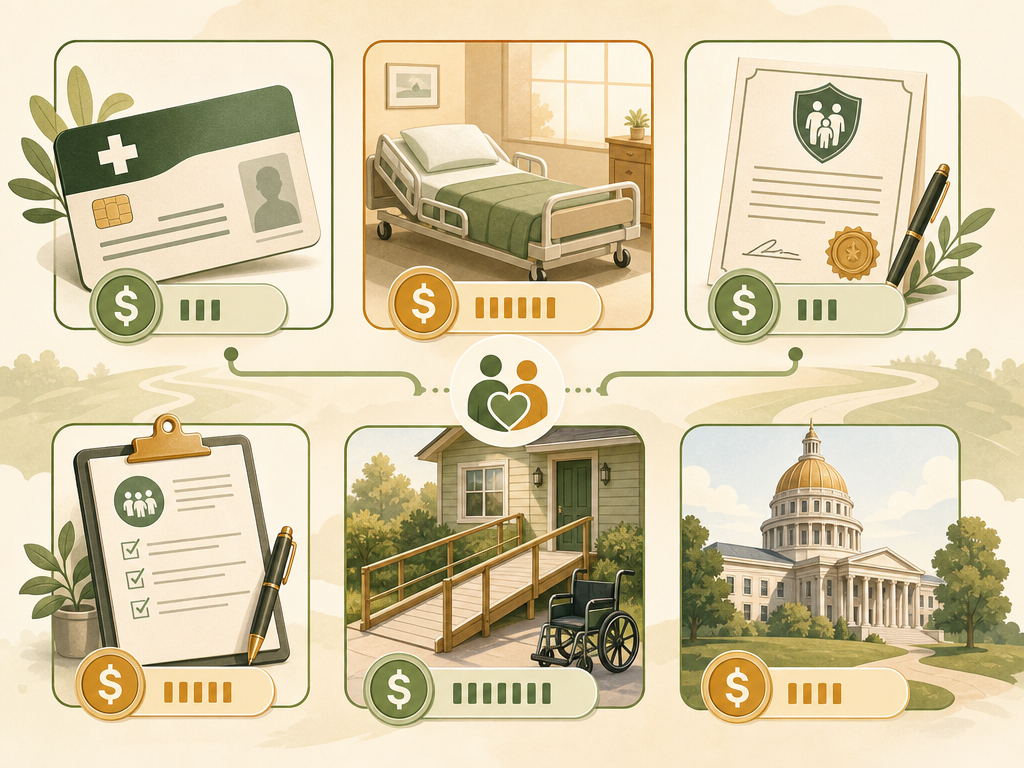
Your Action Plan: Questions to Ask and Where to Start
The most common reason families leave money on the table is not that the programs are too complex — it is that they do not know the right questions to ask. Below is a practical workbook: a checklist of questions for each institution, organized by the programs covered in this guide. Start with the one that seems most relevant to your situation, and make one phone call this week.
| Institution / Program | Key Questions to Ask | Phone Number or Resource |
|---|---|---|
| Parent's Medicare Advantage plan | Does my plan include an OTC benefit card? What is the monthly allowance? Is there a home safety device allowance? Does the plan provide a free PERS device? | Call the number on the back of the insurance card |
| Parent's primary care provider | Are you part of the CMS GUIDE program for dementia care? If not, can you refer me to a participating provider? | Call the provider's office directly |
| Parent's life insurance company | Does the policy include an accelerated death benefit rider? What are the qualifying conditions? What percentage of the death benefit can be accessed? | Call the customer service number on the policy statement |
| VA (if parent is a veteran) | Does my parent qualify for the Temporary Residence Adaptation grant? What documentation is needed? How do I start the application? | 1-800-827-1000 or local VA regional office |
| State Medicaid office | Does your state offer a self-directed care or consumer-directed personal assistance program? Can family members be hired as paid caregivers? | Search '[state name] Medicaid self-directed care' or call your state Medicaid office |
| Area Agency on Aging | Can you help me navigate state-specific caregiver compensation programs? Do you know of any local grant programs for family caregivers? | 1-800-677-1116 (Eldercare Locator) |
The Eldercare Locator (1-800-677-1116) is a national service funded by the U.S. Administration on Aging that connects older adults and their caregivers to local resources. If you are overwhelmed and do not know where to start, this single phone call can route you to your local Area Agency on Aging, which can help with everything from Medicaid applications to respite referrals to grant searches.
Tax Tips for Family Caregivers
While this guide focuses on direct financial assistance programs, do not overlook the tax side of caregiving. Several tax provisions can reduce your out-of-pocket costs:
- Medical expense deduction: If you provide more than half of a parent's financial support and their medical expenses exceed 7.5% of your adjusted gross income, you may be able to deduct those expenses. This includes co-pays, prescription drugs, dental care, long-term care insurance premiums, and even home modifications if they are medically necessary.
- Dependent care credit: If your parent qualifies as your dependent, you may be eligible for the Child and Dependent Care Credit for expenses related to their care while you work. The credit covers a percentage of qualifying expenses up to $3,000 for one dependent or $6,000 for two or more.
- Health Savings Account (HSA) funds: If you have an HSA, you can use those funds tax-free to pay for a parent's qualified medical expenses, provided you claim them as a dependent on your tax return.
For a broader overview of government programs and how to apply for them, see our financial assistance guide for caregivers and our article on unclaimed benefits programs for seniors. For help finding and paying for in-home care, see our step-by-step guide to home help.
The single most important step you can take after reading this guide is to pick one program — the one that seems most relevant to your parent's situation — and make one phone call this week. The $7,200 average out-of-pocket cost does not have to be your reality. The money is there. You just need to ask for it.
Questions to bring to a clinician or OT
This is not medical, legal, or a family's final decision — only a framework. Bring these questions to a clinician, occupational therapist, or your local Area Agency on Aging.
Find Local HelpRelated reading
Noticed something outdated or inaccurate on this page? Flag a correction. We review every report against CDC, NIA, and AARP HomeFit guidance before updating a page.