
Caregiver decision guide
Why Planning for Retiree Healthcare Costs Is More Urgent Than Ever
Many adult children are shocked to learn their parents face an estimated $185,500 in out-of-pocket healthcare costs beyond Medicare. This guide explains what Medicare actually covers, the long-term care blind spot, and actionable steps caregivers can take to help parents plan.
The number that changes the kitchen-table conversation this year is $185,500. That is Fidelity’s 2026 estimate for what a 65-year-old retiring now may need for out-of-pocket healthcare costs in retirement beyond what Medicare pays.[1] It is already a serious number before the hard part: it does not include long-term care.
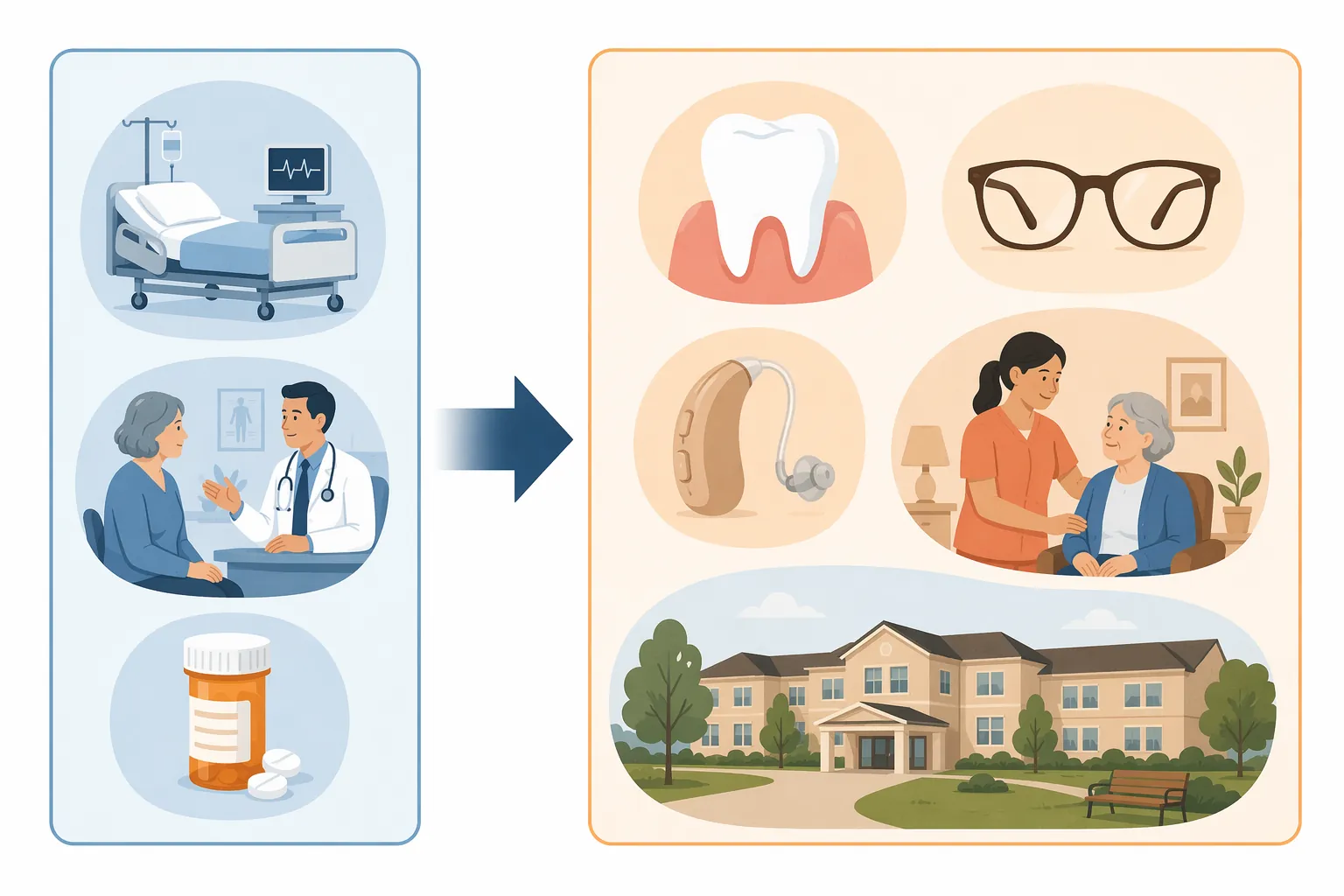
That caveat is where many families get caught. A parent may have Medicare, a supplemental card, a prescription plan, and a folder full of notices, yet still face premiums, deductibles, coinsurance, dental work, hearing aids, eyeglasses, prescription changes, and care needs that do not fit neatly into a doctor’s visit. The surprise usually does not arrive as one bill labeled “retirement healthcare.” It arrives as one uncovered thing after another.

Fidelity also found that 54% of pre-retirees believe Medicare covers everything.[2] If that belief is sitting quietly inside a family, planning retiree healthcare costs starts with correcting it gently but clearly. Medicare matters. It is not a complete healthcare budget.
What the $185,500 Estimate Does and Does Not Mean
The Fidelity estimate is useful because it gives families a current anchor. It says, in plain dollar terms, that even with Medicare, a new retiree should expect meaningful healthcare spending over retirement.[1] But it should not be used as a single all-purpose answer to “What will Mom and Dad need?”
It does not include long-term care. It is also not the same as every other retirement health cost estimate. Milliman’s 2026 Retiree Health Cost Index uses its own assumptions about life expectancy, discount rates, and coverage design, so its figures should be read as comparison context, not averaged with Fidelity into a homemade master number.[3]
| Planning number | What it helps a family understand | What it should not be used for |
|---|---|---|
| $185,500 Fidelity estimate | Out-of-pocket retiree healthcare costs beyond Medicare for a 65-year-old retiring in 2026 | Estimating long-term care costs |
| CMS 2026 Medicare figures | The premiums, deductibles, and coinsurance families may see in annual Medicare notices | Assuming Medicare has an out-of-pocket cap for Original Medicare Part B coinsurance |
| Long-term care cost ranges | The separate cost of help with daily living, home care, adult day care, assisted living, or nursing home care | Treating long-term care as a routine Medicare-covered medical bill |
For an adult child trying to help, the practical move is not to argue over which national estimate is perfect. It is to ask what costs are already visible in the parent’s life: the monthly Medicare premium, the prescription list, the dental work being postponed, the hearing test nobody scheduled, the specialist coinsurance, and whether anyone has said the words “home care” out loud.
Medicare Is the Foundation, Not the Whole Floor
The misunderstanding about Medicare is not foolish. Medicare is complicated enough that even organized families can mistake “covered” for “paid in full.” A service can be covered and still leave a parent with a deductible, a premium, coinsurance, or a plan rule that decides which provider or drug tier applies.
In 2026, the standard Medicare Part B premium is $202.90 per month, and the Part B deductible is $283.[4] After the deductible, Original Medicare generally leaves the beneficiary responsible for 20% coinsurance for many Part B services, and there is no built-in annual out-of-pocket cap under Original Medicare.[4] That last part is the sentence families need to hear slowly.
Part A has its own cost-sharing. The 2026 inpatient hospital deductible is $1,736, and skilled nursing facility care carries coinsurance of $217 per day for days 21 through 100 when Medicare coverage rules are met.[4] That does not mean Medicare pays for an open-ended nursing home stay. It means a very specific kind of post-hospital skilled care may be covered for a limited period under specific rules.
Higher-income retirees can also owe IRMAA, the income-related monthly adjustment amount. For 2026, CMS lists Part B monthly amounts for higher-income beneficiaries ranging from $284.10 to $689.90, depending on income bracket.[4] A parent who sold a home, took a large IRA distribution, or had an unusually high tax year may not connect that decision to a later Medicare premium notice unless someone is watching the mail.
The pressure is not abstract. Boston College’s Center for Retirement Research reported that the standard Part B premium equals 9.4% of the average Social Security benefit in 2026, an all-time high, and that higher Medicare premiums will consume more than 25% of Social Security’s cost-of-living adjustment.[5] For a parent living mostly on Social Security, a premium increase is not just a line item. It can be the grocery budget, the utility bill, or the reason a prescription refill gets delayed.
The Cards in the Wallet Tell Only Part of the Story
When you sit down with a parent, the first question is not “Do you have Medicare?” It is “What kind of Medicare coverage do you have, and what bills still come after it?” A parent with Original Medicare may also have a Medigap policy and a Part D prescription drug plan. Another parent may have a Medicare Advantage plan that bundles hospital, medical, and often drug coverage through a private insurer with provider networks, prior authorization rules, and an annual out-of-pocket maximum.
Those choices are not interchangeable. Medigap can reduce exposure to Original Medicare cost-sharing, but it comes with its own premium and usually does not include prescription drug coverage. Medicare Advantage may have a lower monthly premium, but the trade-off can be narrower networks, plan rules, and costs that depend on how care is used. Part D drug coverage needs its own review because a parent’s prescriptions can change, and formularies do not stay frozen forever.
This is where an adult child can help without taking over. Gather the Medicare card, plan cards, the most recent Annual Notice of Change, premium notices, prescription list, and the last few Explanation of Benefits statements. Then write down what the parent actually pays every month before debating whether the coverage is “good.”
The Costs Families Forget Until They Need Them
The hardest gap is often not inside the Medicare booklet. It is outside the promise families thought Medicare made. Routine dental care, routine vision, hearing aids, many comfort or convenience services, and long-term help with daily living can sit outside traditional Medicare coverage or depend heavily on the specific plan a parent chose.
That matters because these are not luxury add-ons in an older household. A hearing aid can affect whether a parent understands a doctor’s instruction. Dental problems can affect nutrition. Vision changes can affect driving, falls, and medication safety. Home help can be the difference between staying in an apartment and needing a facility. Calling these “extras” makes the family budget look cleaner than real life.
A clean first pass is to separate medical insurance costs from aging-support costs. Medical insurance planning asks: What are the premiums, deductibles, copays, prescriptions, and provider rules? Aging-support planning asks: What happens if Dad cannot bathe safely, Mom cannot manage meals, or one spouse can no longer leave the other alone?
Long-Term Care Is the Blind Spot Inside the Blind Spot
Long-term care changes the meaning of the $185,500 estimate because it sits outside it. Medicare does not pay for ongoing custodial long-term care, which is the help many families eventually mean when they say, “She can’t be alone anymore” or “He needs help getting dressed.”

LTC News reported 2026 long-term care costs ranging from $22,997 per year for adult day care to $128,834 per year for a private room in a nursing home.[6] Those are annual costs, not lifetime totals, and they vary by location, setting, and level of care.
The need is common enough that families should not treat it as a remote exception. HHS/ASPE has estimated that 56% of Americans turning 65 will need some form of long-term services and supports, while Milliman’s long-term care index places the average lifetime long-term care cost for a 65-year-old at about $135,000.[7][8] Those figures should not be pasted onto every parent’s situation as destiny, but they make one thing plain: the risk is too large to leave unnamed.
Home care deserves special attention because many parents say they want to stay home, and many adult children want that too. AARP’s Public Policy Institute reported that home care costs rose 39% from 2021 to 2026.[9] If the family plan is “we’ll bring in help,” someone has to price the actual hours. A few hours a week is one budget. Daily coverage is another. Overnight help is another conversation entirely.
Long-term care insurance may be part of the discussion for some families, but it is not a magic answer. LTC News reported annual premiums for healthy 60-year-olds ranging from $2,610 to $4,550.[6] Premiums depend on age, health, benefits, inflation protection, and underwriting, and some parents will not qualify or will find the premiums unaffordable. Other families may need to discuss savings, home equity, hybrid products, Medicaid rules, or whether an existing life insurance policy can be repositioned through options such as a 1035 exchange for long-term care.
Medicaid is the backstop many families eventually hear about, but it is not simply “the government pays when money runs low.” Eligibility rules, asset limits, estate recovery, state variation, and facility access all matter. If Medicaid might become part of the plan, it is better discussed before a hospital discharge planner is asking where a parent can safely go next.
When the Parent Has No Plan, the Adult Child Becomes the Plan
This is the part families often avoid because it feels disloyal. If a parent cannot cover uncovered healthcare costs, someone else may start filling the gap. At first it may be small: a prescription copay, a dental bill, gas to appointments, a grocery run after a premium increase. Then it becomes time off work, a home aide paid by one sibling, or a credit card used because everyone is too tired to hold a family meeting.
AARP estimated that family caregivers provided more than $1 trillion in unpaid care in 2024.[10] That figure captures the scale of care that never becomes an invoice, but families still pay for it through time, wages, stress, delayed retirement saving, and strained marriages.
The boundary conversation is not about refusing to help. It is about refusing to let silence make the decision. An adult child who is still saving for retirement, paying a mortgage, helping children, or managing their own health cannot assume every uncovered parent expense without consequences. For many Gen X caregivers, a parent’s healthcare gap can become their own retirement gap; that connection is worth facing directly in retirement planning for Gen X when caregiving.
A useful sentence is simple: “I want to help you plan, but I need us to know what insurance pays, what you can afford, and what I can and cannot contribute.” It protects the parent’s dignity because it treats them as part of the decision. It protects the adult child because it does not pretend love has no limit.
A First Planning Session That Does Not Turn Into a Fight
The first conversation should be smaller than the whole problem. Do not start by asking a parent to solve Medicare, long-term care, estate planning, and sibling fairness in one sitting. Start with the papers already in the house.
- Collect the current Medicare card, Medicare Advantage or Medigap card, Part D card if separate, and any dental, vision, or retiree coverage cards.
- Find the most recent Social Security benefit notice, Medicare premium notice, Annual Notice of Change, and tax return if IRMAA could apply.
- List monthly premiums, regular prescriptions, recurring copays, recent out-of-pocket bills, and any delayed dental, vision, or hearing needs.
- Write down the parent’s preferred doctors, pharmacies, hospitals, and specialists before comparing plan trade-offs.
- Ask whether the parent has an HSA from prior high-deductible coverage, long-term care insurance, retiree health benefits, life insurance with living benefits, or earmarked savings.
Only after that inventory does plan comparison become useful. A parent choosing between Medigap and Medicare Advantage is not choosing between “expensive” and “cheap.” They are choosing between different kinds of predictability, provider access, premiums, cost-sharing, drug coverage, and administrative friction. A parent with several specialists may value network flexibility differently than a parent who rarely sees doctors. A parent with limited monthly cash flow may focus first on premiums, even if that leaves more cost exposure later.
Prescription planning needs its own pass. Use the exact drug names, dosages, preferred pharmacy, and mail-order options when reviewing Part D or Medicare Advantage drug coverage. Guessing from memory is how families miss a formulary problem until January.
If the parent is married or partnered, do not assume both people need the same answer. One spouse may have chronic conditions, expensive prescriptions, or a trusted specialist. The other may be healthier but more vulnerable to becoming the caregiver. Senior couples often need coordinated planning rather than identical coverage choices, especially when one person’s care needs could drain shared savings. A broader framework for that conversation belongs in financial planning for senior couples.
The Long-Term Care Question Comes Next
Once the current medical costs are visible, ask one harder question: “If you needed help bathing, dressing, cooking, getting to the bathroom, or being safe at home, how would we pay for that?”
That question is uncomfortable because it points to loss of independence. It is also kinder to ask before a fall, hospitalization, or dementia diagnosis forces the answer. The family does not need to choose a facility at the first meeting. It does need to know whether there is insurance, savings, home equity, family capacity, or a likely Medicaid path. If there is no plan, saying “there is no plan yet” is progress.
For families still working through the larger retirement picture, healthcare should sit beside Social Security, housing, debt, estate documents, and emergency contacts, not off in its own drawer. A next conversation can follow a broader aging-parent retirement planning framework once the healthcare numbers are on paper.
What to Put on One Page
A one-page healthcare cost sheet can do more good than a thick folder nobody opens. It gives siblings the same facts and keeps the parent from having to repeat private details five times.
| Line on the page | What to record |
|---|---|
| Monthly insurance premiums | Part B, Medigap, Medicare Advantage, Part D, dental, vision, retiree coverage, and any IRMAA amount |
| Annual fixed costs | Deductibles, known recurring copays, routine dental, vision, hearing, and planned procedures |
| Prescription exposure | Current drugs, pharmacies, refill rhythm, and any medication that has caused a coverage or affordability problem |
| Care preferences | Preferred doctors, hospitals, pharmacy, home-care wishes, and who may speak with insurers or providers |
| Long-term care resources | Insurance, savings, home equity, family help, Medicaid concerns, or no identified resource yet |
| Family boundaries | What the parent can pay, what adult children can help with, and what no one has agreed to cover |
The page does not have to be perfect. It has to be current enough that when a bill arrives, the family can tell whether it is expected, appealable, unaffordable, or a sign that the plan needs review.
Planning does not remove the burden from aging, illness, or expensive care. It gives the family time, language, and boundaries before the bills start making decisions for everyone. The $185,500 estimate is serious. The long-term care gap can be larger still. Medicare is essential, but it is not the whole plan.
References
- Fidelity Investments Shares 25th Annual Retiree Health Care Cost Estimate, Fidelity Investments, July 21, 2026.
- Fidelity 2026 State of Retirement Planning, Fidelity.
- 2026 Milliman Retiree Health Cost Index, Milliman.
- 2026 Medicare Parts A & B Premiums and Deductibles, Centers for Medicare & Medicaid Services, November 2025.
- Higher Medicare Premiums Will Eat Up More than 25% of Social Security's COLA, Center for Retirement Research at Boston College, January 2026.
- How Much Does Long-Term Care Cost in 2026?, LTC News, February 2026.
- Long-Term Services and Supports for Older Americans: Risks and Financing, HHS Office of the Assistant Secretary for Planning and Evaluation.
- Milliman 2025 LTC Index, Milliman, 2025.
- AARP Report Finds Long-Term Care Costs Outpace Income, AARP, June 2026.
- Valuing the Invaluable 2024 Update, AARP, 2024.
Questions to bring to a clinician or OT
This is not medical, legal, or a family's final decision — only a framework. Bring these questions to a clinician, occupational therapist, or your local Area Agency on Aging.
Find Local HelpRelated reading
Noticed something outdated or inaccurate on this page? Flag a correction. We review every report against CDC, NIA, and AARP HomeFit guidance before updating a page.