
Caregiver decision guide
Fund Long-Term Care with a 1035 Exchange
Learn how a 1035 exchange lets you transfer cash value from an unneeded life insurance policy or annuity into a qualified long-term care insurance policy without triggering taxes, and why the deferred gain may never be taxed.
The question usually comes up at the worst possible time: a parent needs more help, the family is staring at care prices, and someone has just found an old whole life policy or non-qualified annuity in a folder nobody has opened in years. Before anyone surrenders it for cash, pause. The 1035 exchange rules for seniors may allow that old policy value to move directly into qualified long-term care coverage without triggering current income tax.
That pause matters because the care bill can be large enough to make a dormant asset look like an emergency solution. In 2026, LTC News reports a national nursing home cost of $128,834 per year, up 12.1% year over year, and assisted living at $59,591 per year.[1] Families comparing those numbers with home-based options may also want to look at home care costs in 2026 and how to afford it, because the right funding decision depends on the kind of care the parent is likely to need.
The risk is not remote. Amplify Life, summarizing Milliman's 2025 Long-Term Care Insurance Index, reports that 56% of people age 65 and older will need long-term care and that the average lifetime cost is about $135,000.[2] Medicare's limits are also part of the pressure; families who are still sorting out what Medicare does and does not pay for can start with how to pay for senior health care services.

Why Surrendering First Can Be the Expensive Move
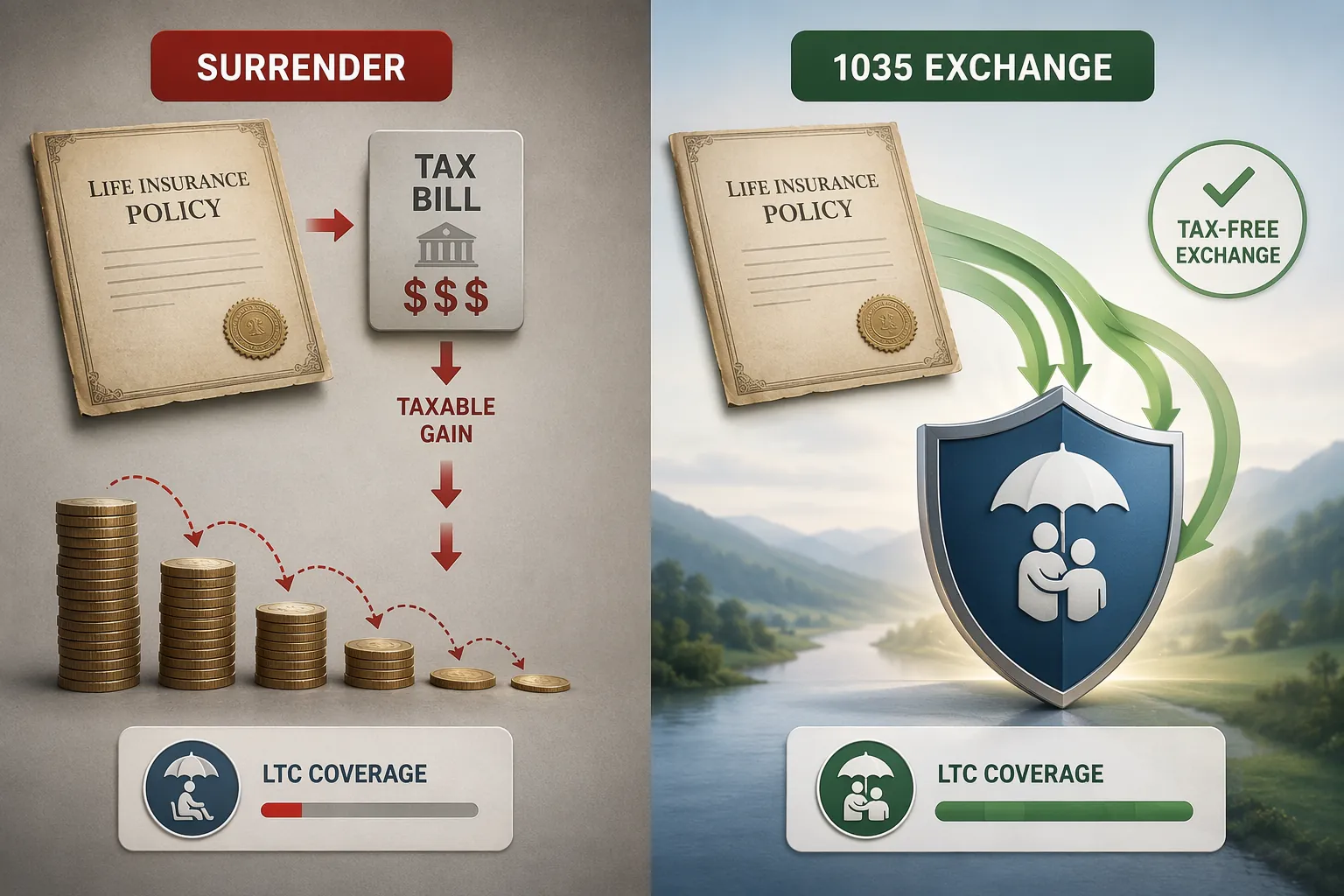
An old policy or annuity has two numbers that matter: what the owner put in, and what it is worth now. If the contract has grown, surrendering it can surface taxable gain. The family may receive cash, but the tax bill comes first, and the remaining after-tax dollars are what can be used for care or insurance premiums.
A properly handled 1035 exchange changes the order. Instead of taking the money out personally, the owner transfers the policy value directly from the old insurance or annuity company to a new qualified long-term care insurance contract. The gain is not taxed at the time of transfer. Then, if the new contract pays qualified long-term care benefits, those benefits are generally received tax-free under Internal Revenue Code Section 7702B. Kitces describes the result plainly: the gain that was deferred in the exchange may never be taxed because the eventual qualified LTC benefits are tax-free.[3]
That is the appealing part of the strategy. It is not just tax deferral in the usual sense, where the tax bill waits for a later withdrawal. If the exchange is completed into qualified LTC coverage and the money later comes out as qualified long-term care benefits, the built-in gain can effectively disappear from the family's income tax problem.[3]
What Section 1035 Allows, and What It Does Not
Section 1035 is the tax rule that allows certain insurance contracts to be exchanged for other eligible insurance contracts without current income tax. Investopedia describes a 1035 exchange as a tax-free replacement of an existing insurance policy, endowment policy, annuity contract, or qualified long-term care product with another qualifying contract.[4]
For long-term care, the important expansion came from the Pension Protection Act of 2006, effective in 2010. The American Association for Long-Term Care Insurance explains that the law extended favorable 1035 exchange treatment to transfers into qualified long-term care insurance policies.[5] That is the authority that makes this planning path possible.
The direction of the exchange matters. A family cannot treat every retirement or insurance asset as interchangeable. Thrivent's consumer guidance notes that life insurance can generally be exchanged for another life insurance policy, an annuity, or long-term care insurance; an annuity can be exchanged for another annuity or long-term care insurance; but an annuity cannot be exchanged into life insurance.[6]
| Existing asset | Potential LTC-related 1035 use | Practical caution |
|---|---|---|
| Permanent life insurance with cash value | May be exchanged into qualified LTC insurance if requirements are met | Do not surrender first; check loans, surrender charges, and carrier rules |
| Non-qualified annuity | May be exchanged into qualified LTC insurance if requirements are met | Only non-qualified annuities fit this route; IRAs and 401(k)s do not |
| IRA, 401(k), or other qualified retirement account | Not a 1035 exchange asset for this purpose | Different tax rules apply; do not move retirement money as if it were an insurance contract |
This is where many families need the cleanest line: a 1035 exchange is not a way to move IRA or 401(k) money into long-term care insurance tax-free. It is an insurance-contract rule. If the asset in the folder is an IRA annuity or another qualified retirement account, the family is in a different tax conversation.
The Tax Difference: Surrender, Then Buy, Versus Exchange Directly
Consider a simplified hypothetical. A parent owns a non-qualified annuity. The contract is worth more than the premiums originally paid into it. If the parent surrenders the annuity, the gain is taxable as ordinary income. The family then uses what remains after tax to buy long-term care coverage, if coverage is still available.
Now compare that with a direct 1035 exchange into a qualified LTC policy. The old carrier transfers the eligible contract value to the new carrier. The taxable gain is deferred instead of recognized. If the new policy later pays qualified long-term care benefits, those benefits are generally tax-free under Section 7702B.[3]
The difference is not cosmetic. In the surrender-first path, the family may reduce the asset before it ever helps with care. In the direct-exchange path, more of the old contract's value can be positioned for qualified care benefits, and the embedded gain may never be taxed if the strategy works as intended.[3]
This is also why casual withdrawals can cause damage. Kitces warns that withdrawals shortly before an exchange may be scrutinized under step-transaction principles and could be treated as taxable boot rather than a clean separate transaction.[7] If a daughter is helping her mother take cash from an annuity to pay immediate bills while also planning an exchange, that timing should be reviewed before money moves.
Partial Exchanges Can Pay Premiums, but They Need Careful Handling
Some families do not want to move an entire annuity or life policy into long-term care coverage. They may only need annual premium funding. Kitces explains that partial 1035 exchanges can be used for LTC premium payments and that Revenue Procedures 2008-24 and 2011-38 apply a pro-rata allocation of cost basis to partial exchanges.[3]
In practice, that means a portion of both basis and gain follows the amount exchanged. The mechanics are administrative, not just conceptual. The old carrier, the new carrier, and the advisor need to coordinate the transfer correctly, and the policy owner should not assume that writing a personal check after taking a withdrawal produces the same result.
State tax treatment also deserves a real question mark. Kitces notes that state guidance on partial 1035 exchanges for LTC premium payments has been limited.[3] A federal tax result does not automatically answer every state-tax reporting question, especially when multiple partial transfers may happen over several years.
Before the Family Gets Attached to the Idea, Test the Bottlenecks
The tax result is strong enough that families can start thinking of an old contract differently. But a 1035 exchange is not complete just because the tax code allows it. It has to pass through insurance-company administration, product availability, underwriting, and timing.
- Confirm the asset type. The source contract should be life insurance with cash value or a non-qualified annuity, not an IRA, 401(k), or other qualified retirement account.
- Confirm the destination. The receiving policy must be qualified long-term care insurance for the favorable LTC benefit treatment to matter.
- Confirm carrier acceptance. Not all long-term care insurers are equipped or willing to accept 1035 exchange money, according to AALTCI.[5]
- Confirm medical eligibility. AALTCI's 2024 data reports that 47% of long-term care insurance applicants age 70 and older were denied coverage.[5]
- Confirm surrender charges and contract restrictions before moving. Some annuity surrender charges can run up to 7%, according to Annuity.org.[8]
That 47% denial rate for applicants age 70 and older is the number families should not brush past.[5] A parent may own the right kind of annuity and still be unable to buy the target LTC policy. The planning sequence should usually be: review the existing contract, identify possible receiving carriers, test underwriting reality, then initiate the exchange only if the path is actually open.
Single-premium LTC policies can make the exchange cleaner because one transfer can fund the coverage. But these products are increasingly rare. If the family is instead funding annual premiums, partial exchanges may be involved, and that raises more administration and tax-reporting coordination.
Policy Replacement Risks Still Apply
A 1035 exchange is often discussed as if the only issue is tax. It is still a policy replacement. FINRA cautions investors to ask about surrender charges, new costs, and a new contestability period when replacing a life insurance policy.[9] Those questions do not disappear because the replacement is tax-free.
For a senior, a new contestability period or changed policy terms may matter more than a younger buyer realizes. The family should compare what is being given up with what is being gained. An old whole life policy may have death benefit value, loan provisions, guarantees, or beneficiaries who are counting on it. Treating it as found money can create a different family problem later.
The same caution applies to annuities. A contract may have surrender charges, income features, or other benefits that are not obvious from the account value alone. If care needs are already severe, the family should also compare insurance-based planning with other payment paths, including senior care options in 2026 and the broader financial picture for dementia care when memory care is part of the likely need.
A Working Route for Families
The safest route is not to start with a form. Start with a small inventory: policy type, owner, insured person, beneficiaries, cash value, cost basis, loans, surrender charges, and whether the contract is qualified or non-qualified. For families already trying to stabilize a parent's whole retirement picture, helping aging parents with retirement planning in 2026 may help organize the surrounding decisions.
| Question | Why it matters |
|---|---|
| Is the existing contract life insurance or a non-qualified annuity? | These are the assets that can potentially fit the LTC 1035 strategy. |
| Does the current contract have gain? | The tax benefit is most meaningful when surrender would create taxable income. |
| Will a qualified LTC carrier accept the exchange? | The strategy fails administratively if the receiving company will not take 1035 funds. |
| Can the parent pass underwriting? | Medical eligibility can block the plan even when the tax rules work. |
| Are there surrender charges, loans, or replacement risks? | The tax savings may not justify giving up valuable contract features. |
| Has the parent taken recent withdrawals? | Recent cash movement may raise boot or step-transaction concerns. |
| Has state tax treatment been checked? | Partial exchanges and reporting may not be settled equally in every state. |
If Medicaid planning is the goal, the family should not try to solve that with a general 1035 explanation. Medicaid-compliant strategies are state-specific and can affect eligibility, transfers, spend-down rules, and estate recovery. An elder law attorney should be involved before repositioning assets for Medicaid purposes.
Families who need help beyond insurance may also need to look at public benefits, family payment capacity, VA-related options where applicable, and local support programs. The gap can be wider than one policy can solve; elder care assistance and the benefits gap is a useful companion when the insurance route is only one piece of the plan.
When the 1035 Exchange Is Worth Serious Attention
The strongest candidate is a senior who owns an unneeded permanent life insurance policy or non-qualified annuity with built-in gain, does not need the old contract for its original purpose, can qualify medically for LTC coverage, and has access to a qualified LTC policy whose carrier accepts 1035 exchange funding.
The weakest candidate is a parent whose health already makes underwriting unlikely, whose existing contract has valuable guarantees or heavy surrender charges, whose asset is actually inside a qualified retirement account, or whose immediate care need is better addressed through a different payment route. Families weighing home care against facility care may need a broader map first, such as what will pay for senior home healthcare in 2026.
A 1035 exchange can be one of the rare ways to repurpose an unneeded insurance or annuity asset for care without ever paying tax on embedded gain. Before money moves, the family should verify the receiving carrier's acceptance, the parent's medical eligibility, the target policy's qualified LTC status, surrender charges and replacement risks, state tax treatment, and tax or legal advice for the exact facts.
References
- How Much Does LTC Cost in 2026?, LTC News, February 2026.
- 50 LTC Statistics, Amplify Life.
- A New Way to Pay for LTC Insurance, Kitces.
- Understanding 1035 Exchanges, Investopedia.
- 1035 Exchanges for LTC Insurance, AALTCI.
- 1035 Exchange: What It Is & How It Works, Thrivent.
- Using 1035 Exchange to Turn Unneeded Life Insurance to Annuity, Kitces.
- Refinancing an Annuity, Annuity.org.
- Should You Exchange Your Life Insurance Policy?, FINRA.
Questions to bring to a clinician or OT
This is not medical, legal, or a family's final decision — only a framework. Bring these questions to a clinician, occupational therapist, or your local Area Agency on Aging.
Find Local HelpRelated reading
Noticed something outdated or inaccurate on this page? Flag a correction. We review every report against CDC, NIA, and AARP HomeFit guidance before updating a page.