
Caregiver decision guide
How Caregiving for Aging Parents Impacts Your Retirement Savings
Sandwich generation caregivers face three compounding financial drains—direct elder care costs, reduced contributions during peak earning years, and lost compound growth—that can slash retirement savings by up to 90%. This article explains how the damage happens and offers concrete, year-one strategies to close the gap.
The private panic usually starts in a very ordinary place: a pharmacy counter, a missed afternoon of work, a child’s bill due the same week as a parent’s home-care invoice. You are paying for your parent now, helping your child now, and the retirement account that was supposed to be quietly growing in the background starts looking less like a plan and more like a question mark.
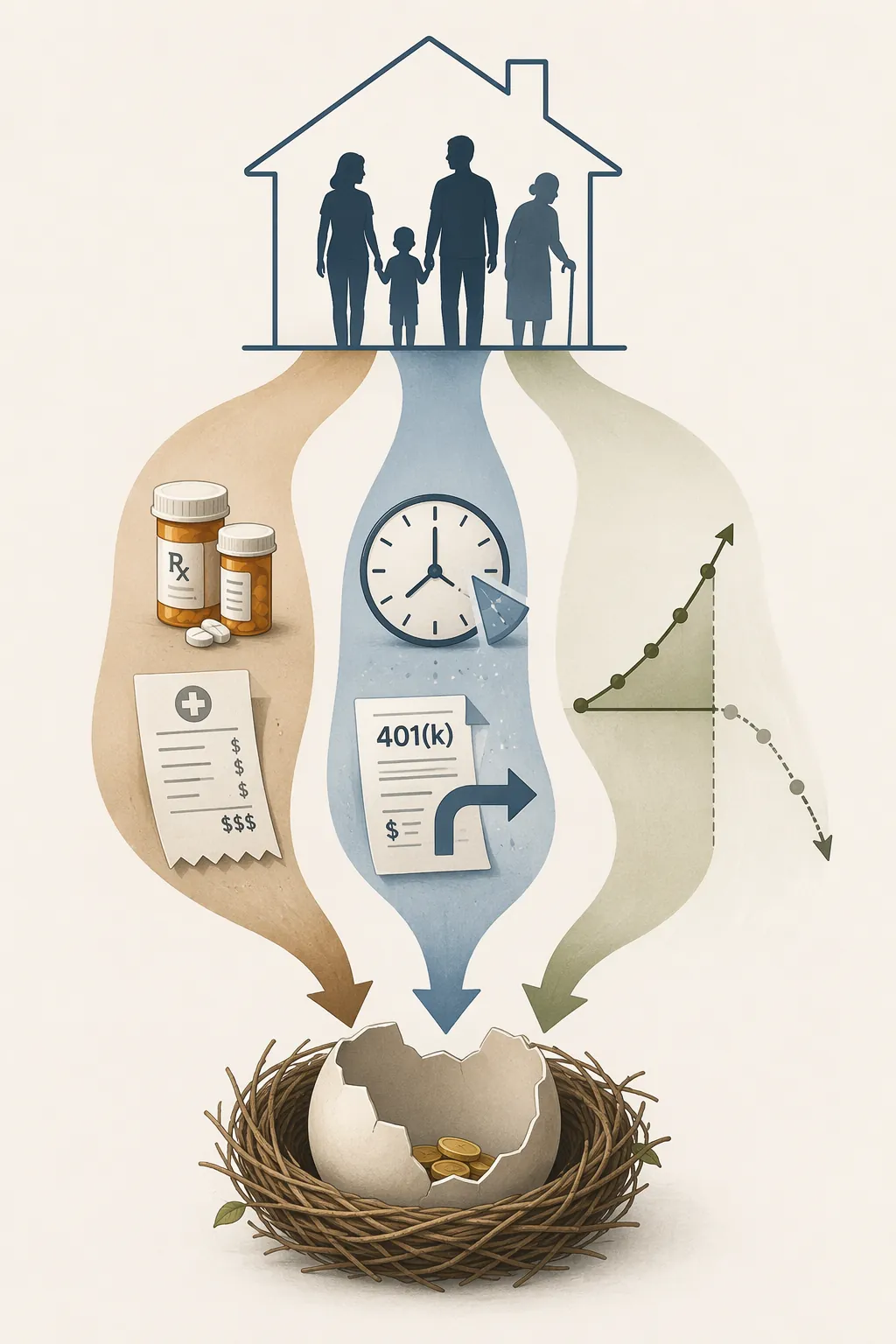
That fear is not a character flaw. The impact of caregiving on retirement savings is especially sharp for sandwich generation caregivers because the damage usually enters through three doors at once: direct elder care expenses, reduced or paused retirement contributions during peak earning years, and lost compound growth on money that never makes it into the account.
AARP describes one in three family caregivers as caught between covering costs for an aging parent and supporting their own children, and its research on family caregiving puts average annual out-of-pocket caregiving expenses at about $7,200 across caregivers more broadly.[1] Caregiver Action Network reports a higher figure for sandwich generation caregivers: about $10,000 a year in caregiving expenses.[2] Those numbers are not identical, and they should not be treated as if they came from the same cost definition or the same population. But together they show why this does not feel like trimming a few extras from the grocery budget.

The retirement damage has three parts
A household can survive one hard expense and still recover. The more dangerous pattern is when one expense changes the next financial decision, and that decision changes the next decade. That is what makes caregiving different from ordinary budget stress.
| Drain | Where it shows up | Why it matters for retirement |
|---|---|---|
| Direct elder care costs | Prescriptions, transportation, home modifications, paid help, medical supplies, uncovered services | Cash that could have gone to savings or debt reduction leaves the household now |
| Reduced contributions | Lower 401(k), IRA, or HSA contributions; missed employer match; fewer catch-up dollars | Caregiving hits during years when many workers are supposed to be making their largest retirement deposits |
| Lost compound growth | Money never contributed cannot earn returns over future years | A temporary caregiving period can leave a permanent retirement gap |
The first drain is visible. The second is often hidden in payroll settings. The third may not show up until years later, when the caregiver realizes the account did not just miss a few deposits; it missed the growth those deposits could have produced.
Drain 1: the care bill competes with the household’s monthly oxygen
A $10,000 annual caregiving cost is not one neat bill. It is closer to $833 a month before the household has paid for its own mortgage or rent, utilities, insurance, groceries, child-related expenses, and debt payments.[2] Even AARP’s broader $7,200 average works out to $600 a month.[1] For many families, that is the difference between contributing to retirement and telling themselves they will restart next quarter.
The hardest part is that caregiving expenses rarely ask permission. A walker, a medication copay, a rideshare to a specialist, or a short stretch of paid help after a fall can arrive before siblings have agreed on a plan. The person closest to the emergency often pays first and explains later. That is how a family cost becomes one adult child’s credit card balance.
This is also where generic advice starts to fail. “Review your budget” is not wrong, but it is incomplete when the budget problem is that a parent’s care need has become a recurring household obligation. The useful question is narrower: which caregiving costs are recurring, which are one-time, which belong to the parent’s own resources, and which should be shared by the family rather than absorbed by whoever answered the phone first?
Drain 2: contributions shrink when they are supposed to be strongest
For many sandwich generation caregivers, caregiving lands between ages 40 and 60, the same period when retirement planning often depends on higher earnings, catch-up discipline, and employer matches. If caregiving forces reduced hours, unpaid leave, a lower-stress job, or even a quiet decision to pause contributions “just for now,” the retirement account loses more than the dollar amount of the missed deposit.
A missed employee contribution can also mean a missed employer match. That match is not a bonus in the abstract; it is compensation the caregiver may never receive because the cash flow was too tight to contribute enough. The household may feel as if it saved money by lowering the contribution, while the retirement account silently gives up both the employee dollars and the matching dollars.
EBRI’s 2023 Retirement Confidence Survey shows the thinner margin caregivers often start with: 25% of caregivers had less than $1,000 in total savings, compared with 15% of non-caregivers.[3] That does not prove caregiving caused every dollar of the difference, but it does explain why one care emergency can push a caregiver from strained to exposed.
Drain 3: the missing growth is real, even when the caregiving period ends
Compound growth is unforgiving in a way that can feel personal, though it is just math. Money contributed earlier has more years to earn returns. Money contributed later has fewer. Money never contributed earns nothing.
TIAA modeling cited by PLANADVISER estimates that intensive caregiving during peak earning years can reduce retirement savings by 40% to 90%, depending on factors such as caregiving duration and intensity, and that caregivers may need 8 to 24 additional working years to make up for lost contributions.[4] That range is modeling, not destiny. It should not be read as a prediction of your exact future. Its value is that it names the mechanism many caregivers already feel: the damage compounds because the interruption happens at the wrong time.
This is why a caregiver can do everything that looks responsible in the moment and still end up behind. Paying the pharmacy bill instead of contributing to a 401(k) may be the humane and necessary choice that week. The retirement shortfall that follows is not proof that the caregiver failed to plan. It is evidence that one household was asked to carry costs that rarely stay neatly inside one generation.
Sandwich generation caregivers have less room for trial and error
A caregiver supporting only an aging parent can still face serious financial strain. The sandwich generation faces a narrower lane because children’s needs do not pause while a parent’s care costs rise. Childcare, tuition, health costs, groceries, transportation, and early adult-child support can all sit beside elder care expenses in the same checking account.
The depletion risk reaches beyond the caregiver’s own retirement. PLANADVISER reports that 42% of sandwich generation caregivers say they will deplete funds intended for their children because of caregiving costs.[4] That does not mean every caregiver will drain a college account or emergency fund. It does mean the pressure often moves through the family balance sheet until there is no category left untouched.
If you need broader coordination help, a general sandwich generation caregiving guide can help with roles, communication, and decision-making. Here, the focus stays closer to the retirement damage itself: where the gap opens and which levers can start closing it this year.
What to do in the first year after you see the gap
The goal in year one is not to build a perfect retirement plan while you are already tired. The goal is to stop the leak from being invisible. A caregiving retirement gap becomes more manageable when you can separate parent costs from household costs, protect at least some contribution flow, and recover benefits or tax relief that would otherwise go unused.
Put the parent’s costs in their own column
Start by listing caregiving expenses separately from your normal household budget. The point is not to shame anyone. It is to make the transfer visible. If prescriptions, transportation, supplies, home repairs, and paid help are mixed into groceries and gas, the family cannot see what caregiving is actually costing.
- Create one running list for recurring parent-care costs.
- Create a second list for one-time or emergency expenses.
- Mark which costs your parent can pay from income, savings, insurance, or benefits.
- Mark which costs you have been paying personally.
- Keep receipts before tax season, benefit applications, or sibling discussions force you to reconstruct the year from memory.
This one step changes the conversation. Instead of saying, “I’m falling behind,” you can say, “Here is the parent-care cost that has been coming out of my retirement contribution.” That is a different kind of sentence.
Ask siblings for a cost-sharing decision, not vague appreciation
Sibling coordination is rarely easy, especially when old family roles show up inside new money problems. Still, the request needs to be concrete. “I need help” is easier to dodge than “Mom’s recurring care costs are now this much per month, and I am asking each of us to cover a defined share or take responsibility for a defined bill.”
A fair split does not always mean equal dollars. One sibling may contribute money, another may cover transportation, another may handle insurance calls or benefit paperwork. But if one person pays the bills, misses work, and manages the logistics while everyone else praises their sacrifice, that is not a plan. It is a retirement transfer from one sibling to the rest of the family.
Protect the employer match if you can protect only one thing
When cash is tight, the first retirement target is often the employer match. If your plan offers one, find the contribution percentage required to receive the full match and treat that number as the line to defend if possible. This is not because the match solves the whole problem. It is because dropping below it can turn one cash-flow shortage into two retirement losses: your reduced contribution and the employer money you no longer receive.
If you have already paused contributions, do not turn that into a moral verdict. Pick a restart trigger: a sibling begins contributing, a parent benefit is approved, a debt is paid down, or an emergency care expense ends. Without a trigger, “temporary” can become the default setting for years.
For broader catch-up decisions beyond the caregiving squeeze, see Retirement Planning for Gen X When You’re Caregiving. That is where contribution limits, later-career catch-up choices, and retirement timing belong. Here, the urgent task is to keep caregiving from quietly severing the contribution habit.
Use tax and workplace tools before they expire unused
Some caregivers have access to dependent care FSAs, health FSAs, paid or unpaid leave protections, employee assistance programs, backup care benefits, or flexible scheduling. The details depend on the employer and the caregiver’s situation. The mistake is assuming these benefits are too small to matter before checking them against the actual caregiving costs.
Fidelity notes that caregiving can carry hidden costs beyond direct bills, including effects on work, income, and long-term savings.[5] That is exactly why workplace benefits matter. A flexible schedule that prevents a reduction in hours, or a leave policy that keeps employment intact during a crisis, can protect retirement contributions more effectively than another round of household belt-tightening.
Tax relief is also worth checking, but it needs its own rules. Eligibility can depend on support tests, dependent status, medical expense thresholds, filing status, and documentation. Use a dedicated 2026 caregiver tax credits and deductions guide rather than guessing from a social media post or last year’s family situation.
Reduce care costs carefully, not desperately
Cost-cutting in caregiving has to be handled with care because the cheapest option can become expensive if it causes a fall, medication error, hospitalization, or caregiver burnout. The useful cuts are usually found in duplication, poor benefit coordination, unreviewed insurance coverage, avoidable transportation costs, unused community programs, or paid services that no longer match the parent’s current needs.
For a deeper cost review, use Cutting Senior Care Costs Without Cutting Quality. If the problem is broader than care expenses alone, The Financial Survival Guide for Family Caregivers can help you look for relief programs and cash-flow supports while keeping the next step manageable.
The question to answer before another year passes
By the end of the first year, try to answer one plain question: how much did caregiving reduce your retirement progress? Not your worth. Not your loyalty. Your progress.
That answer can include direct parent-care dollars you paid, retirement contributions you reduced or skipped, employer match you missed, work hours you gave up, debt you took on, and child-related funds you redirected. It may not be pleasant to total. But a named gap can be divided, negotiated, offset, and planned around. An unnamed gap usually keeps growing in silence.
You may not be able to replace every missed contribution or recover every year of compound growth. Many caregivers cannot. But the moment you understand the three drains, the problem changes shape. It is no longer “I failed to save.” It is “caregiving created a specific retirement gap, and I need specific levers to narrow it.” That is the first repair.
References
- The Huge Financial Toll of Family Caregiving, AARP
- Data & Insights on the Caregiver Experience in the U.S., Caregiver Action Network
- Caregivers and Retirement: Findings From the 2023 Retirement Confidence Survey, EBRI
- Rising Long-Term Care Demands Strain Retirement Savings, PLANADVISER
- Life Events: Hidden Costs of Caregiving, Fidelity
Questions to bring to a clinician or OT
This is not medical, legal, or a family's final decision — only a framework. Bring these questions to a clinician, occupational therapist, or your local Area Agency on Aging.
Find Local HelpRelated reading
Noticed something outdated or inaccurate on this page? Flag a correction. We review every report against CDC, NIA, and AARP HomeFit guidance before updating a page.