
Caregiver decision guide
Can Pole Dancing Help Seniors Maintain Strength and Independence?
This article examines how pole dancing, often perceived as too unconventional for older adults, can function as a full-body resistance workout that builds the strength, balance, and confidence needed for everyday tasks like getting out of a chair and walking safely, while also addressing the necessary safety precautions and evidence limitations.
You notice it in small, irritatingly ordinary moments. Your mother pauses before standing up from the dining chair. Your father starts avoiding the basement stairs. A grocery bag gets shifted from one hand to both arms because the fingers do not quite trust themselves anymore. Then someone mentions pole dancing, and the room goes quiet in that special family way.
Fair enough. Pole dancing is not the first phrase most people file under senior fitness. It sounds too young, too strenuous, too likely to alarm the neighbors. But the better question is not whether it looks conventional. The better question is what it asks the body to practice: gripping, standing tall, shifting weight, controlling the trunk, supporting body weight, stepping around an object, and moving with enough confidence to come back next week.
Those are not circus skills. Those are the ingredients hiding inside everyday independence.
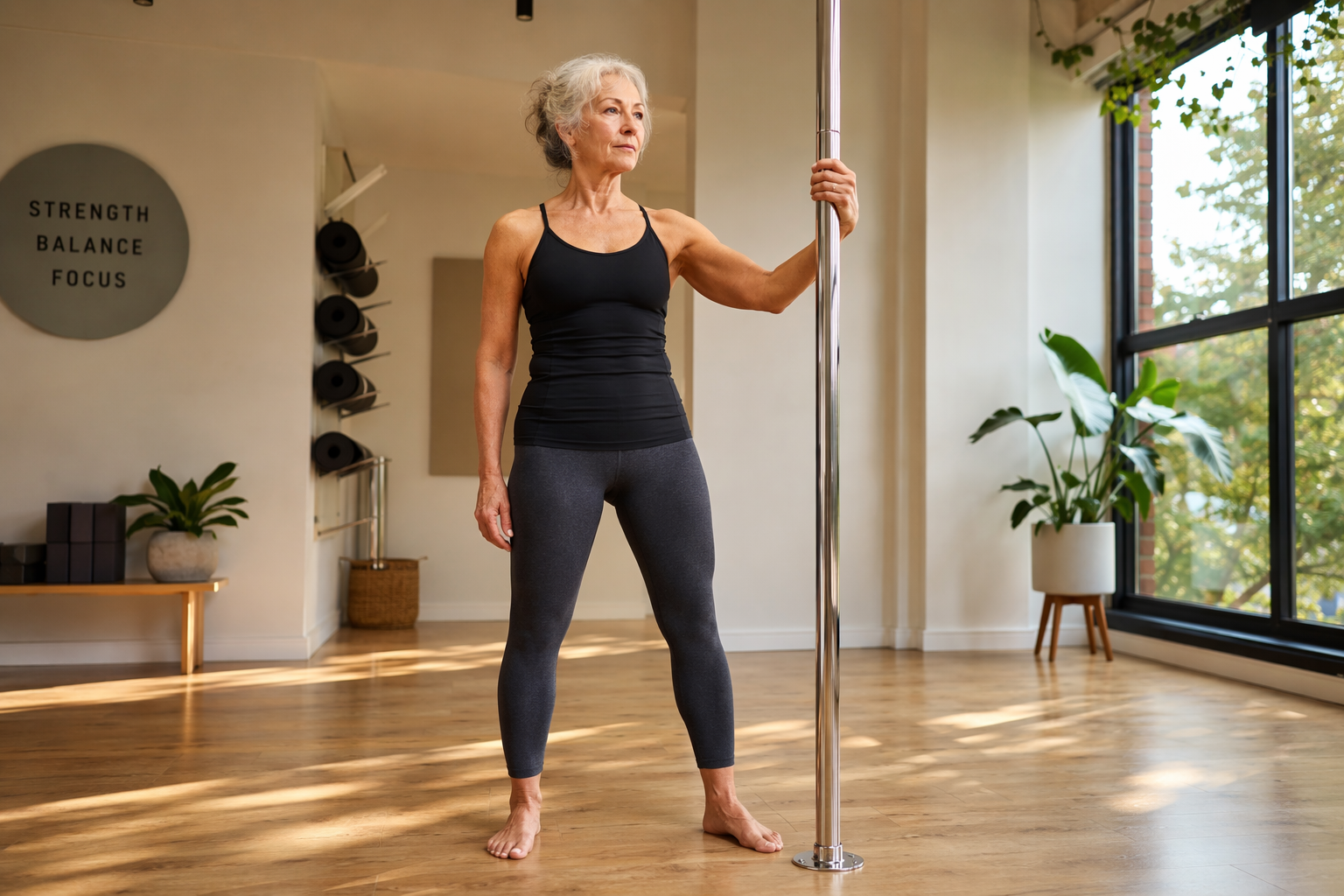
Why the pole matters before the dancing does
Strip away the stage lighting and awkward jokes, and a pole is a stable vertical support. For an older adult who is losing strength or balance, that changes the conversation. The pole gives the hands something to hold while the feet practice turning, stepping, loading, and unloading. It lets the body rehearse movement while still having a point of contact.
That does not make pole dancing automatically safe for every older adult. It does make it more interesting than the usual “just do some exercise” advice, which too often means a photocopied sheet of movements nobody loves enough to repeat. A senior who enjoys the class, laughs at the absurdity of it, and feels stronger afterward may be more likely to keep showing up. Adherence is not a decorative extra in aging fitness. It is the whole plot.
The benefits of pole dancing for senior fitness, then, should be judged less by how impressive a move looks and more by whether the training transfers into useful daily capacity: getting out of a chair, climbing a step, carrying a bag, recovering from a small wobble, and walking without shrinking into every stride.
The daily-life strength hiding inside pole work
Good senior pole instruction does not need to start with spins, inversions, or anything that belongs on an internet highlight reel. It can start with standing beside the pole, placing one hand at shoulder height, changing foot position, and learning how much support the body can safely manage. That sounds modest. It is also where a lot of useful training lives.
| What pole practice trains | What that can mean at home |
|---|---|
| Grip strength and hand endurance | Holding grocery bags, opening jars, managing railings, controlling a walker or rollator handles |
| Core stabilization | Standing taller, walking with less sway, turning without collapsing through the trunk, rising from a chair with better control |
| Upper-body support | Pushing up from a chair, steadying during transfers, using a handrail without panic-gripping |
| Leg strength | Climbing stairs, lowering into a chair, stepping into a car, recovering from a small stumble |
| Weight shifting | Walking, side-stepping in a kitchen, turning in narrow spaces, adjusting when the floor surface changes |
| Coordination and dynamic balance | Moving while thinking, carrying something while stepping, changing direction without freezing |
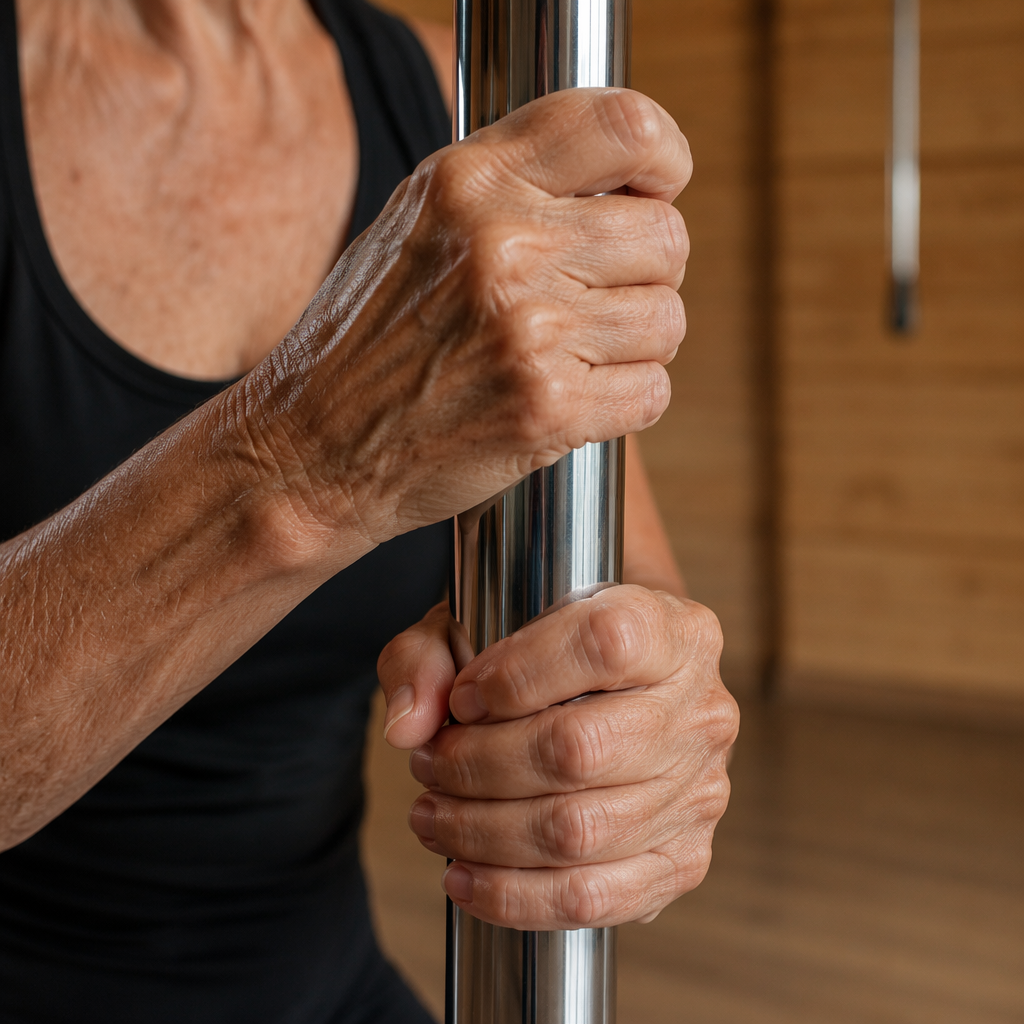
Grip is the easiest place to see the point. A person holding the pole is not merely “doing arms.” The fingers, thumb, wrist, forearm, shoulder, and trunk all negotiate together. That matters because weak grip is not an isolated inconvenience. It shows up when someone cannot carry groceries from the car, struggles with a jar lid, or avoids the handrail because grabbing it no longer feels reliable.
Core control is less visible and just as practical. In daily life, the trunk has to keep the body organized while the legs move underneath it. That is true when walking to the bathroom at night, turning to answer someone in the hallway, or standing from a chair without pitching forward. Pole work often asks the torso to stay active while one foot steps, pivots, or reaches. For an older adult, that can be a useful rehearsal of “move without losing your middle.”
Then there are the legs. Even beginner pole movements can involve partial squats, controlled rises, calf work, stepping patterns, and slow lowering. A climb is not necessary for the training to be meaningful. The senior who practices standing from a bent-knee position while lightly using the pole is working toward the same practical goal as the person doing chair-rise drills: legs that can lift body weight without outsourcing the whole job to furniture and fear.
The balance piece is not static, either. Many older adults can stand still reasonably well and still feel unsafe once movement begins. Pole practice can ask for stepping around, crossing weight from one leg to the other, rotating the body, and coordinating the eyes, hands, trunk, and feet. That is closer to real life than standing like a statue and hoping the world never requires a turn.
What the evidence can say, and what it cannot
Here is the part where we keep our feet on the floor. There do not appear to be randomized controlled trials specifically testing pole dancing in senior-only populations aged 65 and older. So no, one cannot honestly say that pole dancing has been proven, by senior-specific trials, to prevent falls or restore independence.
The strongest nearby evidence comes from broader dance research in older adults. A 2015 systematic review by Hwang and Braun examined 18 dance intervention studies involving adults ages 52 to 87. The review found that 82% of muscular strength and endurance measures and 89% of balance measures showed significant positive changes after dance interventions.[1]
That does not prove pole dancing works the same way in every senior. It does support a narrower and more useful conclusion: dance-based movement can improve strength, endurance, and balance measures in older adults, and pole dancing shares several relevant features with those interventions, including weight-bearing movement, coordinated stepping, trunk control, and balance challenge.
Pole dancing also shows up in a more mainstream place than many families expect. The Arthritis Foundation lists pole dancing among recommended exercises for rheumatoid arthritis, noting coordination, balance, and cardiovascular health as relevant benefits.[2] That is not a senior-specific clinical trial, and rheumatoid arthritis is not the same thing as normal age-related weakness. Still, it is a useful credibility signal: the activity is not automatically outside the bounds of adapted therapeutic fitness.
Fall prevention claims deserve even more caution. A 2024 systematic review by Lazo Green and colleagues found very low-certainty evidence that dance reduces fall incidence.[3] That means pole dancing should not be treated as a replacement for established fall-prevention programs for higher-risk older adults. For someone with a recent fall, frequent dizziness, major balance impairment, or rapidly declining mobility, start with medical evaluation and a structured progression, not a dramatic class signup.
There is also a 2023 randomized controlled trial on pole dancing and mental well-being, but its participants had a mean age of about 23.5, so it is not evidence that pole dancing produces the same outcomes in seniors.[4] Younger bodies are not older bodies with better lighting. The study can be interesting without being generalizable.
Where pole may fit in a senior fitness plan
For a reasonably stable older adult with medical clearance, pole dancing can sit in the same practical family as resistance training, balance work, and dance-based movement. It asks for strength and control, but it can be scaled. The first useful session may look like supported posture work, slow weight shifts, gentle turns, and learning how to hold the pole without yanking the shoulder into next Tuesday.
For someone who is not ready for that, there is no shame in starting smaller. A home-based balance and strength ladder, such as fall prevention exercises for seniors, may be the better first step. If the family is still sorting out general fall risk, a broader fall prevention handout for seniors and caregivers can help separate ordinary deconditioning from warning signs that need clinical attention.
The best fit is often the older adult whose world has started to shrink but who is not medically unstable: the person who still wants a class, still likes music, still enjoys being a little surprised by herself, and needs strength training that does not feel like punishment. Pole can give that person a reason to grip, stand, step, and practice balance in a setting that feels less like homework.
The stories are possibilities, not proof
Greta Pontarelli is the case people tend to remember. Diagnosed with osteoporosis at 59, she reportedly began pole dancing after a doctor recommended weight-bearing exercise, then went on to become a world champion in her 60s and 70s.[5] It is a terrific story partly because it begins in such an ordinary clinical place: bone health, not glamour.
But Pontarelli’s story should not be inflated into a prescription for every older adult with osteoporosis. She is one person, unusually driven, unusually skilled, and surrounded by a training path that most beginners will not follow. The lesson is not “your parent should become a champion.” The lesson is smaller and better: weight-bearing exercise can be motivating when it feels meaningful, and older adults are not automatically disqualified from learning something physically bold.
Ms. Fran’s example is different and, in some ways, more useful for families worried about real-life mobility. In a profile of Moxie Movez’s Grannie + 1 Grandpa Troupe, Ms. Fran, age 76, is described as using a walker and reporting that pole practice improved her balance, fluidity, and confidence.[6] That does not prove clinical effectiveness. It does show something many sterile fitness plans miss: confidence and movement quality matter, including for someone who already uses a mobility aid.
There is a false choice families sometimes make without meaning to: either a person is frail and must be protected from challenge, or athletic and allowed to try interesting things. Real aging is messier. Someone can use a walker and still benefit from supported movement practice. Someone can have osteoporosis and still need appropriately chosen loading. The trick is not pretending risk disappears. The trick is matching the challenge to the body in front of you.
Safety is not the boring fine print
A senior pole class should not be a standard adult class with the music turned down and everyone hoping for the best. Older adults need qualified instruction, slower progressions, and permission to skip moves that do not match their joints, bones, blood pressure, vision, medications, or balance.
- Get medical clearance first if there is osteoporosis, rheumatoid arthritis, recent surgery, heart disease, neurological disease, unexplained weakness, dizziness, fainting, or a recent fall.
- Choose an instructor who is comfortable adapting movement for older adults, not merely someone who can perform advanced pole skills.
- Avoid inversions, drops, aggressive spins, and high-load positions unless a clinician and qualified instructor agree they are appropriate.
- For osteoporosis, prioritize controlled weight-bearing, posture, hip strength, and safe loading; avoid forceful spinal flexion or twisting if advised by a clinician.
- For arthritis, watch hand pain, wrist position, shoulder strain, fatigue, and next-day joint response; the goal is useful loading, not white-knuckle endurance.
- For balance disorders or mobility aid use, start with supported standing work and clear floor space, and consider having a physical therapist help set boundaries.
If dizziness is part of the picture, especially lightheadedness when standing, address that before adding a new balance challenge. Guidance on orthostatic hypotension and fall prevention belongs ahead of pole work. If a fall has already happened, families may need post-fall senior health care guidance before deciding what exercise comes next.
And if a walker or rollator is already part of daily life, do not treat that as a failure or an embarrassment. Make sure the device itself fits and supports safer movement. A practical rollator fit test may be more urgent than any new class.
Confidence counts, but only when it is earned
Fear changes movement. An older adult who is afraid of falling often walks less, reaches less, goes out less, and gradually has fewer chances to practice the very skills that keep walking possible. That cycle can become its own trap, as explained in this guide to the fear of falling cycle.
Pole dancing can help some older adults push back against that shrinking world because the support is right there under the hand. A person can feel the pole, test weight, practice a turn, and discover that movement does not have to be either reckless or timid. That kind of confidence is not pep talk confidence. It is confidence built through repeated, supervised physical evidence: I shifted my weight and stayed upright. I stood taller. I used my hands and legs together. I did not fall apart.
For medically cleared older adults with appropriate instruction, pole dancing can be an engaging form of full-body resistance and balance training. It may support the grip, strength, mobility, coordination, and confidence behind daily independence. That is enough reason to take it seriously. It is not enough reason to push it on every parent, especially one who first needs medical care, basic balance work, or a safer progression.
References
- The Effectiveness of Dance Interventions to Improve Older Adults’ Health: A Systematic Literature Review, Alternative Therapies in Health and Medicine, 2015.
- Best Exercises for Rheumatoid Arthritis, Arthritis Foundation.
- Dance-based interventions and falls in older adults: a systematic review, 2024.
- Pole dancing for physical and mental wellbeing: a randomized controlled trial, 2023.
- Greta Pontarelli Who Pole Dances, Age of Happiness.
- The Surprising Way Pole Dancing Is Empowering Seniors, Yahoo Lifestyle.
Questions to bring to a clinician or OT
This is not medical, legal, or a family's final decision — only a framework. Bring these questions to a clinician, occupational therapist, or your local Area Agency on Aging.
Find Local HelpRelated reading
Noticed something outdated or inaccurate on this page? Flag a correction. We review every report against CDC, NIA, and AARP HomeFit guidance before updating a page.