
Caregiver decision guide
Does Medicaid Use Hurt Seniors' Green Card Chances?
The July 2026 public charge rule change has left many families worried that a senior's Medicaid use could block their green card. This explainer clarifies that under current rules through September 2026, routine Medicaid does not count, and the biggest risk has always been nursing home care — not doctor visits or medications.
If your parent is using Medicaid and has a green card application pending, the first answer is narrower than many headlines make it sound: under the public charge rule still in effect through September 18, 2026, routine Medicaid for doctor visits, hospital care, medications, and home health does not count against them. The Medicaid-related issue that does count is long-term institutional nursing home care paid for by the government.[1]
That date matters. USCIS announced on July 16, 2026 that it is rescinding the 2022 public charge regulation, but the agency also set a 60-day transition period, meaning the 2022 rule remains in effect through September 18, 2026.[1] As of July 18, 2026, DHS has not published the sub-regulatory guidance that would tell officers exactly how to apply the new standard after that window.

What Medicaid Use Means Right Now
For a senior, “routine Medicaid” is not an abstract benefit category. It is the doctor appointment that checks blood pressure before it becomes a stroke. It is the hospital care after a fall. It is the prescription refill that keeps diabetes or heart failure stable. It is home health support after an illness, when the goal is to keep someone recovering safely outside an institution.
Under the 2022 rule, those routine medical uses carry zero weight in the public charge determination through September 18, 2026.[1] Families should not cancel ordinary medical appointments, skip medications, or refuse home health services solely because they heard “Medicaid now counts.” That is not what the rule in effect today says.
| Senior care situation | How it is treated under the 2022 rule through September 18, 2026 |
|---|---|
| Doctor visits covered by Medicaid | Does not count in public charge determinations |
| Hospital care covered by Medicaid | Does not count in public charge determinations |
| Prescription medications covered by Medicaid | Does not count in public charge determinations |
| Home health covered by Medicaid | Does not count in public charge determinations |
| Long-term institutional nursing home care at government expense | Can count in public charge determinations |
This distinction is also why broad family advice can become dangerous. “Avoid Medicaid” sounds protective, but for an older adult it may mean avoiding the very care that prevents a crisis. Public charge analysis is technical, but so is senior care: a missed prescription, a delayed evaluation, or a refused home health visit can create consequences long before an immigration officer reviews a file.
Why Nursing Home Care Is Different
The senior-specific Medicaid risk has always been long-term institutional care, not ordinary medical treatment. If Medicaid is paying for a parent to live in a nursing home on a long-term basis, that is different from Medicaid paying for a clinic visit, hospital stay, medication, or home health service.[1]
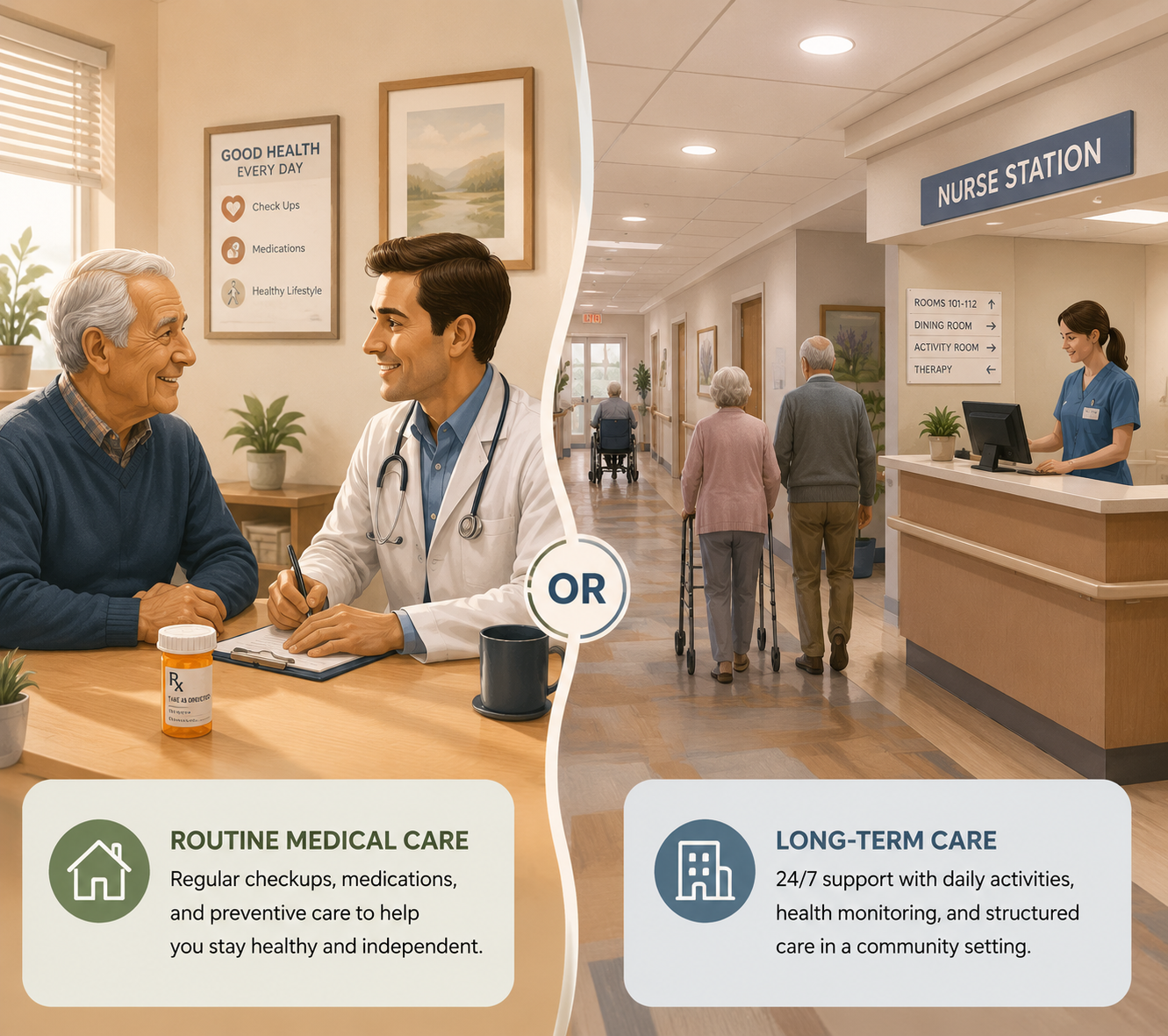
The reason this matters in real planning is that nursing home care often arrives during a crisis. A parent falls, is hospitalized, moves to rehabilitation, and then the family is told that returning home may not be safe. At that point, the family is not deciding between a small benefit and no benefit. They are deciding where the parent can live, who can provide hands-on care, what Medicaid will pay for, and whether an immigration attorney needs to review the timing and facts before the family signs long-term care paperwork.
This is the moment to slow down and separate care planning from rumor management. A short-term medical episode is not the same as long-term institutionalization. Home health is not the same as a nursing home bed. Medicaid home and community-based services are not the same thing as government-funded long-term institutional nursing home care. If your family is comparing care settings, the site guide “Options for Elderly Care: A Complete Guide to Paying for Home Care, Assisted Living, and Nursing Homes in 2026” can help frame the payment side, while an immigration attorney should handle the public charge analysis for the specific application.
What Changed on July 16, 2026
The July 2026 change did not instantly make every Medicaid service dangerous. What it did was rescind the 2022 regulation with its clearer definitions and move toward a broader discretionary standard after the transition window.[1] That is a real change in direction, but it is not the same as published guidance saying that doctor visits, medications, hospital care, or home health will be counted after September 18.
Until DHS publishes the policy guidance officers will use, claims about exactly how each Medicaid service will be treated after September 18 are speculative. Families can prepare for uncertainty without acting as if the uncertainty has already become a rule.
The available denial-rate context should also be kept in proportion. A 2026 update citing USCIS data reported that 0.8% of family-sponsored green card applications were denied on public charge grounds under the 2022 rule, compared with 2.1% under the 2019 expansion.[2] That does not predict one parent’s outcome. It does suggest that public charge denials were uncommon under the current 2022 framework, even though individual facts can still matter.
Why Bad Explanations Can Harm Seniors
Fear changes behavior quickly. During the 2019 public charge expansion, the Migration Policy Institute estimated that 2.3 million to 4.9 million people in immigrant families avoided benefits for which they were eligible.[3] That is the pattern families should try not to repeat in 2026, especially when an older parent’s health can decline because care was delayed.
This is not a small population. Justice in Aging reports that approximately 8 million U.S. residents age 65 and older are immigrants.[4] Many have adult children trying to coordinate insurance, prescriptions, transportation, housing, and legal paperwork at the same time. A headline that collapses all Medicaid into one warning can push those families toward choices the current rule does not require.
DHS itself acknowledged, in analysis discussed by NILC, that rescinding clear definitions may create confusion and reduce participation even among people who are not subject to the rule.[5] That is exactly the risk at the kitchen table: a family may overcorrect, stop care that does not count, and leave an older adult medically worse off without gaining immigration protection.
Do Not Mix Up Public Charge and Medicaid Eligibility Changes
H.R.1 Medicaid eligibility restrictions, effective October 1, 2026 for Medicaid, are a separate policy change from public charge. They may affect who can qualify for Medicaid, but that is not the same legal question as whether Medicaid use counts in a green card public charge determination.
Families need both questions answered, just not by blending them together. A benefits navigator can help with eligibility and coverage. A licensed immigration attorney should answer how a parent’s care history, immigration category, affidavit of support, assets, health, and timing fit into the green card case.
What Families Should Do Before Changing Care
Start with the care decision in front of you. If the issue is a routine doctor visit, medication, hospital care, or home health service through September 18, 2026, the current public charge rule says that Medicaid use does not count.[1] If the issue is long-term institutional nursing home care at government expense, treat it as a legal planning issue before making assumptions either way.
- Keep necessary routine care in place while the 2022 rule remains effective, unless an attorney reviewing the individual case advises otherwise.
- Ask the care team to clarify whether a placement is short-term rehabilitation, home health, community-based support, or long-term institutional nursing home care.
- Before agreeing to long-term nursing home care funded by Medicaid, get case-specific advice from a licensed immigration attorney.
- Watch for DHS guidance after the July 2026 rescission instead of relying on predictions about what officers will count.
- Use benefits-navigation help for Medicaid eligibility questions, because eligibility changes and public charge rules are not the same thing.
For care planning, “Senior Care Assistance Triage: What to Do Now, Next Week, and Next Month” can help families organize urgent decisions from slower paperwork. “The Complete Guide to In-Home Assistance for Seniors” and “Elderly Care Cost Per Hour: How to Afford $34–$35/hr Care with a Layered Funding Strategy” are more useful when the goal is to keep a parent safely at home. For local benefits help, “Senior Health Services Coordination: How Area Agencies on Aging Help Families Navigate Care” can point families toward practical navigation support.
The safest plain-language answer today is this: do not stop routine Medicaid care solely because of public charge fear under the rule still in effect through September 18, 2026. Pay close attention if Medicaid is funding long-term institutional nursing home care. Watch for DHS guidance rather than treating speculation as law, and get individualized immigration advice before changing a parent’s care plan.
References
- U.S. Citizenship and Immigration Services Rescinds 2022 Public Charge Regulation, USCIS, July 16, 2026
- Public Charge Rule Current Status 2026 Update, Peter Chu law firm
- Trump Administration Public Charge Rule Would Amplify Harms to Immigrant Families, Migration Policy Institute
- Public Charge and Immigrant Seniors, Justice in Aging
- Public Charge: What Advocates Need to Know About the November 2025 Proposed Rule, NILC
Questions to bring to a clinician or OT
This is not medical, legal, or a family's final decision — only a framework. Bring these questions to a clinician, occupational therapist, or your local Area Agency on Aging.
Find Local HelpRelated reading
Noticed something outdated or inaccurate on this page? Flag a correction. We review every report against CDC, NIA, and AARP HomeFit guidance before updating a page.