
Caregiver decision guide
Your Elderly Parent Ate Recalled Lettuce — Now What?
A crisis checklist for caregivers whose elderly parent may have eaten recalled lettuce — covering immediate actions to confirm the recall, stop consumption, preserve evidence, deep-clean the kitchen, and monitor for symptoms with a lower threshold for medical care, since Listeria can incubate for up to 70 days and seniors often show atypical signs.
If your elderly parent may have eaten recalled lettuce, start with the ordinary things in front of you: the package, the receipt, the refrigerator shelf, the trash can, the sink, and the phone. Do not wait for symptoms before you stop the exposure. In Q3 2026, this question is not theoretical: as of July 16, 2026, FDA reported 1,644 Cyclospora illnesses and 94 hospitalizations linked to iceberg lettuce served at Taco Bell in 5 states; those figures were current as of FDA’s July 16, 2026 outbreak update and may change as the investigation continues. [1]
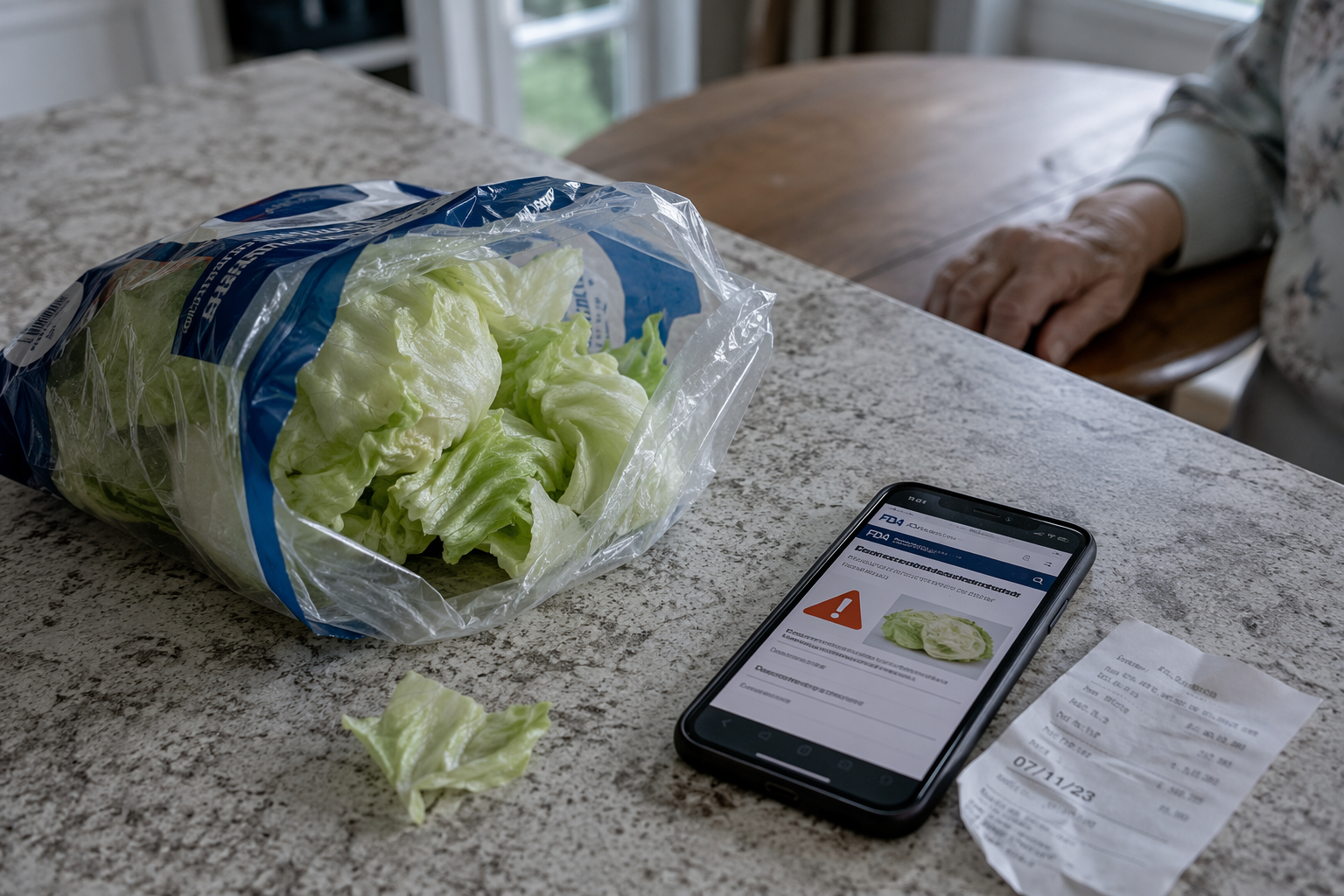
Here is the short version first, because nobody should have to read a food-safety essay while standing in front of an open fridge.
- Confirm whether the lettuce matches the recall: brand, product name, store, lot code, sell-by date, restaurant location, or purchase date.
- Stop anyone from eating more of it, including leftovers, sandwiches, salads, or toppings made with it.
- Separate the product from other food so nobody “just uses the rest.”
- Save the package, label, receipt, delivery record, or a clear photo before discarding anything.
- Throw the lettuce away safely, sealed in a bag where people and pets cannot get to it.
- Clean the refrigerator, drawers, counters, cutting boards, utensils, sink area, and any container that touched the lettuce.
- Write down when your parent ate it, what they ate, and whether anyone else ate the same food.
- Start a symptom log that includes digestive symptoms and older-adult warning signs such as confusion, unusual weakness, irritability, or low energy.
- Call a clinician, urgent care, or emergency services sooner if symptoms appear, your parent is immunocompromised, or something simply looks wrong.
- Keep monitoring long enough for the likely pathogen, not just for the rest of the evening.
Why an Elderly Household Gets a Lower Threshold
For a healthy younger adult, a recall may end with throwing out the food and watching for stomach trouble. With an older parent, that is too casual. CDC says nearly half of people age 65 and older with lab-confirmed Salmonella, Campylobacter, Listeria, or E. coli infection are hospitalized. CDC also explains why: as people age, their immune systems and organs “don’t recognize and get rid of harmful germs as well as they once did.” [2]
Listeria is the one that should make a caregiver slow down and write things down. CDC says more than half of Listeria infections occur in people 65 and older; older adults with Listeria infection almost always require hospitalization, and 1 in 6 die. [3] That does not mean every recalled lettuce exposure becomes Listeria. It means “fine right now” is not a clean ending.
Step 1: Match the Recall Before You Panic or Dismiss It
Open the official recall or outbreak notice and compare it against what you actually bought. Use the product name, brand, package size, lot number, UPC, use-by date, store location, restaurant location, or purchase window listed in the notice. If it was restaurant lettuce, check the location and dates served rather than looking for a bag in the fridge.
Do not rely on memory if you have a receipt, grocery app, credit-card record, delivery order, loyalty-card history, or a photo of the package. A caregiver under stress can misremember which lettuce was bought last week and which one was bought yesterday. The point of this step is not to prove you did something wrong. It is to decide whether the food in the house belongs in the danger pile.
| If you have | Check |
|---|---|
| A packaged bag, clamshell, or head of lettuce | Brand, product name, lot code, UPC, use-by or sell-by date, and package size |
| A grocery receipt or app order | Store, purchase date, product description, and loyalty-card details |
| Restaurant lettuce | Restaurant chain, location, dates eaten, menu item, and FDA or local health department notice |
| Only leftovers | When the meal was made, who ate it, and whether the lettuce packaging is still available |
Steps 2 Through 4: Stop the Exposure and Preserve the Evidence
Once the recall match is possible, stop anyone from eating the lettuce or anything made with it. This includes the obvious salad bowl and the less obvious places: sandwich containers, taco toppings, wraps, chopped salad in a meal-prep box, or a plate your parent put back in the fridge because they “might finish it later.”
Move the product away from ready-to-eat foods. If it is leaking, put it in a sealed bag or container while you sort out disposal. If you still have the package, do not throw it out before you capture the identifying information. Take photos of the front label, lot code, use-by date, store label, and receipt. If someone becomes ill, those details may matter to a clinician, a local health department, or the store handling the recall.
The Academy of Nutrition and Dietetics advises consumers not to eat recalled food and to follow recall instructions for returning or disposing of it; if the recalled item touched other foods or surfaces, those areas should be cleaned. [4] In a house with an elderly parent, I would rather have one extra photo of a label than wish later that I had not emptied the trash so quickly.
Step 5: Throw It Away So It Cannot Come Back Into the Kitchen
If the recall notice tells you to return the product, follow that instruction if it can be done safely. If disposal is the right move, seal the lettuce in a bag before putting it in the trash. Do not compost it. Do not feed it to pets. Do not rinse it and decide it looks fine. Recalled food is not a freshness problem; it is a possible contamination problem.
After disposal, wash your hands. Then assume your hands are not the only thing that touched the lettuce.
Step 6: Clean the Refrigerator Like the Lettuce Left a Trail
This is the step people skip because the lettuce is already gone. Do not skip it. Lettuce sits in drawers, brushes against containers, sheds moisture, and gets handled on counters and cutting boards. If the product was contaminated, the refrigerator can keep the problem available for the next snack.
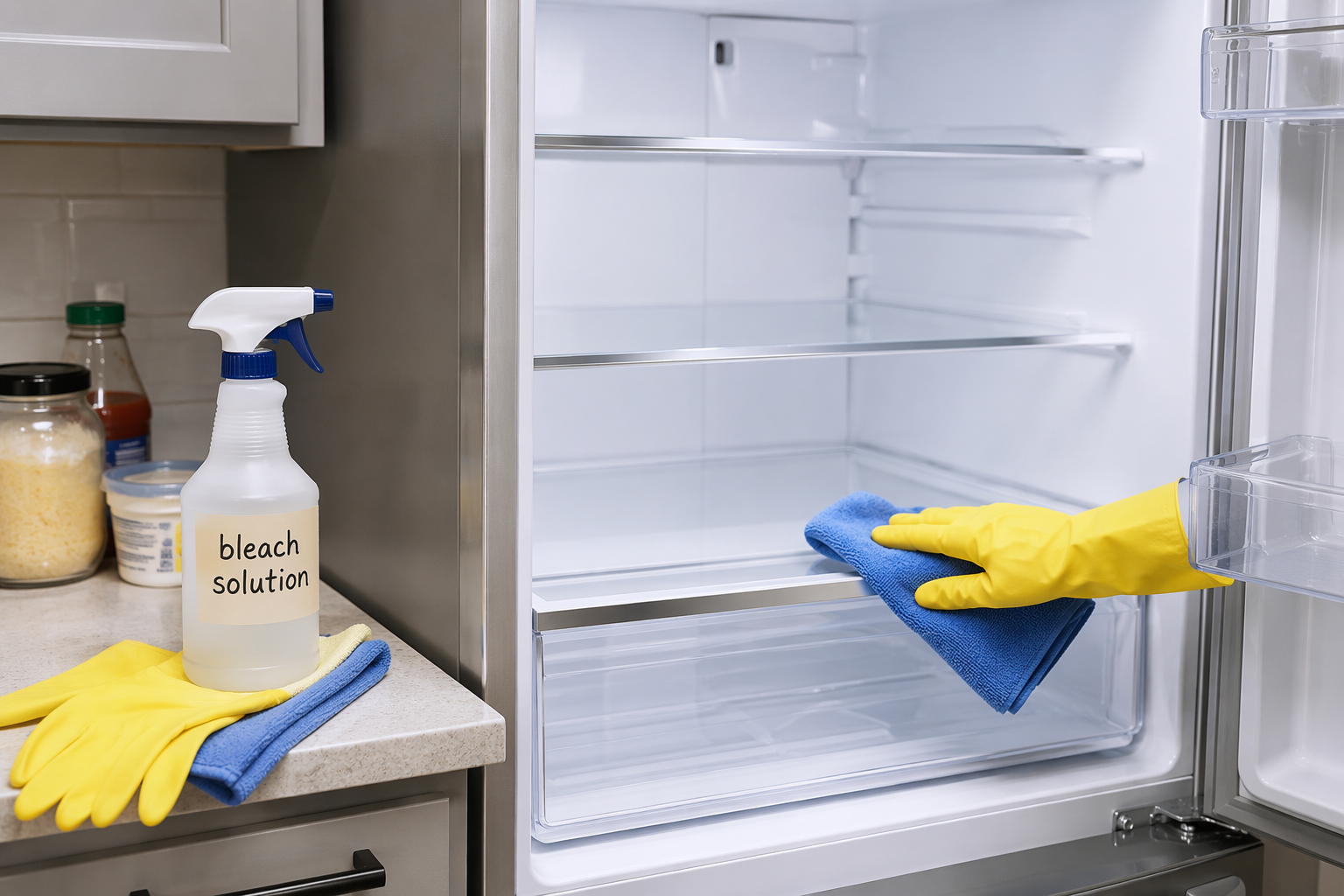
CDC’s refrigerator cleaning instructions give a workable order: remove the recalled food, empty the rest of the refrigerator items that may have touched it, wash removable shelves and drawers with hot soapy water, dry them, wipe the inside of the refrigerator, then sanitize with a bleach solution made from 1 tablespoon of liquid bleach in 1 gallon of water. CDC also says to let surfaces dry after using the bleach solution. [5]
- Clear nearby foods onto a clean counter or cooler, not onto a dirty sink edge.
- Wash drawers, shelves, bins, and containers that touched the lettuce with hot soapy water.
- Wipe the refrigerator walls, shelf tracks, drawer handles, and door handles.
- Sanitize with the CDC bleach solution, then let surfaces dry before restocking.
- Wash towels or cloths used during cleanup, or use disposable towels and discard them.
- Wash your hands again after cleaning, even if you wore gloves.
If your parent uses a walker, cane, medication organizer, or water cup near the kitchen, watch what you touch while cleaning. The refrigerator handle, faucet, phone, and cabinet pulls are the places a rushed person contaminates without noticing.
Step 7: Write Down the Exposure While It Is Still Fresh
A symptom log starts before symptoms. Put the basic facts in one place: the date you bought the lettuce, the date your parent ate it, what meal it was in, roughly how much they ate, whether anyone else ate it, and when you learned about the recall. If you are not sure, write “not sure.” Guessing neatly is less useful than admitting uncertainty.
| Log item | What to write |
|---|---|
| Food | Brand or restaurant, lettuce type, package or menu item, lot code if available |
| Exposure | Date and meal when your parent may have eaten it |
| Other people | Names of others who ate the same food and whether they feel ill |
| Parent’s risk factors | Age, immune-suppressing medicines if known, cancer treatment, transplant history, serious chronic illness, or recent hospitalization |
| Actions taken | When product was removed, discarded, and refrigerator cleaned |
| Calls | Clinician, nurse line, poison control, health department, store, or restaurant contact |
This is also the moment to check whether your parent has a clinician’s after-hours number, a nurse line, or discharge paperwork with specific instructions about fever, dehydration, immune suppression, or infection risk. Do not go hunting for that at midnight with a sick parent in the bathroom.
Step 8: Monitor for Senior-Specific Warning Signs, Not Just Stomach Symptoms
General recall advice often says to watch for diarrhea, vomiting, fever, and stomach cramps. Do that, but do not stop there. NIDDK lists a change in mental state, including irritability, lack of energy, or confusion, as a reason to seek medical care for food poisoning. [6] In an older adult, “she’s just off today” can be a more important sentence than it sounds.
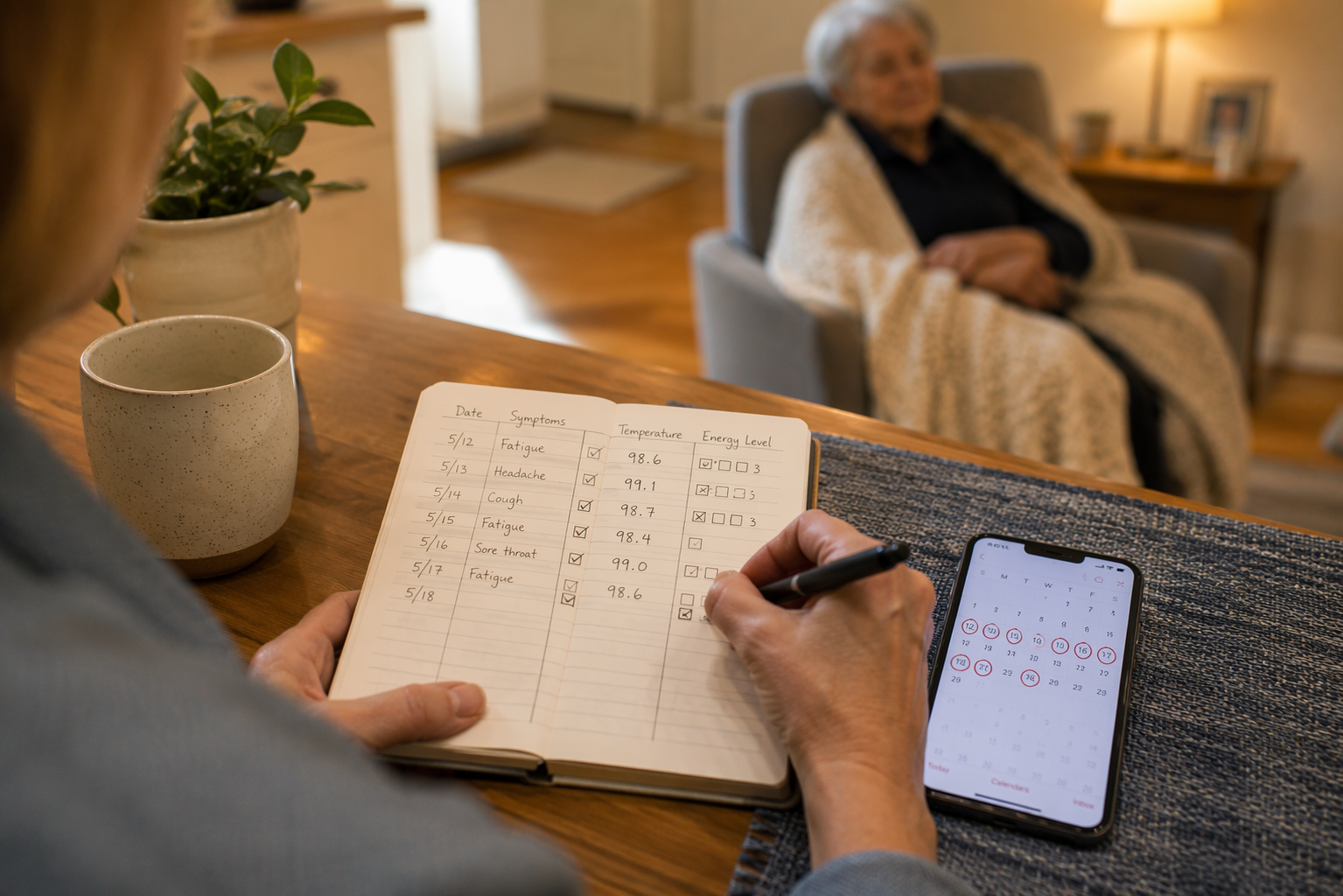
Use plain observations. Can they get out of the chair the way they did yesterday? Are they drinking? Are they urinating normally? Are they newly confused about the day, the room, or their medications? Are they unusually sleepy, weak, irritable, chilled, or uninterested in food? The log is not for drama. It is for noticing a change early enough to make a better call.
| Watch for | Why it matters in an elderly parent |
|---|---|
| Diarrhea, vomiting, stomach cramps, fever | These are common foodborne illness symptoms and can lead to dehydration quickly |
| Confusion or new disorientation | NIDDK treats mental-state change as a red flag in food poisoning |
| Unusual weakness or trouble standing | May be the first practical sign that illness or dehydration is affecting function |
| Irritability, lack of energy, or “not acting like themselves” | These can be atypical warning signs in older adults rather than mere mood changes |
| Low fluid intake or fewer bathroom trips | Dehydration can become dangerous faster in frail or medically complex seniors |
| Worsening chronic symptoms | Foodborne illness can destabilize an already fragile baseline |
Step 9: Match the Monitoring Window to the Pathogen
This is where “no symptoms today” becomes a trap. Different pathogens do not work on the same schedule. A Marler Clark foodborne-illness incubation summary lists Listeria incubation as up to 70 days, E. coli as up to 10 days, and Cyclospora as 2 days to more than 2 weeks. [7] That does not prove which germ, if any, your parent was exposed to. It tells you how long your household needs to keep the exposure in mind.
| Pathogen named in recall or outbreak | Practical monitoring window |
|---|---|
| Listeria | Keep the exposure on the calendar for up to 70 days |
| E. coli | Watch closely for up to 10 days |
| Cyclospora | Watch from about 2 days to more than 2 weeks |
| Unknown pathogen or recall notice is unclear | Use the recall notice, clinician guidance, and the longest relevant window if Listeria is possible |
Put the last monitoring date on a calendar. If Listeria is involved or not ruled out, that date may be weeks away. This is not a reason to stare at your parent for 70 days. It is a reason to keep the recall note visible in case fever, diarrhea, confusion, or weakness appears later and somebody needs to connect the dots.
Step 10: Call for Medical Help Earlier Than You Would for Yourself
This article cannot tell you whether your parent needs treatment. It can tell you when not to sit on the decision. Call a clinician, nurse line, urgent care, or emergency service if your parent develops diarrhea, vomiting, fever, severe stomach pain, blood in stool, signs of dehydration, confusion, unusual weakness, lack of energy, or any sudden change that worries you. If your parent has a weakened immune system, recent hospitalization, cancer treatment, transplant history, serious kidney disease, or another condition their doctor has flagged as high risk, call sooner.
When you call, have the facts ready: age, symptoms, temperature if you have it, when symptoms began, what recalled lettuce was eaten, when it was eaten, medications that affect immunity if known, and whether anyone else is sick. Say clearly, “My elderly parent may have eaten recalled lettuce,” and name the pathogen if the recall notice names one. That sentence moves the call out of vague stomach-bug territory.
If your parent seems severely ill, confused, faint, unable to keep fluids down, difficult to wake, or suddenly much weaker than usual, do not wait for the primary-care office to open. Use urgent or emergency care according to the severity of the situation.
What Not to Do While You Are Waiting
- Do not taste the lettuce to “check” it. Contaminated food can look, smell, and taste normal.
- Do not rinse recalled lettuce and serve it anyway.
- Do not give anti-diarrhea medicine, antibiotics, or leftover prescriptions without medical guidance.
- Do not throw away every label, receipt, or delivery record before taking photos.
- Do not let “no fever” override confusion, weakness, dehydration, or a sudden behavior change.
A Small Amount of Background, After the Kitchen Is Safe
Leafy greens are not forbidden for older adults, and buying lettuce does not make a caregiver careless. But CDC’s safer-food guidance for adults 65 and older places unwashed leafy greens in the “higher risk” column and advises choosing washed leafy greens instead. [8] That guidance is not about blaming one grocery trip. It is about recognizing that the same exposure can carry a heavier consequence in an older body.
After this incident is handled, it is reasonable to tighten the household routine: buy prewashed greens when appropriate, keep raw produce away from ready-to-eat foods, refrigerate promptly, use clean cutting boards and utensils, and throw out products named in recalls without negotiating with yourself. None of that replaces the crisis steps. It just makes the next crisis less messy.
The scare is not over when the lettuce leaves the fridge. It is over when nobody can eat more of it, the refrigerator and kitchen contact points have been cleaned, the evidence is saved, the exposure is written down, and the monitoring window is long enough to match the pathogen involved.
References
- Investigation of 5-State Outbreak of Cyclospora Illnesses: Iceberg Lettuce, FDA, July 2026, link
- People at Increased Risk for Food Poisoning, CDC, link
- Older Adults and Listeria Infection, CDC, link
- What to Do During a Food Recall, Academy of Nutrition and Dietetics, link
- How to Clean Your Refrigerator Because of a Food Recall, CDC, link
- Treatment for Food Poisoning, NIDDK, link
- What should I do if I already ate a product that was just recalled?, Marler Clark, link
- Safer Food Choices for Adults 65 and Older, CDC, link
Questions to bring to a clinician or OT
This is not medical, legal, or a family's final decision — only a framework. Bring these questions to a clinician, occupational therapist, or your local Area Agency on Aging.
Find Local HelpRelated reading
Noticed something outdated or inaccurate on this page? Flag a correction. We review every report against CDC, NIA, and AARP HomeFit guidance before updating a page.