
Caregiver decision guide
Royal chef kitchen adaptations for safer senior cooking
Learn how to adapt your parent's kitchen using principles from a former royal chef — from ergonomic tools and layout changes to food-safety protocols — so they can keep cooking safely and confidently at home.
The first sign is often small enough to argue with. A jar stays closed until someone else comes over. The cast-iron pan is suddenly “too much trouble.” A chair appears beside the pantry because the baking dish lives on the top shelf. Then there is the burn on the wrist, brushed off as nothing.
For many older adults, cooking is not just another household task to simplify out of existence. It is a daily proof of competence, taste, memory, and control. In the University of Michigan National Poll on Healthy Aging, 42% of adults age 50 to 80 who cooked dinner 6 to 7 days a week rated their diet as excellent, compared with 23% of those who cooked dinner 2 days a week or less.[1] That does not prove cooking alone creates a better diet, but it does show why the kitchen matters. When an older parent stops cooking, something larger than dinner may be slipping.
That is where royal-chef thinking for older home cooks needs to be interpreted carefully. The useful idea is not palace glamour. It is discipline: fewer wasted motions, dependable tools, clean work surfaces, simple methods, and routines that make safe behavior easier than risky improvisation.
Darren McGrady, the former royal chef associated with Queen Elizabeth II, Princess Diana, Prince William, and Prince Harry, is often used as the credibility hook for this way of thinking.[2] His direct senior-dining connection comes through his role with Koelsch Communities, which describes him as a culinary advisor for its “Royal Chef Approved” dining program.[3] That matters, but it has limits: there is no evidence in the provided materials that McGrady has published a dedicated senior kitchen-safety manual or personally endorsed specific adaptive tools. The better use of the royal-chef frame is to borrow the kitchen standard, then adapt it honestly for aging hands, balance, stamina, and food-safety risk.
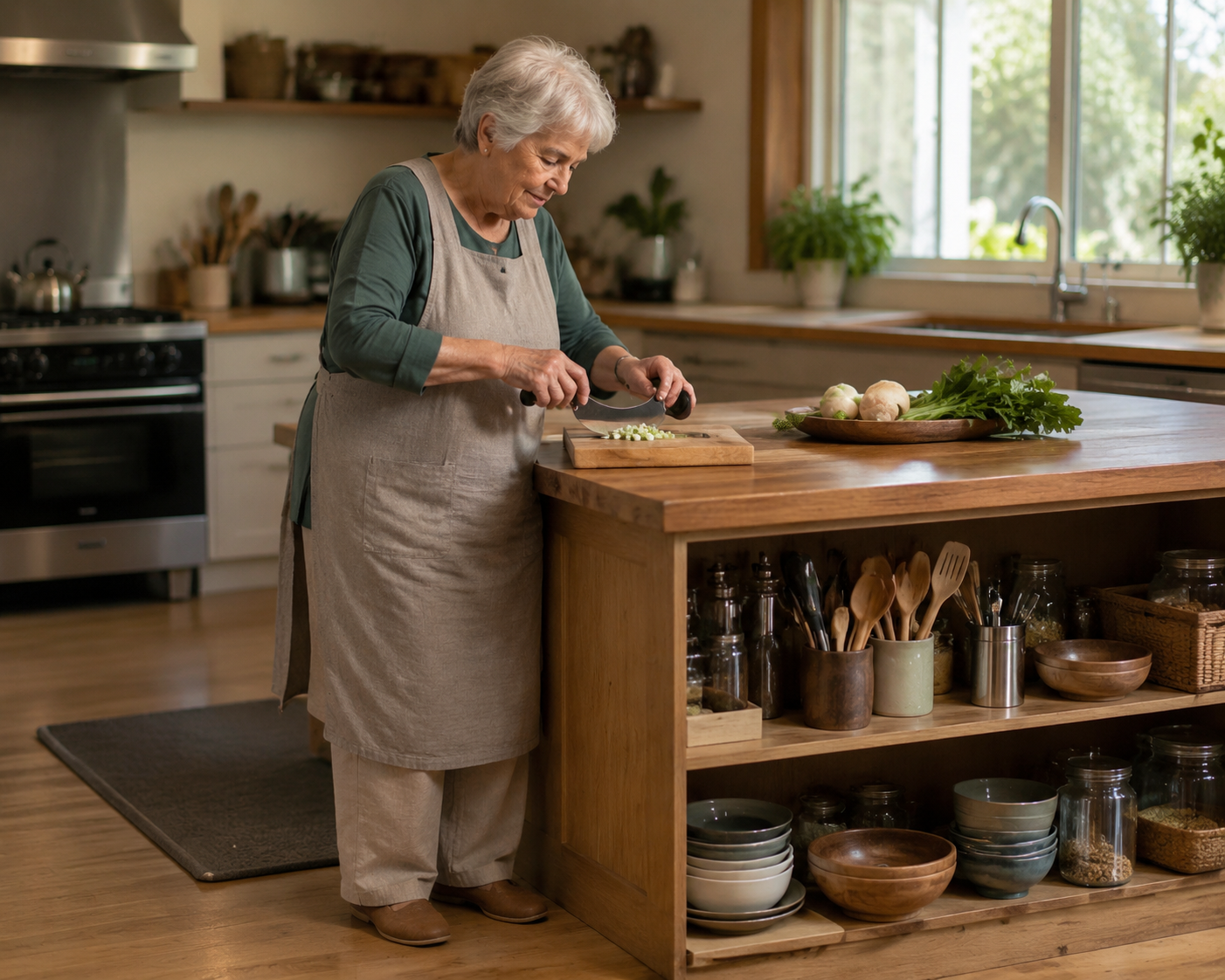
Start With the Hands, Not the Menu
If a parent says cooking has become tiring, the problem may not be the recipe. It may be the grip, pinch, twist, lift, and chop hidden inside every familiar meal.
The National Council on Aging reports that 47.3% of U.S. adults age 65 and older have arthritis.[4] That number changes how a family should read kitchen resistance. Avoiding onions may mean the knife hurts. Buying pre-cut fruit may mean the cutting board slips. Letting someone else open the sauce jar may mean the hand pain has already negotiated the meal down before cooking begins.
A disciplined kitchen does not ask painful joints to prove character. It changes the tool.
- Replace narrow-handled utensils with wide, cushioned, non-slip grips so the hand does not have to squeeze as tightly.
- Use a rocker knife or other adaptive cutting tool when chopping with a standard chef’s knife requires too much finger control or wrist pressure.
- Add an electric jar opener or mounted opener for lids that require painful twisting.
- Choose lightweight pans with two handles when a one-handed lift from stove to counter has become unsteady.
- Use non-slip cutting boards, silicone mats, or damp towel stabilization so the cook is not using one painful hand as a clamp.
The National Council on Aging specifically points older adults with arthritis toward arthritis-friendly tools and strategies such as ergonomic grips, adaptive knives, jar openers, and lighter cookware.[4] These are not indulgences. They reduce the force required to do ordinary cooking work.
The order of changes matters. Start with the task your parent still wants to do, not the gadget aisle. If she still makes soup every Sunday, watch the motions in that meal: opening broth, chopping vegetables, lifting the pot, ladling into containers. If breakfast is the non-negotiable ritual, watch the coffee canister, skillet, egg carton, toaster, and reach into the refrigerator. The right adaptation is the one that preserves the chosen ritual with fewer painful steps.
A rocker knife may be useful for someone who can press down with the heel of the hand but struggles with fine finger control. An electric opener may matter more for someone whose recipes rely on canned tomatoes, jars of sauce, or bottled condiments. A lightweight skillet may be the quiet difference between continuing to cook eggs and deciding the stove is no longer worth the trouble.
Move the Kitchen Down to a Safer Height
The most elegant kitchen adaptation may be moving the mixing bowl.
Upper cabinets are often treated as neutral storage. They are not neutral when an older adult is climbing, stretching, or pulling down something heavy with both arms above shoulder height. A royal-chef-inspired kitchen keeps the work close to the worker. In a senior kitchen, that means the daily tools belong between shoulder and knee height, with the heaviest items closer to waist level.
| Kitchen item | Better location | Reason |
|---|---|---|
| Everyday plates and bowls | Waist-level shelf or pull-out drawer | Reduces overhead reaching and awkward lifting |
| Heavy pots and pans | Lower pull-out cabinet or open shelf near the stove | Keeps weight close to the body before cooking starts |
| Coffee, tea, mugs, sweeteners | One breakfast station near the kettle or coffee maker | Prevents repeated trips across the kitchen |
| Cutting board, knife, peeler, prep bowl | Single prep zone beside good lighting | Makes chopping a seated or stable standing task |
| Food storage containers | Near the refrigerator or main counter | Supports safer cooling and leftovers without a search |
This is the part adult children can often fix in one afternoon without making the kitchen feel confiscated. Ask which three meals or snacks your parent actually prepares. Then build the room around those routines. The seldom-used roasting pan can live higher. The daily saucepan cannot. Holiday platters can move to the garage shelf. The cereal bowl should not require a step stool.
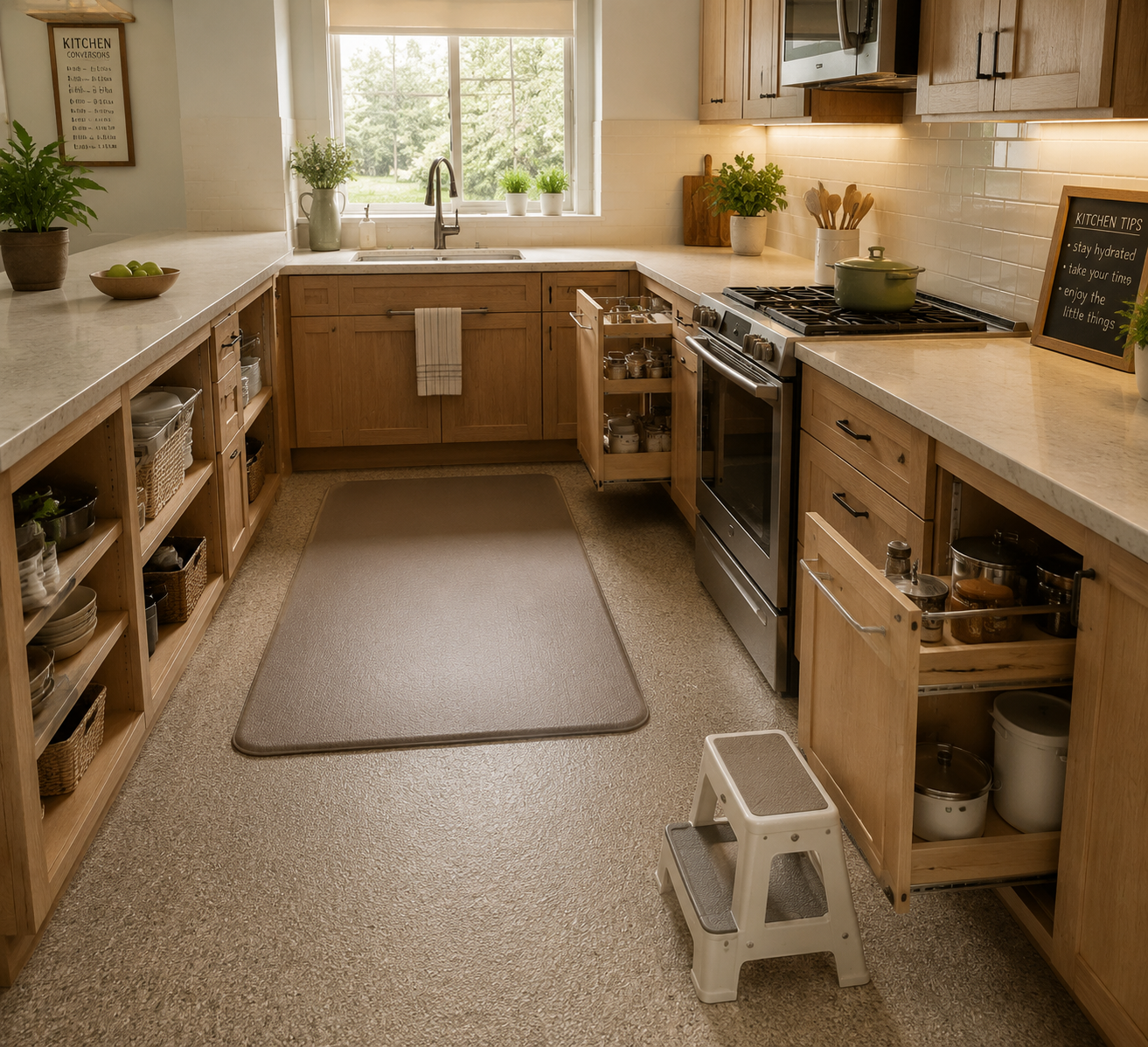
The counter deserves the same discipline. A cluttered counter makes every safe motion more complicated: the hot pan has nowhere to land, the cutting board shifts toward the edge, the cook reaches across a toaster cord to grab the oil. Clear counter space on both sides of the stove and beside the sink is not a design preference. It is working room.
Lighting also belongs in the safety conversation. Under-cabinet task lighting can make it easier to see knife position, burner status, spill edges, and food condition. A parent who cooked for decades by habit may not volunteer that the kitchen looks dimmer now. The room simply becomes more tiring, and mistakes become easier to miss.
Flooring is less glamorous than a new knife, but it is often more important. A non-slip mat at the sink or prep area can reduce fatigue during longer standing tasks, while a curled rug edge or loose runner should leave the kitchen. If a mat slides, it is not a safety tool. If it creates a lip near the stove, it may become the hazard it was supposed to solve.
Treat the Stove as a Workstation, Not a Test of Independence
Cooking fires are not a theoretical worry. Chefs for Seniors cites National Fire Protection Association data that ranges or cooktops were involved in 61% of reported home cooking fires.[5] That statistic should not end the conversation with “then stop using the stove.” It should start a better one: what makes stove work harder, slower, more distracting, or more dangerous than it needs to be?
A safer stove station has landing space, clear surfaces, reachable tools, and fewer reasons to turn away. Pot holders live beside the stove, not across the room. A spoon rest sits where a sauce-covered utensil will not roll. Paper towels, mail, plastic bags, and dish towels stay away from burners. The pan used most often is light enough to control and stored close enough that it does not require a risky carry before the heat even starts.
For some families, the most useful change is a simple stove routine: turn on the light, set a timer before stepping away, keep a clear landing zone, turn handles inward, and check that all burners are off before leaving the kitchen. The point is not to make the parent recite rules like a child. It is to make the same closing ritual happen every time, the way a serious kitchen shuts down a station.
If memory lapses, vision changes, tremor, dizziness, or repeated near-misses are already present, the family may need more than rearrangement. That may mean supervision during high-heat tasks, shifting some meals to microwave or countertop appliances, or asking a clinician or occupational therapist to assess what is still safe. The answer should fit the actual risk, not the caregiver’s anxiety alone.
Make Food Safety Easier to Follow Than to Forget
Food safety often gets treated as a lecture, which is why it fails. Older adults do not need a longer speech about leftovers. They need a refrigerator thermometer, shallow containers, visible dates, and a system that works when they are tired.
Chefs for Seniors recommends keeping the refrigerator at 40°F or below, using shallow containers for leftovers, and using color-coded cutting boards to reduce cross-contamination risk.[5] Those are small habits with clear jobs. The thermometer answers whether the fridge is cold enough. Shallow containers cool food more evenly than deep ones. Color-coding keeps raw meat, produce, and ready-to-eat foods from sharing the same surface by accident.

- Place a refrigerator thermometer where it can be read without moving food around.
- Store leftovers in shallow containers rather than one deep pot.
- Use a simple date label, even if it is just painter’s tape and a marker.
- Keep color-coded cutting boards in the same visible place so the system does not require memory.
- Batch-cook only what can be cooled, stored, reheated, and eaten safely.
Batch cooking can be a friend to an older cook when it reduces daily chopping, lifting, and stove time. It becomes less helpful when a large pot is too heavy, containers are hard to open, or leftovers disappear into the back of the refrigerator. A better version is modest: cook the beans, soup base, rice, or roasted vegetables in amounts that can be divided immediately into shallow, easy-open containers.
This is where the royal-chef idea earns its keep. Mise en place is not just chopped shallots in tiny bowls. At home, for an older adult, it can mean the thermometer is already in the refrigerator, the clean board is already visible, the container lids match, and the safe path from stove to storage is not blocked by yesterday’s mail.
Change the Kitchen Without Taking Over the Cook
The hardest part is often not buying the tool or moving the shelf. It is making the change without turning the kitchen into evidence that the parent is failing.
A useful approach is to start with a shared standard instead of a correction. “Let’s set this up like a working kitchen” lands differently than “You shouldn’t be climbing for that anymore.” The first protects competence. The second invites resistance, even when the concern is justified.
Walk the kitchen during an ordinary meal, not during a crisis. Notice where the body hesitates. Is the cook bracing against the counter to open a jar? Carrying a pot with both hands and no free hand for balance? Reaching over the burner for the spice used every day? Leaving the cutting board near the sink because the good light is there, even though water makes the floor slick? These are not character flaws. They are design notes.
Then make one cluster of changes at a time. A hand-pain cluster might include a jar opener, rocker knife, cushioned peeler, and non-slip board. A reach-and-lift cluster might move daily dishes, pans, oils, and measuring cups into the main work zone. A food-safety cluster might add the fridge thermometer, shallow containers, cutting boards, and date labels on the same day.
After that, watch whether the change is actually used. If the electric opener stays in the box because it is hard to understand, it has not solved the jar problem. If the anti-fatigue mat migrates away from the sink because it catches the walker, it is not the right mat. If the color-coded boards live in a drawer underneath the heavy mixer, the system is too clever for the room.
What a Safer Senior Kitchen Looks Like in Practice
A safer kitchen for an older parent does not have to look medical. It may look almost ordinary: the favorite skillet on a waist-level shelf, the jar opener mounted where the tomatoes are stored, the cutting board that does not skid, the pot holders beside the stove, the counter cleared enough for a hot pan, the refrigerator thermometer quietly doing its job.
The parent still chooses the soup, seasons the eggs, slices the fruit, and decides when dinner tastes right. The caregiver has not made cooking risk-free, and should not pretend to. What has changed is the number of painful motions, unstable reaches, cluttered landings, and preventable food-safety mistakes standing between the cook and the meal.
References
- Cooking and Food Skills Among Older Adults, University of Michigan National Poll on Healthy Aging.
- Darren McGrady, Wikipedia.
- Assisted Living Dining, Koelsch Communities.
- Get Cooking: Top Tips for Older Adults Managing Arthritis Hand Pain, National Council on Aging.
- Kitchen Safety Guidelines for Seniors, Chefs for Seniors.
Questions to bring to a clinician or OT
This is not medical, legal, or a family's final decision — only a framework. Bring these questions to a clinician, occupational therapist, or your local Area Agency on Aging.
Find Local HelpRelated reading
Noticed something outdated or inaccurate on this page? Flag a correction. We review every report against CDC, NIA, and AARP HomeFit guidance before updating a page.