
Equipment comparison
How Seniors Can Stay Comfortable on a Long Flight
Long flights take a specific toll on older bodies — stiffness, swelling, dehydration, ear pressure, and poor sleep — and each has a documented countermeasure. Seniors who plan seat choice, movement breaks, hydration, and compression before boarding arrive measurably more comfortable, based on CDC, AARP, Mayo Clinic, and Cleveland Clinic guidance.
| Equipment category | compression socks |
|---|---|
| Comparison criteria | compression level, fit, timing of application, clinician approval |
| Best fit for | older air travelers on flights over 4 hours with clinician approval |
The best air travel comfort tips for seniors are usually decided before the boarding door closes. Once the tray table is down and the aisle is blocked, it is much harder to fix swollen ankles, a dry throat, stiff hips, ear pressure, or a sleep plan that depends on luck.
That does not mean turning a vacation into a medical project. It means matching each predictable in-flight stressor with a simple countermeasure: access to movement, leg exercises, smart compression, water and medications kept in reach, ear-pressure tricks, a modest sleep kit, and food choices that do not make a pressurized cabin feel worse.
Longer flights are worth taking seriously because cabin conditions do place real strain on some older and more vulnerable passengers. Harvard T.H. Chan researchers reported that simulated cabin pressurization equivalent to 7,000 to 8,000 feet produced moderate hypoxia and measurable cardiac stress in older or vulnerable passengers, with a suggested tipping point around 3.5 to 4 hours; the same report warned that alcohol and sedating medications can worsen in-flight physiological stress.[1]
Plenty of older adults are still traveling: AARP’s 2026 survey found that 64% of adults 50 and older expected to travel, while 15% said they needed disability or health accommodations.[2] The practical goal is not to make flying risk-free. It is to remove avoidable discomfort before it has several hours to build.
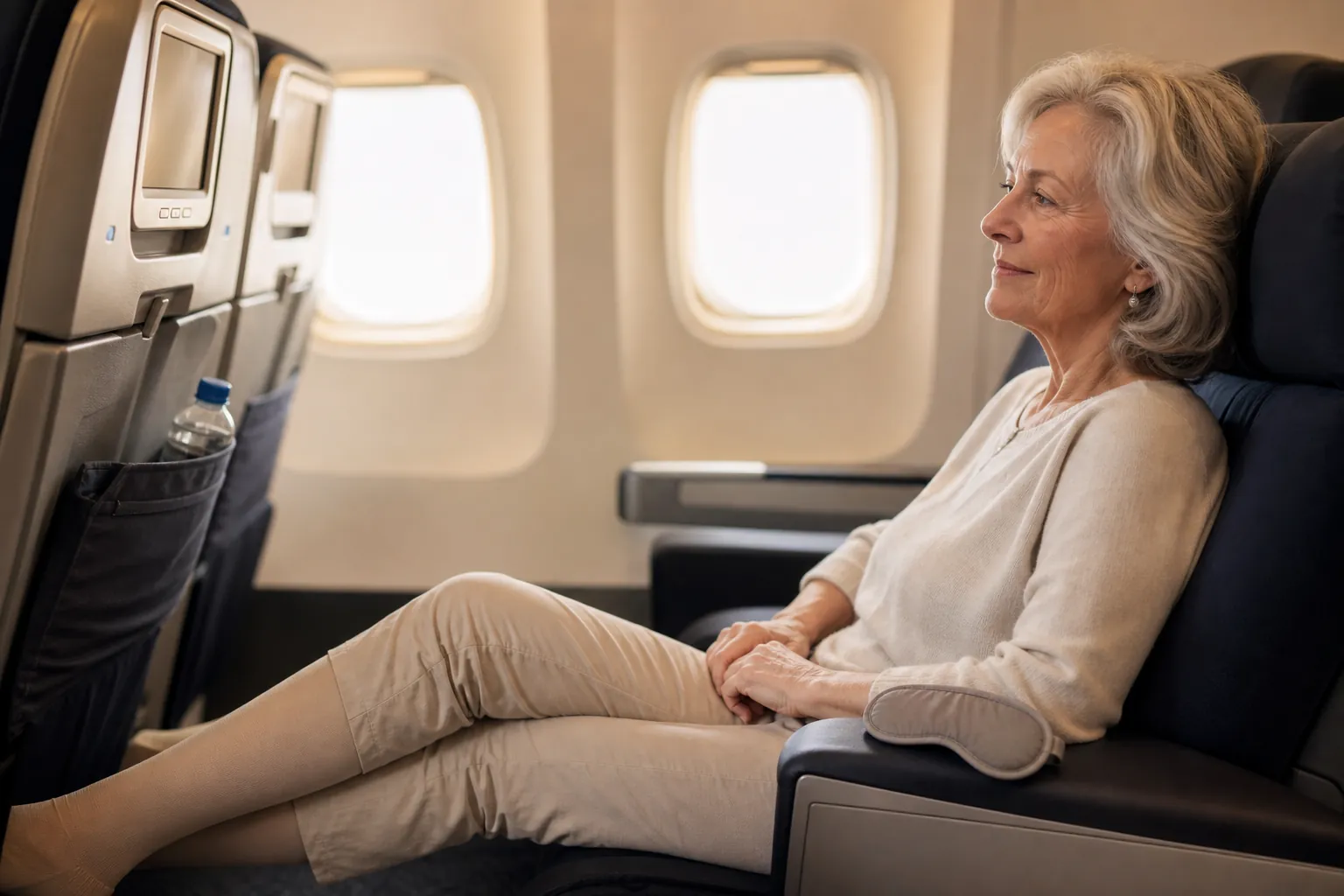
Match the problem to the countermeasure
A long flight is not one discomfort. It is several small physical problems arriving at once. Treating them separately keeps the plan manageable.
| What tends to happen | What to arrange before or during the flight |
|---|---|
| Stiff legs, puffy ankles, slower blood flow | Choose movement-friendly seating when possible, walk on a schedule, do seated heel and toe raises, and consider properly fitted compression socks |
| Dry mouth, headache, fatigue from cabin dryness | Hydrate before travel, keep water accessible, and carry permitted medications or medically necessary liquids instead of checking them |
| Ear pressure during takeoff and landing | Swallow, yawn, or otherwise keep the ears clearing during pressure changes |
| Motion sensitivity | Consider a window seat over the wing if motion sensation is the main problem |
| Poor sleep and next-day grogginess | Use light, nonmedical sleep supports first; ask a clinician before melatonin or sedating medicines |
| Bloating and gas | Go easy on gas-producing foods before and during the flight |
The circulation part deserves the most attention because it is where comfort and safety overlap. Swelling and stiffness are annoying; prolonged immobility can also contribute to blood-clot risk in susceptible travelers.
Build the flight around movement, not willpower
The CDC says anyone traveling more than 4 hours may be at risk for blood clots, and that risk increases with age after about 40, along with other medical and personal risk factors.[3] For an older passenger, that is a good reason to plan movement before the seat belt sign, meal cart, and a sleeping seatmate make the aisle feel off-limits.
If choosing seats is still possible, an aisle seat is often the most useful comfort purchase on a long flight. The CDC notes that travelers may want to choose an aisle seat when possible because it makes it easier to get up and walk around.[4] That does not make the aisle seat perfect: people brush past, carts pass close, and the armrest may be bumped. But for a traveler who tends to wait too long because they do not want to disturb anyone, aisle access matters.
The CDC’s movement target is plain: get up and walk every 2 to 3 hours when traveling for long periods.[4] That can be a slow walk to the lavatory, a loop near the galley when the crew is not serving, or simply standing and shifting weight for a minute if the aisle is crowded. It is better to move before the legs feel wooden than to wait until standing up has become an event.
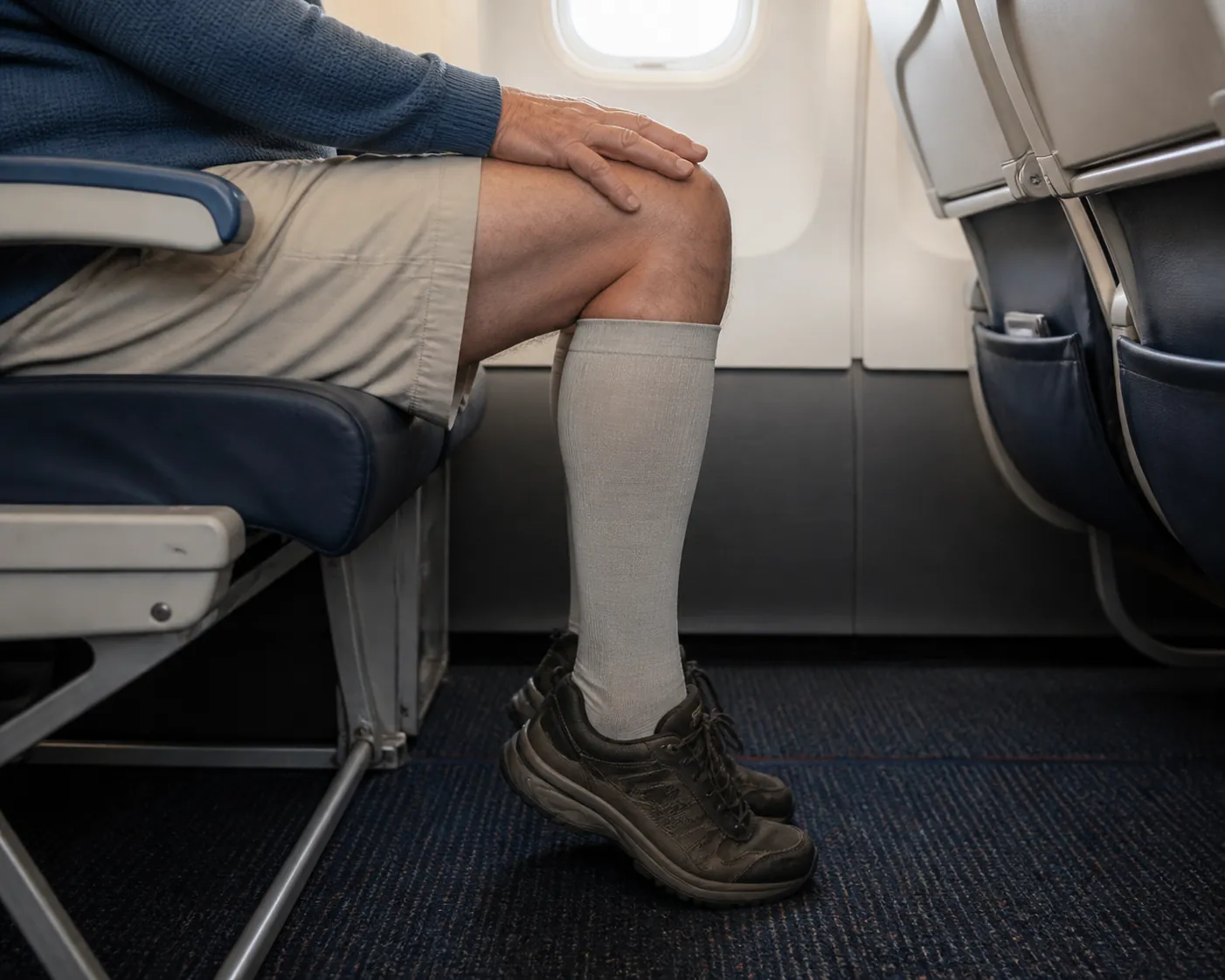
Between walks, seated leg exercises keep the lower legs from being parked in one position for hours. The CDC recommends heel raises with toes on the floor, toe raises with heels on the floor, and tightening and releasing the leg muscles while seated.[4] These are small movements, but they have the advantage of being possible even when the aisle is blocked.
- Heel raises: keep toes on the floor and lift the heels, then lower them.
- Toe raises: keep heels on the floor and lift the toes, then lower them.
- Leg tightening: gently tighten the calf and thigh muscles, hold briefly, then release.
- Standing breaks: when the aisle is safe and open, stand, walk, or shift weight instead of staying folded into the seat.
One point should stay clear: aspirin is not a do-it-yourself substitute for movement or medical advice. The CDC specifically says aspirin is not recommended solely to prevent travel-related blood clots.[4] A traveler with a history of clots, a vascular condition, recent surgery, active cancer, pregnancy, hormone therapy, or other clot risk factors needs an individualized plan from a clinician, not a generic travel tip.
Set up circulation help before you board
Compression socks are easiest to use when they are treated as part of getting dressed for the flight, not as something to wrestle on in row 34. Mayo Clinic Store’s compression guidance says 15–20 mmHg moderate compression is generally sufficient for flying, that higher compression levels should be used only on a provider’s recommendation, and that socks should be put on before the flight while the traveler is still mobile.[5]
AARP’s 2026 long-flight advice also cites 15–20 mmHg as a reasonable starting point from Dr. Tonie Reincke.[6] That is useful as a shopping range for many ordinary travelers, but it is not a universal prescription. Socks that bite into the calf, bunch behind the knee, or leave deep marks are not a comfort tool. People with circulation problems, neuropathy, skin wounds, peripheral artery disease, prior clots, or uncertainty about fit should ask a clinician before relying on compression.
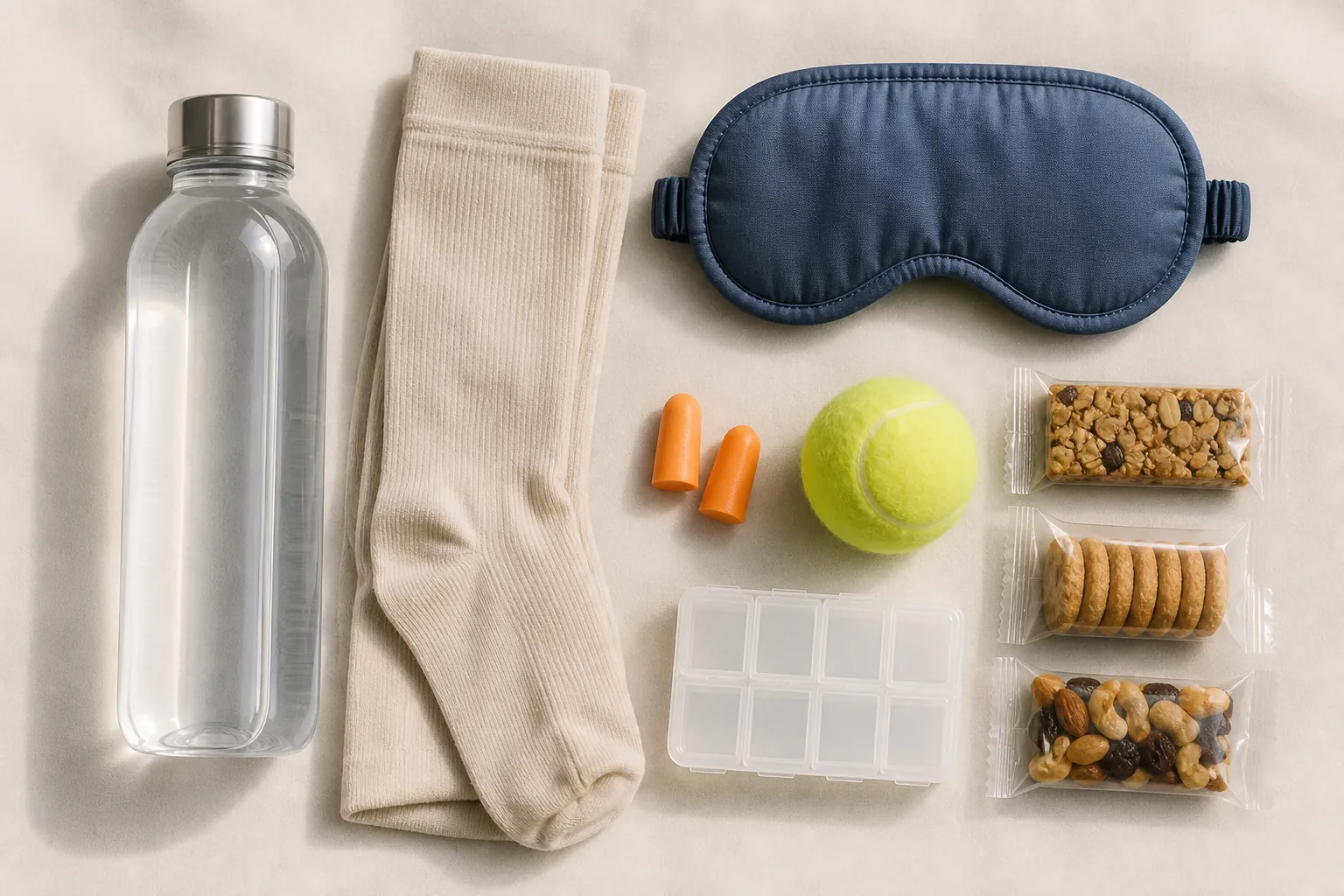
The same pre-boarding logic applies to medications and fluids. Pack regular medications in the carry-on, not in checked luggage, and keep the day’s doses accessible without unpacking the overhead bin. TSA says medically necessary liquids are allowed in carry-on bags and must be declared to security officers for inspection.[7] That matters for travelers who assume every larger liquid must be checked and then spend the flight without something they were medically allowed to bring.
Hydration also starts early. AARP’s long-flight guidance recommends pre-hydrating the day before a flight.[6] That does not mean overdrinking right before boarding and then being trapped by a window seat. It means arriving at the airport already reasonably hydrated, carrying an empty bottle to fill after security if appropriate, and not counting on the small service cup to do all the work.
If an adult child is helping, this is the place to help without taking over: confirm the seat, put compression socks where they will be worn before boarding, check that medications and medically necessary liquids are in the personal item, and ask whether a clinician should weigh in before the trip. A pre-travel appointment can be especially useful when sleep aids, melatonin, clot history, vascular disease, or medication timing across time zones is part of the plan; it can also fit naturally into a broader fall-prevention conversation during a Medicare wellness visit.
Dry cabin air: keep water and comfort items within reach
Cabin air is dry enough to be felt in the mouth, eyes, skin, and throat. Cleveland Clinic explains that about half of cabin air is drawn from outside the plane and is nearly moisture-free, contributing to very low humidity in the cabin.[8] For an older traveler, dryness can make an already tiring day feel heavier.
The practical fix is ordinary but important: do not bury water, lip balm, eye drops, or needed medications in the overhead bin. Keep them in the personal item under the seat if they are safe and permitted. If dehydration is already a concern at home, the same planning habit matters away from home; the connection between hydration and stability is one reason water access belongs in any senior mobility plan, not just a travel plan. For a broader look at that issue, see why a water crisis can become a fall emergency for older adults.
Alcohol deserves a plain word here. It may feel like a sleep shortcut, but Harvard’s cabin-simulation report specifically cautioned that alcohol combined with sedating medications worsens in-flight physiological stress.[1] Anyone who uses prescription sleep medication, anti-anxiety medication, opioid pain medication, or other sedating drugs should be especially careful about adding alcohol in the air.
Handle ears, motion, sleep, and food with narrower fixes
Ear pressure is one of the few flight discomforts that often has a very direct response. Cleveland Clinic recommends swallowing or yawning during takeoff and landing to help with pressure changes.[8] A bottle of water, a lozenge, or gum can be useful if swallowing on command is difficult, though those are comfort aids rather than medical treatment.
Seat choice changes when motion sensitivity is the bigger issue than aisle access. Cleveland Clinic suggests a window seat over the wing to minimize motion sensation.[8] That is the honest trade-off: an aisle seat usually makes walking easier, while an over-wing window seat may feel steadier for someone prone to motion sickness. The better seat is the one that solves the traveler’s main problem.
For sleep, start with low-risk tools: an eye mask, earplugs or noise reduction, a light layer, and a neck position that does not leave the head hanging forward. AARP includes an eye mask and doctor-approved melatonin near destination bedtime among its long-flight suggestions.[6] The doctor-approved part is doing real work in that sentence. Melatonin can interact with health conditions, medications, and next-day alertness, so it should not be packed casually just because it is sold over the counter.
Food is another small thing that gets large in a pressurized cabin. Cleveland Clinic recommends avoiding gas-producing foods before flying.[8] That may mean skipping the bean-heavy airport meal, carbonated drinks, or anything a traveler already knows causes bloating. This is not about eating perfectly; it is about not giving the body one more complaint when it is already sitting still.
A few comfort tricks belong in the optional category. AARP’s expert tips include rolling a tennis ball under the foot and packing an extra pair of socks for a mid-flight reset.[6] Those can feel surprisingly pleasant on a long trip, but they should be understood as comfort hacks, not substitutes for walking, leg exercises, hydration, compression guidance, or a clinician’s clot-prevention plan.
Do not spend all your energy before the gate
For many older travelers, the flight is only the middle of the physical day. The airport may require long walks, standing in lines, carrying bags, using escalators, and moving quickly when a gate changes. If that is likely to drain the traveler before boarding, request wheelchair assistance, ask the airline about pre-boarding, or plan more time between airport steps.
Travelers who use a cane, walker, wheelchair, or airport wheelchair assistance should think about the handoff points: curb to check-in, security to gate, gate to aircraft seat, aircraft door to baggage claim. A home wheelchair safety checklist will not answer every airport question, but the same habits apply: brakes, footrests, transfers, clear paths, and not rushing when someone else is waiting.
A realistic long-flight comfort plan is simple: wear what will not bind, put compression socks on before boarding if they are appropriate, choose the seat that matches the main problem, walk before stiffness sets in, move the feet while seated, keep water and medications reachable, clear the ears during pressure changes, and use sleep aids cautiously. Typical long-flight discomfort is often predictable and preventable. A history of clots, vascular disease, complex medication use, or higher-risk compression needs a clinician’s individualized plan.
References
- The Potentially Unfriendly Skies, Harvard T.H. Chan School of Public Health, 2019.
- 2026 Travel Trends Survey, AARP.
- Understanding Your Risk for Blood Clots with Travel, Centers for Disease Control and Prevention, May 2024.
- Blood Clots and Travel: What You Need to Know, CDC Travelers’ Health, August 2022.
- Importance of Wearing Compression Socks on Longer Flights, Mayo Clinic Store.
- Travel Hacks for Long Flights, AARP, April 2026.
- Medications (Liquid), Transportation Security Administration.
- Dehydration, Exhaustion and Gas: What Flying on an Airplane Does to Your Body, Cleveland Clinic.
Questions to ask your clinician or OT
This comparison doesn't decide final medical fit — bring it to a clinician or occupational therapist conversation, not a purchase decision.
Find Local HelpRelated reading
Noticed something outdated or inaccurate on this page? Flag a correction. We review every report against CDC, NIA, and AARP HomeFit guidance before updating a page.