
Caregiver decision guide
How to Set Up Easy Meal Prep for Seniors Living Alone
Learn how to set up a weekly self-serve meal system that lets a senior living alone reheat and eat safely between visits. The plan covers a capability-first check, single-serving batch cooking, walker-tray transport, food-safety rules, and when to shift to home-delivered meals.
Before you plan a week of easy meal prep ideas for seniors living alone, test the meal loop that will actually decide whether the plan works: container, microwave, table, eating. Put one real serving in the real container. Ask your parent to open it, move it to the microwave, heat it using the buttons they normally use, remove the hot food, close the microwave, get the meal to the place where they eat, sit down, and start eating.
Do not test this with an empty dish, a caregiver holding the door, or a light snack carried two steps to the counter. Use the actual microwave, the actual counter height, the actual walker or rollator, the actual chair, and the actual container you want to rely on all week. A meal prep system that looks efficient on Sunday can fail on Tuesday because the lid is too tight, the label is too small, the bowl is too hot, the soup sloshes, or both hands are needed for the walker.
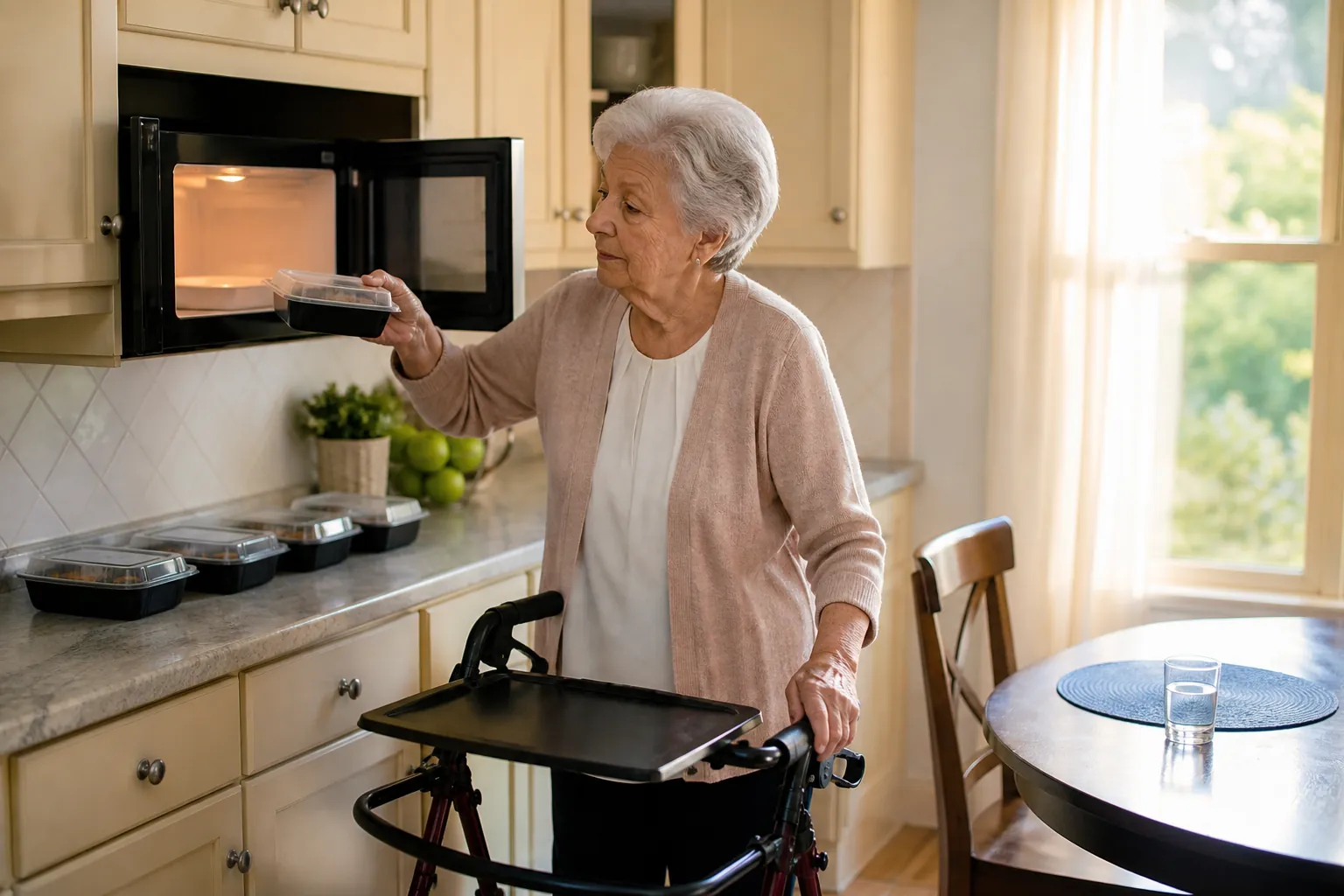
The safety gate: can they complete the container-to-table loop alone?
The first decision is not chicken or pasta. It is whether your parent can safely self-serve when no one is standing nearby. Watch for the small failures that tend to get hidden during family visits: bracing against the counter to pull off a lid, touching the hot underside of a dish, guessing at microwave time, reaching across a walker, carrying coffee in one hand while steering with the other, or abandoning the meal because getting it to the table feels like too much work.
Caregivers in an AgingCare forum discussion have described practical fixes such as rollator or walker trays with cup holders and testing whether an older adult can open, reheat, and move meals before relying on the setup. That thread is caregiver experience, not research, but it names the right problem: the meal is not truly prepared until the person can get it from storage to eating position without improvising under heat, pain, fatigue, or poor balance.[1]
During the test, stay close enough to prevent a fall or burn, but do not silently do the hard parts for them. If you loosen the lid, lift the dish, read the label, press the microwave buttons, or carry the soup, you have not tested independent meal prep. You have tested a supervised meal.
| Part of the loop | What to test | What failure looks like |
|---|---|---|
| Fridge or freezer | Can they identify the right meal and read the date? | Labels are too small, meals look alike, older containers stay in rotation |
| Container | Can they open it without pain, tools, or spills? | Arthritic fingers struggle, lids pop suddenly, liquid leaks |
| Microwave | Can they set the time and power safely? | Guessing, repeated reheating, confusion over buttons |
| Hot dish removal | Can they remove or slide the dish without touching hot surfaces? | Bare hands on hot glass, reaching too far, unstable grip |
| Transport | Can they get the meal and drink to the table while using mobility support? | One-handed walker use, wet hands, hot liquid carried against the body |
| Eating | Can they sit, open condiments if needed, and eat while food is still appealing? | Meal cools before eating, fatigue sets in, food is left unfinished |
If one part fails, adjust that part and test again. A lighter container may solve what a new recipe cannot. A larger-print label may matter more than a prettier weekly menu. A tray on a rollator may turn a risky carry into a controlled slide-and-transport routine. If the loop still fails after reasonable changes, do not scale up to seven days of containers. Move to a safer meal tier instead.
Build the week smaller than you think
A full refrigerator of identical containers can feel organized to the caregiver and overwhelming to the person living with it. Hebrew SeniorLife recommends starting with a 2- to 3-day meal plan before trying to prep for a full week, using airtight containers and labeling meals with contents and dates.[2] That is a sensible starting point because it gives you a short trial: enough meals to reduce daily cooking, not so many that unsafe habits sit unnoticed for days.
For many households, the caregiver’s weekly system can be simple:
- Shop once for the next few days, with backup foods that do not require stove use.
- Batch-cook one or two plain, familiar proteins or mixed dishes.
- Portion food into single servings before storing it.
- Label each container with the contents and date in large, high-contrast writing.
- Place the next meals where your parent can reach them without bending, digging, or moving heavy items.
- Test one reheated meal from the refrigerator and one from the freezer, if frozen meals are part of the plan.
Single servings are not just tidier. They remove decisions. Your parent does not have to judge how much soup to ladle, whether a casserole has been reheated too many times, or whether the remaining half-container is still safe. Taking.care’s UK-based meal-prep guidance also points to portioning soups, stews, and casseroles into individual servings to support portion control and reduce waste; here, that idea is useful as a practical setup step, not as U.S. nutrition authority.[3]
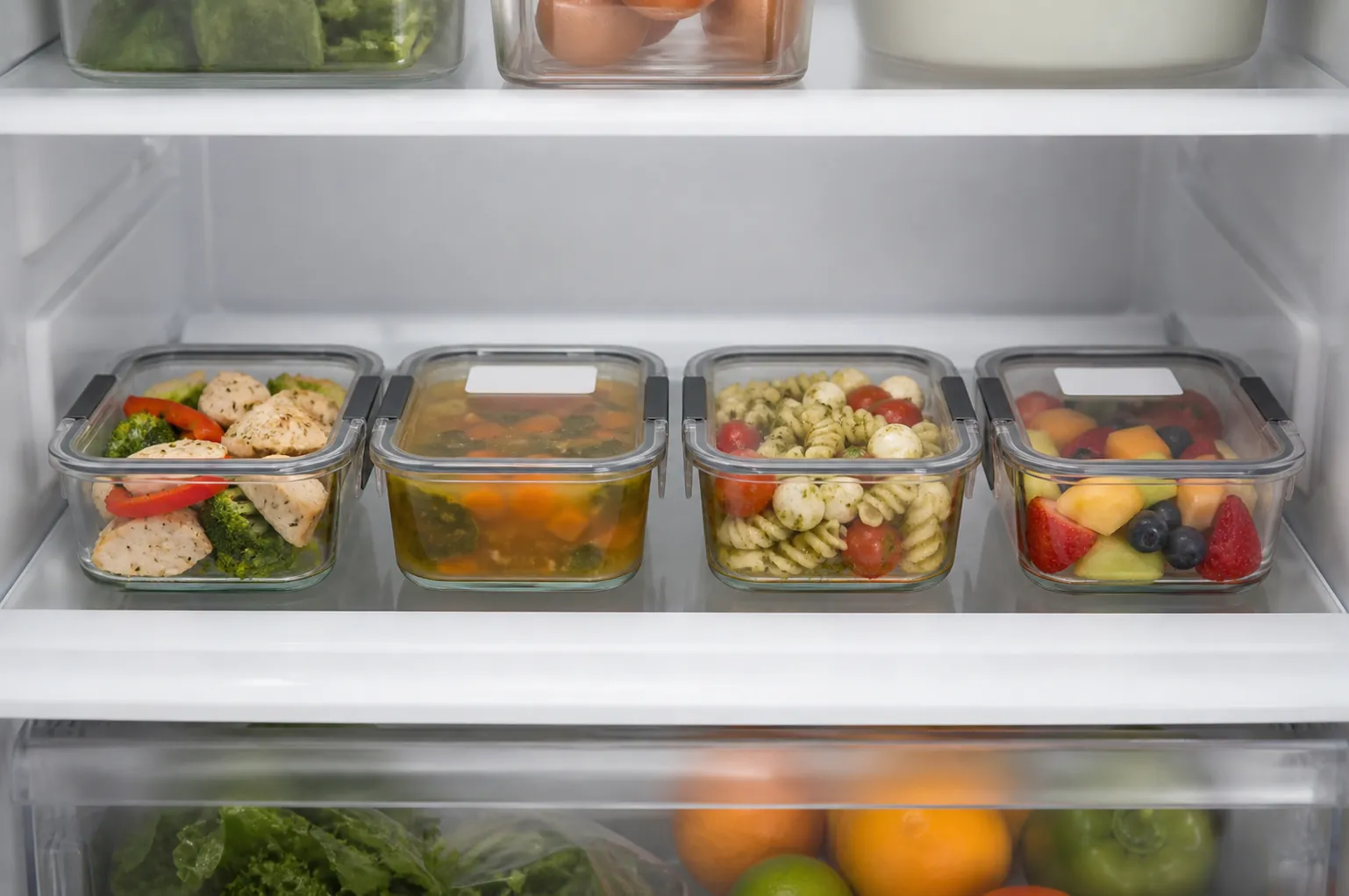
Use meal templates that do not depend on the stove
The stove is often where a well-meant meal plan becomes fragile: pans are heavy, burners are easy to leave on, and standing time adds up. If the goal is reliable eating between visits, build around cold, room-temperature, and microwave meals unless a clinician or home-safety professional has confirmed that stove use is still safe.
Useful templates include:
- Cold plates: tuna salad or chicken salad, cottage cheese with fruit, pasta salad, egg salad if safely prepared and stored, or a sandwich with fruit and a drink already nearby.
- Microwave plates: a small portion of meat or beans, a grain or potato, and vegetables arranged in a container that reheats evenly enough for your parent’s microwave.
- Small soups and stews: frozen or refrigerated in shallow single-serving containers, not large tubs that require prying, ladling, and balancing hot liquid.
- Shortcut meals: rotisserie chicken used in sandwiches, salads, or microwave plates; frozen vegetables; pre-chopped produce; pre-boiled grains; and low-sodium stock for simple soups.
- Slow-cooker meals: prepared by the caregiver when present, then cooled and portioned, rather than leaving the older adult to manage a heavy insert or hot batch.
Hebrew SeniorLife suggests time-saving supports such as frozen pre-chopped produce, overnight recipes, and pre-boiled grains.[2] Harvard Health similarly describes practical nutrition shortcuts for people living alone, including batch-cooking, using rotisserie chicken in multiple meals, and combining low-sodium stock with frozen vegetables.[4] None of that requires turning the refrigerator into a restaurant menu. It means the person can find a recognizable meal, heat it if needed, and eat without starting from scratch.
Keep the number of choices modest. Two lunch options and two dinner options may work better than ten containers with different instructions. Choice is only helpful if the person can still compare, remember, open, heat, and eat the choices safely.
Make containers, labels, and placement do more of the work
Airtight containers are useful only if your parent can open them. Test lids after the food has been chilled, because some containers feel different when cold. Avoid making the heaviest container the default. A beautiful glass dish that requires two steady hands may be the wrong dish for a parent who uses one hand for balance.
Labels should answer three questions without squinting:
- What is it?
- When was it made or opened?
- Is it meant to be eaten cold or heated?
Use plain words: “Chicken + rice — made Mon — heat” is better than a color-coded system only you understand. If microwave time is needed, write it large and test that time in the actual microwave. If the instruction changes by container size, the system is probably too complicated.
Placement matters as much as labeling. Put the next meals at eye to chest level when possible. Do not store daily meals behind heavy milk jugs, under stacked bowls, or in a freezer drawer that requires tugging. If your parent has a habit of eating the first visible item, make the safest meal the first visible item.
Solve transport before hot food is in their hands
Hot food and mobility equipment do not mix well when the plan is “just carry it carefully.” A walker or rollator tray with a cup holder can become part of the meal system because it gives food and drinks a stable place to ride while both hands remain available for mobility. The point is not the accessory. The point is eliminating the one-handed shuffle with a hot bowl.
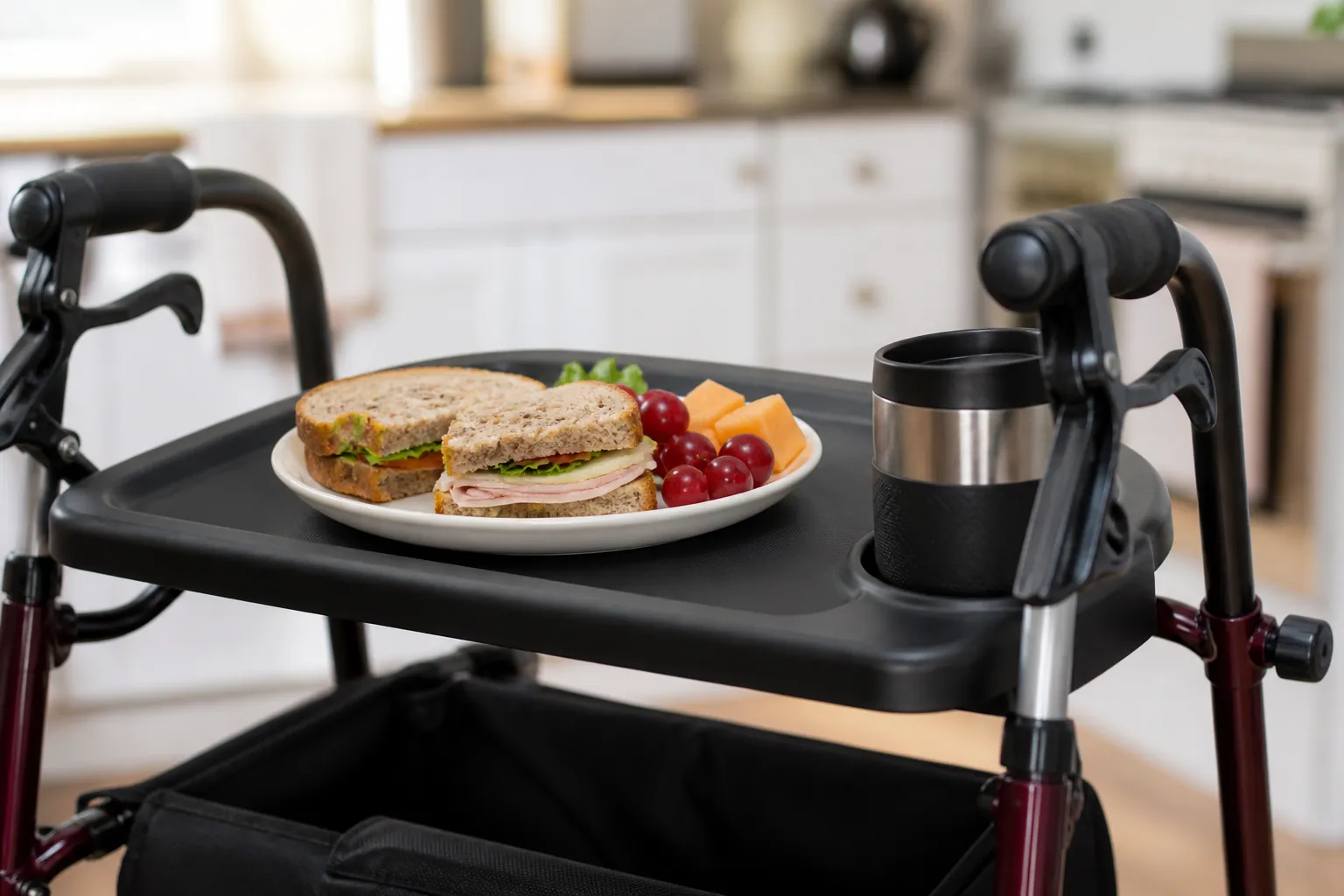
Test the route from microwave to table. Remove throw rugs, clutter, or low objects in the path. Check whether the microwave door blocks the walker. Watch what happens when the tray holds both a plate and a drink. If the tray rattles, tilts, or requires reaching too far, adjust the setup before relying on it.
Use covered containers for reheating and transport when appropriate, but make sure the cover can be vented or removed safely according to the container’s instructions. For soup, smaller containers are usually easier to control than one large container poured or ladled into a bowl. For drinks, a lidded cup or travel mug can prevent a wet floor, which is not a minor concern for someone using a walker.
Food safety rules should be few and non-negotiable
This article is general caregiving information, not medical or nutrition advice. Older adults may have swallowing problems, diabetes, kidney disease, heart failure, medication interactions, appetite changes, or cognitive changes that require individual guidance. If there is any doubt, ask a registered dietitian, geriatric RN, occupational therapist, physician, or speech-language pathologist to review the plan for the person and the kitchen involved.
For food safety, use the CDC’s rules rather than recipe-blog habits. The CDC advises adults 65 and older to follow clean, separate, cook, and chill practices; use refrigerated prepped food within 3 to 4 days; and reheat leftovers and deli meats to 165°F or until steaming hot.[5]
That means the weekly system needs dates, not guesses. If you prep more than a few days of food, freeze the later servings instead of letting them wait in the refrigerator. If your parent cannot reliably judge dates, rotate meals yourself during visits or reduce the amount of DIY prep kept at home.
Do not leave food-safety decisions to smell, appearance, or memory. A container that says “turkey soup — made Monday” is safer than a mystery bowl that requires your parent to remember when you visited. If labels come off, smear, or are ignored, the system needs a simpler storage plan.
A practical 2- to 3-day starter setup
For a first trial, skip the ambitious seven-day menu. Set up enough food to learn where the system breaks.
| Meal slot | Low-friction option | Setup detail that matters |
|---|---|---|
| Lunch 1 | Tuna or chicken salad sandwich with fruit | Make it easy to open and eat cold; place drink nearby |
| Dinner 1 | Microwave plate with chicken, rice, and vegetables | Use one tested container and one tested microwave time |
| Lunch 2 | Cottage cheese with fruit, crackers, or a prepared sandwich | Choose packaging the person can open without tools |
| Dinner 2 | Small container of soup or stew | Use a stable tray and a lidded cup; test hot-liquid transport |
| Backup | Frozen single-serving meal or caregiver-made frozen portion | Label clearly; test whether freezer access and reheating are safe |
After the trial, look at what actually happened. Were meals eaten? Were the safest foods left untouched because they were hard to open? Did your parent reheat something twice? Did they avoid soup because carrying it felt risky? Did a sandwich work better than the “healthier” hot meal? This is the useful information. Build the next shopping trip around it.
When the backup meal tier is the safer plan
There is a point where better containers and bigger labels are not enough. If your parent cannot safely open meals, understand dates, reheat food, remove hot dishes, transport meals, or remember basic food-safety steps, the next step is not a more creative recipe list. It is a backup meal tier.
That may mean Meals on Wheels, another home-delivered meal program, help from a local senior center, grocery delivery paired with ready-to-eat foods, or congregate meals when transportation and health allow. Hebrew SeniorLife includes home-delivered and congregate meals among options that can support older adults who need help with meals.[2] Meals on Wheels America also frames home-delivered meals as part of addressing hunger, nutrition risk, and isolation among older adults, while noting that demand and waitlists vary by community.[6]
Using those services is not a failure of independence. It can be the safer version of the same goal: your parent eats reliably between visits, and meals stop depending on a fragile chain of lids, hot bowls, memory, balance, and luck.
References
- I need ideas for meals that senior can serve themselves? — AgingCare, 2015
- Time-Saving Meal Prep Ideas for Older Adults — Hebrew SeniorLife, Jan 2025
- The ultimate guide to meal prepping for older adults — Taking.care, Feb 2024
- Nutrition shortcuts when you live alone — Harvard Health
- Safer Food Choices for Adults 65 and Older — CDC, May 2024
- Hunger and Malnutrition — Meals on Wheels America
Questions to bring to a clinician or OT
This is not medical, legal, or a family's final decision — only a framework. Bring these questions to a clinician, occupational therapist, or your local Area Agency on Aging.
Find Local HelpRelated reading
Noticed something outdated or inaccurate on this page? Flag a correction. We review every report against CDC, NIA, and AARP HomeFit guidance before updating a page.