
Caregiver decision guide
Senior-Friendly Northern Lights Destinations in the US
A location-by-location guide comparing US northern lights destinations on accessibility, heated viewing options, cold-weather safety, and aurora reliability — helping caregivers choose the best spot for a parent with limited mobility.
The practical question behind the top senior-friendly northern lights locations in the US is not “Where is the sky prettiest?” It is “Where can an older adult wait safely, get to a bathroom, return to warmth quickly, and still have a realistic chance of seeing the aurora?” In 2026, that question is worth asking seriously because post-solar-maximum years are expected to bring some of the strongest aurora activity before the next comparable window in the mid-2030s.[1]
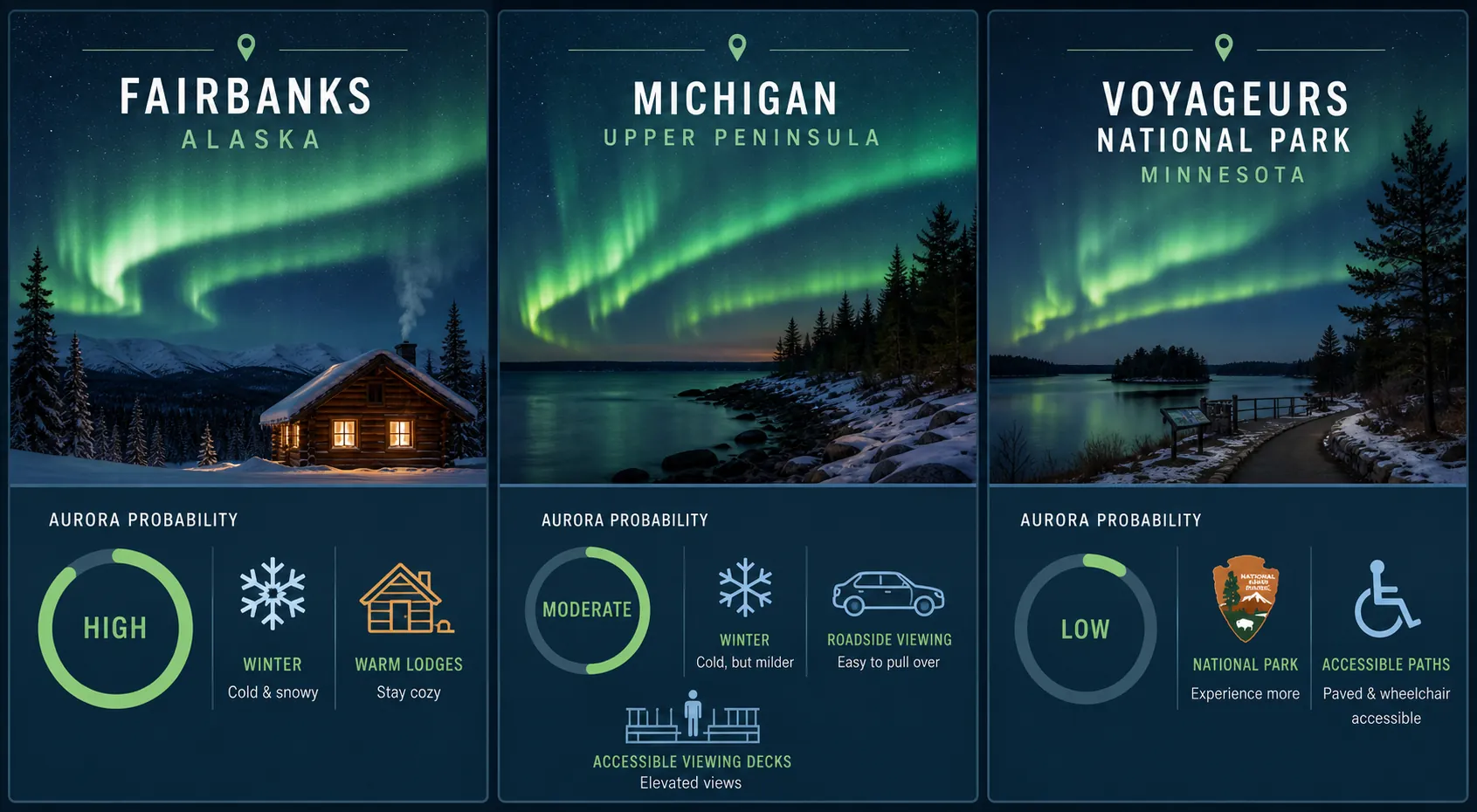
There is no single best answer. Fairbanks gives a caregiver the strongest odds and the best heated-viewing setup, but it also asks the most from the body in winter. The Michigan Upper Peninsula gives up some aurora reliability in exchange for easier car-based viewing, milder cold, and accessible overlooks. Voyageurs National Park adds National Park Service accessibility infrastructure, but its lower aurora frequency means the trip should be planned as a national-park stay with a northern-lights possibility, not as a near-guarantee.
Start With The Waiting, Not The Sky
Aurora travel has a strange rhythm for limited-mobility travelers: the big moment may last minutes, but the trip is built out of waiting. A senior may sit in a car for an hour, transfer from a wheelchair to a bench, stand briefly in snow, or decide whether it is worth leaving a heated room for a faint glow that might strengthen or fade. The safest destination is the one that reduces the number of hard decisions after dark.
For a caregiver, the useful comparison points are specific: how far parking is from the viewing spot, whether the route is paved or snow-covered, whether restrooms are ADA-accessible and open during aurora hours, whether the traveler can wait indoors or in a car, and how quickly the group can retreat if cold, fatigue, pain, or confusion sets in. A destination described as “easy” is not very helpful unless it says easy for whom, in what season, and across what surface.
| Destination | Best fit | Main senior-friendly advantage | Main trade-off |
|---|---|---|---|
| Fairbanks, Alaska | Caregivers prioritizing aurora reliability | Heated viewing rooms and high three-night viewing probability | Extreme winter cold requires serious planning |
| Michigan Upper Peninsula | Travelers who need car-based viewing and lower physical strain | Roadside viewing, accessible dark-sky sites, and milder winter temperatures | Lower aurora probability than Alaska |
| Voyageurs National Park, Minnesota | Families who value NPS accessibility infrastructure and a park setting | Accessible visitor centers, restrooms, trails, boat lifts, and campsites | Auroras are less frequent and require stronger conditions |
Fairbanks: The Strongest Odds, With The Hardest Cold
Fairbanks is the US destination to consider when the family is making a once-in-a-lifetime attempt and wants the best aurora odds without leaving the country. Alaska.org states that visitors who spend three nights in Fairbanks have a 90% chance of seeing the northern lights, a site-stated probability that is useful for planning but should not be treated as a weather guarantee.[2]
The senior-friendly part of Fairbanks is not simply the latitude. It is the viewing model. Aurora Pointe, about 15 minutes from downtown Fairbanks, lets visitors wait inside a heated building and step outdoors when the aurora appears; Alaska.org lists the price at $50 per person, though pricing should be checked before booking.[2] For an older adult who cannot stand outside for long, that indoor waiting space changes the trip from a test of endurance into a series of short, controlled exposures.

That kind of setup matters because the cold in Fairbanks is not a decorative detail. Winter lows can run from –20°F to –40°F, and older adults are more vulnerable to hypothermia; the National Institute on Aging warns that hypothermia can happen to older adults even when temperatures are above 60°F.[3] In Fairbanks, the planning standard should be much stricter than “bring a warm coat.” It should include medical clearance when appropriate, medication timing, layered clothing that can be managed during bathroom trips, backup gloves, footwear that handles ice, and a clear limit on outdoor exposure.
Chena Hot Springs is the tempting Fairbanks-area option because it offers the possibility of watching aurora from a 100°F mineral hot springs pool.[2] For some seniors, warm-water viewing sounds like the perfect workaround to cold exposure. The caution is accessibility: the available information is inconsistent, with one source describing aurora-tour accessibility and a Tripadvisor listing marking it as not wheelchair accessible. That conflict should not be smoothed over. A caregiver should call the resort directly and ask about wheelchair routes, transfer requirements, pool access, changing areas, restroom access, icy surfaces between buildings, and transportation from lodging to viewing areas.
Fairbanks also requires a different kind of emotional planning. The older adult may be thrilled to be in Alaska, and that matters. It may be the bold trip they have talked about for years. But the person handling the walker, the car door, the bathroom timing, and the medication bag needs permission to choose the heated lodge over the scenic pullout if conditions turn harsh. The safer version of Fairbanks is not less meaningful; it is the version that gives the family enough control to stay out long enough for the sky to have a chance.
When Fairbanks Makes Sense
- Choose Fairbanks when aurora reliability matters more than short travel distance or mild weather.
- Favor heated viewing venues over remote roadside pullouts for seniors with limited standing tolerance.
- Use March or September when possible; near-equinox solar activity and milder temperatures can make these safer windows for senior travelers.[1]
- Verify every accessibility claim by phone, especially if a wheelchair, walker, oxygen equipment, or pool transfer is involved.
Michigan Upper Peninsula: Lower Odds, Easier Logistics
The Michigan Upper Peninsula is the practical counterweight to Fairbanks. It cannot honestly promise Alaska-level aurora frequency, because the Lower 48 generally needs stronger geomagnetic activity; KP Index values around 3 to 5 are more relevant for places like Michigan and Minnesota than they are for Fairbanks.[1] But for a senior who struggles with long flights, severe cold, or prolonged outdoor waiting, Michigan may be the trip that can actually be done well.
Winter cold in the Upper Peninsula is still real, but the expected range of 0°F to –15°F is a different planning problem than Fairbanks’ deeper winter lows. It may still be too cold for some older adults, especially at night near open water, but it gives caregivers more room to use the car as a warming base and avoid long exposure.
Headlands International Dark Sky Park near Mackinaw City is one of the clearest senior-friendly choices in this region because the available accessibility details are unusually concrete: accessible illuminated sidewalks, 24/7 ADA restrooms, free admission, no hiking requirement, and a 0.3-mile paved accessible trail to the dark sky deck.[4] For an older adult, the phrase “24/7 ADA restrooms” may matter more than any scenic adjective in the brochure. Aurora watching often happens late, and a restroom that exists only during office hours does not solve the caregiver’s problem.
The Upper Peninsula also supports the simplest low-exposure model: stay near the car. Michigan’s Upper Peninsula travel site describes 24/7 accessible turnouts along M-28, which allow car-based viewing without requiring a hike or a long transfer in the cold.[5] This is not the romantic version of aurora travel, but it may be the safest one. A parent can sit in a warm vehicle, step out only if the sky strengthens, and end the attempt without navigating a trail in the dark.
Miners Castle at Pictured Rocks National Lakeshore adds another useful option because the National Park Service identifies a paved wheelchair-accessible path to the upper overlook and notes that it is the only cliff area accessible by car.[6] The same NPS accessibility information also mentions a beach wheelchair available by reservation and a Mobi mat from parking to the water’s edge during summer, though those beach features are more relevant to daytime or seasonal access than winter aurora viewing.[6]
Michigan’s weakness is probability. A family can do everything right with lodging, timing, and accessibility and still see only stars. That does not make the trip a failure if the destination has been chosen honestly. The Upper Peninsula works best when the senior would enjoy the place even without aurora, and when the caregiver would rather accept lower odds than manage Alaska-level cold.
How To Use Michigan Without Overpromising It
- Track aurora forecasts closely and look for stronger KP Index nights rather than assuming clear skies are enough.
- Pick lodging close to the viewing area so fatigue does not build during the drive back.
- Prioritize car-based sites or paved overlooks over beaches, dunes, or informal lakefront access.
- Call ahead about snow removal, restroom hours, and whether accessible paths remain usable in winter.
Voyageurs National Park: Strong Accessibility Framework, Modest Aurora Expectations
Voyageurs National Park in northern Minnesota belongs in the conversation because its accessibility information is managed through the National Park Service and covers more than a single overlook. The park lists three visitor centers with accessible entrances and restrooms, accessible boat tour vessels with lifts, the 1/4-mile accessible Oberholtzer Trail, and accessible campsites.[7] For families who already trust NPS-style infrastructure, that can reduce some of the uncertainty that comes with privately marketed aurora stops.
The limitation is location. Voyageurs is farther south than Fairbanks, so the aurora generally needs stronger geomagnetic activity to be visible.[1] It can be a good northern-lights attempt for a senior who wants a national-park setting, accessible facilities, and a slower trip structure. It should not be sold to the family as the equal of Fairbanks for aurora reliability.
The best use of Voyageurs may be as a comfortable accessible park trip with aurora monitoring built into the evenings. During visitor-center hours, restrooms and indoor space can support the day. For night viewing, the caregiver still needs to verify the specific site, surface conditions, parking distance, restroom access, and whether the senior can wait in the car without blocking traffic or creating a safety issue.
The 2026 Timing Helps, But It Does Not Remove The Caregiver Work
The 2026 aurora window is a real reason to consider the trip now, especially for a parent whose mobility may not be the same in a few years. Post-solar-maximum activity improves the chance of stronger displays, and shoulder-season timing around March and September can help reduce cold exposure while taking advantage of near-equinox aurora activity.[1]
That does not mean every senior should go north in winter. Cold tolerance, circulation issues, fall risk, nighttime confusion, medication schedules, and bathroom urgency can matter more than the forecast. A healthy adult may remember a northern-lights night as a little uncomfortable. A frail older adult may experience the same night as unsafe if the path is icy, the restroom is closed, or the group waits too long because the aurora is “almost” appearing.
Before booking, caregivers should treat accessibility claims as starting points, not proof. Ask venues about the exact route from parking to viewing, the surface material, snow and ice management, indoor waiting space, restroom hours, wheelchair turning room, seating, emergency contacts, and whether staff are present during aurora viewing hours. A website label that says “accessible” is not enough when the key part of the trip happens at night in cold weather.
A Practical Way To Choose
Choose Fairbanks if the family’s priority is the strongest US aurora probability and the caregiver can build the trip around heated viewing, short outdoor exposure, and serious cold-weather preparation. It is the boldest choice and the most demanding one. Aurora Pointe’s indoor waiting model is the kind of design that makes Fairbanks plausible for some limited-mobility travelers; Chena Hot Springs may be wonderful for the right person, but its accessibility needs direct verification before it becomes part of the plan.[2]
Choose the Michigan Upper Peninsula if mobility access, car-based viewing, and somewhat milder winter conditions matter more than maximizing the odds. Headlands, M-28 turnouts, and Miners Castle give caregivers more ways to reduce walking and cold exposure, but the family should be honest that the aurora may not appear unless geomagnetic conditions cooperate.[4][5][6]
Choose Voyageurs National Park if the older adult would value the park experience and the family wants NPS-managed accessibility features, with northern lights treated as a hoped-for bonus. Its visitor centers, accessible restrooms, trail, boat lifts, and campsites are meaningful infrastructure, but they do not change the basic aurora-frequency trade-off of being farther south.[7]
For any of the three, the trip should be planned around the older adult’s safest night, not the most dramatic photograph. Review medical and medication logistics, lodging access, transportation, and fatigue limits before committing; our senior travel safety guide can help with that pre-trip checklist. For Fairbanks or any winter route where storms, power interruptions, or extreme cold could strand travelers, also review emergency preparedness for elderly travelers during warnings before departure.
References
- 2026 solar maximum and KP Index guidance, Space.com
- Aurora viewing probability, Aurora Pointe pricing, and Chena Hot Springs information, Alaska.org
- Hypothermia risks in older adults, National Institute on Aging
- Accessible northern lights destinations overview and Headlands International Dark Sky Park details, Travegali
- Michigan Upper Peninsula viewing locations and M-28 roadside turnouts, Michigan UP Travel
- Pictured Rocks accessibility page, National Park Service
- Voyageurs accessibility page, National Park Service
Questions to bring to a clinician or OT
This is not medical, legal, or a family's final decision — only a framework. Bring these questions to a clinician, occupational therapist, or your local Area Agency on Aging.
Find Local HelpRelated reading
Noticed something outdated or inaccurate on this page? Flag a correction. We review every report against CDC, NIA, and AARP HomeFit guidance before updating a page.