
Caregiver decision guide
Emergency preparedness for elderly travelers during warnings
When a travel warning targets your aging parent's destination, use a four-factor decision framework — advisory level, health stability, medical infrastructure, and support network — to decide whether to proceed, modify, or cancel. This guide delivers a transparent Go/Modify/Cancel matrix that replaces reactive gut checks with a defensible caregiver decision.
The hardest moment is not when the travel warning appears. It is ten minutes later, when the flights are paid for, your parent says they still want to go, and the family group chat starts turning one advisory into three different opinions.
Emergency preparedness for older adults during travel warnings should not begin with a blunt yes or no. It should begin with a more defensible question: under this warning, with this parent’s health, at this destination, with this support, what would have to be true for the trip to be reasonable?
That distinction matters because older adults are not a fringe travel group. AARP reported that 64% of adults 50 and older expected to travel in 2026, and 15% said they require disability or health accommodations when traveling. The same survey was conducted in November and December 2025, during and after the U.S. government shutdown, so its findings about cancellation concern should not be treated as a clean long-term trend detached from that moment. Still, the larger point is plain: travel remains part of normal life for many older adults, not an indulgence that automatically disappears with age. [1]

Start With The Four-Factor Decision
Use the warning as one input, not the whole answer. The State Department advisory level tells you something important about country-level or area-level risk, but it does not know whether your father uses supplemental oxygen, whether your mother’s blood pressure has been unstable, or whether either of them could manage a disrupted return flight without help. USA.gov summarizes the four advisory levels as Level 1: exercise normal precautions, Level 2: exercise increased caution, Level 3: reconsider travel, and Level 4: do not travel. It also points travelers to STEP enrollment for safety alerts and embassy contact during emergencies. [2]
If you need a fuller advisory-level refresher before applying the framework, read How State Department travel advisories affect older adults. For this decision, stay focused on four observable factors.
| Factor | What To Verify | Why It Changes The Decision |
|---|---|---|
| Advisory level | Current State Department level for the destination, including regional differences | A Level 3 or 4 changes the burden of proof; the family should not treat the trip as routine |
| Health stability | Recent symptoms, medication changes, mobility, oxygen needs, cognitive changes, and physician concerns | A stable condition can often be planned around; an unstable condition becomes more dangerous when systems are disrupted |
| Medical infrastructure | Nearby hospitals, emergency care capacity, pharmacy access, evacuation options, and language barriers | The same medical issue has different consequences depending on whether appropriate care is reachable |
| Support network | Who is physically present, who can drive or translate, who can manage documents, and who can stay if plans change | A warning is harder on an older traveler who would be alone when something goes wrong |
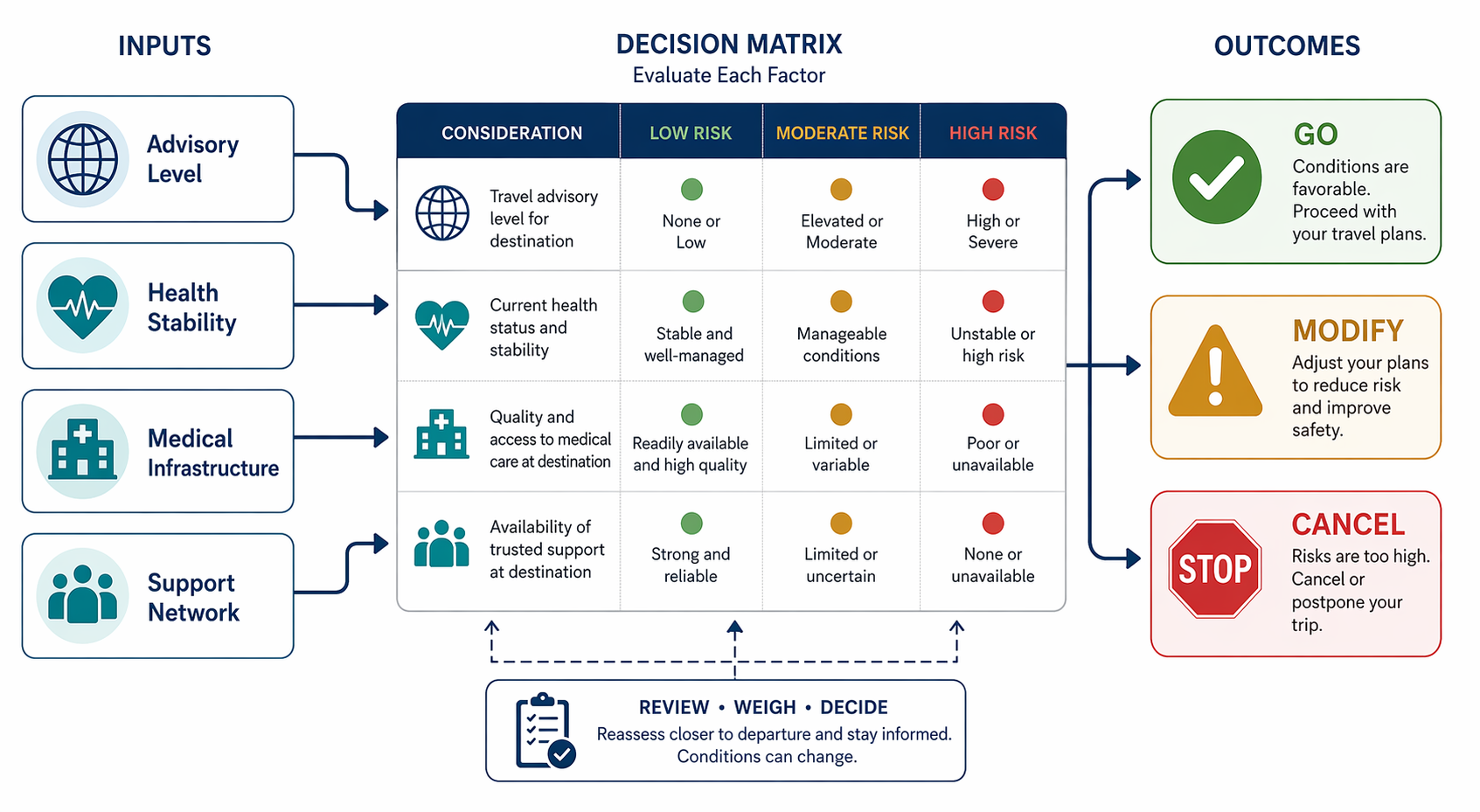
The Go, Modify, Cancel Matrix
This matrix is not a permission slip. It is a way to make the family name the conditions behind the decision. A trip can move from Go to Modify or Cancel because one factor changes: a new flare-up, a hospital closure, a regional escalation, a travel companion dropping out, or an insurance window that has already passed.
| Likely Decision | Advisory Level | Health Stability | Destination Medical Capacity | Support At Destination |
|---|---|---|---|---|
| Go | Level 1 or Level 2, with no destination-specific issue that directly affects the itinerary | Stable and managed; no recent major change in symptoms, medications, cognition, or mobility | Appropriate emergency care and pharmacy access are reachable for the traveler’s likely needs | A real person or organized support system can help with transportation, communication, and urgent decisions |
| Modify | Level 2 with meaningful local disruption, or Level 3 where part of the trip can be changed or avoided | Mostly stable, but with vulnerabilities that require a simpler itinerary, companion, medical clearance, or delay | Adequate in some places but weak near part of the itinerary, or uncertain enough to require rerouting | Some support exists, but gaps remain in overnight help, translation, transportation, medication management, or emergency backup |
| Cancel | Level 4, or Level 3 combined with health fragility, poor access to care, or isolation | Fragile or unstable; recent hospitalization, uncontrolled symptoms, new confusion, oxygen dependence without reliable logistics, or physician objection | Emergency care is compromised, too far away, inaccessible, or unable to manage the likely emergency | No dependable person is present, and the older traveler cannot safely manage delays, illness, paperwork, or evacuation alone |
“Go” should mean the risk is understood and bounded. It does not mean the warning is ignored. “Modify” should be treated as a serious outcome, not a consolation prize. Many families will land there because the parent’s goal may still be possible if the plan becomes smaller, slower, closer to care, or better supported. “Cancel” should be used when the family can name the specific failure point they cannot reasonably protect against.
Factor 1: Read The Advisory For The Actual Itinerary
Do not stop at the country label. Look at the place your parent will actually be: airport city, hotel neighborhood, tour route, cruise port, border area, rural family home, or connecting region. A Level 2 advisory may be manageable for one itinerary and unreasonable for another if the trip depends on long ground transfers, remote lodging, or frequent movement through affected areas.
For baseline preparation during broad caution periods, Senior Travel Safety Tips During the 2026 Worldwide Caution can help with the general warning context. In this decision, the advisory becomes practical only when it is mapped to the parent’s movements.
- Check whether the warning applies to the whole country or specific regions.
- Identify whether the itinerary enters the affected area or only connects through it.
- Ask whether the warning affects predictable needs: transportation, curfews, demonstrations, medical access, communications, or airport operations.
- Enroll the traveler in STEP if the trip proceeds, so safety alerts and emergency contact information are easier to receive while abroad. [2]
The advisory level sets the starting pressure. It does not settle whether an older adult can travel safely. That comes from the next two factors, which deserve the most careful attention.
Factor 2: Decide Whether The Parent Is Stable Enough For Disruption
A parent can be “cleared to travel” in ordinary conditions and still be a poor candidate for travel during an active warning. The question is not whether they have diagnoses. Many older travelers do. The question is whether their current condition can tolerate delay, stress, missed sleep, heat, walking, medication disruption, language barriers, and slower access to care.
Stable and managed means the condition has been predictable recently. Medications are not being actively adjusted. Symptoms are not escalating. Mobility needs are known. The traveler can describe what they take, what worsens their condition, and whom to call. If there is mild cognitive impairment, someone has already decided who manages documents, pills, money, and schedule changes.
Fragile or unstable means the family is already compensating before the trip begins. Blood pressure has been erratic. Shortness of breath has worsened. A fall happened recently. Confusion is new or increasing. A medication was just changed. Oxygen logistics are unresolved. A caregiver is saying, “They’ll probably be fine,” while quietly planning to solve every problem from another time zone.
The CDC’s older adult travel guidance emphasizes discussing health conditions, medications, vaccines, and destination risks before travel; the CDC Yellow Book also treats medication planning and traveler-specific health kits as part of pre-travel preparation. Those are not packing formalities when a warning is active. They are evidence of whether the trip has been converted from hope into a plan. [5][6]
| Health Signal | Go-Leaning Interpretation | Modify Or Cancel Interpretation |
|---|---|---|
| Medication routine | Doses are stable, supplies are available, and the traveler or companion can manage them | Recent medication changes, confusion about dosing, or no backup supply |
| Mobility | Known limitations are matched to the itinerary and transportation | The itinerary requires more walking, stairs, transfers, or standing than the parent can reliably handle |
| Cardiac or respiratory status | Symptoms are stable and the physician has no destination-specific concern | Recent worsening, unresolved oxygen logistics, or no realistic emergency plan |
| Cognition | The traveler can manage independently or has a companion who will actively manage risks | New confusion, wandering risk, poor judgment under stress, or no person assigned to supervise |
| Recent care needs | No recent hospitalization or acute episode that changes the baseline | Recent hospitalization, falls, infection, flare-up, or unresolved test results |
If the trip is still possible but the health signal is yellow, modification is usually the honest middle. That can mean postponing until a medication change has settled, adding a companion, shortening the trip, removing rural legs, booking accessible transfers, or choosing lodging close to appropriate care.
Factor 3: Match The Destination’s Care To The Likely Emergency
Families often ask whether there is “a hospital nearby.” That is too vague for an older traveler during a warning. The better question is whether reachable care can handle the emergency this parent is most likely to have.
For a parent with heart disease, “nearby care” means more than a clinic that can take a blood pressure reading. For a parent with COPD, it means oxygen access, respiratory support, and a way to get there quickly. For a parent with diabetes, it means medication storage, food predictability, pharmacy access, and a plan if illness disrupts eating. For a parent with dementia, it may mean a calm environment and a companion who can prevent a minor delay from becoming a safety event.
This is where a Level 2 advisory can become a much more serious family decision. A healthy, independent traveler may reasonably accept “increased caution.” An older traveler with unstable respiratory disease, limited mobility, or new confusion may need the family to treat the same conditions as a reason to modify or cancel, especially if the destination’s care is strained or distant.
- Name the most likely medical problem, not every possible disaster.
- Identify the nearest facility that could actually manage that problem.
- Check how the parent would reach that facility during the warning conditions.
- Confirm whether language, payment, documentation, or transportation would delay care.
- Decide who has authority to make decisions if the parent cannot coordinate care alone.
Coverage belongs in this part of the conversation because a medical plan that depends on U.S. Medicare abroad is usually not a plan. Medicare.gov states that Medicare does not cover health care outside the United States except in limited situations. [3]
That does not mean every family needs the same insurance product, and it certainly does not mean a policy can make a medically fragile trip safe. It means the family should know who pays for foreign medical care, whether medical evacuation is covered, whether pre-existing conditions are excluded, and whether the policy was bought early enough for those provisions to matter.
Squaremouth’s 2026 senior travel insurance category information reports that senior comprehensive travel insurance policies average about $371 per trip and that pre-existing condition waivers commonly require buying coverage within 14 to 21 days of the initial trip deposit. It also describes Cancel for Any Reason coverage as typically reimbursing 50% to 75% of trip cost and requiring purchase within a similar early window. These are category-level planning facts, not an endorsement of a provider or a guarantee that a given claim will be paid. [4]
| If This Is True | Decision Pressure |
|---|---|
| Medicare is the parent’s only assumed health coverage for an international trip | Modify or pause until coverage and payment responsibility are clear |
| The trip was deposited months ago and no travel medical policy was bought | Do not assume pre-existing condition waivers or CFAR options are still available |
| The warning raises the chance of delay, rerouting, or evacuation | Look specifically at interruption, medical evacuation, and emergency assistance provisions |
| The parent’s condition is unstable | Insurance may reduce financial exposure, but it does not solve the safety problem |
Factor 4: Test The Support Network Before You Need It
Support is not the name of a hotel desk, a distant cousin who “might be around,” or an adult child who promises to stay reachable by phone. During a warning, support means someone can act in the same place and time as the older traveler.
A strong support network has names, phone numbers, roles, and limits. One person can drive. One can translate. One has copies of prescriptions and insurance documents. One knows the parent’s baseline cognition and can tell whether confusion is new. One can stay overnight if the return flight is canceled. If the plan depends on a tour operator, cruise line, hotel, or paid aide, the family should know exactly what that service will and will not do during a warning.
The uncomfortable test is this: if your parent cannot come home on schedule, who takes over for the first 24 hours? If the answer is “we would figure it out,” the trip may still be possible, but it belongs in Modify until that gap is closed.
| Support Question | Acceptable Answer | Unacceptable Answer |
|---|---|---|
| Who is physically present? | A named person or service with confirmed availability | Someone may be nearby, but no one has confirmed |
| Who handles communication? | A person can translate or communicate with local providers and family | The parent will rely on strangers or apps during an emergency |
| Who manages documents? | Copies of passport, prescriptions, insurance, physician contacts, and emergency contacts are accessible | Documents are scattered across email, luggage, and family phones |
| Who handles medication disruption? | Someone knows the medication list, refill options, and storage needs | The parent alone is expected to solve lost, delayed, or spoiled medication |
| Who stays if plans change? | A companion or local contact can remain until the parent is safely transferred or returned | Everyone else must leave as scheduled |
STEP enrollment fits here as a support layer, not a substitute for one. It can help travelers receive safety alerts and helps the U.S. embassy contact them in an emergency, but it does not provide bedside caregiving, transportation, medication management, or medical decision-making. [2]
What Modify Can Look Like
Modify deserves more respect than it gets. It is often the choice that protects both the parent’s dignity and the caregiver’s responsibility. It says the trip matters enough to redesign, not that the parent’s wishes were dismissed.
- Change dates: postpone until the advisory eases, a health flare stabilizes, or medication changes are no longer new.
- Change geography: remove the region named in the warning, choose a city with stronger medical access, or avoid remote side trips.
- Change pace: reduce hotel changes, group activities, walking demands, night travel, or long transfers.
- Change supervision: add a travel companion, paid aide, family member, or tour structure that has real emergency procedures.
- Change financial protection: review whether travel medical, evacuation, interruption, pre-existing condition, or CFAR coverage is still available and relevant.
- Change the destination: preserve the purpose of the trip when the original place no longer has a safe enough risk profile.
A modified trip should still pass the four-factor test after the changes. If the only modification is “we’ll be more careful,” nothing meaningful has changed.
When Cancel Is The Defensible Decision
Canceling a long-awaited trip can feel like taking something away from a parent who has already lost enough independence. That grief is real. It is also not the same as evidence that the trip is safe.
Cancel becomes defensible when the family can identify the specific risk that cannot be reduced: a Level 4 advisory, a Level 3 advisory combined with fragile health, no reachable care for the likely emergency, no person who can help on the ground, no workable coverage for international medical care, or a physician concern that the family cannot honestly answer.
The language matters. “We’re canceling because you’re too old” is both cruel and inaccurate. “We’re canceling because your breathing has worsened, the nearest appropriate hospital is not reliably reachable under the current warning, and no one can stay with you if your return is delayed” is a care decision. It names the conditions. It leaves room to revisit the trip if those conditions change.
Document The Decision So It Can Survive Family Pressure
In a tense family, the person doing the risk work can end up sounding like the obstacle. A short written record changes the conversation. It lets you explain the decision to the parent, siblings, physician, travel companion, or spouse without relying on fear or memory.
| Decision Note | What To Write |
|---|---|
| Trip | Destination, dates, purpose, and who is traveling |
| Advisory | Current advisory level and whether it affects the specific itinerary |
| Health | Current conditions, recent changes, mobility or cognitive concerns, and physician input if obtained |
| Medical access | Nearest appropriate care for the most likely emergency and how the parent would get there |
| Support | Names and roles of people who can help in person, plus gaps that remain |
| Coverage | What is known about Medicare limits, travel medical coverage, evacuation, pre-existing condition rules, and cancellation options |
| Outcome | Go, Modify, or Cancel, with the conditions that would change the decision |
For a Go decision, the record should say why the warning is manageable for this parent: stable health, appropriate care nearby, a real support network, and a plan for alerts, documents, medication, and delay. For a Modify decision, it should list the changes that must happen before departure. For a Cancel decision, it should name the risk that remains too large after reasonable changes.
That record will not remove disappointment. It can prevent the worse outcome: a family making a rushed decision no one can explain after something goes wrong.
References
- AARP Survey: Adults 50+ Prioritize Travel in 2026, AARP.
- See Travel Advisories and Register in STEP, USA.gov.
- Travel outside the U.S., Medicare.gov.
- Best Travel Insurance for Seniors for 2026, Squaremouth.
- Older Adults and Healthy Travel, CDC, January 2022.
- Travel Health Kits, CDC Yellow Book 2026.
Questions to bring to a clinician or OT
This is not medical, legal, or a family's final decision — only a framework. Bring these questions to a clinician, occupational therapist, or your local Area Agency on Aging.
Find Local HelpRelated reading
Noticed something outdated or inaccurate on this page? Flag a correction. We review every report against CDC, NIA, and AARP HomeFit guidance before updating a page.