
Caregiver decision guide
Senior Help When Social Security Disability Is Delayed
Waiting for a senior's Social Security Disability decision can take months with no income. This guide covers practical steps — from concurrent SSI eligibility and senior meal programs to requesting dire-need processing — to bridge the financial gap.
Last reviewed: July 21, 2026.
When a senior’s Social Security Disability Insurance application is delayed, the hard part is not only waiting for an answer. It is paying rent, keeping prescriptions filled, and buying food while the file sits in a system that does not move at family speed. Current disability-aid guidance cites a 209-day average initial disability decision wait, and SSDI also has a separate 5-month statutory waiting period before benefits can begin for most approved applicants.[1][2]
That distinction matters. A delay in the decision and the SSDI waiting period are not the same problem, and they do not have the same fix. A caregiver can ask for faster handling when food, housing, or medical care is at risk. A caregiver cannot talk Social Security out of the 5-month SSDI waiting period unless the narrow ALS exception applies.[1]

The useful question is therefore smaller and more practical: what can be put in place while the SSDI claim is pending? For many older adults, the answer starts with programs that do not depend on SSDI approval, especially Supplemental Security Income, senior food programs, local emergency aid, and dire-need processing when the facts justify it.
Start By Separating SSDI From SSI
SSDI is based on a worker’s earnings record and disability status. SSI is a needs-based program for people who are aged, blind, or disabled and have limited income and resources. A senior can sometimes have an SSDI claim and an SSI claim moving at the same time. That is usually called a concurrent claim.
The reason to check SSI early is simple: SSI does not have the same 5-month statutory waiting period that applies to SSDI.[2] It will not fit every household. Income, resources, living arrangements, and other support can affect eligibility. But if a parent has little or no income while waiting for SSDI, SSI is too important to leave for later.
Do not assume Social Security has already screened the file correctly just because an SSDI application is pending. Ask directly whether an SSI application has also been filed or whether the parent can be screened for SSI now. If there is an appointed representative, legal aid office, or disability attorney involved, ask the same question there as well.
| Question to ask | Why it matters |
|---|---|
| Is there an SSI claim pending along with the SSDI claim? | A concurrent SSI claim may provide a bridge for a senior with very limited income and resources. |
| Has Social Security counted current income and resources correctly? | Old bank balances, changed living arrangements, or stopped earnings can affect need-based eligibility. |
| Is any work income above the current SGA amount? | For 2026, Social Security lists the non-blind substantial gainful activity amount at $1,690 per month; this figure updates annually.[1] |
| If SSDI is approved, when could payments actually begin? | The decision date and the SSDI benefit start date can be different because of the statutory waiting period.[1] |
The SGA number is one of those figures worth checking before every important call. In 2026, Social Security lists the non-blind substantial gainful activity threshold at $1,690 per month.[1] Because Social Security updates SGA amounts annually, use SSA.gov for the current-year number if you are reading this after 2026.
Use A Bridge Plan, Not A Hope Plan
Current disability-aid guidance reports that more than 60% of initial disability applications are denied.[2] That does not mean a senior should give up. It does mean the household budget should not be built around an approval arriving soon. The safer plan is to protect the essentials in the order they can do the most damage if they fail: income, food, housing, utilities, medical care, and case processing.
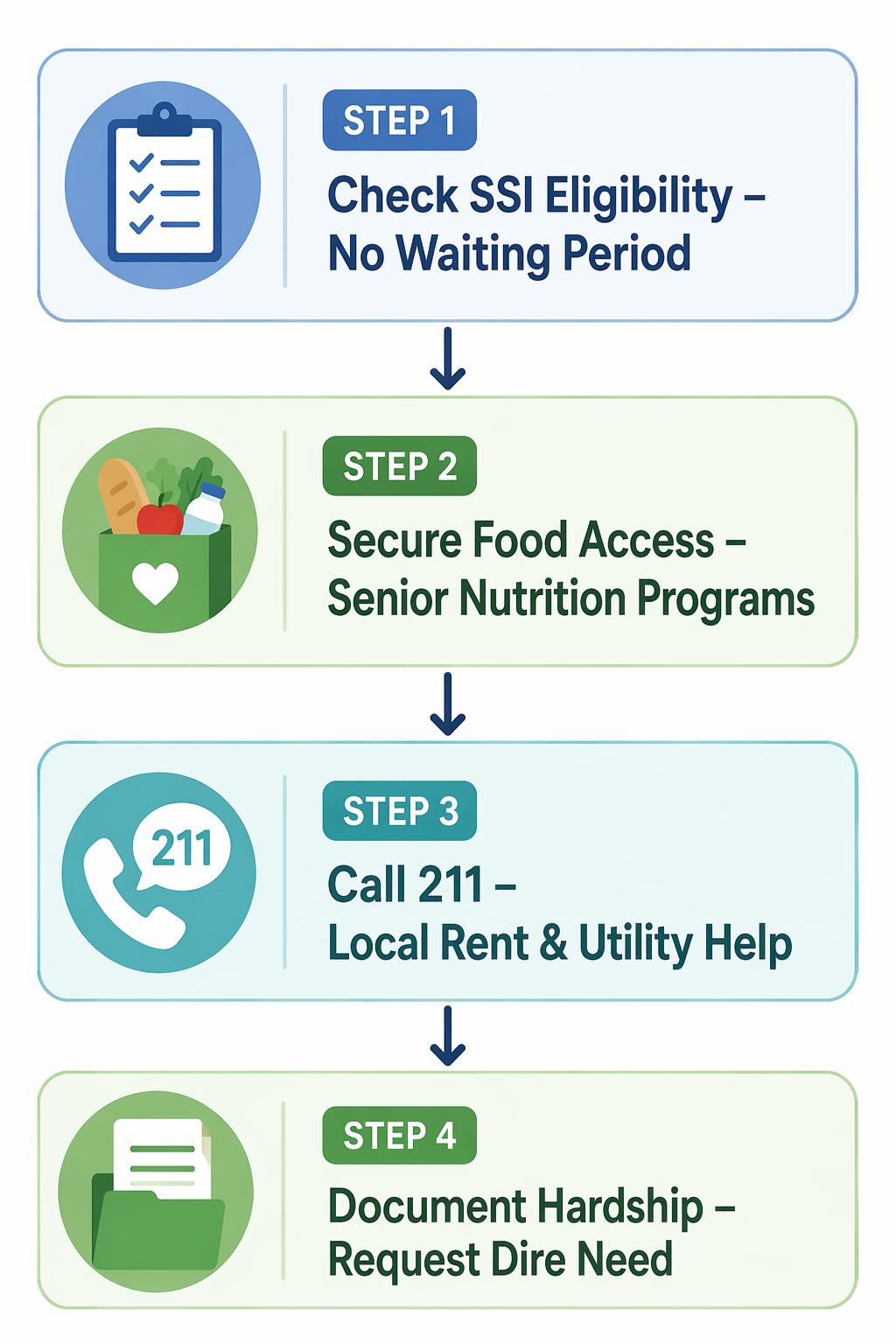
- Ask Social Security or the representative whether concurrent SSI is possible.
- Secure food access through senior nutrition programs and local food help.
- Call 211 for rent, utility, transportation, food, and emergency-assistance referrals.
- Gather proof of hardship if food, shelter, or medical care is at risk.
- Ask SSA, the disability examiner, or the hearing office about dire-need handling when the facts support it.
This order is not about neat paperwork. It is about stopping one problem from multiplying. A missed disability payment is bad enough. A missed disability payment that turns into an eviction notice, a shutoff notice, skipped insulin, or an empty refrigerator is the crisis to prevent.
Check SSI Before Chasing Smaller Programs
If a senior has no income or very low income, SSI is the first eligibility door to check because it is connected to Social Security’s own disability and aged-benefit structure. Some families skip it because they think “we already applied for disability” covers everything. It may not.
On the next SSA call, have the parent’s Social Security number, current address, rent amount, household members, bank balances, income sources, and recent medical-provider list nearby. If the senior recently stopped working, moved in with family, lost a spouse’s income, or started receiving help with bills, say so plainly. SSI is sensitive to current financial facts, and old assumptions can send the conversation in the wrong direction.
If the senior already has an SSDI attorney or representative, ask whether SSI was included when the claim was filed. If it was not, ask whether filing now could help. If the representative says no, ask why in terms of income, resources, or living arrangement. A clear “no” is useful. A vague “probably not” is not enough when rent is due.
Protect Food First
Food help should not wait until the refrigerator is empty. Seniors may have access to programs younger applicants do not, including Meals on Wheels for people age 60 and older and the Senior Farmers Market Nutrition Program.[2] Availability, waitlists, delivery rules, and income guidelines vary by area, so the practical move is to contact the local Area Agency on Aging, senior center, or 211 rather than spending hours guessing from national descriptions.
When calling, describe the situation in concrete terms: “My parent is 67, has a pending SSDI claim, has no current income, and needs meal delivery or senior food assistance.” If the senior cannot shop, cook, drive, stand long enough to prepare meals, or safely carry groceries, say that too. Those details can affect which food program is realistic.
If the parent already receives SNAP or another food benefit, do not assume that closes the door. Ask whether senior meal delivery, congregate meals, food pantry delivery, or produce vouchers are still available locally. A monthly benefit and a hot meal delivered to the door solve different problems.
Call 211 For Rent, Utilities, Transportation, And Local Aid
Many emergency programs are local, temporary, and hard to find through a general web search. Calling 211 is often faster than trying to guess which nonprofit, county office, church fund, utility program, or aging-service agency has money this month. The call should be treated like an intake, not a casual referral.
- Rent: ask about eviction-prevention funds, senior housing stabilization, and one-time emergency assistance.
- Utilities: ask about shutoff prevention, energy assistance, payment plans, and medical-need protections if equipment or temperature control is medically necessary.
- Food: ask for senior meal programs, food pantries, home delivery, and produce programs.
- Transportation: ask about non-emergency medical transportation, paratransit, senior ride programs, and volunteer driver programs.
- Care coordination: ask for the local Area Agency on Aging or aging and disability resource center.
Before calling, put the urgent bills in front of you: lease, rent ledger, utility notice, pharmacy receipts, insurance premium, medical bills, and any shutoff or eviction paperwork. Write down each agency name, phone number, application deadline, document requirement, and the name of the person who answered. A tired caregiver should not have to reconstruct a phone tree from memory at 9 p.m.
Ask For Dire-Need Processing When The Facts Support It
Dire need is not a magic word for impatience. It is a request to flag a disability case because the claimant faces serious hardship, commonly involving lack of food, shelter, or needed medical care.[3] If a senior is at risk of eviction, homelessness, utility shutoff that affects health, inability to afford medication, or lack of food, the hardship should be documented and raised with Social Security or the office handling the case.
The request can be made at different points depending on where the case is: to SSA, to the disability examiner, to the hearing office, or through the appointed representative. If the case has reached appeal, the representative should know whether a dire-need letter or on-the-record request makes sense. If there is no representative, the caregiver can still ask where to send hardship evidence and how to confirm it was added to the file.
What To Put In A Hardship Packet
- A short signed statement explaining the crisis: no income, pending disability claim, and the specific risk to food, housing, utilities, or medical care.
- Eviction notice, late-rent letter, foreclosure notice, shelter letter, or written statement from the person providing temporary housing.
- Utility shutoff notice, past-due bill, or medical-necessity documentation if loss of service would affect health.
- Pharmacy records, medication cost printouts, insurance denial, doctor letter, or proof that treatment is being missed because of cost.
- Bank statements, benefit notices, wage-stop proof, or other documents showing the lack of current income.
- Names, dates, fax numbers, upload confirmations, or mailing receipts showing when the packet was sent.
Keep the statement plain. A useful hardship letter does not need dramatic language. It needs dates, amounts owed, deadlines, medical consequences, and contact information. If the landlord has given a deadline, include it. If a prescription has not been filled, name the medication category in general terms and include the pharmacy cost record. If the parent is staying with a relative temporarily and cannot stay there, say when that arrangement ends.
Dire-need handling can move attention to the file, but it does not guarantee approval and it does not erase the SSDI waiting period.[1][3] That is why it belongs beside the food, rent, utility, and SSI work, not instead of it.
Do Not Spend Too Much Time On Poor-Fit Options
Some programs sound promising until the eligibility rules are read closely. State short-term disability can help in the few places that have it, but current disability-aid guidance identifies only five states with state short-term disability programs: California, Hawaii, New Jersey, New York, and Rhode Island.[2] If the parent never worked in one of those states or is not covered under the state’s rules, this may be a dead end.
TANF is another example. It can be vital for families with children, but it is usually not the main bridge for an older adult without dependent children.[2] If there are dependent grandchildren in the home, it may be worth asking 211 or the county human services office about it. If not, put the time into SSI, food, housing, utilities, and medical-prescription stability first.
Office access can also slow people down. Advocacy reporting has warned that Social Security field office changes can hit seniors and disabled people especially hard, because in-person help is often how complicated benefit problems get untangled.[4] If reaching SSA by phone is not working, document call attempts, use the online account where appropriate, contact the local office, and consider legal aid, an aging-service agency, or a congressional constituent-services office when the situation is urgent.
Keep The Disability Claim From Getting Weaker While You Stabilize The Household
The bridge plan should not accidentally damage the disability case. Keep medical appointments if at all possible. If appointments are missed because there is no transportation, no money, or the parent is too ill to travel, tell the provider and keep a note of the reason. Medical gaps can be misunderstood later if nobody records why they happened.
Open every SSA letter the day it arrives. Put response deadlines on a calendar. Return function reports, work-history forms, and medical-release forms on time. If a deadline cannot be met, call before it passes and ask what to do. A delayed claim is bad; a delayed claim that gets denied because a form sat under a stack of bills is worse.
If the initial decision is a denial, read the appeal deadline before reading the whole packet. Denials are common at the initial level, and appeals have their own deadlines and stages.[2] The family may still need every bridge step in this guide, just for longer than anyone wanted.
A Stabilization Checklist For The Next Week
- Confirm whether the senior has an SSI claim pending along with SSDI, or ask to be screened for SSI.
- Check the current SGA amount on SSA.gov; the 2026 non-blind amount is $1,690 per month, but the figure changes annually.[1]
- Call 211 and ask specifically about senior food, rent, utility, transportation, and emergency assistance.
- Contact the local Area Agency on Aging or senior center about Meals on Wheels, congregate meals, and senior nutrition options.
- Collect hardship documents if food, housing, utilities, or medical care is at risk.
- Ask SSA, the disability examiner, hearing office, or representative how to submit a dire-need request.
- Keep medical appointments, prescription records, SSA letters, and appeal deadlines in one folder.
Families cannot make SSDI fast by pretending the wait is shorter than it is. They can, however, stop the wait from taking everything else down with it. The immediate work is to verify current Social Security rules, check SSI, secure food, find local emergency help, preserve medical and housing stability, and document hardship clearly enough that the case can be considered for dire-need handling.
References
- Disability Benefits | How You Qualify, Social Security Administration.
- What to Do for Income While Waiting for Disability, Atticus, April 2026.
- Financial Assistance While Waiting on Disability, DisabilitySecrets, August 2025.
- SSA Field Office Closures, The Arc, October 2025.
Questions to bring to a clinician or OT
This is not medical, legal, or a family's final decision — only a framework. Bring these questions to a clinician, occupational therapist, or your local Area Agency on Aging.
Find Local HelpRelated reading
Noticed something outdated or inaccurate on this page? Flag a correction. We review every report against CDC, NIA, and AARP HomeFit guidance before updating a page.