
Caregiver decision guide
2027 Social Security COLA Forecast: Why It Won't Cover Senior Care Costs
The projected 2027 Social Security COLA of 3.6%–3.8% adds only about $74–$79 per month, but senior home care costs have surged 39% since 2021 and are rising at more than double the COLA rate. This article cuts through the headline number to show families the real gap between Social Security income and what care actually costs.
For a senior receiving the average retired worker benefit, the current 2027 Social Security COLA forecast translates into something much smaller than the headline percentage suggests: roughly $74 to $79 more per month. A 3.6% increase would move an average monthly benefit of about $2,071 to roughly $2,146; a 3.8% increase would put it near $2,150. The official number is not set yet, but that is the working range families are seeing in mid-2026 forecasts based on CPI-W inflation data through June.[1]
That extra money can matter. It may cover part of a utility increase, a medication copay, groceries, or a tank of gas for appointments. But if the bill on the table is paid care for an older adult, the math changes quickly. Home care costs rose 7.9% from May 2025 to May 2026 and are up 39% since 2021, according to an AARP Public Policy Institute report using BLS-linked cost data.[2]
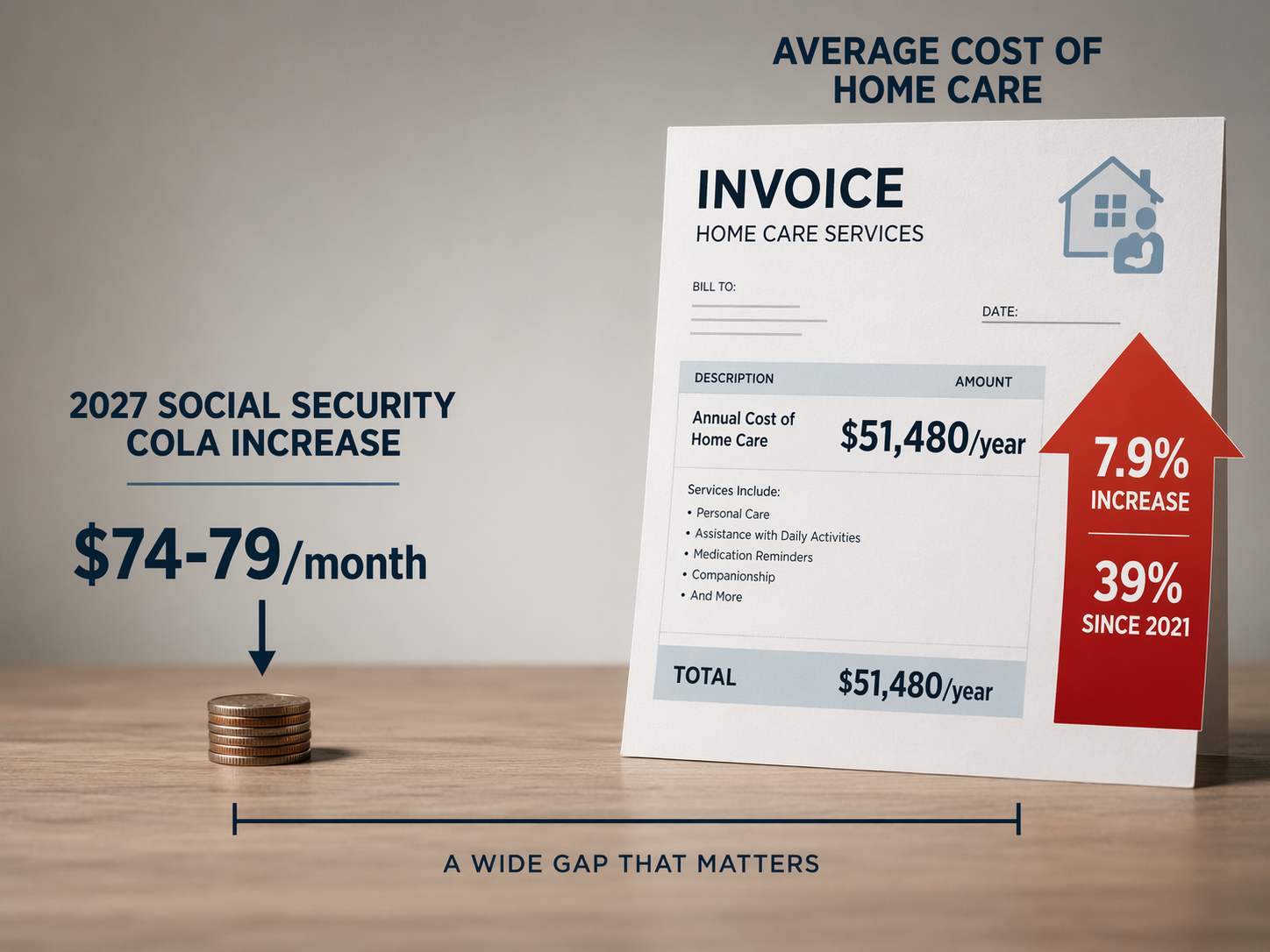
So the practical answer to the main question is no: the projected 2027 COLA will not meaningfully cover the rising cost of home care, assisted living, or nursing home pressure for most families already relying on Social Security as a major income source. It softens one corner of inflation. It does not fund a care plan.
The monthly increase meets an annual care bill
The national median annual cost of home care is $51,480 for 30 hours a week, using Genworth/CareScout Cost of Care Survey figures cited by AARP.[2] That is not round-the-clock care. It is part-time help: several hours a day, enough to assist with bathing, dressing, meals, light supervision, or relief for a spouse who cannot safely do every transfer alone.
Now put the Social Security number beside it. An average monthly benefit near $2,071 equals about $24,852 a year before the 2027 COLA. After a 3.6% to 3.8% increase, the annual benefit would be roughly $25,752 to $25,800. The projected annual increase is about $888 to $948.
| Budget item | Approximate amount | What it means for a care budget |
|---|---|---|
| Average retired worker benefit before 2027 COLA | $2,071 per month | About $24,852 per year before any Medicare premium, tax, housing, food, or care expenses |
| Projected 2027 COLA increase | $74–$79 per month | About $888–$948 more over a year |
| Average benefit after projected COLA | $2,146–$2,150 per month | Still far below the median annual cost of part-time home care |
| Median home care cost for 30 hours per week | $51,480 per year | More than twice the average annual Social Security benefit |
That is the kitchen-table gap. A COLA in this range may add less than $1,000 over the year. The cited median home care bill is more than $51,000 a year. Even if a family uses far fewer than 30 hours a week, the extra Social Security income is quickly absorbed by a small number of aide hours, a respite weekend, a rent increase, or one new recurring medical expense.
The problem is not that the COLA is useless. The problem is that families are often forced to treat it like a solution because every other source of help is complicated, limited, or unavailable. A spouse may delay hiring help because the bank balance still looks manageable. An adult child may cover the grocery order, then the pharmacy card, then a few aide shifts. By the time everyone admits the care plan is underfunded, the family has usually been subsidizing it with unpaid labor for months.
Why the COLA can feel wrong even when the formula is working
Social Security COLAs are tied to the Consumer Price Index for Urban Wage Earners and Clerical Workers, or CPI-W. The Social Security Administration calculates the COLA by comparing average CPI-W data for the third quarter of the current year with the average for the third quarter of the last year in which a COLA was determined.[3]
That formula can be mechanically correct and still feel mismatched for older households. CPI-W reflects a broad worker-oriented market basket. Many seniors, especially those with care needs, spend their fragile dollars in categories that do not behave like a neat national average: healthcare, housing, home maintenance, transportation to medical appointments, paid help, and the supplies that make a home safe enough to stay in.
The Senior Citizens League estimated in a 2026 report that Social Security benefits had lost 13.7% of buying power since 2010, arguing that CPI-W does not match seniors’ real spending patterns closely enough.[4] A separate TSCL analysis cited elsewhere has used a larger buying-power-loss figure for a different endpoint and methodology, so the exact percentage should not be treated as one fixed universal number. The narrower point is enough: many seniors’ essential expenses have outpaced the benefit adjustments meant to keep them stable.
The dissatisfaction data points in the same direction, though it should be read with care. In a self-selected TSCL survey of 904 respondents, 89% said the 2026 COLA of 2.8% was too low, and only 10% said they were satisfied with their monthly benefit.[5] Because the survey likely attracts seniors who are especially engaged or concerned, it should not be stretched into a precise national measurement of all retirees. But it does capture the complaint many caregivers hear at the kitchen table: the benefit went up, and the bills still moved faster.
Recent COLAs did not fix the care-cost problem
The recent COLA history is useful mostly because it shows how little a percentage alone tells a caregiver. Social Security benefits rose 8.7% in 2023, 3.2% in 2024, 2.5% in 2025, and 2.8% in 2026.[6] Those were real increases. They helped people absorb broad inflation. They did not turn Social Security into a long-term care financing system.
Home care is the clearest example because the available data are current and blunt. AARP found home care costs rose 39% since 2021, compared with 27% for general services over the same period.[2] A family that started with a modest weekly aide schedule in 2021 may now be choosing between fewer hours, more unpaid caregiving, or a drawdown of savings that was supposed to last for housing, taxes, and emergencies.
Assisted living and nursing home care belong in the same affordability conversation, but they create different planning problems. Assisted living often bundles rent, meals, supervision, and some support, then adds charges as care needs increase. Nursing home care can move quickly into Medicaid eligibility questions if private funds run down. Home care is the pressure point many families meet first because it sounds smaller: a few mornings a week, help with bathing, someone to sit with Dad while Mom goes to her own appointment. Then the hourly invoice becomes the largest bill in the house.
Families comparing those paths may want a broader cost view before making a move. A side-by-side look at senior care options can help separate the sticker price from the add-ons, deposits, transportation costs, and unpaid family time that rarely appear in one clean number.
For that next layer, see Senior Care Options in 2026: The Real Costs Families Pay.
The forecast can still change, but not enough to close this gap
The official 2027 COLA is scheduled to be announced on October 14, 2026, and it will take effect in January 2027.[1][3] Forecasts available now are still provisional because the July, August, and September CPI-W readings can move the final calculation.
That uncertainty matters for benefit estimates, but it does not change the care conclusion. Whether the final COLA lands closer to 3.6%, 3.8%, or a somewhat higher forecast, the average monthly increase remains small compared with paid care. A few more dollars in the monthly benefit does not erase a part-time home care bill measured in thousands of dollars per month.
The better use of the forecast is not to celebrate or panic. It is to update the care budget before the January benefit change arrives: current Social Security income, expected COLA increase, pension or annuity income, cash savings, home equity options if relevant, family contributions, benefits eligibility, and the actual number of paid care hours needed to keep the older adult safe.
What families should do with the shortfall
Once the COLA is treated as one line item instead of the answer, the next steps become more honest. They are not easy steps, and they do not all apply to every household. But they are better than waiting for a benefit increase to do work it cannot do.
- Price the care plan in hours, not wishes. Write down the current paid hours, the unpaid family hours, and the minimum hours needed for safety. A parent who needs help bathing twice a week has a different budget problem from a spouse who cannot be left alone.
- Screen for benefits before assuming the family must privately cover every gap. Medicaid home- and community-based services waivers, state aging programs, local respite funds, nutrition programs, property tax relief, utility assistance, and veterans benefits may help some households, though eligibility and waitlists vary.
- Check Medicare expectations early. Traditional Medicare generally does not pay for ongoing custodial home care when the main need is help with daily activities rather than skilled medical care.
- Make family contributions explicit. If one adult child is paying the aide, another is handling transportation, and a spouse is giving up work hours, those are all contributions. Leaving them unnamed makes the plan look cheaper than it is.
- Compare care-hour reductions with home safety costs. Sometimes a grab bar, ramp, medication dispenser, shower change, or meal delivery plan can reduce risk or unpaid labor. Sometimes it cannot. The decision should be based on the actual care task, not on a general hope that aging in place is always cheaper.
- Revisit the plan after health changes, not only after financial emergencies. A fall, hospitalization, dementia progression, or caregiver illness can turn a manageable schedule into an unsafe one very quickly.
For families already focused on keeping a parent at home, the most useful next read is Home Care Costs in 2026 and How to Afford It. If the immediate question is how to pay for aides, companions, or household help, start with Paying for Home Help for an Elderly Parent.
Benefits screening deserves its own line in the family notebook. Many households miss programs because they assume Social Security income alone makes a parent ineligible, or because the application process feels too difficult during a care crisis. A guide to unclaimed elder care assistance can help identify which doors are worth checking before private-pay care drains the emergency fund.
The Medicare question also needs to be settled before a discharge planner, agency intake worker, or family argument settles it for you. If the care need is mainly bathing, dressing, toileting, meal preparation, supervision, or companionship, review why Medicare will not pay for custodial home care and what alternatives may exist.
Use the COLA as a small input, not the care plan
The 2027 Social Security COLA forecast for seniors is worth watching because every dollar matters in a tight retirement budget. But a projected $74 to $79 monthly increase should be assigned to real bills with real names. It may help with food, utilities, transportation, or an insurance premium. It should not be used to assume paid senior care has become affordable.
For a family caregiver, the next useful task is not waiting for the October announcement and hoping the percentage sounds better. It is building the care budget with the projected COLA in one modest row, then looking for the remaining funding through benefits, care-hour choices, family support, home-safety tradeoffs, and a clear-eyed comparison of care settings. The headline percentage may change. The gap between Social Security and paid care still needs its own plan.
References
- COLA Watch — The Senior Citizens League
- AARP Report Finds Long-Term Care Costs Outpace Income — AARP — June 2026
- Cost-of-Living Adjustment (COLA) Information — Social Security Administration
- New TSCL Study Estimates 24.6 Million Seniors Get by On Social Security Alone — The Senior Citizens League
- TSCL 2026 Senior Survey — The Senior Citizens League
- History of Social Security COLA Increases by Year — AARP
Questions to bring to a clinician or OT
This is not medical, legal, or a family's final decision — only a framework. Bring these questions to a clinician, occupational therapist, or your local Area Agency on Aging.
Find Local HelpRelated reading
Noticed something outdated or inaccurate on this page? Flag a correction. We review every report against CDC, NIA, and AARP HomeFit guidance before updating a page.