
Caregiver decision guide
Why Sensory-Friendly Clothing Matters for Dementia
When dementia shifts how touch is processed, the same person may rip off a shirt over a seam they never noticed and still not feel that they are cold or sitting in wet clothes. Sensory-friendly clothing for dementia therefore means a paired response: garments that reduce irritation, plus caregiver vigilance for discomfort the wearer may not report.
The same shirt can feel unbearable and still leave other discomfort unnoticed
A caregiver can see both things in the same week: a parent pulling hard at a neckline because the fabric touches the wrong place, then later sitting quietly in clothes that are cold, damp, or soiled. That contradiction is the reason sensory friendly clothing for seniors with dementia cannot be reduced to “buy softer shirts.” The clothing matters, but so does what the person may no longer register or report.
A 2025 comparative study gives this everyday observation some structure. Researchers compared 120 community-dwelling older adults, 60 with dementia and 60 without, with a mean age of about 75, using the Adolescent/Adult Sensory Profile. In the dementia group, 76.7% scored above norm for “low registration,” compared with 30% of the control group. At the same time, 65% of the dementia group scored above norm for “sensory sensitivity,” compared with 33.3% of controls. The dementia group also scored significantly higher on the touch-modulation subscale, which matters because it points toward altered touch processing itself, not only memory or cooperation during dressing. [1]
That study should not be treated as a universal profile for every person with dementia. It is one comparative study, and dementia is not one single sensory experience. But it does support a more careful reading of clothing behavior: the person who rejects a seam may also be the person who does not reliably notice cold hands, a wet waistband, or skin irritation until the problem has become visible to someone else.
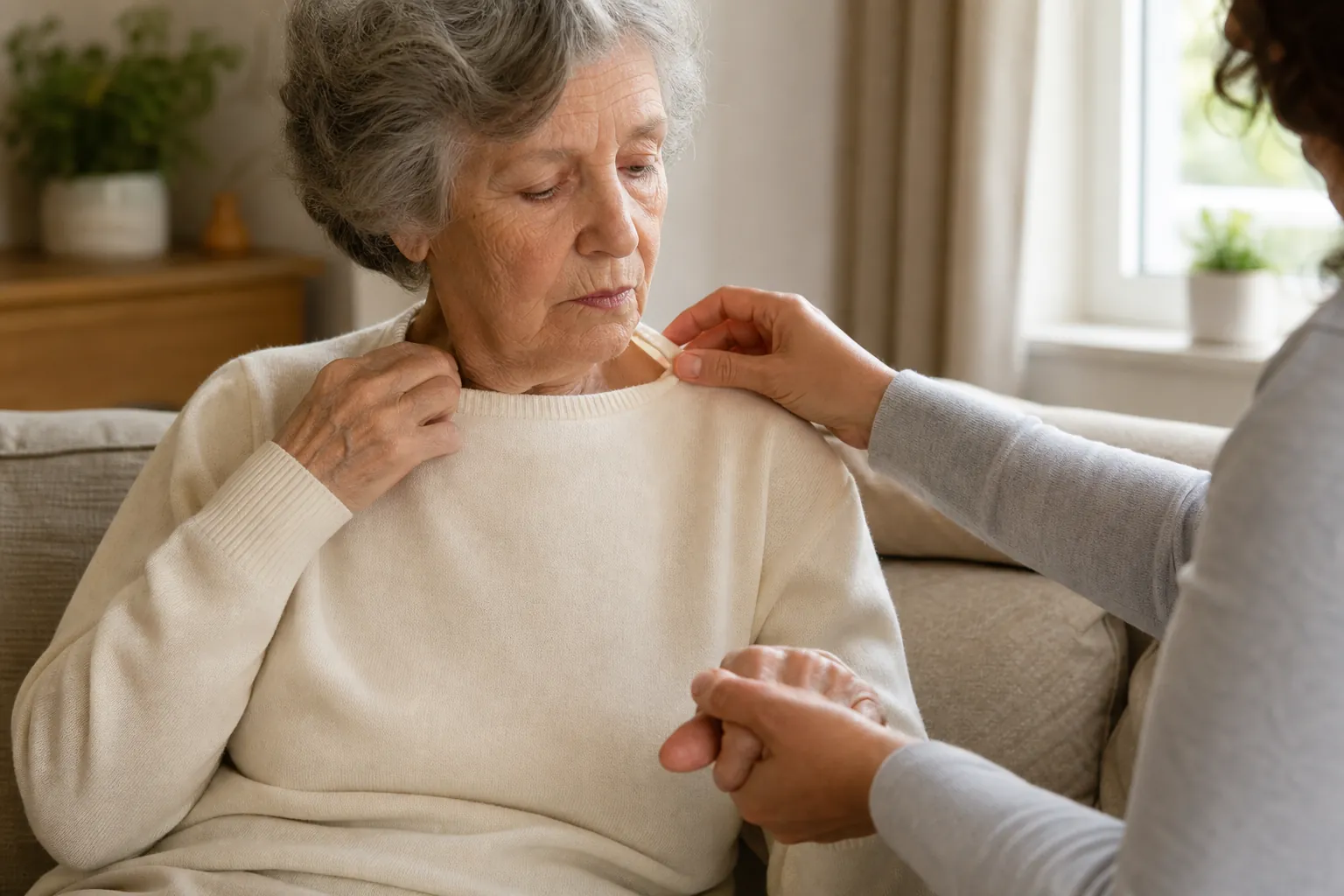
Two sensory directions, one dressing routine
Sensory processing changes in older adults can show up as heightened sensitivity or reduced awareness of input. Heightened touch sensitivity can make ordinary contact feel intrusive enough to trigger agitation or distress. Reduced registration can mean the body is receiving information, but the person is slower to notice, identify, or respond to it. [2]
In dementia care, that second direction is easy to miss because it is quieter. A person may not name the problem even when the problem is physically present. MedBridge describes dementia-associated tactile perception changes as potentially delaying a person’s ability to identify temperature, hunger, thirst, or the location of pain. [3] In dressing, that can mean a parent does not tell you they are too cold, too hot, damp, pinched, or sore.
| What you see during dressing | One possible sensory pattern | Caregiver response |
|---|---|---|
| Tugging at a collar, pushing away sleeves, scratching at a seam, refusing a waistband | Heightened sensitivity to touch or pressure | Reduce avoidable irritation: softer fabric, smoother seams, fewer tags, looser fit, easier closures |
| No complaint despite cold hands, damp clothing, soiling, redness, or pressure marks | Low registration or delayed awareness | Do not wait for a complaint; inspect temperature, dampness, skin, and fit directly |
| Some days the garment is tolerated and other days it is not | The trigger may be context-dependent: fatigue, speed, room temperature, pain, or the sequence of dressing may change tolerance | Track the response without turning one refusal into a permanent rule |
The table is not a diagnostic tool. It is a way to keep two possibilities open long enough to respond humanely: the clothing may be bothering the person, and the person may also be missing other body signals that a caregiver now has to check.
What “sensory-friendly” can mean when dementia is the reason clothing changed
“Sensory-friendly” is a useful phrase only if it stays descriptive. It is not a standardized senior-clothing category with one regulated meaning, and dementia-related sensory changes should not be casually folded into autism-derived language. The question is narrower and more practical: which avoidable sensations can this garment remove from the dressing routine?
The most defensible garment choices are the ones that reduce common sources of touch input without making the caregiver fight the clothing. The Alzheimer’s Association recommends comfortable clothing with soft, stretchable fabrics, loose fit at the waist and hips, front fastenings rather than pullovers when possible, and Velcro as a substitute for buttons when buttons become difficult. [4] AOTA’s adaptive fashion guidance similarly points to wider necklines, softer materials, seamless designs, and closures that can reduce dressing difficulty; it also notes that magnetic closures can be an option but require caution for people with pacemakers. [5]
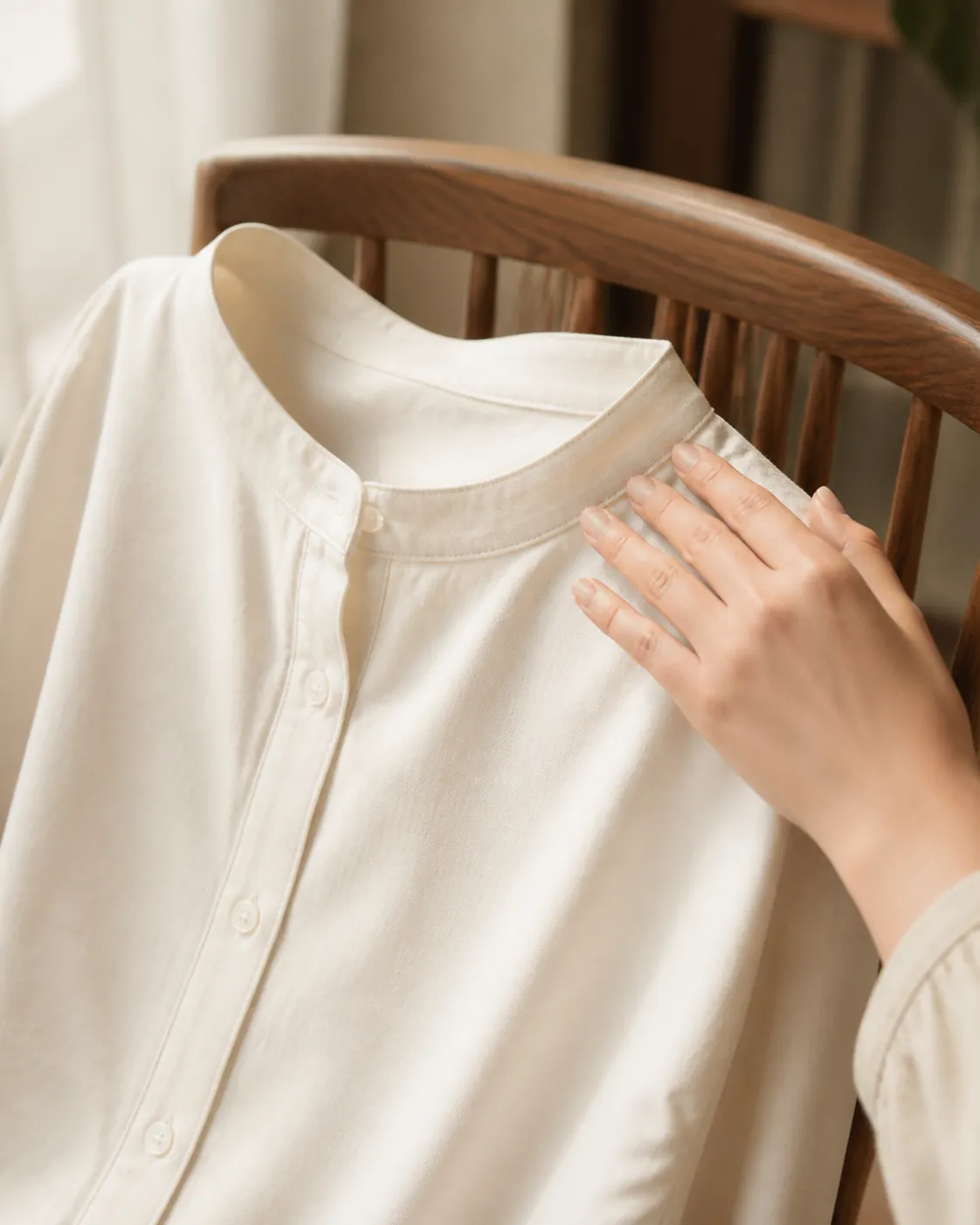
In practice, that means looking at the garment from the inside first. A beautiful sweater is less useful if the inner seam sits exactly where the person keeps rubbing. A shirt that feels soft in your hand may still fail if the neck opening catches on the ears, the cuff grips the wrist, or the waistband presses into skin when the person sits.
- Choose soft, breathable, stretchable materials when possible, especially for base layers that touch skin for hours.
- Prefer flat seams, covered seams, or seamless areas where the person repeatedly rubs or scratches.
- Remove or avoid tags if the person reaches for them, but do not assume a tag-free label solves the whole sensory problem.
- Use looser, non-binding waistbands and cuffs, especially for someone who sits much of the day or cannot clearly describe pressure.
- Favor front openings when pullovers trigger distress or require too much pulling around the head and neck.
- Consider Velcro, larger buttons, or other easier closures when fine-motor steps are making dressing longer and more frustrating.
The goal is not to create a perfect wardrobe. It is to remove the predictable irritants so the remaining behavior tells you more. If a parent still tears at a soft, loose, flat-seamed shirt, the next question may not be “What brand should I buy?” but “What else is touching, hurting, cold, damp, swollen, or frightening right now?”
Comfort reports are no longer enough
The Alzheimer’s Society advises that caregivers may not be able to rely on a person with dementia to say they are too hot, too cold, or uncomfortable in clothing, so signs of discomfort need to be watched for. It also notes that dementia can affect washing and dressing through difficulties with perception and with working through the steps involved. [6]
That changes the dressing routine. Asking “Are you comfortable?” may still be respectful, but the answer cannot be the only safety check. A parent may say yes because they want the dressing to be over, because the question is confusing, or because the sensation has not registered clearly enough to name.
- Before dressing: check room temperature, your own hand temperature, and whether the garment itself is cold, stiff, damp, or scratchy.
- As clothing touches skin: watch for flinching, breath-holding, grabbing, swatting, rubbing, grimacing, freezing, or sudden attempts to remove the garment.
- After dressing: inspect collars, cuffs, waistbands, underarms, socks, and seated pressure areas for redness, bunching, dampness, or skin caught under fabric.
- Before meals, appointments, and bed: recheck temperature, wet or soiled clothing, and whether layers still match the room or weather.
These checks are not about forcing compliance. They protect the person doing the dressing too. A caregiver who notices the collar is the trigger can stop pulling the same shirt over the person’s head every morning. A caregiver who finds damp clothing does not have to interpret silence as consent or comfort.
Let one good garment teach you, then keep observing
A practical way to test clothing is to change only a few high-friction features at once. For example, replace a tight pullover with a soft front-opening shirt, or replace a narrow waistband with a looser one. Then watch the exact moments that used to cause distress: over the head, around the neck, through the sleeves, across the abdomen, at the sock cuff, when seated, and when the person stands again.
If the reaction improves, the garment probably removed a real irritant. If the reaction does not improve, that does not prove the person is “being difficult.” The trigger may be pain, fear, cold, time pressure, fatigue, a toileting need, a skin problem, or the sequence of dressing itself. Dementia can make it harder for the person to connect the feeling with words, and harder for the caregiver to know which part of the routine caused the distress.
This is where an occupational therapist can be useful without turning clothing behavior into a diagnosis. AOTA frames occupational therapy as a way to assess and adapt the dressing routine, clothing features, and the person’s abilities. [5] That assessment can include fit, fasteners, seated positioning, sequencing, caregiver technique, and whether a garment that looks simple is actually creating extra handling or distress.
When to stop treating it as only a clothing issue
Clothing rejection can be a sensory clue, but it should not be used to diagnose the cause at home. Sudden new distress, repeated grabbing at one body area, visible skin breakdown, swelling, signs of infection, unexplained pain behavior, or a major change in dressing tolerance should be brought to the person’s physician. If the problem is mainly fit, fasteners, positioning, or the steps of dressing, an occupational therapist is often the better professional to evaluate the routine.
This guidance is general education, not medical advice. The safest interpretation is paired: reduce irritating touch where you can, and check for discomfort the person may not report.
Related CareWise Guide paths
Dressing rarely sits alone. If clothing distress shows up during transfers, toileting, wheelchair use, or recovery after a fall, the surrounding routine may need attention too.
- For hands-on movement and dementia-related caregiver considerations, see Transfer Aids and Techniques for Senior Caregivers.
- For wheelchair positioning, safety, and when to request an occupational therapist evaluation, use Wheelchair Safety at Home.
- If a fall has changed mobility, confidence, or dressing safety, start with the Aging in Place Checklist After a Parent Falls.
- For the broader caregiver judgment behind mobility and independence decisions, read Help Your Aging Parent Stay Mobile and Independent.
References
- A comparison study of sensory processing in older adults with and without dementia — Turk J Med Sci, 2025.
- Understanding Sensory Processing in Older Adults — National Sensory Network.
- Dementia-Associated Sensory Challenges: Tips for Effective Communication — MedBridge.
- Dressing & Grooming — Alzheimer’s Association.
- Adaptive Fashion — AOTA.
- How does dementia affect washing and dressing? — Alzheimer’s Society UK.
Questions to bring to a clinician or OT
This is not medical, legal, or a family's final decision — only a framework. Bring these questions to a clinician, occupational therapist, or your local Area Agency on Aging.
Find Local HelpRelated reading
Noticed something outdated or inaccurate on this page? Flag a correction. We review every report against CDC, NIA, and AARP HomeFit guidance before updating a page.