
Caregiver decision guide
Shower Chair and Bath Seat Selection Guide for Seniors: Matching Seat Type to Mobility Level
Choosing the wrong shower chair or bath seat creates false security and ongoing fall risk — even when correctly installed. This guide helps family caregivers and older adults identify the right seat type by starting with a mobility-level assessment, then matching that assessment to the correct equipment, bathroom layout, and complementary safety system.
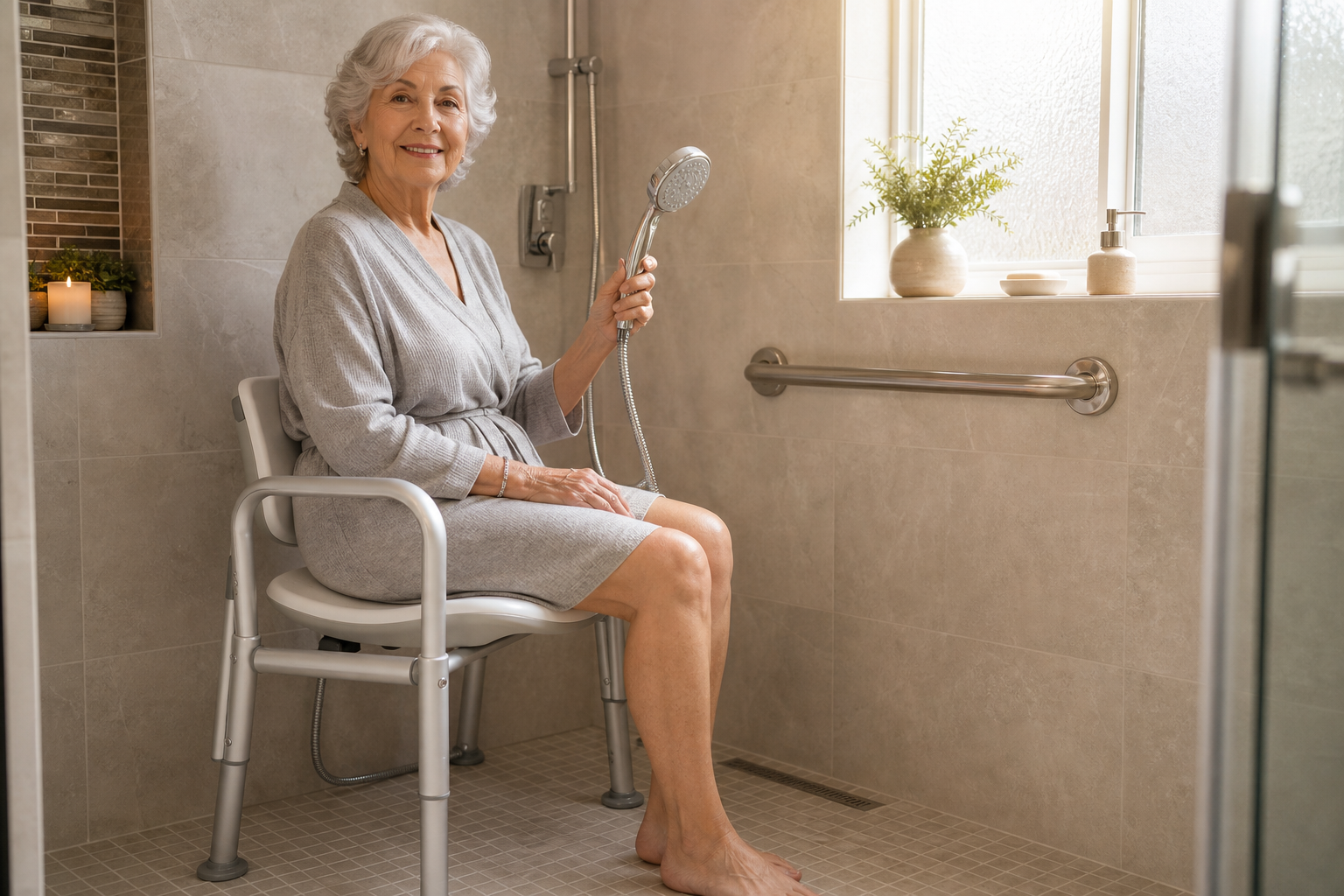
Why Bathing Is the Highest-Risk Daily Activity for Older Adults
Falls are not evenly distributed across the home. The bathroom concentrates more fall risk per square foot than any other room — and the consequences are disproportionately severe. According to the National Safety Council, in 2024, 43,020 older adults died from preventable falls, and in 2023 more than 3.85 million were treated in emergency departments for fall-related injuries — a 38% increase in ED visits over the prior decade.
The CDC reports approximately 3 million emergency department visits annually due to older adult falls, with nearly 319,000 hospitalizations each year for hip fractures alone. Falls are also the most common cause of traumatic brain injuries in this age group.
Within the home, the bathroom is particularly dangerous. Research cited by occupational therapists at FOX Rehab indicates that bathroom falls are twice as likely to result in injury as falls that occur elsewhere in the home. The reason is structural: bathing requires balance, lower-body strength, problem-solving, and adequate vision — all simultaneously, on wet surfaces, inside a confined space with hard edges.
A shower chair or bath seat reduces this risk — but only when the seat type matches the person's actual mobility level. The wrong seat, even when correctly installed, can create a false sense of security that makes the situation more dangerous, not less.
Start Here: A Four-Tier Mobility Assessment Before You Buy Anything
The most common mistake when choosing shower seating is starting with a product search. The correct starting point is a functional assessment of the person who will use the seat. Seat type is not a feature decision — it is a mobility-matching decision.
The following four-tier framework reflects the functional distinctions that occupational therapists use when recommending bathing equipment. Read each tier carefully and identify where your situation fits before moving to the seat-type section.
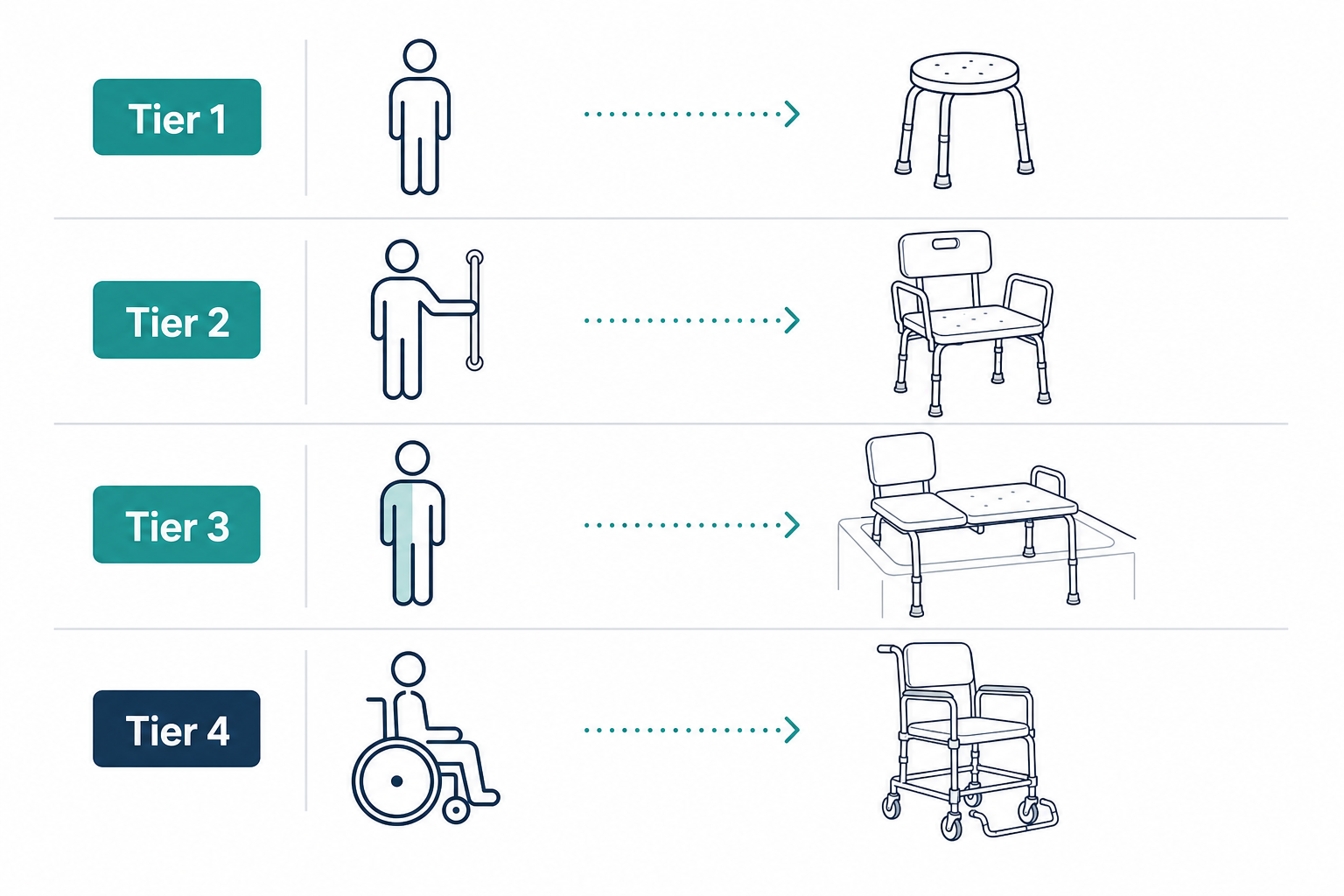
- Tier 1 — Independent with mild endurance deficits: Can step into the shower or over the tub threshold without assistance. Has adequate standing balance. Tires easily during bathing or experiences pain with prolonged standing. Does not need support to lower onto or rise from a seat.
- Tier 2 — Needs upper-body support during transfers: Can step into the shower but uses arms or a grab bar to lower onto and rise from a seat. Balance is adequate for stepping but not for unsupported lowering. Grab bars are available or can be installed.
- Tier 3 — Cannot safely step over a tub threshold: Has a tub-only bathroom. Stepping over the tub edge is no longer safe due to one-sided weakness, a post-surgical restriction, significant balance impairment, or a recent fall during tub entry. Can still sit independently once positioned.
- Tier 4 — Non-ambulatory or requires caregiver assistance: Uses a wheelchair or has poor muscle control that makes safe self-transfer impossible. Requires caregiver assistance for bathing. May not be able to sit upright without support.
The Five Seat Types and Which Mobility Tier Each Serves
There are five distinct shower and bath seat categories. Each serves a specific functional profile. Using a seat from the wrong category — even a well-built one — means the equipment is not doing the job it appears to be doing.
Shower Stool
A shower stool is a backless, armless seat — typically a simple four-legged platform. It is appropriate only for Tier 1 users who have good standing balance and need to sit primarily because of fatigue or discomfort, not because of instability.
It works well in small shower stalls where a larger chair would crowd the space, in multi-generational households where the seat needs to be removed easily when not in use, and in situations where the person's condition varies (a stool can be left in place on difficult days and ignored on good ones).
Standard Shower Chair with Arms and Backrest
A standard shower chair with armrests and a backrest is appropriate for Tier 1 and Tier 2 users. The armrests allow the person to push up to standing and lower down with control. The backrest provides seated stability for those who cannot maintain upright posture without support.
This is the most commonly purchased seat type, and it works well in most shower stalls when grab bars are also available. One important distinction: a shower chair provides seated stability but does not assist with the entry step. The person must still be able to step into the shower independently.
Transfer Bench
A transfer bench is the correct solution for Tier 3 users who have a tub-only bathroom and can no longer safely step over the tub threshold. The bench straddles the tub wall — two legs inside the tub, two outside. The user sits down on the outside portion of the bench and slides laterally into the tub, eliminating the need to step over the edge entirely.
Sliding-seat versions with a rotating disc are available for users who have difficulty with the lateral slide. Transfer benches do not require grab bars to function safely, though grab bars remain a useful complement.
Note that transfer benches require floor space outside the tub for the entry side of the bench — this is a layout consideration addressed in the next section. For a broader discussion of the transfer process itself in other daily-living contexts, see the guide on transfer aids and techniques for senior caregivers.
Wall-Mounted Folding Seat
A wall-mounted folding seat is appropriate for Tier 1 and Tier 2 users in accessible or low-barrier shower designs. It folds flat against the wall when not in use, preserving floor space for other household members who do not need it.
This is a semi-permanent installation requiring proper wall support — it must be anchored to wall studs or blocking, not just drywall. The seat height is set at installation and cannot be adjusted afterward, so correct height selection before installation matters.
Rolling Shower Chair
A rolling shower chair is required for Tier 4 users — those who are non-ambulatory, have poor muscle control, or require caregiver assistance throughout bathing. The person is transferred into the chair outside the bathroom (or from a wheelchair) and wheeled directly into a barrier-free walk-in shower.
Tilt-in-space models are available for users who cannot sit upright without support. Some models function as both a shower chair and a commode chair. Price and complexity vary significantly across this category.
A rolling shower chair requires a zero-barrier walk-in shower — it cannot be used with a standard tub or a shower with a threshold lip. Families whose loved one uses a wheelchair full-time will find additional context in the guide on wheelchair safety at home, which covers broader home safety considerations for wheelchair users.
| Seat Type | Mobility Tier | Key Requirement | Not Appropriate When |
|---|---|---|---|
| Shower stool | Tier 1 only | Good balance; needs to sit for endurance | User needs arm support to sit or stand |
| Standard shower chair with arms | Tier 1–2 | Can step into shower; grab bars available or installable | User cannot safely step over the threshold |
| Transfer bench | Tier 3 | Tub-only bathroom; cannot step over threshold | Walk-in shower only; no tub present |
| Wall-mounted folding seat | Tier 1–2 | Barrier-free or low-barrier shower; proper wall support | User needs help entering the shower |
| Rolling shower chair | Tier 4 | Zero-barrier walk-in shower; caregiver assistance available | Any shower with a threshold or lip |
Bathroom Layout Factors That Determine What Will Actually Fit
Knowing the right seat type is necessary but not sufficient. The bathroom's physical layout determines whether the chosen equipment will actually fit and function safely. Measure before purchasing — not after.
The following assessments reflect the evaluation protocol used by occupational therapists conducting home safety assessments.
- Identify the bathroom type: Is it a tub-only bathroom, a walk-in shower, or a tub-shower combination? This single factor immediately rules out certain seat types. Rolling shower chairs require a zero-barrier walk-in shower. Transfer benches require a tub or tub-shower combination.
- Measure doorway width: Can the equipment enter the bathroom? A rolling shower chair may not fit through a narrow doorway. Measure the door opening (not the door itself) and compare it to the equipment's listed width before purchasing.
- Measure the shower or tub interior: A standard shower chair needs enough room for the user to sit with legs extended comfortably. Small shower stalls (32 × 32 inches) may only accommodate a stool. Measure width and depth.
- Measure the threshold lip height: Even a low threshold (2–3 inches) can be an insurmountable barrier for someone with one-sided weakness or a post-surgical hip restriction. This measurement directly informs whether a transfer bench is needed.
- Assess floor space outside the tub: Transfer benches require space on the floor beside the tub for the user to sit down before sliding in. If the toilet or vanity is immediately adjacent to the tub with no clearance, a transfer bench may not be workable.
- Check the showerhead type: A fixed overhead showerhead is not compatible with seated bathing — the user cannot direct water flow without excessive reaching and movement. A handheld showerhead on a slide bar is required for any seated bathing setup. Assess whether one is present or can be installed.
- Note any built-in seating: Built-in tile or granite shower seats cannot be adjusted for height after installation. If the existing built-in seat is the wrong height for the user, a freestanding or wall-mounted adjustable option may be preferable.
Feature Evaluation Criteria: What to Look for Once You Know the Seat Type
Once the seat type is confirmed and the layout is assessed, feature comparison within that category becomes relevant. The following criteria apply across most seat types, with noted exceptions.
| Feature | What to Look For | Notes |
|---|---|---|
| Seat height | 17–19 inches above the floor | This range reflects the ADA standard for accessible seating. In residential settings it is a clinical recommendation, not a legal requirement. Adjustable-leg models allow customization to the individual's height. |
| Weight capacity | Standard: 250 lbs minimum. Bariatric: 400–500 lbs | Most consumer-grade chairs meet the 250 lb ADA minimum. Bariatric models exist for users who exceed this limit. Verify the listed capacity before purchase. |
| Adjustable legs | Preferred for most users | Fixed-height models may not accommodate shorter or taller users. Wall-mounted seats are fixed at installation height — confirm correct height before mounting. |
| Armrests | Required for Tier 2 users; optional for Tier 1 | Armrests allow the user to push to standing and lower with control. A seat without armrests is appropriate only when the user does not need upper-body support for transfers. |
| Backrest | Required for users who cannot maintain upright posture independently | A backrest adds seated stability. Stools have no backrest and are appropriate only for the most capable Tier 1 users. |
| Materials | Aluminum frame; moisture-resistant seat | Aluminum resists corrosion and is durable for long-term use. Seat materials include plastic, resin, bamboo, teak, and phenolic — all moisture-resistant. Treated wood options exist but require more maintenance. |
| Drainage holes | Preferred on seat surface | Drainage holes prevent water pooling on the seat surface, which reduces slip risk and bacterial accumulation. |
| Non-slip rubber feet | Required on all freestanding models | Rubber feet prevent the chair from sliding on wet tile. Check that all four feet are present and intact before each use. |
On seat height: the 17–19 inch range is derived from ADA accessibility standards, which apply as a legal requirement in public spaces. For residential use, this range is the clinically validated baseline — not a regulatory requirement. An adjustable-leg model that can be set to this range, or customized above or below it for an unusually tall or short user, is preferable to a fixed-height model.
On aesthetics: some older adults resist shower chairs because they look institutional. Contemporary designs in aluminum with contoured seats, or in teak and bamboo with warmer finishes, are widely available and function identically to standard plastic models. The appearance of the equipment does not change its safety value — but if the chair sits unused because the person refuses to use it, it provides no safety value at all.
Completing the Safety System: Handheld Showerhead, Grab Bars, and Non-Slip Mat
A shower chair is one component of a bathing safety system, not a complete solution on its own. Three complementary items consistently appear in occupational therapist recommendations alongside shower seating.
- Handheld showerhead: A handheld showerhead on an adjustable slide bar is required for seated bathing. A fixed overhead showerhead forces the seated user to reach, lean, and shift weight to direct water — exactly the movements that create fall risk. A handheld unit allows full water control from a stable seated position. This is not optional for any seated bathing setup.
- Grab bars: Grab bars anchored to wall studs provide a stable handhold for lowering onto and rising from the seat, and for balance during washing. They are the appropriate wall-mounted complement for standard shower chairs and transfer benches. Suction-cup grab bars are not a safe substitute — they can release without warning on wet tile.
- Non-slip mat or textured flooring: A non-slip mat inside the tub or shower stall reduces the risk of the chair's rubber feet sliding on a wet surface, and provides traction for any weight-bearing steps during entry or exit. Place the mat so it does not obstruct the transfer bench entry path.
Cost Ranges and How to Pay for Shower Seating Equipment
Shower seating spans a wide price range depending on seat type, materials, and features. Understanding the realistic cost range before shopping prevents both underspending (choosing a seat that won't hold up) and overspending on features that don't match the functional need.
- $25–$50: Basic shower chairs, stools, and tub transfer benches in standard plastic or lightweight aluminum. Appropriate for short-term recovery or Tier 1 users with straightforward needs.
- $50–$200: Mid-range chairs with improved materials, bariatric weight ratings, or specialized features (sliding transfer bench seats, teak or bamboo finishes, wall-mount hardware).
- $200–$1,000: Heavy-duty rolling shower chairs, institutional-grade transfer benches, and higher-end wall-mounted systems.
- $1,000–$5,000: Tilt-in-space rolling shower chairs and specialized systems for Tier 4 users with complex positioning needs. An OT evaluation is essential before purchasing in this range.
Medicare and Insurance Coverage
Standard shower chairs and bath seats are generally not covered by Original Medicare (Part A or Part B). Medicare Part B covers durable medical equipment that is medically necessary — defined as equipment used for a medical reason that would not be useful to someone who is not sick or injured. Shower chairs do not meet this definition under standard Medicare guidelines because their primary use is not classified as medical.
A commode chair is a partial exception. If a commode chair that is also waterproof and designed for shower use is prescribed by a healthcare provider and obtained through an approved DME supplier, it may qualify for Medicare Part B coverage. This requires a prescription and documentation of medical necessity.
- Medicare Advantage (Part C): Some Medicare Advantage plans include coverage for bathroom safety devices or provide an over-the-counter spending allowance that can be applied to shower chairs. Coverage varies significantly by plan and changes annually. Contact the plan provider directly or visit Medicare.gov to verify current coverage.
- FSA and HSA accounts: Shower chairs and bath seats are generally eligible for purchase using Flexible Spending Account (FSA) or Health Savings Account (HSA) funds. Confirm eligibility with the account administrator before purchasing.
- Loan closets: Area Agencies on Aging, religious organizations, and Veterans Affairs programs often maintain equipment loan closets where shower chairs and other assistive devices can be borrowed at no cost or low cost. Contact your local Area Agency on Aging to ask about availability in your area.
When to Request an Occupational Therapy Evaluation Before Buying
This guide provides a framework for understanding seat types and matching them to mobility levels — but it is not a substitute for an individual assessment. There are specific situations where purchasing independently, without professional guidance, carries meaningful risk.
Request an occupational therapy home evaluation before purchasing when any of the following apply:
- The person has had multiple falls, including one or more in the bathroom.
- The mobility picture is complex — for example, one-sided weakness from a stroke, Parkinson's disease affecting balance and coordination, or post-surgical movement restrictions.
- The bathroom layout is constrained and it is not clear whether the right seat type will fit.
- The person is Tier 4 (non-ambulatory or requiring caregiver assistance) and equipment in the $1,000+ range is being considered.
- Previous equipment has been purchased and is not being used, or has been used in a way that seems unsafe.
An occupational therapist can assess the full physical environment, observe the person's actual transfer mechanics, recommend the correct equipment for the specific situation, and in some cases provide documentation that opens insurance coverage pathways — including the commode chair prescription pathway described above.
To find an occupational therapist who conducts home safety evaluations, ask the person's primary care physician for a referral, contact a local home health agency, or search the American Occupational Therapy Association's (AOTA) therapist locator. Some OT services are covered by Medicare Part B when ordered by a physician as part of a medically necessary plan of care.
Questions to bring to a clinician or OT
This is not medical, legal, or a family's final decision — only a framework. Bring these questions to a clinician, occupational therapist, or your local Area Agency on Aging.
Find Local HelpRelated reading
Noticed something outdated or inaccurate on this page? Flag a correction. We review every report against CDC, NIA, and AARP HomeFit guidance before updating a page.