
Caregiver decision guide
Walker vs. Rollator: A Caregiver's Guide to Choosing the Right Mobility Aid for Your Parent
Choosing between a standard walker and a rollator is a clinical decision — not a lifestyle preference — and picking the wrong device can increase your parent's fall risk rather than reduce it. This guide gives adult-child caregivers a structured, five-variable framework to evaluate which mobility aid fits their parent's specific needs, along with practical strategies for managing resistance and understanding Medicare coverage.

Why the Wrong Mobility Aid Can Make Falls More Likely
When a parent starts struggling with balance or mobility, most families assume that getting them a mobility aid — any mobility aid — is a step in the right direction. The instinct is understandable. But the device you choose matters enormously, and choosing the wrong one can actively increase your parent's fall risk rather than reduce it.
The most common mistake is treating a rollator as the obvious upgrade over a standard walker — newer, more capable, easier to move. For the right person, a rollator is an excellent tool. For the wrong person, it is a hazard. Rollators are not designed to bear significant upper-body weight. If your parent leans heavily on their mobility device for support, a rollator can roll out from underneath them mid-stride.
This guide gives you a structured framework for understanding which device fits your parent's specific clinical profile. It is designed to help you support a professional's recommendation — not to replace one. An occupational therapist (OT) or physical therapist (PT) remains the most important resource in this decision.
What Each Device Actually Does: Standard Walker, Two-Wheel Walker, and Rollator
Before applying any decision framework, it helps to understand what each device is actually designed to do. These are not interchangeable options at different price points — they have fundamentally different stability profiles and intended use cases.
A standard walker has four rubber-tipped legs and no wheels. It must be lifted and placed with each step. This design makes it the most stable option of the three — it does not move unless the user moves it, and it can support a significant portion of the user's body weight. According to ThedaCare At Home, some walkers can support up to approximately 50% of the user's body weight — making them the appropriate tool when a person genuinely needs to offload weight through their arms and upper body.
A two-wheel walker has wheels on the two front legs and rubber tips on the two back legs. The user glides it forward rather than lifting it, which reduces fatigue. The back tips drag slightly to prevent runaway movement. The Mayo Clinic notes that a two-wheel walker can make it easier for users to stand fully upright, which may help improve posture and lower fall risk compared to a standard walker. It offers meaningful stability while being easier to propel — a combination that makes it an underappreciated middle option.
A rollator has four wheels, hand brakes, and typically a padded seat. It rolls continuously, which makes it easier to move at a normal walking pace and allows for rest breaks on longer distances. The trade-off is stability: because the wheels roll freely, the rollator can slide away if the user leans heavily on it. It is the least stable of the three devices, and it requires the user to actively engage the hand brakes before sitting down on the seat.
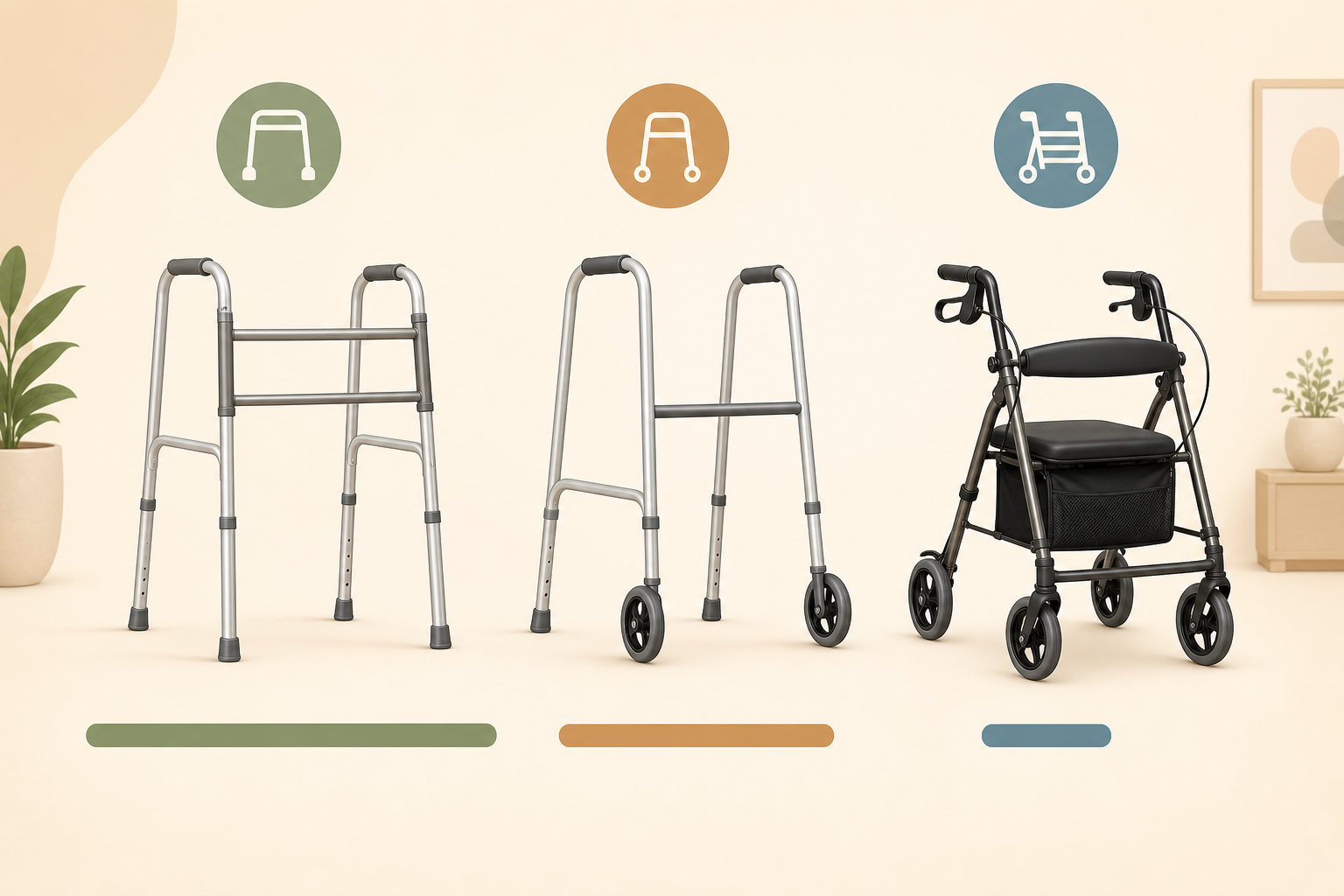
| Device | Wheels | Weight-Bearing | Stability Level | Best Use Context |
|---|---|---|---|---|
| Standard walker | None | Up to ~50% body weight | Highest | Post-surgery recovery, significant balance deficits, tight indoor spaces |
| Two-wheel walker | Front two only | Moderate support | Intermediate | Users who tire from lifting a standard walker but need more stability than a rollator |
| Rollator | All four | Minimal — not designed for weight-bearing | Lowest of the three | Mild balance issues, endurance/fatigue challenges, community outings, need for rest breaks |
The Five-Variable Decision Framework
Matching a mobility aid to a person is not about which device has the best reviews or the most features. It turns on five specific clinical variables. Each one connects directly to fall risk — get any one of them wrong, and the device becomes a liability.
- Weight-bearing capacity. How much upper-body weight does your parent place on the device while walking? If the answer is "a lot" — if they are leaning rather than just steadying themselves — a rollator is contraindicated. It will roll away from them under that load. A standard walker is the appropriate tool.
- Balance severity. Mild-to-moderate balance issues are compatible with rollator use. Significant bilateral balance deficits — difficulty staying upright without substantial support — call for a standard walker. The stability hierarchy matters here: standard walker is most stable, two-wheel walker is intermediate, rollator is least stable.
- Cognitive status. This is the most underrepresented variable in most walker comparisons, and it is a critical safety factor. Rollator use requires the person to reliably engage the hand brakes before sitting on the seat. Someone with moderate-to-severe dementia or significantly impaired judgment may not remember to do this every time — and a single failure to brake before sitting can cause a serious fall. Cognitive impairment is a near-absolute contraindication for rollator use.
- Home environment. Rollators are harder to maneuver in tight indoor spaces — narrow hallways, small bathrooms, crowded kitchens. A standard or two-wheel walker is typically more practical for home use. Rollators tend to perform better in open indoor areas and community settings.
- Endurance and fatigue profile. Does your parent tire quickly, become short of breath on longer walks, or need to stop and rest? The rollator's seat is a genuine functional benefit for users with this profile. If fatigue is not a factor and the primary need is stability, a rollator's seat adds weight and complexity without adding safety.
When a Standard Walker Is the Clinically Appropriate Choice
A standard walker is not the fallback for people who "aren't ready" for a rollator. It is the correct tool for a specific set of clinical profiles — and choosing it over a rollator in these situations is the safer, more appropriate decision.
According to occupational therapist guidance from Beyond Accessible, a standard walker is recommended when safety is the top concern — particularly for people with severe balance issues, leg or trunk weakness, or those recovering from surgery.
A standard walker is typically the clinically indicated choice when your parent:
- Is recovering from surgery with weight-bearing restrictions on one or both legs
- Has significant balance deficits on both sides and needs maximum stability
- Has cognitive impairment that makes reliable brake engagement unsafe or unreliable
- Leans heavily on the device rather than using it primarily for steadying
- Moves slowly and carefully, taking deliberate steps — a gait pattern that pairs well with a lifted, placed device
- Primarily uses the device indoors in tight spaces where a rollator would be difficult to maneuver
When a Rollator Is the Right Fit
A rollator is genuinely the right device for a specific clinical profile — but that profile is narrower than most families assume. The rollator's benefits (continuous movement, built-in seat, easier pace) are real, but they only outweigh its stability limitations for users who meet certain conditions.
As Trualta's caregiver guidance explains, a rollator is best suited for someone who can walk household and community distances but gets fatigued or short of breath and needs a place to sit — not for someone who needs to put significant upper-body weight through the handles.
A rollator is likely appropriate when your parent:
- Has mild-to-moderate balance issues — not severe bilateral deficits
- Experiences significant fatigue, shortness of breath, or the need to rest on longer distances
- Has the hand strength and coordination to reliably engage and hold the brakes
- Has sufficient cognitive ability to remember to brake before sitting on the seat — every time
- Uses the device for community outings, errands, or environments where a continuous rolling gait is practical
- Does not lean heavily on the device — uses it primarily for steadying and pacing rather than weight support
The Two-Wheel Walker: An Overlooked Middle Option
Many families move directly from "standard walker" to "rollator" without considering the two-wheel front-wheel walker as a distinct option. That is a gap worth closing, because for a specific group of users, the two-wheel walker is the best fit of the three.
The two-wheel walker is more stable than a rollator — the back rubber tips drag slightly, preventing it from rolling away under load. It is easier to propel than a standard walker — the user glides it forward rather than lifting it with each step, which reduces arm and shoulder fatigue. And as the Mayo Clinic notes, it can help the user stand more fully upright, which may improve posture and reduce fall risk compared to a standard walker that encourages a hunched-forward stance.
The two-wheel walker does not have a seat, and it is not designed for community outings the way a rollator is. But for indoor daily use where lifting fatigue is a barrier and stability is still a priority, it fills a real gap between the other two options.
Getting the Fit Right: The Basics Every Caregiver Should Know
Even the right device becomes a fall risk if it is improperly fitted or poorly maintained. The fit principles below apply across all three walker types.
- Handle height. The top of the walker grip should align with the crease on the inside of the wrist when the user stands upright with arms relaxed at their sides. The elbow should bend at approximately 15 degrees when the hands are on the grips.
- Rubber tips. The rubber tips on the back legs of two-wheel walkers — and all four legs of standard walkers — must be checked regularly. Worn or cracked tips reduce traction and increase slip risk.
- Rollator brakes. Brakes that are too loose will not stop the rollator reliably. Brakes that are too tight require excessive hand strength to engage. Either condition raises fall risk. An OT can adjust brake tension to the individual's grip strength.
- Device weight. A device that is too heavy for the user to lift or maneuver is a barrier to consistent use — which is its own risk. If your parent avoids using the device because it is cumbersome, the device is not serving its purpose.
Medicare Coverage for Walkers and Rollators
Both standard walkers and rollators are covered under Medicare Part B as durable medical equipment (DME) — but coverage is not automatic. Several conditions must be met.
- Physician prescription required. A Medicare-enrolled provider must prescribe the device as medically necessary for use in the home.
- Medicare-enrolled supplier required. The device must be purchased or rented from a supplier that is enrolled in Medicare. If the supplier does not accept assignment, out-of-pocket costs may be significantly higher.
- Cost-sharing structure. After meeting the Part B deductible — which was $257 in 2025 and adjusts annually — Medicare covers 80% of the approved amount. The patient pays the remaining 20%. Verify the current-year deductible at CMS.gov before planning costs.
- Rollator-specific eligibility condition. For rollator coverage, the patient's mobility difficulties must be significant enough to interfere with daily tasks, but not so severe that they cannot operate an assistive device. This is a documented medical necessity determination, not a self-reported condition.
When Your Parent Refuses: Evidence-Based Strategies for Managing Resistance
You have done the research, spoken with the doctor, and identified the right device. Your parent wants nothing to do with it. This is not unusual — and it is not stubbornness in the simple sense of the word.
Resistance to using a walker is most often rooted in identity. A mobility aid is a visible signal of decline, and many older adults experience accepting one as a form of surrender. As geriatric psychiatrist Dr. George Grossberg has noted, parents resist because of vanity, denial, or because they feel the device makes them look weak or vulnerable. These are real psychological barriers, and they respond poorly to pressure.
"Giving ultimatums or trying to browbeat someone into using a walker doesn't work."
That is the direct guidance from clinical psychologist Barry J. Jacobs, cited in a January 2026 AARP resource on encouraging walker use. Pressure from family members — even well-intentioned pressure — tends to make resistance worse, not better. Here is what the evidence supports instead.
- Let the clinician deliver the recommendation. A physician or OT saying "you need to use this device" carries significantly more weight than a family member saying the same thing. If your parent's doctor has not explicitly recommended the device in their presence, ask for that conversation to happen at the next appointment.
- Reframe the device as an independence tool. Instead of framing the walker as a response to decline, frame it as something that allows your parent to do more — walk farther, stay on their feet longer, keep going to the places they care about. The device enables independence; it does not signal the end of it.
- Use habit stacking. Scott Trudeau of the American Occupational Therapy Association recommends creating a specific "parking spot" for the walker next to wherever your parent usually sits — their favorite chair, the kitchen table. Bringing the device into the spaces where they already are, rather than expecting them to seek it out, builds consistent use over time.
- Frame it as an energy-saver. For parents who resist because they feel the device is for "sick people," reframing it as a tool that conserves energy for the things they enjoy — cooking, gardening, visiting family — can shift the emotional calculus.
- Normalize through observation. If your parent can observe peers using walkers in everyday settings — at a senior center, in their community — the device becomes less of a marker of individual decline and more of an ordinary tool.
When to Request a Formal OT or PT Mobility Assessment
This guide provides a framework for understanding the decision — it does not replace a clinical evaluation. If any of the following apply to your situation, a formal mobility assessment from an occupational therapist or physical therapist is the right next step.
- You are uncertain which device type is appropriate given your parent's specific balance, strength, or cognitive profile
- Your parent has multiple complicating factors — for example, post-surgical recovery combined with cognitive impairment
- Your parent has been using a device for some time but continues to fall or near-fall
- You are concerned about fit and cannot determine whether the current device is adjusted correctly
- Your parent's condition has changed recently and you are not sure the existing device still matches their needs
A mobility assessment conducted by an OT or PT includes evaluation of gait, balance, strength, cognitive ability, and home environment — the same five variables this guide covers, but assessed with clinical tools and direct observation. This assessment is often covered by Medicare when ordered by a physician.
Quick-Reference Decision Summary
Use this table as a rapid orientation tool. Each cell indicates which device type is appropriate (✓), may be appropriate depending on degree (◐), or is generally contraindicated (✗) for that variable.
| Decision Variable | Standard Walker | Two-Wheel Walker | Rollator |
|---|---|---|---|
| Significant weight-bearing need (leans heavily on device) | ✓ Appropriate | ◐ Moderate support only | ✗ Contraindicated — may roll away |
| Significant bilateral balance deficits | ✓ Appropriate | ◐ Depends on severity | ✗ Contraindicated |
| Mild-to-moderate balance issues | ✓ Appropriate | ✓ Appropriate | ✓ Appropriate if other criteria met |
| Cognitive impairment (cannot reliably use brakes) | ✓ Appropriate | ✓ Appropriate | ✗ Contraindicated — brake failure risk |
| Tight indoor home environment | ✓ Appropriate | ✓ Appropriate | ◐ Difficult to maneuver |
| Fatigue, shortness of breath, need for rest breaks | ◐ Does not address fatigue | ◐ Reduces lifting fatigue only | ✓ Appropriate — seat available |
| Lifting a standard walker is too fatiguing | ✗ May not be sustainable | ✓ Appropriate — glides forward | ✓ Appropriate if balance criteria met |
| Community outings, longer distances | ◐ Functional but tiring | ◐ Better than standard walker | ✓ Appropriate if balance criteria met |
Questions to bring to a clinician or OT
This is not medical, legal, or a family's final decision — only a framework. Bring these questions to a clinician, occupational therapist, or your local Area Agency on Aging.
Find Local HelpRelated reading
Noticed something outdated or inaccurate on this page? Flag a correction. We review every report against CDC, NIA, and AARP HomeFit guidance before updating a page.