
Caregiver decision guide
How to get tornado damage assistance for an older adult
This guide helps caregivers of older adults navigate tornado recovery step by step — from verifying safety and applying for FEMA assistance to connecting with local Area Agencies on Aging and avoiding post-disaster scams.
Right after a tornado, do not start by hunting for a “program.” Start with the person, the roof, and the phone.
- First: make sure the older adult is safe for tonight, even if that means leaving the house.
- Second: check FEMA eligibility by address and begin the application as soon as the disaster is federally declared.
- Third: call the local aging network and get a real person involved before the small problems turn into outages, missed medicines, and paperwork you cannot unwind later.
Older adults need this sequence because tornado recovery hits harder when the person is on a fixed income, moves slowly, or cannot easily jump between websites, offices, and repair crews. CDC's review of the 2011 outbreak found that about one third of the fatalities were older adults, and AARP has also pointed to how disasters land harder on older adults when mobility, chronic conditions, and daily logistics are already tight. [1][4]
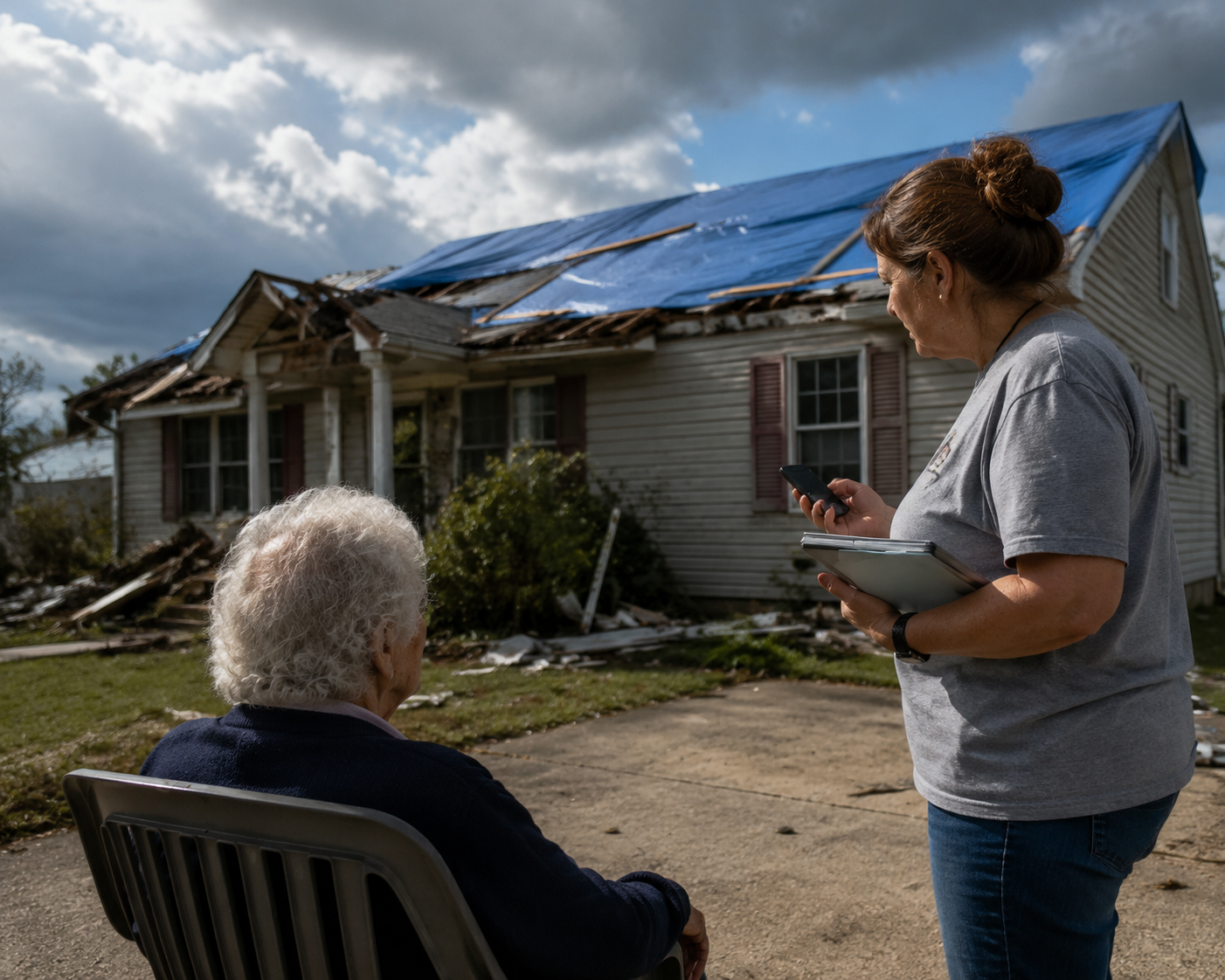
Get FEMA Moving First
Do not waste time assuming FEMA is open just because the neighborhood got hit. FEMA Individual Assistance depends on a presidential disaster declaration, so the first check is whether the specific disaster is eligible, and the easiest way to confirm that is by address on DisasterAssistance.gov. [2]
- If the older adult can use a phone, call FEMA at 1-800-621-3362. TTY users can call 800-462-7585. Phone lines are open 7 a.m. to 10 p.m. local time, 7 days a week. [3]
- If the older adult cannot manage the process, use FEMA Form FF-104, Authorization for Release of Information, so FEMA can speak with you on their behalf. That form matters when the person is tired, frightened, or simply done with talking to another automated menu. [3]
- Keep the call moving with the basics nearby: current address, damaged address if it is different, contact number, insurance details, and a simple list of what is damaged.
If the internet is not an option, treat the phone route as the main route, not a backup. The person in front of you does not need to be “computer ready” to get help.
Bring In The Aging Network
This is the part most caregivers do not hear about soon enough: call the Eldercare Locator at 1-800-677-1116 and ask for the local Area Agency on Aging. NCOA says AAAs can help with disaster case management, home repair coordination, temporary housing, replacement medical devices, and essential supplies. [5][6]
- Use them when the older adult needs help sorting what comes next, not just when a form needs another signature.
- Ask whether they can connect you with temporary housing, a repair contact, or replacement items the older adult cannot go without.
- If your state has D-SNAP or LIHEAP disaster help, verify the rules through the state Department of Human Services or the local AAA before you spend hours chasing a dead end.
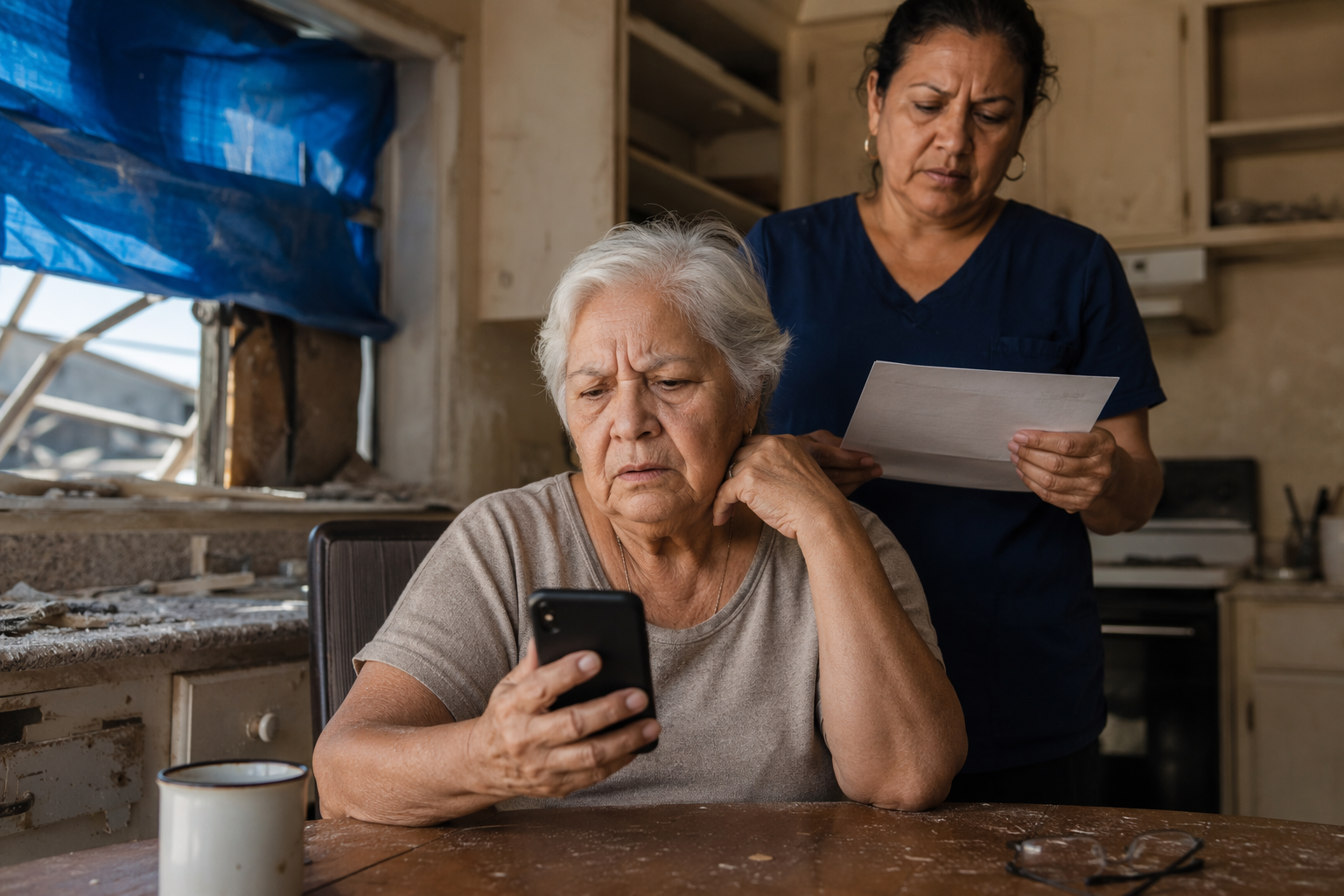
Use SBA For What FEMA Does Not Cover
A lot of people hear “SBA” and stop listening because they think it is only for business owners. That is the wrong read. SBA disaster loans are also for homeowners and renters: up to $500,000 for home repair, up to $100,000 for personal property, with repayment terms up to 30 years. [9]
That does not mean a loan is always the right answer, but it does mean you should not throw away the option before you know what FEMA will and will not cover.
Keep Scam Rules Tight
After a disaster, the wrong person will call before the right one does. The FTC says FEMA does not charge application fees, so anyone asking for money to help someone “qualify” for aid is not helping. [7]
The scale of the problem is ugly. GAO said 77% of disaster survivors experienced a possible scam within one month in a 2024 Census Bureau survey. [8] That is why bank details, Social Security numbers, and Medicare information should only go to offices you called first, not to somebody who found you by text, social media, or a door knock.
- Trust the published FEMA number, the Eldercare Locator, the state human services office, and the insurer you already know.
- Do not pay a stranger to “speed up” disaster aid.
- If someone says they can get benefits only if you pay now, close the conversation.
Do Not Treat State Help As Automatic
D-SNAP and LIHEAP disaster help can matter, but they are not universal and they do not run the same way everywhere. Check with the state Department of Human Services or the local AAA before you count on them. The point is not to chase every acronym; it is to move in the order that actually gets food, housing, medicine, and repairs back under control.
References
- CDC MMWR: Tornado-Related Fatalities — Five States, Southeastern United States, April 25–28, 2011 — CDC
- FEMA.gov: Individual Assistance — FEMA
- FEMA.gov: I Applied for Assistance. What's Next? — FEMA
- AARP: The Impact of Disasters on Older Adults — AARP
- Eldercare Locator: 1-800-677-1116 / eldercare.acl.gov
- NCOA: Disaster Assistance — 6 Helpful Programs for Older Adults — NCOA
- FTC: Dealing with Tornado Damage? Avoid Post-Disaster Scams — FTC
- GAO: After A Disaster, Survivors May Get Hit Again By Scammers — GAO, May 19, 2026
- SBA: Disaster Assistance — SBA
Questions to bring to a clinician or OT
This is not medical, legal, or a family's final decision — only a framework. Bring these questions to a clinician, occupational therapist, or your local Area Agency on Aging.
Find Local HelpRelated reading
Noticed something outdated or inaccurate on this page? Flag a correction. We review every report against CDC, NIA, and AARP HomeFit guidance before updating a page.