
Caregiver decision guide
How to Keep Older Adults Safe During a Power Outage
This guide helps family caregivers protect older adults from the disproportionate risks of power outages — including medication loss, medical device failure, temperature extremes, and darkness-related falls — with evidence-backed steps for each season.
A blackout is not just an inconvenience when the person on the other end is older, on medication, or moving with a walker. In one study of Florida nursing home residents after Hurricane Irma, power loss was associated with a 25% increase in mortality within 7 days [1]. Weather-related outages are also getting harder to dismiss as rare flukes; Climate Central reported that they doubled between 2000-2009 and 2014-2023, and that 80% of major outages from 2000-2023 were weather-related [8]. That does not mean every outage turns dangerous, but it does mean the margin is thinner than a generic checklist suggests.
What Actually Fails First
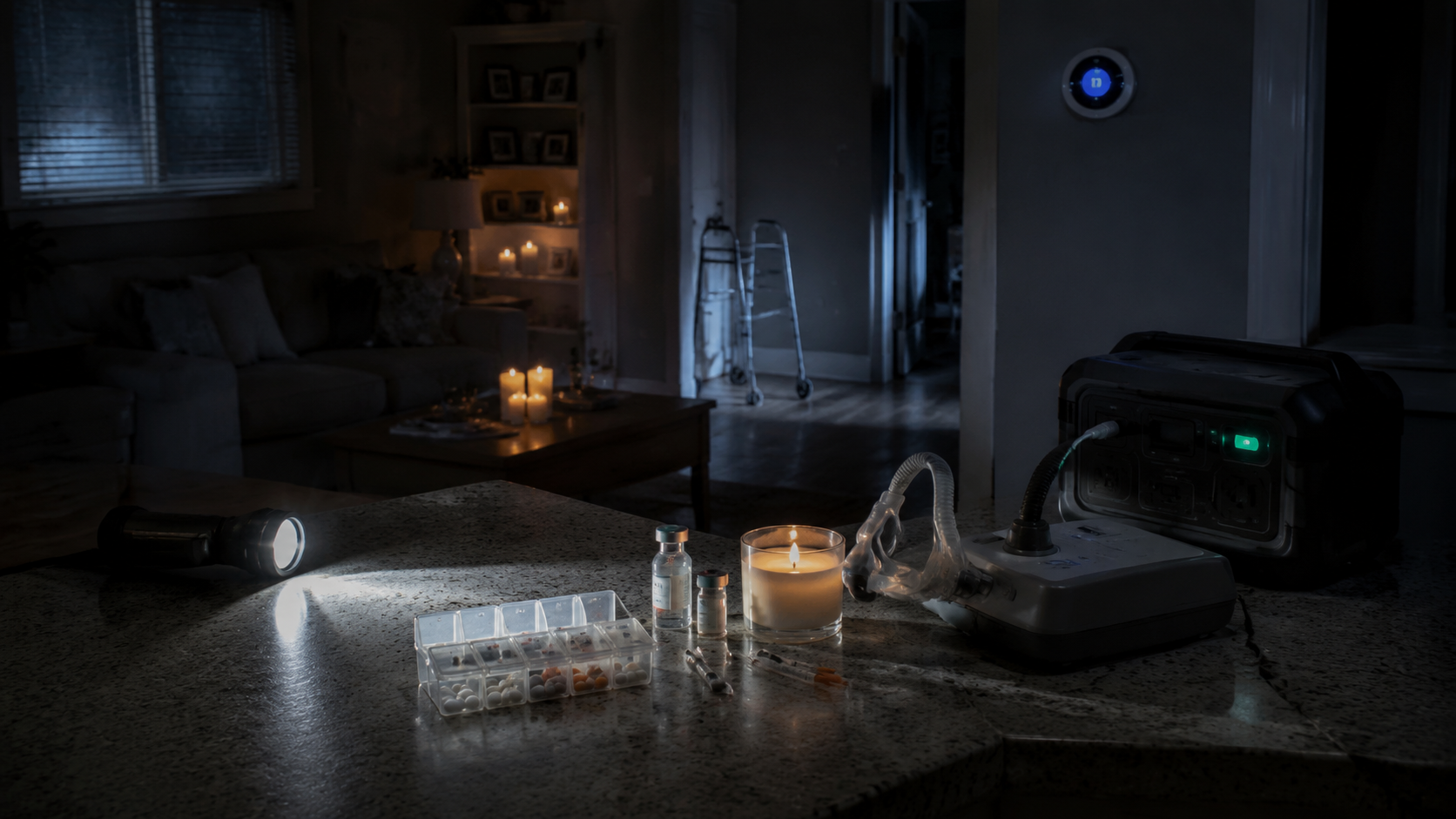
Start with the failures that actually cascade: temperature, meds, devices, and movement in the dark. If you want a fuller planning flow, How to Prepare an Aging Parent for a Power Outage covers the sequence; this section stays with the parts that actually break.
| Vulnerability | Check now | Why it matters |
|---|---|---|
| Temperature control | Can the main room stay warm or cool for several hours if HVAC fails? | Older adults regulate temperature less efficiently, and some medications weaken that response [5] |
| Medication | Which prescriptions need refrigeration or special timing? | Storage rules are not one-size-fits-all; check the label before the outage |
| Medical devices | How long does each battery or backup pack actually run? | Many home device batteries last only 3 to 8 hours [6] |
| Mobility and lighting | Can your parent reach the bathroom, charger, and water in the dark? | Dark hallways raise fall risk fast |
If this sounds more detailed than the usual advice, that is the point. Older adults who live alone reported lower perceived disaster preparedness than those who did not live alone, 42% versus 57% in a 2016 NYC survey [7]. The geography is limited, but the failure mode is the same: nobody notices the fridge warming, the oxygen battery dropping, or the hallway getting dark until the problem is already theirs.
Medication And Devices Need Their Own Plan
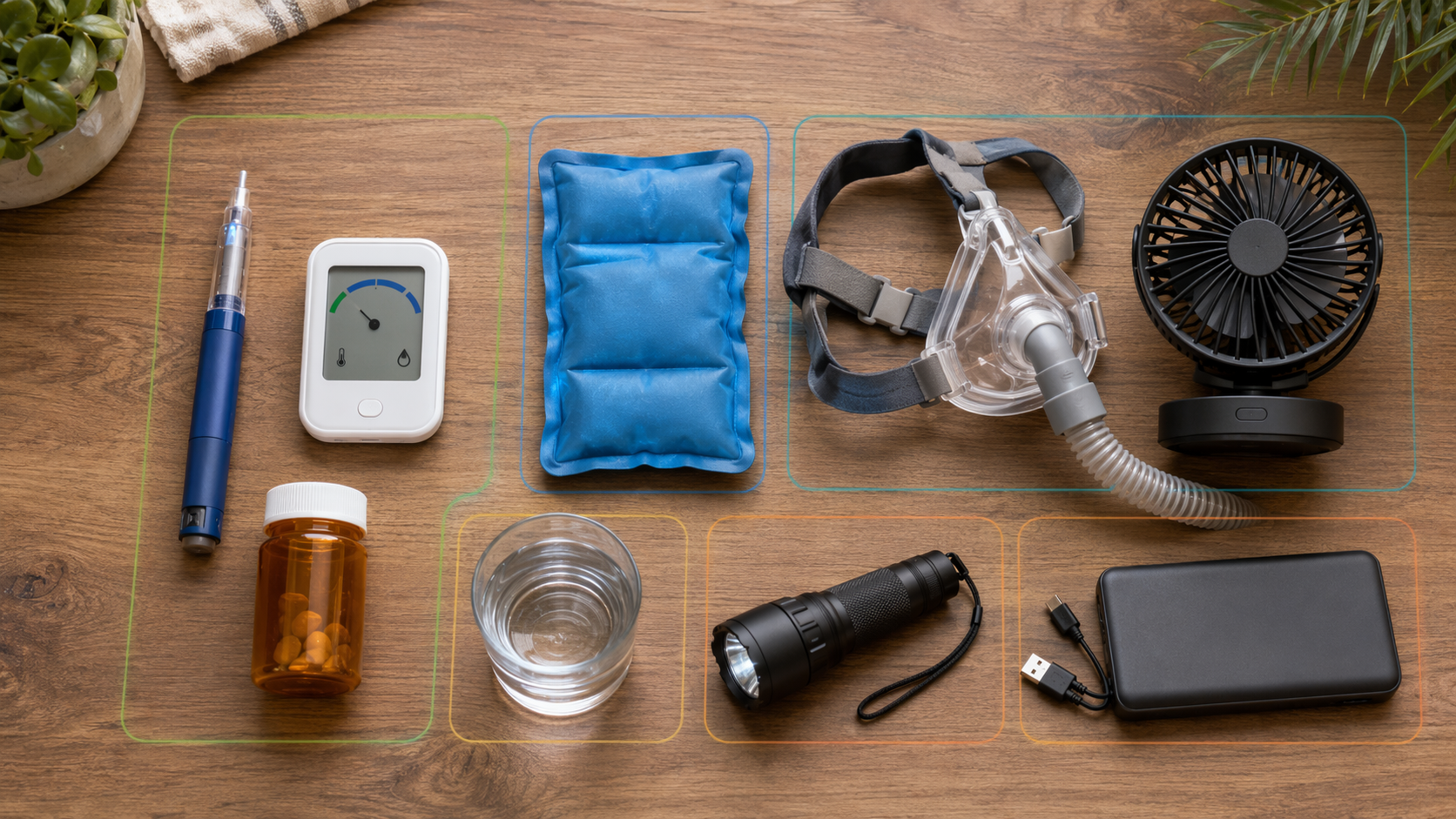
This is where generic kits go wrong. Food in an unopened refrigerator is generally safe for about 4 hours, and a full freezer for about 48 hours [3]. That helps with the kitchen, not the pill organizer. For insulin and other temperature-sensitive medicines, check the specific product label and ask the pharmacist what to do before an outage, because stability depends on the formulation. For battery-dependent medical equipment, write down the exact model and the real backup time. The ADA notes that many home medical device batteries last only 3 to 8 hours, and the number changes with settings and battery age [6].
- Make a one-page medication sheet with drug name, dose, schedule, storage needs, prescriber, and pharmacist phone number.
- Put device manuals, chargers, spare batteries, and any extra tubing or masks in one bin.
- Label the outlet or power bank that keeps the most important device running.
- If the parent uses oxygen, CPAP, a lift chair, or a scooter charger, confirm with the supplier what still works on battery and for how long.
- Keep prescription refills current so the outage does not expose a supply problem.
Temperature Is The Other Failure Point
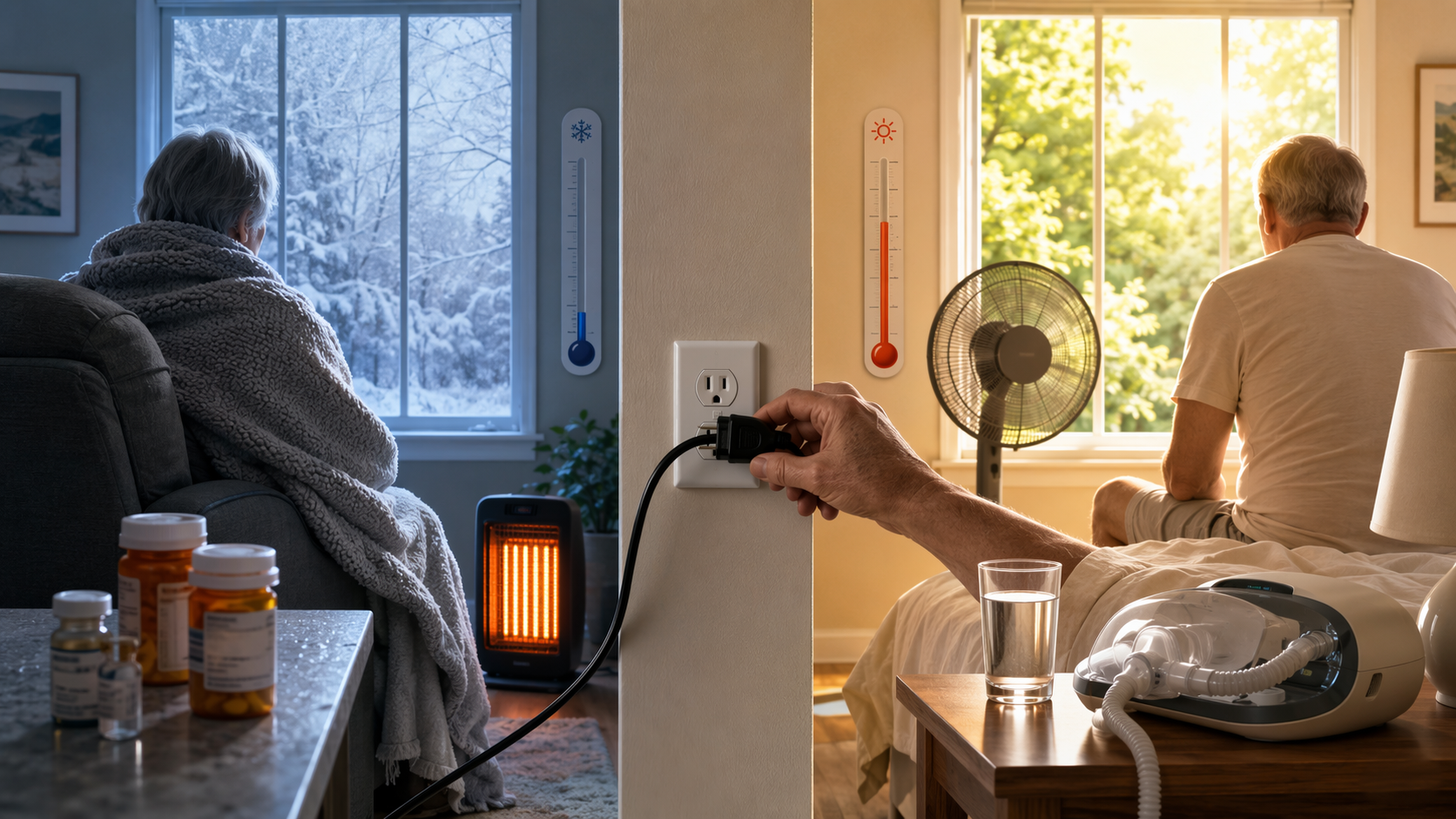
Older adults are more vulnerable to both hypothermia and heat stress because thermoregulation changes with age, and common medications such as beta-blockers, anticholinergics, and diuretics can make it harder to adapt [5]. If your parent already runs cold in winter or gets wiped out fast in summer, do not wait for them to complain. A person who says they are fine may still be drifting into trouble. If medication is part of the issue, the companion piece 8 Medication Classes That Raise Heat Risk in Older Adults is the right next read.
Winter
In winter, move the parent into the warmest safe room before the house cools down. Close doors, block drafts, keep socks, blankets, medication, water, and a charged phone within reach, and do not make them walk a dark hallway to hunt for any of it. If the outage is long enough that food storage becomes part of the decision, follow the CDC's time window: about 4 hours for an unopened refrigerator and about 48 hours for a full freezer [3].
Summer
In summer, pick the coolest room, reduce exertion, and keep water where they can see it. Heat rises faster than people expect, especially if the parent takes drugs that blunt temperature response [5]. If medication is part of the concern, the guide on 8 Medication Classes That Raise Heat Risk in Older Adults is the better place to start than a generic stay-hydrated reminder.
During The Outage
- Check the person first, not the house. Are they awake, oriented, warm or cool enough, and able to move safely?
- Move to the planned room with the flashlight, water, meds, and the device battery that matters most.
- Put phones and power banks on a hierarchy. Charge the medical device or the communication tool first, not whatever is easiest.
- If you have a generator, run it at least 20 feet from windows and doors and never indoors [3].
- Escalate early if the backup plan stops covering oxygen, temperature, medication timing, breathing, confusion, or mobility.
If the parent uses a walker, a cane, or anything that makes a dark hallway a hazard, keep that path clear before the storm season starts. For more on the fall piece of the problem, see Why Storms Create a Dangerous Fall Risk for Seniors or Severe Storm Fall Prevention Tips for Older Adults.
After Power Returns
When the power comes back, do not turn the whole house back into normal before checking what actually survived. Reset the thermostat, check whether the refrigerator and freezer stayed in safe range, and inspect anything temperature-sensitive before using it. The CDC food timeline is still the one that matters: about 4 hours for an unopened refrigerator and about 48 hours for a full freezer [3]. For food-specific discard decisions, the guide on Food Safety Tips for Seniors is the safer reference than guessing. For medications that warmed or froze, follow the label or pharmacist instructions before using them again.
References
- Association of Power Outage With Mortality and Hospitalizations Among Florida Nursing Home Residents After Hurricane Irma — PubMed Central, 2021
- Weather-related Power Outages Rising — Climate Central, 2024
- Power Outage Preparedness and Concern among Vulnerable New York City Residents — PubMed Central, 2018
- What to Do to Protect Yourself During a Power Outage — CDC
- Emergency Power Planning for People Who Use Electricity and Battery-Dependent Assistive Technology — ADA National Network
- Heat and Older Adults — CDC, 2024
Questions to bring to a clinician or OT
This is not medical, legal, or a family's final decision — only a framework. Bring these questions to a clinician, occupational therapist, or your local Area Agency on Aging.
Find Local HelpRelated reading
Noticed something outdated or inaccurate on this page? Flag a correction. We review every report against CDC, NIA, and AARP HomeFit guidance before updating a page.