
Caregiver decision guide
How to Build a Wildfire Evacuation Plan for Elderly Parents
A wildfire evacuation plan for an older parent only works when it is built around their specific mobility, medication, sensory, and cognitive needs — not a generic checklist. Build the support network, pack a senior-specific go bag, plan transport and lifting, and rehearse twice a year so the plan holds up when there is little time to leave.
A workable wildfire evacuation plan for elderly parents starts with one uncomfortable fact: the person who needs the most time is often the person the ordinary checklist assumes can move quickly. Fire risk is not evenly distributed. The U.S. Fire Administration reports that adults 65 and older had a 2.5 times greater risk of dying in a fire than the total population in 2020.[1] When smoke, darkness, traffic, power shutoffs, missed calls, and fear compress decisions into minutes, age-related limits stop being “health issues” and become evacuation problems.
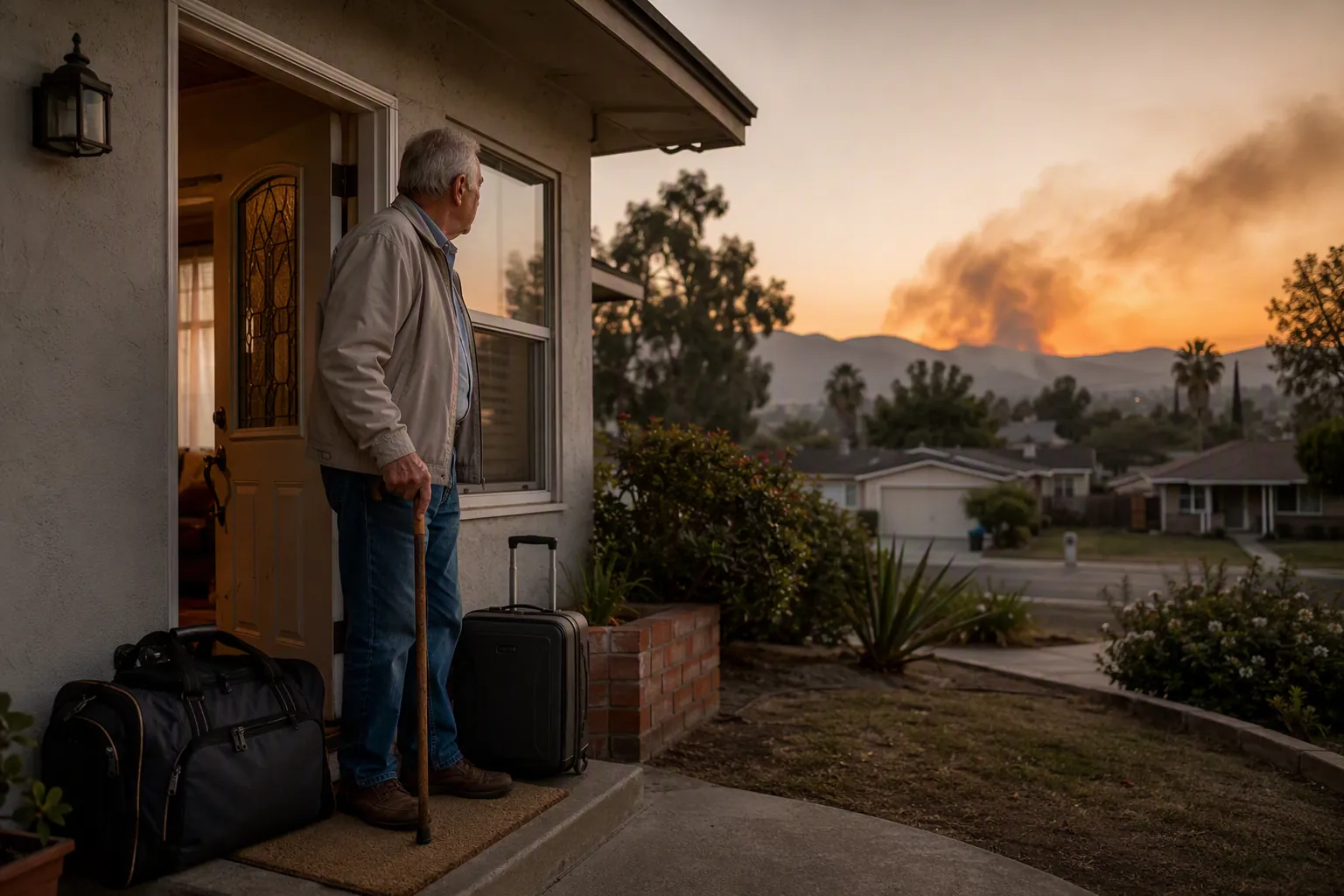
The worst fires make that plain without needing much embellishment. In the 2018 Camp Fire, 85 people died; CalMatters reported the average victim age as 72, Places Journal described 80% of those killed as over 65, and AARP reported that 72 of 84 identified fatalities were 60 or older.[2][3][4] Those are not identical age measures, so they should not be flattened into one neat statistic. They do point in the same direction: older residents carried a heavy share of the loss.
Lahaina showed a related failure point: warning systems that do not reach people in time. AARP reported about 115 confirmed deaths after the August 2023 fire, with nearly three-quarters of publicly identified victims over 60; the same account notes that the fire moved toward town at about a mile per minute and that Maui’s 80 sirens never sounded.[5] A family plan that depends on one siren, one phone alert, one neighbor, or one adult child answering immediately is not a plan yet.
The Camp Fire also shows how quickly public systems can become overwhelmed. NIST’s case study describes approximately 40,000 evacuees, 85 fatalities, 31 temporary refuge areas serving more than 1,200 civilians, and 198 evacuation-assistance or rescue events.[6] That is the scale adults should picture when they are deciding whether Mom can “probably wait and see.” For an older parent, the safer rule is to leave early when conditions point that way — before a mandatory order if possible — because the last ten minutes are the worst time to discover that the walker will not fit, the garage door will not open, or the medication list is locked in a desk.
This article is general safety-planning information, not medical, legal, transportation, or emergency-management advice. If your parent has complex medical equipment, dementia, oxygen, dialysis, severe mobility limits, or no safe way to transfer into a vehicle, build this plan with their clinician, home-health team, local fire agency, or emergency-management office before fire season.
Build the plan around the parent you actually have
Start with a written profile of your parent’s real limitations, not with a downloaded checklist. The point is not to catalog everything that could go wrong. The point is to remove guesswork from the first ten rushed minutes.
| Planning question | What to write down |
|---|---|
| Mobility | Can they stand from bed or a recliner without help? Do they use a cane, walker, wheelchair, scooter, stair lift, transfer pole, or grab bars? How far can they walk when tired or frightened? |
| Transfers | Who can safely help them move from bed to chair, chair to walker, walker to car seat, or wheelchair to vehicle? Is a gait belt, ramp, portable step, or different vehicle needed? |
| Medications | Which medications must travel, where are they stored, who knows the refill routine, and what happens if the parent is away from home longer than a weekend? |
| Vision and hearing | Can they hear phone alerts, smoke alarms, sirens, doorbells, and knocking? Can they read texts without glasses? Do they need hearing-aid batteries, amplified alerts, or a flashing alarm? |
| Cognition | Will they understand an evacuation message, unlock the right door, find shoes, avoid going back inside, and follow a caller’s instructions under stress? |
| Equipment | What must leave with them: walker, cane, wheelchair cushion, CPAP, oxygen supplies, hearing aids, dentures, eyeglasses, chargers, incontinence supplies, or wound-care supplies? |
| Pets and service animals | Who can crate, leash, lift, or transport the animal if the parent cannot do it alone? |
| Transportation | Which vehicle works, who drives it, where is it parked, how much fuel is in it, and does the parent’s mobility device fit without unloading the entire trunk? |
Be blunt about the difference between a good day and an evacuation day. A parent who can walk slowly to the mailbox at noon may not be able to step over a hose in smoke at 2 a.m. A parent who remembers pills perfectly at home may not know which bottle matters after sleeping in a relative’s guest room for a week. A parent who says “I’ll just drive myself” may not be able to back out if the power is off, the garage door is heavy, and traffic is already blocking the street.
If the parent lives with a spouse, do not assume the spouse is the plan. Two older adults may both be scared, slow, medicated, hard of hearing, or physically unable to lift equipment. Put the spouse in the plan as a person with a job only if that job is realistic.
Assign people, keys, vehicles, and backups
Ready.gov’s older-adult guidance is useful because it names the support network instead of pretending independence solves everything. It recommends having at least one person who keeps an extra key, knows where emergency supplies are stored, and knows how to use lifesaving equipment or administer medicine; it also tells older adults to plan how assistive devices will come with them during evacuation.[7]
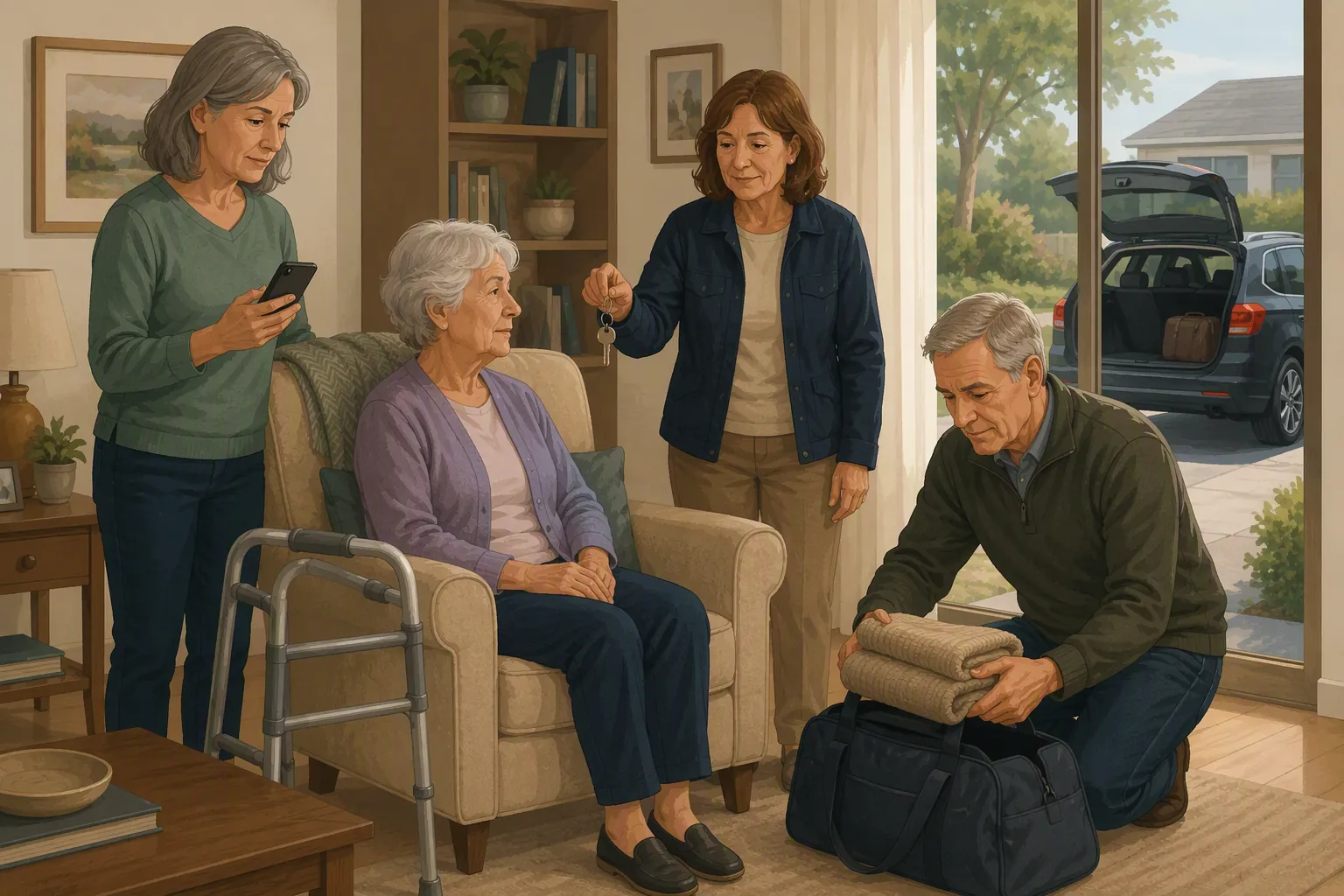
For an adult child, that means writing names beside tasks. “Neighbors will help” is too soft. “Ellen next door has the side-door key, can help Dad stand, and will call me after she reaches him” is usable. “My brother will come if needed” is not enough if he lives 90 minutes away and works nights.
| Job | Primary person | Backup | Details that prevent failure |
|---|---|---|---|
| Alert watcher | Named adult child, neighbor, or spouse | Second person in a different household | Monitors county alerts, fire agency updates, weather warnings, and power-shutoff notices; calls parent before an order becomes urgent. |
| First person to the house | Nearest capable person | Second nearby person | Has a key or lockbox code; knows which entrance is safest; can reach the parent without waiting for permission. |
| Transfer helper | Person physically able to assist | Home-health aide, trained family member, or neighbor if appropriate | Knows whether the parent needs a walker, gait belt, wheelchair, ramp, or two-person assist. Does not improvise unsafe lifting. |
| Medication and equipment lead | Person who knows the routine | Pharmacy contact or second family member | Knows where medications, CPAP parts, eyeglasses, hearing aids, chargers, oxygen-related supplies, and documents are kept. |
| Driver | Person with the right vehicle | Second driver or transportation service | Vehicle has fuel, room for mobility devices, and a clear driveway exit. |
| Destination contact | Relative, friend, hotel contact, or shelter contact | Second destination | Knows the parent may arrive with mobility equipment, medications, pets, or power needs. |
Every person on that list needs the same current version of the plan. Put it on paper in the home, share a digital copy, and keep one in the evacuation bag. A plan trapped on the adult child’s phone is not helpful if the adult child is unreachable.
If your parent lives alone, local special-needs or access-and-functional-needs registries may be worth checking. The Red Cross specifically tells older adults to find out whether their area has a registry for people who need extra help during an emergency.[8] Registering can be a sensible extra layer. It should never become the family’s only layer, because a fast wildfire may not leave time for individualized rescue.
Walk the route from bed or chair to the car
This is where many plans look finished and then fail. Write the evacuation as a route, not an intention.
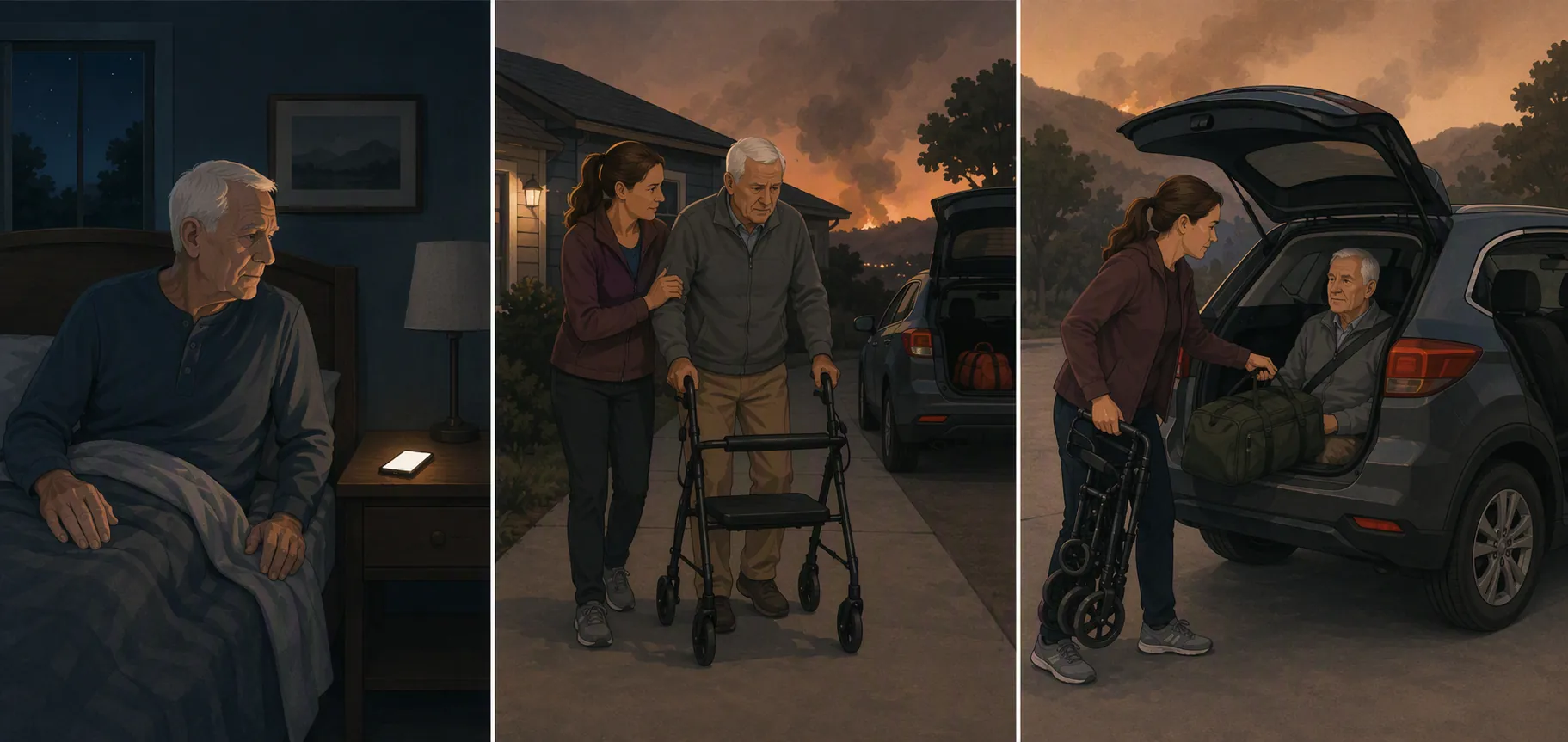
- Parent hears, sees, or receives the alert.
- Parent gets out of bed, recliner, or wheelchair.
- Parent puts on shoes, glasses, hearing aids, and any brace or mobility support.
- Helper collects the go bag, medications, phone, charger, documents, and assistive device.
- Parent moves through the chosen exit route.
- Helper transfers parent into the vehicle.
- Walker, wheelchair, cane, oxygen-related supplies, pet carrier, and go bag are loaded.
- Driver leaves by the planned route or the safest open route directed by officials.
Now test each link. Can your parent stand from the actual chair they sleep in? Is the walker parked within reach or across the room? Are shoes by the bed for nighttime evacuation, as CAL FIRE’s Ready for Wildfire guidance recommends?[9] Can the parent manage the threshold at the front door? Does the wheelchair fit through the side gate? If the safest exit has steps, who can help, and is that help available at night?
Do not make a neighbor, spouse, or adult child discover during an evacuation that they cannot lift your parent safely. If transfers are difficult, ask an occupational therapist, physical therapist, nurse, or trained home-health worker to teach the safest method for that person’s body and equipment. Product-neutral evacuation chairs, sleds, ramps, or transfer aids may be appropriate in some homes, but they need training and storage where they can actually be reached. A piece of equipment no one has practiced with is just another obstacle.
Make the vehicle part of the medical plan
The car is not just transportation. It is the transfer point, equipment carrier, medication carrier, and first waiting room. CAL FIRE’s Ready for Wildfire guidance says to keep at least half a tank of gas, learn how to open a garage door or gate manually during a power shutoff, and park the car in the driveway facing out when preparing to evacuate.[9][10]
Check the vehicle with the same seriousness you check the bag. Put the folded walker, wheelchair, cane, or portable ramp in the vehicle and close the trunk. Have the parent sit in the passenger seat. See whether they can lift their legs in, whether the seat is too low, whether the oxygen tubing or CPAP bag has a safe place, and whether the driver can load everything without leaving the parent standing in the driveway. If a sedan does not work, name the vehicle that does.
Also decide when the parent stops driving. Some older adults can drive themselves early in a watch or warning period but not in smoke, darkness, panic, or gridlock. Write the rule ahead of time: for example, “If an evacuation warning is issued within our zone, Dad leaves with the neighbor or waits for my sister only if she is already within 15 minutes.” That example is hypothetical; your rule should match local guidance, distance, roads, and the parent’s abilities.
Pack a senior-specific go bag, not a weekend bag
A go bag for an older parent has to solve the problems that follow them out the door. Food, water, flashlight, and clothing matter, but the items that most often get missed are the ones that make the parent functional: medications, glasses, hearing aids, dentures, continence supplies, mobility aids, chargers, written routines, and documents.
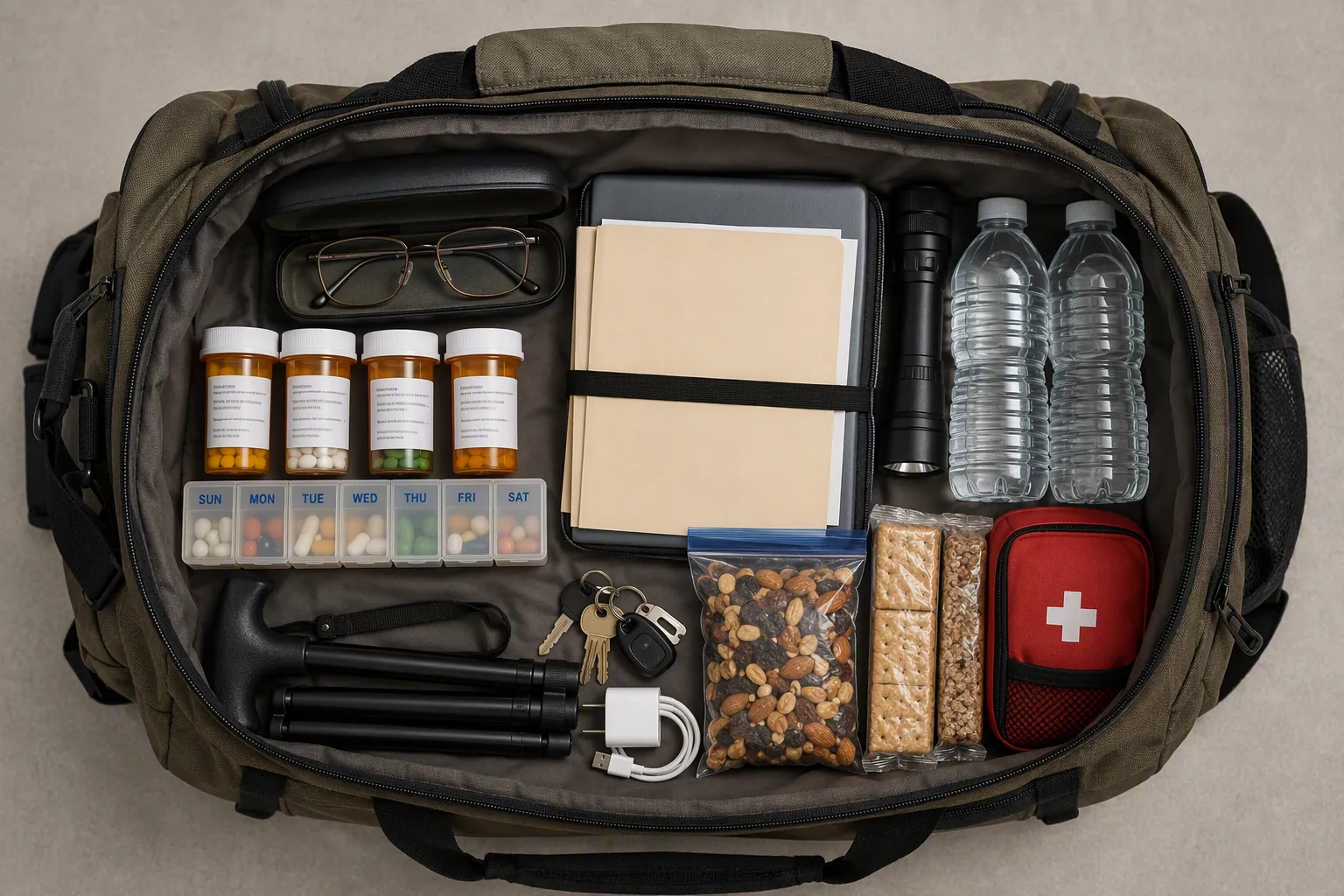
There is one medication detail to handle honestly. The Red Cross older-adults preparedness page recommends storing at least 30 days of medication, while its general survival-kit page lists a 7-day supply of medications and medical items.[8][11] For many elderly parents, the older-adult standard is the safer planning target if prescriptions, insurance rules, and clinicians allow it. If 30 days is not possible, write down the refill process, pharmacy phone number, prescriber contact, dosage list, and which medications cannot be skipped.
- Medication supply, current medication list, allergies, pharmacy and prescriber contacts, and instructions for time-sensitive doses.
- Extra eyeglasses, hearing-aid batteries or charger, dentures and supplies, cane tips, wheelchair cushion, or other assistive items. The Red Cross older-adults guidance specifically mentions extra assistive items such as a cane or eyeglasses.[8]
- Water and food. The Red Cross survival-kit guidance lists 1 gallon of water per person per day, with a 3-day evacuation supply and a 2-week home supply.[11]
- Phone charger, backup battery, flashlight, spare batteries, radio if used locally, and written emergency contacts.
- Copies of identification, insurance cards, Medicare or Medicaid cards, advance directives if used, power-of-attorney documents if relevant, and a current photo of the parent.
- Clothing layers, sturdy shoes, masks if recommended locally, hygiene items, incontinence products, wipes, and plastic bags.
- Spare keys, cash in small bills if the family chooses, pet supplies, and destination information.
Keep the bag where the first helper will look, not where it looks tidy. If the parent uses a walker or wheelchair, attach a smaller pouch with the items that must stay with the parent even if the main duffel gets separated: medication list, ID copy, emergency contacts, glasses, hearing aids, phone, charger, and a note about mobility or cognitive needs.
Use redundant alerts because one warning can fail
Do not build the plan around the parent hearing one siren. Lahaina’s silent sirens are a hard warning against that.[5] Older adults may also miss alerts because of hearing loss, sleep, medication effects, confusion, dead phones, power outages, or the simple habit of ignoring unfamiliar alarms.
Use several channels and assign someone to watch them. Sign up for county or city emergency alerts. Follow local fire, sheriff, emergency-management, and weather sources used in the parent’s area. Enable wireless emergency alerts on the parent’s phone if appropriate. Add a weather radio or accessible alerting device if the parent does not reliably hear or read phone alerts. Give the alert-watcher permission to call early and say, “Start the plan now,” even before the parent feels personally threatened.
This is also where the parent’s agreement matters. The plan will not work if every early call becomes a debate. Talk through the trigger points before fire season: evacuation warning, nearby road closure, visible smoke, power shutoff, red-flag conditions plus a new fire, or official instruction from local authorities. The parent does not have to like leaving early. They do need to know who is allowed to insist.
Write the pre-evacuation home steps in order
Home-preparation steps are useful only if they do not delay departure. CAL FIRE’s Ready for Wildfire guidance includes practical pre-evacuation actions such as closing windows and doors but leaving them unlocked, turning off gas at the meter, loading the vehicle, and parking it facing out.[9] Those steps belong in the plan, but only with a person assigned and a stop rule.
| If there is time | Who does it | When to skip it |
|---|---|---|
| Load go bag, medications, assistive devices, chargers, documents, and pet supplies | First helper or parent if able | Do not skip medication, mobility, or communication items unless life safety requires immediate exit. |
| Put parent’s shoes, glasses, hearing aids, phone, and mobility aid on or within reach | Parent or transfer helper | Do not delay for nonessential belongings. |
| Close windows and doors as directed by local guidance | Second adult if present | Skip if the parent is not already safely moving toward the vehicle. |
| Move flammable items away from the house if already staged and safe | Capable adult only | Skip if smoke, heat, traffic, or official orders make delay unsafe. |
| Turn off gas at the meter if instructed and the assigned person knows how | Assigned adult | Skip if untrained, physically unsafe, or departure would be delayed. |
| Park vehicle facing out and keep driveway clear | Driver | This should be done before conditions are urgent whenever possible. |
The older parent’s body sets the priority. If there is only time for one thing, get the parent out with the medications, mobility device, phone, charger, ID, and someone who knows where they are going. Curtains, patio cushions, and keepsakes do not outrank a slow transfer in smoke.
Choose destinations before the evacuation
Do not wait until the car is moving to decide where an elderly parent can sleep, use the bathroom, charge equipment, and manage medications. Pick at least two destinations in different directions if geography allows: a relative, friend, hotel area, community shelter, or other local option that matches the parent’s needs.
For each destination, write down the practical fit. Are there stairs? Is there a walk-in shower or at least a bathroom the parent can reach? Can a walker turn beside the bed? Is there a place to plug in equipment? Are pets allowed? If the parent uses oxygen or other powered medical equipment, ask the clinician or supplier what backup arrangements are safe; do not assume a shelter, hotel, or relative’s house can support it without planning.
Routes need the same treatment. Choose more than one exit route from the neighborhood, but do not promise the family that Route A will be open. The driver should follow official evacuation instructions when conditions change. The written plan should still include familiar roads, likely bottlenecks, gas stops outside the immediate hazard area, and a meeting point if family members leave in separate vehicles.
Rehearse it while everyone is calm
A rehearsal is not a dramatic disaster drill. It is a test of whether the plan can survive ordinary friction. The parent is tired. The walker is in the wrong place. The pill bottles do not fit in the bag. The neighbor cannot open the lockbox. The garage door is too heavy. The adult child realizes the wheelchair only fits if the back seat is folded down.
A 2024 scoping review in Frontiers in Rehabilitation Sciences found that evacuation drills for seniors and people with disabilities should occur at least once or twice a year. The review focused on seniors’ residences and long-term care homes, not single-family houses, so it should not be treated as direct proof for every home situation. Still, its findings about alarm hesitation, sensory loss, medication effects, and delayed movement are exactly the kinds of problems families see when an older person has to leave under pressure.[12]
Practice the parts that matter most:
- Call the parent using the agreed alert script and see whether they answer, hear, understand, and start moving.
- Have the parent put on shoes, glasses, hearing aids, and any brace or mobility support.
- Move from the usual bed, recliner, or wheelchair to the exit.
- Load the parent into the actual vehicle.
- Load the walker, wheelchair, cane, go bag, medications, documents, phone charger, and pet carrier if used.
- Manually open the garage door or gate if that is part of the route.
- Drive the first few turns of the evacuation route, then return and fix what failed.
Time the drill if the parent is willing, but do not turn it into a contest. The useful question is not whether everyone moved fast enough to feel proud. It is where the plan broke: the hearing aid was not charged, the lockbox code was wrong, the medication list was outdated, the bag was too heavy, the helper could not lift safely, or the parent refused because the trigger for leaving had not been agreed on.
Refresh the plan, supplies, and documents every six months, as the Red Cross recommends for older adults.[8] Use that same schedule to check medication lists, phone numbers, batteries, chargers, keys, garage-door instructions, fuel habits, and whether the parent’s mobility has changed. A fall, new diagnosis, medication change, hospital stay, or move from cane to walker should trigger an update immediately, not at the next calendar reminder.
The safest wildfire evacuation plan for an elderly parent is not the longest checklist. It is the one that has already been walked, packed, assigned, and corrected before the fire starts.
References
- Fire Safety for Older Adults — USFA
- How we analyzed the risk wildfires pose to older people — CalMatters
- Lessons from Paradise on Fire — Places Journal
- Paradise Camp Fire A Year On — AARP
- Extreme Weather's Impact on Older Adults — AARP
- Case Study of the Camp Fire — Notification, Evacuation, Traffic, and Temporary Refuge Areas (NETTRA) — NIST, 2023
- Older Adults — Ready.gov
- Older Adults Emergency Preparedness — American Red Cross
- Go Evacuation Guide — Ready for Wildfire
- Prepare Your Family — Ready for Wildfire
- Survival Kit Supplies — American Red Cross
- Current learning strategies in fire evacuation for seniors and people with disabilities: a scoping review — Frontiers in Rehabilitation Sciences, 2024
Questions to bring to a clinician or OT
This is not medical, legal, or a family's final decision — only a framework. Bring these questions to a clinician, occupational therapist, or your local Area Agency on Aging.
Find Local HelpRelated reading
Noticed something outdated or inaccurate on this page? Flag a correction. We review every report against CDC, NIA, and AARP HomeFit guidance before updating a page.